Archive for June, 2016
04 Jun 2016
You may soon be able to get Hodor to hold your own door. io9:

04 Jun 2016


I didn’t think it could be done, but Rory Sutherland, in the Spectator, makes (sort of) a case for supporting Trump.
I’m not sure about my prefrontal cortex, but if I were American, my amygdala would vote for Donald. Because, in primatological terms, Trump is a beta male’s idea of what an alpha male should be. Trump does what most normal people imagine they would do if they had a billion dollars: he enjoys it. He buys a plane with his name on it and flies around mouthing off. It reminds me of visiting Texas, where I realised that Texans were exactly what my Welsh farming relatives would have become if they’d had oil instead of sheep.
He’s also unapologetically American — one of your own. Somehow we like our leaders to magnify the flaws of the cultures they represent. It’s why Britain is led by a slightly vague but amiable posh bloke, France is run by a man who visits his mistress on a moped and Germany is run by Rosa Klebb. This ‘vote your national stereo-type’ thing is definitely a trend. And I haven’t even mentioned Russia because I often drink tea in hotels.
Trump could only be American. And much as elite opinion despises his banausic tribe, America really would not be America without them. The country owes its success to the fact that, for a few hundred years, it became the natural homeland for the world’s overconfident loudmouths, blowhards, wiseacres and minor assholes. It didn’t get rich through agonising about safe spaces and the gender assignment of bathrooms. It got rich because of people called Vinnie building things.
Read the whole thing.

The German Chancellor
03 Jun 2016

And you think you’re so clever and classless and free,
But you’re still fucking peasants as far as I can see.
—Working Class Hero, John Lennon/Plastic Ono Band, 1970
A number of intelligent and respectable conservative bloggers have, over time, started regularly quoting and linking blogging representatives of Alt-Right. The better representatives of Alt-Right frequently deliver withering and accurate criticism of PC, Multiculturalism, and the kind of treasonous animosity toward one’s own race, nation, culture, and civilization that Roger Scruton refers to as oikophobia. I have occasionally myself quoted and linked a couple of these bloggers, whose postings I read via Vanderleun and liked.
However, if you start looking at Alt-Right, you find very quickly that that movement is diverse in quality and intelligence. Some people (I would disagree) identify the Neoreactionary Movement (Mencius Moldbug aka Curtis Yarvin, Eliezer Yudkowsky, and Nick “Dark Enlightenment” Land) as the intellectual wellspring of Alt-Right. I don’t think so. These guys (with whom I by-and-large agree) are hyper-intelligent pessimist libertarians.
The real (semi-)respectable roots of Alt-Right, I’d say, can be found with Pat Buchanan who left the mainstream Conservative Movement and retired to his own Isolationist, Nativist, Protectionist fever swamp, where he somehow miraculously spawned, producing The American Conservative and TakiMag.
Alt-Right, however, as an intellectual phenomenon declines rapidly from Pat Buchanan’s bilious desire to hop into a time machine and return to the late-1840s-early-1850s heydey of Know-Nothing-ism and Taki Theodoracopoulos striking reactionary poses to a lot less savory sphere, inhabited by all sorts of unbelievably stupid, vulgar, and objectionable white trash. You do not have to go very far into Alt-Right-land at all, before you start running into White Supremacists and 1488-ers.
One particularly toxic symptom of the contagious influence of the atrocious Neo-Nazi element of Alt-Right on the rest is the spread of the slang insult “cuck” or “cuckservative.”
The word “cuck” has a whiff of obscenity about it, being so close in sound to the vulgar term for the male generative organ, but its etymology is obviously from “cuckold,” a rather old-fashioned pejorative referring to the unfortunate fellow afflicted with an unfaithful wife which was, long ago, during the English Restoration, generally regarded as the most embarrassing and hilarious of all misfortunes.
The mystery, of course, is how on earth did the semi-literate Alt-Right inhabitants of trailer parks, whose Verbal SATs would have been in the two-digits, come up with a truncated form of such a period and esoteric insult. I was puzzled, and made a point of looking into the mystery. I found that cuck seems to have come into use for the first time on 4Chan in 2014, and took on its specifically racialist overtones in attacks on a particular comedian whose stand-up routines featured racial attitudes that people didn’t like. But the 4Chan correspondents, it turned out, were not drawing their reference to cuckoldry from the comedies of William Wycherly. No, the reference was coming from Internet pornography, where there exists apparently a standard “cuck” meme featuring a masochistic white male who submissively looks on as his wife/girlfriend has sexual intercourse with one or more black males.
I decided to comment on all this, specifically because I think the spread of this toxic insult right out of the White Supremacist sewers into mainstream conservative politics is a disgrace and ought to be curtailed.
Iowahawk (below) has it dead right. The use of that term is a dead giveaway of whom you have been reading and what kind of people you are willing to be associated with politically.

03 Jun 2016

The Atlantic has news about the (dual) origin of man’s best friend.
On the eastern edge of Ireland lies Newgrange, a 4,800-year-old monument that predates Stonehenge and the pyramids of Giza. Beneath its large circular mound and within its underground chambers lie many fragments of animal bones. And among those fragments, Dan Bradley from Trinity College Dublin found the petrous bone of a dog.
Press your finger behind your ear. That’s the petrous. It’s a bulbous knob of very dense bone that’s exceptionally good at preserving DNA. If you try to pull DNA out of a fossil, most of it will come from contaminating microbes and just a few percent will come from the bone’s actual owner. But if you’ve got a petrous bone, that proportion can be as high as 80 percent. And indeed, Bradley found DNA galore within the bone, enough to sequence the full genome of the long-dead dog.
Larson and his colleague Laurent Frantz then compared the Newgrange sequences with those of almost 700 modern dogs, and built a family tree that revealed the relationships between these individuals. To their surprise, that tree had an obvious fork in its trunk—a deep divide between two doggie dynasties. One includes all the dogs from eastern Eurasia, such as Shar Peis and Tibetan mastiffs. The other includes all the western Eurasian breeds, and the Newgrange dog.
The genomes of the dogs from the western branch suggest that they went through a population bottleneck—a dramatic dwindling of numbers. Larson interprets this as evidence of a long migration. He thinks that the two dog lineages began as a single population in the east, before one branch broke off and headed west. This supports the idea that dogs were domesticated somewhere in China.
But there’s a critical twist.
The team calculated that the two dog dynasties split from each other between 6,400 and 14,000 years ago. But the oldest dog fossils in both western and eastern Eurasia are older than that. Which means that when those eastern dogs migrated west into Europe, there were already dogs there.
Here’s the full story, as he sees it. Many thousands of years ago, somewhere in western Eurasia, humans domesticated grey wolves. The same thing happened independently, far away in the east. So, at this time, there were two distinct and geographically separated groups of dogs. Let’s call them Ancient Western and Ancient Eastern. Around the Bronze Age, some of the Ancient Eastern dogs migrated westward alongside their human partners, separating from their homebound peers and creating the deep split in Larson’s tree. Along their travels, these migrants encountered the indigenous Ancient Western dogs, mated with them (doggy style, presumably), and effectively replaced them.
Today’s eastern dogs are the descendants of the Ancient Eastern ones. But today’s western dogs (and the Newgrange one) trace most of their ancestry to the Ancient Eastern migrants. Less than 10 percent comes from the Ancient Western dogs, which have since gone extinct.
Read the whole thing.

Newgrange, the white facade is modern.
02 Jun 2016

There was a Becket Conference at Trinity College.
02 Jun 2016

Mashable:
Ruth Bader Ginsburg… was just honored with her very own species of praying mantis.
According to the Cleveland Museum of Natural History, scientists have successfully used female genitalia to identify different species of praying mantises. Using this process, they have discovered a new mantis, which has been named Ilomantis ginsburgae, in honor of Ruth Bader Ginsburg.
Ginsburg, a beloved 83-year-old supreme court justice, active feminist and oldest member of the highest court in the country was honored “for her relentless fight for gender equality.”
Additionally, the bug’s neck plate sort of looks like a jabot, which Ginsburg is well known for sporting around her neck.
And we all know what the female mantis does to the male after mating…
Hat tip to Matthias Storme.
02 Jun 2016

Ernst Jünger (1895-1998)
Karl Marlantes (Y ’67), who served as an officer in the Marine Corps, received the Navy Cross, and wrote perhaps the best Vietnam War novel, is pretty much the ideal choice to write the introduction for the new Penguin Classics edition of Ernst Jünger’s WWI memoir Storm of Steel.
[L]ike Jünger, who observed the stream of colored flares, I can appreciate that, borrowing a phrase from Yeats, there is a terrible beauty about war, even though I’m not a born warrior. I remember watching enemy tracers seeming to float into the night sky over Laos, seeking to down one of our airplanes, in much the same way I’d watch fireworks. I remember even being enthralled, late in my tour when I’d been transferred to an air obÂserver squadron, by green tracers flying by both windows of our OV-10 as we dived firing, head to head with an NVA antiaircraft gun. Jünger sees the beauty—it’s everywhere in his memoir—and perhaps you will see it too. This doesn’t need to change how you judge war; coral snakes and tsunamis are beautiful too.
Jünger writes about many things other than combat, but all take us into the trenches as he saw them. He writes about fear and panic. He writes about nature—about having to live outside, just like a wild animal, in all of nature’s cruelty and beauty. He writes about the code of honor and manliness that engenders mutual respect beÂtween soldiers on opposite sides of the battle, as when he encounÂtered a young British officer just before Christmas during a poignant temporary truce that unfortunately went bad:
We did, though, say much to one another that betokened an almost sportsmanlike admiration for the other, and I’m sure we should have liked to exchange mementoes.
At another point he writes:
Throughout the war, it was always my endeavour to view my opponent without animus, and to form an opinion of him as a man on the basis of the courage he showed.
And he writes about the understated and often gallows humor that goes hand in hand with the code of honor and manliness. I remember in Vietnam a kid waiting to be medevaced, gasping for air because he’d taken a bullet through one lung, saying, “You know, sir, it ruined my whole day.†Jünger often uses such humor:
We suffered many casualties from the over-familiarity engendered by daily encounters with gunpowder. My dugout was somewhat changed as well . . . the British had fumigated it with a few hand-grenades. We were so abundantly graced with trench mortars . . .
In another scene, Jünger describes a fierce skirmish with IndiÂan soldiers from the First Hariana Lancers:
With only twenty men we had seen off a detachment several times larger, and attacking us from more than one side, and in spite of the fact that we had orders to withdraw if we were outnumbered. It was precisely an engagement like this that I’d been dreaming of during the longueurs of positional warfare.
I’d have been dreaming of my high school girlfriends.
“These short expeditions,†Jünger writes, “where a man takes his life in his hands, were a good means of testing our mettle and interrupting the monotony of trench life. There’s nothing worse for a soldier than boredom.†I would say homesickness, hunger, hypothermia, getting gassed, gangrene, and trench foot, not to mention getting killed or maimed, would all be worse than boredom. But Jünger was different.
Read the whole thing.
02 Jun 2016
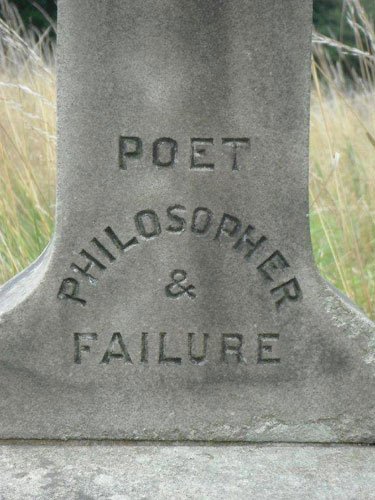
Headstone, St. Peter’s, Heysham.
Via Ian Duhig.
/div>

Feeds
|