Archive for July, 2016
05 Jul 2016

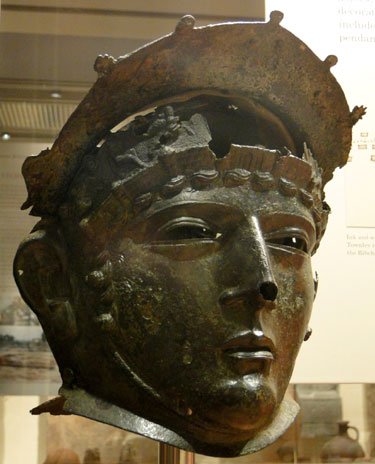
The Ribchester Helmet is a Roman bronze ceremonial helmet dating to between the late 1st and early 2nd centuries AD, … now on display at the British Museum. It was found in Ribchester, Lancashire, England in 1796, as part of the Ribchester Hoard. The model of a sphinx that was believed to attach to the helmet was lost.
Wikipedia:
The helmet was discovered, part of the Ribchester Hoard, in the summer of 1796 by the son of Joseph Walton, a clogmaker. The boy found the items buried in a hollow, about three metres below the surface, on some waste land by the side of a road leading to Ribchester church, and near a river bed. The hoard was thought to have been stored in a wooden box and consisted of the corroded remains of a number of items but the largest was this helmet. In addition to the helmet, the hoard included a number of paterae, pieces of a vase, a bust of Minerva, fragments of two basins, several plates, and some other items that the antiquarian collector Charles Townley thought had religious uses. The finds were thought to have survived so well because they were covered in sand.
The helmet and other items were bought from Walton by Townley, who lived nearby at Towneley Hall. Townley was a well-known collector of Roman sculpture and antiquities, who had himself and his collection recorded in an oil painting by Johann Zoffany. Townley reported the details of the find in a detailed letter to the secretary of the Society of Antiquaries, intended for publication in the Society’s Proceedings: it was his only publication. The helmet, together with the rest of Townley’s collection, was sold to the British Museum in 1814 by his cousin, Peregrine Edward Towneley, who had inherited the collection on Townley’s death in 1805.
In addition to the items purchased by Townley, there was also originally a bronze figurine of a sphinx, but it was lost after Walton gave it to the children of one of his brothers to play with. It was suggested by Thomas Dunham Whitaker, who examined the hoard soon after it had been discovered, that the sphinx would have been attached to the top of the helmet, as it has a curved base fitting the curvature of the helmet, and has traces of solder on it. This theory has become more plausible with the discovery of the Crosby Garrett Helmet in 2010, to which is attached a winged griffin.
04 Jul 2016

Daily Star:
AN SAS soldier killed three Islamic State fighters with a Gurkha knife with the elite trooper decapitating one with a single swipe of the kukri after he was caught in an ambush in Iraq.
The sergeant, with 15 years’ combat experience, killed a further two gunmen and injured at least three others.
The attack occurred when Iraqi troops launched a massive assault on the besieged city of Fallujah, a key IS stronghold.
The SAS were acting as military advisors and leading small groups of Iraqi special forces.
During one attack, an SAS and Iraqi team entered a bombed-out factory hunting a sniper. But the troops were ambushed by IS gunmen and several Iraqi soldiers were killed and four seriously wounded.
The SAS soldier returned fi re as he dragged injured troops to safety before he was pinned down by enemy gun-fire.
When he ran out of ammo the IS gunmen attempted to capture him alive but instead the 27-year-old sergeant began lashing out with kukri, given to him by a British Gurkha soldier.
A senior defence source said: “As soon as his ammunition was expended, the IS gunmen tried to storm him.
“As they went to grab him he unsheathed his kukri and began slashing away.
“He decapitated the first gunman, slit the throat of second and killed another with a third blow. He then sliced away at three others.
“The IS gunmen fled in panic allowing the SAS soldier to carry the injured men to safety.
“He expected to be killed but thought he’d take as many of the enemy with him.
“When he was reunited with Iraqi troops they thought the he was seriously wounded because he was covered in blood but he explained that the blood wasn’t his.
“He cleaned his knife, grabbed some more ammo and then led another Iraqi special forces team into battle.â€
The sergeant is now expected to receive a gallantry award from the Iraqi Army.
The Daily Star Sunday understands that the SAS man had taken his kukri on combat missions in Iraq, Afghanistan and Libya but this was the first time that it had been used in battle.
He was given the knife by a Gurkha before he joined the SAS and was told that once unsheathed the knife must draw blood.
Full story.
04 Jul 2016

Jonah Goldberg explains why he is not moved by arguments urging him to fall into line and start supporting Donald Trump.
I can’t stand Kasich. But he meets my own minimal requirements for support. Trump, simply, doesn’t. He falls short of the mark like John Candy in the long jump. I’m not going to rehash all of my reasons for this conviction, but suffice it to say I think he’s unpatriotically unprepared and unqualified for the job. Politically, conservatism at its core is about the importance of ideas and the importance of character. With the exception of his longstanding support for protectionism and the unalloyed importance of “strength,†Trump cares not a whit for policy or philosophy. His attachment to principles is, for the most part, a nearest-weapon-to-hand approach. As a matter of character he’s crude, boorish, dishonest, proudly promiscuous, and has launched countless businesses based on the idea that it’s morally acceptable to take advantage of people. He dodged the actual Vietnam War but claimed that avoiding the clap in the 1970s was his own personal Vietnam.
Kozak and many others either disagree with me on these points or they simply don’t care. If it’s the former, we have some substantial disagreements about what I think are obvious facts. If it’s the latter, then I take our disagreement as a badge of honor. If Roger Simon wants to describe that as “moral narcissism,†so be it. But, there’s a practical point here too. I plan on being in this line of work for a while longer. In the future, I want to be able to continue to say character and ideas matter without someone shouting, “Oh yeah, then why did you support Donald Trump?†…
By waiving the standards we use to judge liberal politicians in order to defend an allegedly conservative one, we are waiving those standards for all time. I’m not talking about some allowances at the margins, politics should be flexible — strange bedfellows and all that. But there’s a difference between being flexible and willingly snapping your own spine to bend over for a politician who, almost certainly, has contempt for the standards you once held near and dear.
Read the whole thing.
03 Jul 2016

Newser:
It wasn’t quite death-by-selfie, but it wasn’t far off. Peru This Week reports that a German tourist died Wednesday while posing for a photo at Peru’s famed Machu Picchu site.
Oliver Park, 51, went into a restricted area of the mountainous tourist locale in the Andes, despite warning signs and instructions from wardens, reports the BBC. The channel says that while posing for a photo at the edge of a ravine, Park apparently decided to jump in the air to make it look like he was flying. Instead, he ended up falling off the cliff.
03 Jul 2016

Fox4kz:
A 62-year-old Australian man who ventured to within 3 to 5 feet of one bison was seriously injured Tuesday when the animal charged and tossed him into the air several times, park officials said in a statement.
This is the second such incident within weeks.
A 16-year-old Taiwanese exchange student was gored by a bison on May 15 while posing for a photo.
03 Jul 2016
Golden Arrow Land Speed Racer, 925 hp, 11 March 1929 set a record of 231.45 mph.


02 Jul 2016

Believed to be from San Antonio, Texas, circa 1967.
Via Robert Ruark’s Andover nephew.
02 Jul 2016

Richard Verney, 19th Baron Willoughby de Broke, 1869-1923.
Noel Annan, Our Age: English Intellectuals Between the World Wars: A Group Portrait:
The ideal that Our Age was taught to admire when they were children was the ideal of English gentleman. The ideal of those pre-1914 days has been caricatured for so long, and sometimes amusingly, that one forgets this was the ethos that Churchill invoked in 1940. It went back to the eighteenth century. Wellington embodied it, Waterloo exhibited it. According to this code an Englishman should be guided by an overpowering sense of civic duty and diligence. Every man’s first loyalty should be to the country of his birth and the institution in which he served. Loyalty to institutions came before loyalty to people. Individuals should sacrifice their careers, their family, and certainly their personal happiness or whims, to the regiment, the college, the school, the services, the ministry, the profession or the firm. Service was an acknowledgment that there were other communities or territories which it was now the duty of the British to rule. Ruling other men and other races did not mean discovering and complying with their wishes. Their wishes would almost certainly be self-interested pleas for ephemeral ends often a mask for the duplicity of would-be politicians, demagogues and agitators. While the rest of the world feared the will to power that was behind the missionary force of the Empire, the British, whose administrators exported the life of the motherland in their clothes, their food, their sport and pipe-smoking, could never be brought to admit they were in danger. They were indignant when told that they exploited idealistic movement such as anti-slavery and Zionism as ways of getting others to do their work for them, or that they betrayed idealists such as E. D. Morel in the Belgian Congo or T.E. Lawrence in Arabia. Plutarch gave them examples of the type to admire: Lycurgus rather than Pericles, Julius Caesar rather than Pompey or Brutus; never Cleon or Catiline.
The gentleman was someone who developed his latent qualities by engaging in gentlemanly pursuits. An officer acquired an eye for country by riding to hounds, and thus learnt the art of moving his infantry platoon into dead ground to hide them from the enemy. Provided he excelled as a sportsman and played games fearlessly, his men would follow him anywhere. At Waterloo, officers courted danger to encourage their men much the same way as naval officers at Trafalgar strolled up and down the quarterdeck regardless of sharpshooters or grapeshot. In the early days both of the Boer war and the Great War to take cover was thought to be a bit iffy. A gentleman disguised his abilities as much as he disguised his emotions: not to do so was to show side and drop one’s guard. When Tony Chevenix Trench, later a public school headmaster, emerged from a Japanese prisoner of war camp, he was greeted by his brother with the words, ‘Oh, I didn’t expect to find you alive.’ The key to recognition was good manners – unceremonious, relaxed behavior designed to put friends at ease. The temptation to intellectualize about one’s calling was unwise and people who had theories needed to be watched. To reduce tradition and custom to dry principles, to become too reliant on technology, was to forget that character was more important than hare-brained schemes. Men should be judged by their conduct rather than their ideas. Mark Anthony was an example of self-indulgence and that weakness of character which tempts a man to desert duty for pleasure. Women were a potential snare and they should be treated warily. But good women were romantic objects and, because they were good, could be treated as such. The young were full of good stuff but callow. They would be all the better for being snubbed and put in their place.
People wanted to show that they too knew what leisure pursuits to follow, what matters to copy. This is how others would recognize that you are incorporated within society. Perhaps it is not going too far to say that a man and his family came to be regarded as citizens by the degree to which they were able to conform to the code of the governing class and to the part of the country they belonged. Before 1914 you had to assimilate as far as your means allowed to the governing class’s way of life to be received within the social pale. Servants indicated status, and it is astonishing how many of those with modest incomes and jobs had servants until one remembers the kitchen ranges, coal fires instead of Central heating, the copper instead of a washing machine, created so much work that there was a real inducement to economize on consumer goods and employ servants. A housemaid needed to be paid only thirty pounds a year. Clothes no less than servants were the clue to your social standing. A hat was a symbol of being socialized. That was one reason why even the poorest wore one: they were staking claim to being a citizen even if they had no vote. Only the self-confident could neglect the requirements of fashion, like the Cecils who dressed in shapeless garments or the intellectuals who climbed mountains and communed with nature on thirty-mile walks. Invited in 1929 to Bicton for a country house party, Alan Pryce-Jones, twenty-one years old and impecunious, descended for dinner wearing a black tie to find the other men wearing tail coats. ‘Which footman have you got?’ asked his uncle and host when he apologized. ‘It is not the fault of the footman,’ he replied, ‘I haven’t brought a white tie.’ Putting a hand on his shoulder, his host proposed the only remedy. ‘My dear fellow, sack your man.’ He was not invited again. …
Like Dickens, Trollope thought that making money and decent ambition in life were desirable: his gentry and clergy talk money all the time. His crooked financiers were guilty not because they pursued wealth but because they overrode the law and morality. But if a gentleman goes in for politics he should not act the prig when he finds he has to bribe his electors. Compromise and dissimulation are part of the game. You stand by your leader even if you don’t like him because personal likes or dislikes should be beneath the gentleman in politics. It is ignoble to claim you are a fly caught in the wheel of history or whine that you had a hard upbringing. Nor is it corrupt to show deference to rank and position. No doubt there are plenty of silly, vain and pompous aristocrats in Trollope’s pages but formal differences in society will always exist. The deference a scientist might show to a Nobel Prize winner or journalist to his editor is no more than tribute to sagacity and know-how. Social distinctions are not barriers, they are signposts which can be disregarded for good cause; but in a country which had no signposts it will be hard to find one’s way.
There were other virtues that the true gentleman required. He should not be too spontaneous in his conduct. That virtue which Castiglione had so admired had become suspect. Like a game fox a man should run straight. Predictability was a virtue. To strain to be original was a sign of side, conceit, vanity and showing off. To be determined to distinguish oneself from one’s fellows was considered disagreeable. A dandy could get by, an aesthete was fishy. Of course, the notion of the gentleman is bound up with social status: indeed it held within it the assumption that a gentleman was responsible for others, for his tenants, the soldiers under his command, his flock in the parish, his servants: but only rarely the hands in his mill. He would command, but off duty he would be courteous.
In his entertaining book on the subject Philip Mason maintains that Protestant Christianity said so impossibly high standard of conduct that the cult of the gentleman had to be substituted to provide a realizable ideal.
/div>
Feeds
|





