According to Levin, the great conceptual barrier to reforming and modernizing American politics is baby boomer nostalgia for the 20th-century Golden Age of their memories. He writes:
Democrats talk about public policy as though it were always 1965 and the model of the Great Society welfare state will answer our every concern. And Republicans talk as though it were always 1981 and a repetition of the Reagan Revolution is the cure for what ails us. It is hardly surprising that the public finds the resulting political debates frustrating.
What neither side can see is that they expect the impossible. Generally speaking, liberals want maximal individual liberty in personal life, especially on matters related to sexual expression, but demand more state involvement in the economy for the sake of equality. Conservatives desire maximal economic freedom but lament the social chaos and dysfunction—in particular, the collapse of the family among the poor and working classes—that afflict American society. The uncomfortable truth is that what each side loathes is the shadow side of what it loves.
As Alan Ehrenhalt pointed out in The Lost City, his 1995 book about Chicago in the 1950s and 1960s, contemporary people lie to themselves about what things were like in the Golden Age. The thick social bonds and sense of community Americans enjoyed back then came at a significant cost—including cultural conformity and a lack of personal and consumer choice—that few of us today would tolerate. Ehrenhalt wrote that beginning in the 1960s, however, Americans embraced “the belief in individual choice and suspicion of any authority that might interfere with it.â€
America’s political, social, and economic life of the last half-century has been a working-out of that belief—thus, the Fractured Republic. The inability of the U.S. political class, now dominated by boomers, to deal with the consequences prevents them from coming to terms with realities of the 21st-century world. We are stuck in what Levin describes as a “politics of dueling nostalgias.â€
The Sword of Goujian is an archaeological artifact of theSpring and Autumn period (771 to 403BC) found in 1965 in Hubei, China. Forged of copper and tin, it is renowned for its unusual sharpness and resistance to tarnish rarely seen in artifacts so old. …
In 1965, an archaeological survey was being performed along the second main aqueduct of the Zhang River Reservoir in Jingzhou, Hubei, more than fifty ancient tombs of the Chu State were found in Jiangling County. The dig started in the middle of October 1965 and ended in January 1966.
More than 2,000 artifacts were recovered from the sites, including a bronze sword. In December 1965, 7 kilometres (4.3 mi) from the ruins of Jinan, an ancient capital of Chu, a casket was discovered at Wangshan site #1. Inside, an ornate bronze sword was found with a human skeleton.
The sword was found sheathed in a wooden scabbard finished in black lacquer. The scabbard had an almost air-tight fit with the sword body. Unsheathing the sword revealed an untarnished blade, despite the tomb being soaked in underground water for over 2,000 years.
On one side of the blade, two columns of text are visible. Eight characters are written in an ancient script which was found to be one known as Bird-worm seal script (literally “birds and worms characters†owing to the intricate decorations of the defining strokes), a variant of seal script. Initial analysis of the text deciphered six of the characters, “King of Yue†and “made this sword for [his] personal useâ€. The remaining two characters were probably the name of this King of Yue.
From the sword’s origin in 510 BC to its demise at the hands of Chu in 334 BC, nine kings ruled Yue, including Goujian,Lu Cheng, Bu Shou, Zhu Gou, and others. The identity of this king sparked debate among archeologists and Chinese language scholars. …
After more than two months, the experts started to form a consensus that the original owner of the sword was Goujian, the King of Yue made famous by his perseverance in time of hardship. So the entirety of the text reads “[Belonging to] King Goujian of Yue, made for [his] personal useâ€. …
The Sword of Goujian still has a sharp blade and shows no signs of tarnish. … It is likely that the chemical composition, along with the almost air-tight scabbard, led to the exceptional state of preservation. The body of the blade is mainly made of copper, making it more pliant and less likely to shatter; the edges have more tin content, making them harder and capable of retaining a sharper edge; the sulfur decreases the chance of tarnish in the patterns.
The largest war in animal history — in fact, by numbers the largest war in history — is going on right now.
Once upon a time there was a tiny brown ant who lived by a swamp at the end of the Paraná River in Argentina. Her name, Linepithema humile, literally means “humble†or “weakâ€. Some time during the late 1800s, an adventurous L. humile crept away from the swamp where giant river otter played and capybaras cavorted.
She stowed away on a boat that sailed to New Orleans. And she went to war.
At home in the Paraná delta, L. humile nests would ferociously defend themselves from other nests, both of their own species and other kinds of ant. It was a life of never-ending territorial skirmishes, where nobody could really get ahead. When two L. humile met, they would flick their antennae over each others’ bodies, tasting the combination of hydrocarbons on their skin. This flavor would tell them whether the stranger belonged to the same nest. If she tasted familiar, she would be recognized as a sister. She would be gently stroked, offered food and welcomed into the nest. But if the flavor were not recognized, the ants would try to kill each other.
In New Orleans, something changed. L. humile, invading the United States, spread like wildfire. Instead of forming discrete, competing colonies, they behaved as a united army. They would brutally attack ants of other species, but welcome every L. humile as a long-lost sister in arms. Like L. humile in Argentina, other species of ants in the US must defend their territories against their own species. This gives the cooperative L. humile a huge strategic advantage; they waste neither lives nor energy on fighting with their own kind, but focus ruthlessly upon species-level conquest. Though individually tiny, they can swarm over native ants many times their size.
The supercolony grew to cover most of the United States. Then it spread to England, Europe, Japan, Australia and New Zealand. L. humile is now abundant on every continent except Antarctica, and wherever she goes, she slaughters native ant species.
How did she do this? Did inbreeding reduce the diversity of hydrocarbons on the ants’ skin, such that they no longer saw one another as enemies, but as sisters? Did natural selection tone down L. humile’s territorial instincts to suit their environment, so they would react aggressively only to the strong stimulus of another species? It seems likely both mechanisms were involved.
Things have not been perfect. Near San Diego, a schism formed, and a separate supercolony was created. The battlefront extends for miles; some 30 million ants die there every year. Another super-colony has formed in Catalonia. Perhaps as L. humile eliminates her competitors, her alliance will fracture entirely into squabbling tribes. But for now, from Europe to the United States, all the way to New Zealand, a global megacolony still persists, consisting of around 1 trillion individuals: a humble brown ant united in war against every other ant alive.
People always talk about the meek inheriting the earth. In L. humile’s case, it’s clearly working.
Not many Vietnam memoirs refer to “fond memories,” but Barry Fixler is not your ordinary memoirist. Fixler was a feisty little (130 lb. — 60 kilo.) Jewish kid from Long Island, who decided that he needed more discipline and joined the Marine Corps instead of going straight to college in the late 1960s, during the War in Vietnam, when pretty much everybody else was dodging the draft.
Fixler survived the ordeal of Marine Corps boot camp, and indeed went to Vietnam.
We landed in Da Nang and walked down the stairs from the plane to a Marine sergeant waiting on the tarmac. He started in alphabetical order, handing guys their orders telling them their assigned units.
I’d been in Vietnam for an hour and the sergeant was telling me I’m already dead. I turned to Mike Ali, my good buddy from boot camp. “Fuck, I’m dead!”
“Yeah,” Mike said. Sergeant just told me I’m a basket case.”
We didn’t realize at the time just how ominous that label was for him.
If you are alive, that meant your unit was in one of the less dangerous places in Vietnam. If you were a basket case, your unit was in a pretty bad place. If you were dead, that meant you were headed straight into the deep shit. Your unit was in the middle of the worst of the worst combat.
The sergeant probably should have only designated Fixler “a basket case,” as he was initially headed, for the first part of his 13 month tour, to Phu Bai to walk combat patrols and arrive by helicopter into hot landing zones.
Fixler really became “dead” in the second portion of his tour, consisting of defending the besieged Marine base at Khe Sanh, where Fixler and other Marines were overrun on Hill 861-A, February 5, 1968. Despite being overrun, Barry Fixler actually survived Khe Sanh, and later got to patrol the DMZ out of Con Thien and Dong Ha.
Fixler finished his enlistment showing the flag in Dress Blues in the Mediterranean. Unlike a lot of people who complain, Barry Fixler tells his readers that he enjoyed his time in the Marine Corps, that he liked the discipline and comraderie so much that, when he got home, he re-enlisted in the reserves.
Barry Fixler is the kind of guy who remains a Marine all his life.
Many years later, his home of Rockland County was looking for combat veterans to counsel soldiers who’d returned from Iraq and Afghanistan complaining of Post Traumatic Stress Disorder (PTSD). Fixler volunteered, but he was never assigned a position as a counselor because he simply does not believe in PTSD.
Some great anecdotes from the book illustrate his position.
During a course given to volunteer instructors, preparing them for their roles, there was a lecture and book signing by a nationwide PTSD specialist, at which Fixler encountered quite a coincidence and expressed his own opinion.
He was only 10, 15 minutes into a two-hour lecture, and he started describing one of his patients who had fought in the siege of Khe Sanh. He described how traumatized the Marine was, how his hill was overrun, how he had to kill or be killed, how his life was torn apart, how he lost his soul right then and there.
It was obvious to me that Dr. Tick was describing the night of February 5, 1968 – the night we were overrun on Hill 861-A.
Tick was quoting this patient, speaking for the Marine now:” I lost my soul! My life is gone! Everything is gone! I can’t continue! I can’t fight! I can’t do anything!”
People sat with their mouths open in awe, listening to Tick talk about the so-called warrior who lost it all, lost his soul, everything, died, spiritually died at that point, and I couldn’t keep quiet any longer. ..
I stood and introduced myself.
I was at Khe Sanh. I have credibility, a unit citation from President Lyndon B. Johnson. And I was on that hill, at that exact place, at that exact moment. If what that Marine said to you about losing his soul and losing his life, losing everything, if he had said that to me then or now, I would say to him, “You are a coward!'”
Then I sat again. The room was silent. Tick lectures for living –he’s a professional –but he struggled to regain his composure.
“I see your point,” he mumbled. “I see your point.”
As the talk proceeded:
I kept my peace and let the other veterans speak for the rest of lecture, until one of the West Point cadets stood and asked Tick, “What can we do to stop this PTSD?”
I blew it then. She asked Tick the question, but I popped up.
“That’s easy. Are you guys trained to get used to seeing bodies scattered all over the place? Well, when we kill a bad guy in Iraq, when we blow their skulls apart, we should freeze that body and send it to West Point and scatter it around so you could smell the blood and the horror and get used to fighting that way. If you’re used to fighting with blood and dead Iraqis all over the place, it will be nothing. That’s what needs to be done. Period.”
Everyone was quiet again. I glanced at the three West Pointers. Their eyes were wide, mouths still, like “Whoa!” I got that look from some others in the crowd, too.
My WWII Marine father would have said exactly the same kind of thing.
I recommend Semper Cool (great title, isn’t it?) highly, as a fun read for any aficionado of Marine Corps culture.
The author, by the way, is donating all the book’s earning to help wounded veterans.
——————————————–
More evidence of just how hard-core little Barry Fixler remains, long after Vietnam:
On Valentine’s Day 2005, Barry Fixler proves to two armed robbers that you don’t want to try to rob a former Marine.There were actually two more of them outside in the car, equipped with a body bag. The robbers had intended not only to rob the jeweler, but to murder him as well. This security camera video shows that their plans did not work out.
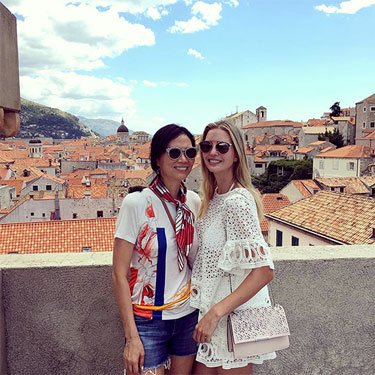
Surprise, surprise! Republican presidential nominee Donald Trump’s daughter Ivanka and the ex-wife of Fox News owner Rupert Murdoch and current girlfriend of Russian dictator Vladimir Putin, Wendi Deng Murdoch, are best buddies who just went on a lavish vacation together…. Trump’s vow that he does not know or speak to Putin is now obviously proved untrue.
———————————-
Occupy Democrats is obviously a commie blog, but People Magazine confirms the story, and adds one pretty significant detail.
Ivanka Trump is taking a break from the campaign trail to vacation with friends.
The daughter of GOP nominee Donald Trump shared a scenic snap with Wendi Deng Murdoch, the ex-wife of billionaire media mogul Rupert Murdoch, from Dubrovnik, Croatia.
Trump, 34, was spotted with husband Jared Kushner in the city’s old town, seemingly taking a couple’s vacation without their three children – Arabella, 5, Joseph, 2, and Theodore, 4 months.
Deng Murdoch was actually responsible for setting up Trump and Kushner.
———————————-
Concerning the Wendi Deng Murdoch-Putin Connection, I find that there were gossip stories all over the media last March & April.
How’s this for a new couple alert? The rumor circulating around the corridors of power — from Washington, D.C., to Europe and Asia — is that Vladimir Putin and Wendi Deng, Rupert Murdoch’s ex-wife, are dating.
Reports of the pair have been floating around for years, ever since their respective divorces in 2014 and 2013.
One insider close to the powerful leader tells Us Weekly the relationship is “serious.†…
Deng has yet to be spotted looking romantic with the Russian leader, but was seen boarding her pal Roman Abramovich’s yacht in St. Bart’s on Monday, March 28. Abramovich also happens to be friends with Putin.
Wendi Deng has been seen frolicking in the tropical waves of St Barts amid claims that she is in a ‘serious’ relationship with Russian leader Vladimir Putin.
The 47-year-old showed off her impressive figure in a skimpy red bikini as she splashed about on the Caribbean coast with friends.
Deng has been enjoying a holiday on St Barts aboard the $400 million yacht of Russian billionaire Roman Abramovich, a close friend of Putin.
Assuming the gossip reportage is correct, it looks like there really are some pretty intimate links between Donald Trump and Vladimir Putin.
Kuriositas profiles an exceptionally spectacular ancient sculpture featuring particularly realistic and fine battle scenes:
It was discovered in 1931 near Via Tiburtina, in the eastern suburbs of Rome. Its front depicts a symbolic picture of a battle which is on two levels. The carving remains to this day an incredible achievement – the dark and light contrast beautifully to produce a veritable chiaroscuro effect. This skill involved was superlative.
The sarcophagus was probably used in the burial of a Roman general who was closely involved in the campaigns of Marcus Aurelius. He is seen on the front of the sarcophagus, frozen forever in a charge against his enemies. Yet the face of the high ranking officer for which the sarcophagus was intended is left blank.
It is thought that it was left blank with the intention of the sculptor creating a death mask of the general in that position. Yet perplexingly it has been left unfinished and we can only guess at the reasons for that. We will never know if some form of shame descended on the general before his death or why it was his family or friends decided that he was to be left nameless and faceless for eternity.
Certainly it was not for expediency or money. This sarcophagus would have been incredibly expensive to create and would probably have taken over a year to create. Plus the rest of it (and thus his reputation) was left intact. You can see his troops laying in to their barbarian enemies with gusto. Some are already on the ground, others apparently beg for his mercy. …
The military insignia which can be seen on the upper edge of the casket allows us to try to figure out the identity of the man. It shows the eagle of the Legio IIII Flavia and the boar of the Legio I Italicai. Historians who have studied the casket have pointed towards Aulus Iulius Pompilius. He was an official of Marcus Aurelius who was in control of two squadrons of cavalry which were on detachment to both legions for the duration of the war against the Marcomanni (172-175AD).
Portonaccio Sarcophagus, 2nd Century A.D., Museo Nazionale Romano
Shooting competitions used to attract mass audiences a bit over a century ago, not today. Today’s urbanized, emasculated, hoplophobic America prefers ball games, and current reporting associates firearms only with terrorism and mass shootings. It is additionally more technically difficult for television to cover the shooting sports, and NBC cannot be bothered to make the effort.
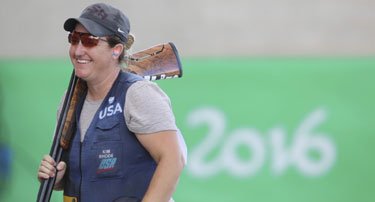
Kimberly Rhode, who shoots skeet, is the first woman to medal in six consecutive Olympic games, but no big corporate sponsor wants anything to do with her.
When Team USA’s Kim Rhode won a bronze medal in skeet shooting Friday, she claimed a piece of Olympic history: the 37-year-old Californian became the first woman to take the podium in six straight Olympics.
Landing a big-name sponsor might be the bigger feat. In the year leading up to Rio 2016, Rhode’s agent Patrick Quinn pitched her to around 20 companies that back the Olympics. None were convinced.
“The big mystery is how someone like Kim isn’t part of the Coca-Cola, Procter & Gamble, and the Olympics sponsor push,’’ Quinn said by phone from Chicago.“It would be nice to have an Olympic sponsor recognize the magnitude of her accomplishment.’’
Coca-Cola Co. didn’t respond to a request for comment, and Procter & Gamble Co.’s spokesperson Damon Jones said in an e-mail the company receives hundreds of sponsorship requests so it must be selective. Rhode and other shooters on Team USA think the reason they’re passed over is obvious. The rise in gun violence and mass shootings in the US have attached a stigma to shooting as a sport, they say. So while companies like Winchester, Beretta and Otis Technology support Rhode, she doesn’t have a single sponsor from outside the firearm industry.
The same is true for USA Shooting, even though the sport has since 2000 been the fifth-highest medal producer for the US team at Summer Olympics. The very first gold medal for any sport awarded in Rio went to 19-year-old Ginny Thrasher, competing in her Olympics debut.
Politics may only tell part of the story. American television audiences don’t tend to watch shooting – or, for that matter, a number of other sports. “The biggest challenge is limited exposure,†said Peter Carlisle, head of the Olympic Sports and Action division at Octagon Worldwide. “If the sport itself doesn’t provide a consistent platform for the athletes to become recognizable and maintain relevance, there’s limited value to a sponsor.â€
Gilgamesh cylinder seal impression, Schoyen Collection.
Martin Worthington, Lecturer in Assyriology, Babylonian and Assyrian grammar, Akkadian and Sumerian Cambridge University, reads The Epic of Gilgamesh in Akkadian.