Archive for 2016
28 Mar 2016

Daily Caller reports that Donald Trump is just a little shaky on the meaning and significance of the Easter holiday.
Donald Trump says Easter “represents family and get-together and — and something.â€
Appearing on ABC’s “This Week,†on Easter Sunday, Trump was asked what Easter means to him and if he had an Easter tradition. The real estate mogul replied, “Well, it really means something very special. I’m going to church in an hour from now and it’s going to be — it’s a beautiful church. I’m in Florida.â€
“And it’s just a very special time for me. And it really represents family and get-together and — and something, you know, if you’re a — a Christian, it’s just a very important day,†Trump said.
28 Mar 2016


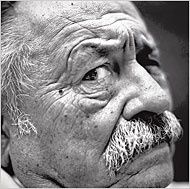
Harrison looked like one of those European mastiffs, so ugly that he was beautiful.
Jim Harrison, who passed away on Saturday at the age of 78, was for my money the best living American writer of fiction. Jim Harrison wrote simply, elegantly, and perceptively about real Americans, the out-of-doors, and what the Japanese refer to as “the immortal questions.” He was prolific: 21 books of fiction and 14 of poetry, and, with the help of a loan of $15,000 from Jack Nicholson early in his writing career that gave him time to complete the break-through collection of novellas which sold some screenplays, successful enough to support a life-style which included flying to Paris to have lunch, extreme oenophilia with an emphasis on Burgundies, and a kitchen larder loaded with caviar and pâté.
Jim Harrison could step gracefully from writing violent escapist fantasies to serious, meditative novels focused on love, guilt, aging, and la condition humaine. He did not like being compared to Ernest Hemingway, but the comparison was an obvious one. Like Hemingway, Jim Harrison was a masculine writer, sophisticated and intellectual, but fundamentally and always an outdoorsman. Like Hemingway, Harrison was a romantic and a stoic, whose fiction was preoccupied with acute and intelligent observation in the course of living up to a demanding and aristocratic code.
The novelist Thomas McGuane was Harrison’s classmate at Michigan State, and Jim Harrison was himself the most distinguished representative of a group of rural, huntin’, fishin’, and shootin’ writers, basically at odds with the contemporary urban community of fashion culture, which included McGuane, Russell Chatham, Guy de la Valdène, and Steve Bodio.
The New York Times obit has some great anecdotes:
His food writing, much of which first appeared in Esquire, was collected in his 2001 book, “The Raw and the Cooked,†whose title invokes the anthropologist Claude Lévi-Strauss’s volume of that name. Mr. Lévi-Strauss’s book is about myth and ritual. Mr. Harrison’s is about rituals that include his flying to France for the sole purpose of having lunch — a lunch that spanned 11 hours, 37 courses and 19 wines. …
At bottom, Mr. Harrison was not so much like Hemingway as he was like something out of Hemingway. Or, more accurately, something out of Rabelais — a mustachioed, barrel-chested bear of a man whose unapologetic immoderation encompassed a dazzling repertory:
There was the eating. Mr. Harrison once faced down 144 oysters, just to see if he could finish them. (He could.)
There was the drinking. One fine summer, he personally tested 38 varieties of Côtes du Rhône. (“It was like a small wine festival. Just me, really,†he told The Washington Post afterward.) …
All these ingredients were titanically encapsulated in a dinner Mr. Harrison once shared with Orson Welles, which involved, he wrote, “a half-pound of beluga with a bottle of Stolichnaya, a salmon in sorrel sauce, sweetbreads en croûte, a miniature leg of lamb (the whole thing) with five wines, desserts, cheeses, ports†and a chaser of cocaine.
He will be missed.
27 Mar 2016

Gerard van der Leun of American Digest (who is normally our most kindred spirit blogger) disagrees with NYM on Trump. Yesterday, he responded indignantly in a comment to our quoting John Hawkins‘s negative opinion of Trump:
The enemy of my enemy is always my friend until he helps me to destroy my enemy. After that he becomes my enemy again.
That or adios supreme court for one or two generations.
I think myself that Mr. van der Leun is not looking properly at the big picture. He ought to consider the historical perspective proposed by National Review’s Avi Snyder, to begin with.
With the GOP looking at the possibility of an open convention — complete with floor fights, riots, and the threat that the party will tear itself in two — the best historical analogue seems clear: Donald Trump is Teddy Roosevelt, and this is 1912 all over again.
The 1912 Republican National Convention was a battle for the soul of the party.
Though President William Howard Taft had been Theodore Roosevelt’s chosen successor in 1908, by 1912, the increasingly radical Roosevelt was dissatisfied with Taft’s relative conservatism in office. In violation of an earlier pledge not to run for a second full term, Roosevelt chose to challenge the president for the Republican nomination.
Much like Donald Trump, the progressive Roosevelt was a post-constitutional candidate. There are parallels between Trump’s defense of eminent domain abuse and Roosevelt’s contempt for property rights, and Trump’s strongman tendencies have antecedents in TR’s impatience with the machinery of constitutional government.
In the early 20th century, only a handful of states held popular primaries to choose presidential nominees, and the results weren’t even binding. But Roosevelt was a popular figure, and he took advantage of these contests, carrying nine out of twelve primaries. President Taft, however, still controlled the machinery of the party, and in states where convention delegates were chosen by party regulars, Taft’s forces dominated.
This didn’t stop Roosevelt from crying foul. “I believe in pure democracy,†he had proclaimed at the Ohio Constitutional Convention in February of that year. As the forces of his era’s Republican establishment stood arrayed against him, Roosevelt, in the words of historian Lewis Gould, remained “firm in his conviction that the nomination was being stolen from him.†One can almost imagine the outrage of Trump boosters, such as Sean Hannity, Newt Gingrich and others, at the notion that the “will of the people†could be so successfully thwarted by the party apparatus. Unlike Trump, Roosevelt didn’t promise riots if he failed to secure the nomination, but the convention organizers were prepared for them. A thousand policemen patrolled the aisles of the convention, and barbed wire was hidden beneath the bunting of the speaker’s platform in order to prevent assaults. For Roosevelt had cast his battle for the nomination in apocalyptic language, proclaiming to his followers that: “We stand at Armageddon, and we battle for the Lord.â€
None of these protests stopped the conservative forces of President Taft from denying Roosevelt the nomination. Taft’s ally Elihu Root defeated Roosevelt’s chosen candidate for convention chairman. Roosevelt’s forces lost important votes on the floor, and the convention awarded contested delegates to Taft. Roosevelt had won more primaries and had entered the convention with a plurality of delegates, but Taft easily wrapped up the nomination on the first ballot.
Taft and Root knew that denying Roosevelt the nomination would likely lead him and his supporters to bolt the convention and run on a third-party ticket, splitting the GOP vote and virtually guaranteeing a Democratic victory in November. Of course, this is precisely what happened. Combined, Roosevelt and Taft won over 50 percent of the popular vote, but Democrat Woodrow Wilson won the election with just over 40 percent.
Why was the Republican establishment of the day so intent on denying Roosevelt the nomination? Didn’t they know that their dirty tricks would “hand the election to the Democrats?†Didn’t they know it was time to “come together as a party?†What Taft, Root, and their allies understood was that, as Root would later put it, “worse things can happen to a party than to be defeated.†In fact, as Root understood the situation before the party, “the result of the convention was more important than the question of the election.â€
In 1912, America’s very system of constitutional government was under attack. Woodrow Wilson, the man who would become the Democratic candidate, had spent his prior academic career attacking the Constitution as outdated and dismissing the eternal truths of the Declaration of Independence as passé. Roosevelt’s progressivism led him to support a variety of radical measures — such as popular recall elections for judges and judicial decisions — that also threatened America’s constitutional order. Had Roosevelt captured the party in 1912, America would have been without a constitutionalist, conservative party.
Root and Taft insisted that the party of Lincoln should be maintained as “a nucleus about which the conservative people who are in favor of maintaining constitutional government can gather.†And even though they lost the election, ushering in Wilson’s disastrous presidency, history has proven their wisdom. It is hard to imagine a President Coolidge, a candidate Goldwater, or a “Reagan Revolution†had the Republican party become the vehicle for promoting Roosevelt’s proto-welfare state. In the face of defeat, the losers of the election of 1912 could rest in the knowledge that they had ensured constitutionalism would continue to find a home in one of America’s major parties.
The relevance of 1912 to the 2016 GOP primary race should be obvious.
———————-
Of course, apart from such grand issues as preserving the alternative of a constitutionalist party, one needs to bear in mind that it likely to be better for the future of the country, and of the conservative cause, to see one’s adversaries elect a failed and disastrous presidency than to elect one of those supposedly representing your own party and your own principles.
I do not believe that Donald Trump shows any reasonable probability at all of winning, making America great, or making good decisions or appointments. I can easily picture Donald nominating his liberal sister and a few random poker buddies to the Supreme Court. I can picture Donald Trump taking a shot at reviving tariffs and Protectionism and instigating a world-wide trade war, dramatically deepening the economic bad times, and shaking the foundations of the world economic order.
I can picture Donald Trump bullying corporations, initiating his own series of New-Deal-style make-work federal programs, and adding some next larger entitlement to the Welfare State.
I think that four years of Donald Trump at the helm will produce results similar to Trump University’s or Trump steaks’, and that electing Donald Trump as a Republican will inevitably result in giving the radical democrat party a “One-Free-Presidency” coupon to be cashed for absolutely anyone.
Beyond these practical considerations, I think that we have a duty as citizens to respect our country and our institutions and to support for the chief magistracy only, in the words of John Adams’ prayer, “wise and honest men.”
It may be, this year, as in 2008 and other disastrous years, that Fate is against us. There is nothing we can do to win. We may not be able to command success, but we can, at least, conduct ourselves, and choose, in such a way as to deserve it.
27 Mar 2016
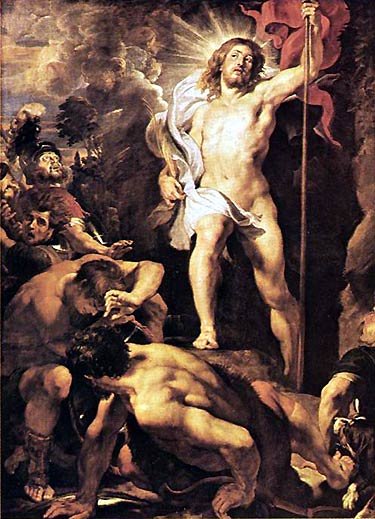
Peter Paul Rubens, The Resurrection of Christ, 1611-1612, Vrouwekathedraal, Antwerp
From Robert Chambers, The Book of Days, 1869:
Easter
Easter, the anniversary of our Lord’s resurrection from the dead, is one of the three great festivals of the Christian year,—the other two being Christmas and Whitsuntide. From the earliest period of Christianity down to the present day, it has always been celebrated by believers with the greatest joy, and accounted the Queen of Festivals. In primitive times it was usual for Christians to salute each other on the morning of this day by exclaiming, ‘Christ is risen;’ to which the person saluted replied, ‘Christ is risen indeed,’ or else, ‘And hath appeared unto Simon;’—a custom still retained in the Greek Church.
The common name of this festival in the East was the Paschal Feast, because kept at the same time as the Pascha, or Jewish passover, and in some measure succeeding to it. In the sixth of the Ancyran Canons it is called the Great Day. Our own name Easter is derived, as some suppose, from Eostre, the name of a Saxon deity, whose feast was celebrated every year in the spring, about the same time as the Christian festival—the name being retained when the character of the feast was changed; or, as others suppose, from Oster, which signifies rising. If the latter supposition be correct, Easter is in name, as well as reality, the feast of the resurrection.
Though there has never been any difference of opinion in the Christian church as to why Easter is kept, there has been a good deal as to when it ought to be kept. It is one of the moveable feasts; that is, it is not fixed to one particular day—like Christmas Day, e. g., which is always kept on the 25th of December—but moves backwards or forwards according as the full moon next after the vernal equinox falls nearer or further from the equinox. The rule given at the beginning of the Prayer-book to find Easter is this: ‘Easter-day is always the first Sunday after the full moon which happens upon or next after the twenty-first day of March; and if the full moon happens upon a Sunday, Easter-day is the Sunday after.’
The paschal controversy, which for a time divided Christendom, grew out of a diversity of custom. The churches of Asia Minor, among whom were many Judaizing Christians, kept their paschal feast on the same day as the Jews kept their passover; i. e., on the 14th of Nisan, the Jewish month corresponding to our March or April. But the churches of the West, remembering that our Lord’s resurrection took place on the Sunday, kept their festival on the Sunday following the 14th of Nisan. By this means they hoped not only to commemorate the resurrection on the day on which it actually occurred, but also to distinguish themselves more effectually from the Jews. For a time this difference was borne with mutual forbearance and charity. And when disputes began to arise, we find that Polycarp, the venerable bishop of Smyrna, when on a visit to Rome, took the opportunity of conferring with Anicetas, bishop of that city, upon the question. Polycarp pleaded the practice of St. Philip and St. John, with the latter of whom he had lived, conversed, and joined in its celebration; while Anicetas adduced the practice of St. Peter and St. Paul. Concession came from neither side, and so the matter dropped; but the two bishops continued in Christian friendship and concord. This was about A.D. 158.
Towards the end of the century, however, Victor, bishop of Rome, resolved on compelling the Eastern churches to conform to the Western practice, and wrote an imperious letter to the prelates of Asia, commanding them to keep the festival of Easter at the time observed by the Western churches. They very naturally resented such an interference, and declared their resolution to keep Easter at the time they had been accustomed to do. The dispute hence-forward gathered strength, and was the source of much bitterness during the next century. The East was divided from the West, and all who, after the example of the Asiatics, kept Easter-day on the 14th, whether that day were Sunday or not, were styled Qiccertodecimans by those who adopted the Roman custom.
One cause of this strife was the imperfection of the Jewish calendar. The ordinary year of the Jews consisted of 12 lunar months of 292 days each, or of 29 and 30 days alternately; that is, of 354 days. To make up the 11 days’ deficiency, they intercalated a thirteenth month of 30 days every third year. But even then they would be in advance of the true time without other intercalations; so that they often kept their passover before the vernal equinox. But the Western Christians considered the vernal equinox the commencement of the natural year, and objected to a mode of reckoning which might sometimes cause them to hold their paschal feast twice in one year and omit it altogether the next. To obviate this, the fifth of the apostolic canons decreed that, ’ If any bishop, priest, or deacon, celebrated the Holy Feast of Easter before the vernal equinox, as the Jews do, let him be deposed.’
At the beginning of the fourth century, matters had gone to such a length, that the Emperor Constantine thought it his duty to take steps to allay the controversy, and to insure uniformity of practice for the future. For this purpose, he got a canon passed in the great Ecumenical Council of Nice (A.D. 325), that everywhere the great feast of Easter should be observed upon one and the same day; and that not the day of the Jewish passover, but, as had been generally observed, upon the Sunday afterwards. And to prevent all future disputes as to the time, the following rules were also laid down:
‘That the twenty-first day of March shall be accounted the vernal equinox.’
‘That the full moon happening upon or next after the twenty-first of March, shall be taken for the full moon of Nisan.’
‘That the Lord’s-day next following that full moon be Easter-day.’
‘But if the full moon happen upon a Sunday, Easter-day shall be the Sunday after.’
As the Egyptians at that time excelled in astronomy, the Bishop of Alexandria was appointed to give notice of Easter-day to the Pope and other patriarchs. But it was evident that this arrangement could not last long; it was too inconvenient and liable to interruptions. The fathers of the next age began, therefore, to adopt the golden numbers of the Metonic cycle, and to place them in the calendar against those days in each month on which the new moons should fall during that year of the cycle. The Metonie cycle was a period of nineteen years. It had been observed by Meton, an Athenian philosopher, that the moon returns to have her changes on the same month and day of the month in the solar year after a lapse of nineteen years, and so, as it were, to run in a circle. He published his discovery at the Olympic Games, B.C. 433, and the cycle has ever since borne his name. The fathers hoped by this cycle to be able always to know the moon’s age; and as the vernal equinox was now fixed to the 21st of March, to find Easter for ever. But though the new moon really happened on the same day of the year after a space of nineteen years as it did before, it fell an hour earlier on that day, which, in the course of time, created a serious error in their calculations.
A cycle was then framed at Rome for 84 years, and generally received by the Western church, for it was then thought that in this space of time the moon’s changes would return not only to the same day of the month, but of the week also. Wheatley tells us that, ‘During the time that Easter was kept according to this cycle, Britain was separated from the Roman empire, and the British churches for some time after that separation continued to keep Easter according to this table of 84 years. But soon after that separation, the Church of Rome and several others discovered great deficiencies in this account, and therefore left it for another which was more perfect.’—Book on the Common Prayer, p. 40. This was the Victorian period of 532 years. But he is clearly in error here. The Victorian period was only drawn up about the year 457, and was not adopted by the Church till the Fourth Council of Orleans, A.D. 541.
Now from the time the Romans finally left Britain (A.D. 426), when he supposes both churches to be using the cycle of 84 years, till the arrival of St. Augustine (A.D. 596), the error can hardly have amounted to a difference worth disputing about. And yet the time the Britons kept Easter must have varied considerably from that of the Roman missionaries to have given rise to the statement that they were Quartodecimans, which they certainly were not; for it is a well-known fact that British bishops were at the Council of Nice, and doubtless adopted and brought home with them the rule laid down by that assembly. Dr. Hooke’s account is far more probable, that the British and Irish churches adhered to the Alexandrian rule, according to which the Easter festival could not begin before the 8th of March; while according to the rule adopted at Rome and generally in the West, it began as early as the fifth. ‘They (the Celts) were manifestly in error,’ he says; ‘but owing to the haughtiness with which the Italians had demanded an alteration in their calendar, they doggedly determined not to change.’—Lives of the Archbishops of Canterbury, vol. i. p. 14.
After a good deal of disputation had taken place, with more in prospect, Oswy, King of Northumbria, determined to take the matter in hand. He summoned the leaders of the contending parties to a conference at Whitby, A.D. 664, at which he himself presided. Colman, bishop of Lindisfarne, represented the British church. The Romish party were headed by Agilbert, bishop of Dorchester, and Wilfrid, a young Saxon. Wilfrid was spokesman. The arguments were characteristic of the age; but the manner in which the king decided irresistibly provokes a smile, and makes one doubt whether he were in jest or earnest. Colman spoke first, and urged that the custom of the Celtic church ought not to be changed, because it had been inherited from their forefathers, men beloved of God, &c. Wilfrid followed:
‘The Easter which we observe I saw celebrated by all at Rome: there, where the blessed apostles, Peter and Paul, lived, taught, suffered, and were buried.’ And concluded a really powerful speech with these words: ‘And if, after all, that Columba of yours were, which I will not deny, a holy man, gifted with the power of working miracles, is he, I ask, to be preferred before the most blessed Prince of the Apostles, to whom our Lord said, “Thou art Peter, and upon this rock will I build my church, and the gates of hell shall not prevail against it; and to thee will I give the keys of the kingdom of heaven†?’
The King, turning to Colman, asked him, ‘Is it true or not, Colman, that these words were spoken to Peter by our Lord?’ Colman, who seems to have been completely cowed, could not deny it. ‘It is true, 0 King.’ ‘Then,’ said the King, ‘can you shew me any such power given to your Columba? ’ Colman answered, ’ No.’ ‘You are both, then, agreed,’ continued the King, are you not, that these words were addressed principally to Peter, and that to him were given the keys of heaven by our Lord?’ Both assented. ‘Then,’ said the King, ‘I tell you plainly, I shall not stand opposed to the door-keeper of the kingdom of heaven; I desire, as far as in me lies, to adhere to his precepts and obey his commands, lest by offending him who keepeth the keys, I should, when I present myself at the gate, find no one to open to me.’
This settled the controversy, though poor honest Colman resigned his see rather than submit to such a decision.
On Easter-day depend all the moveable feasts and fasts throughout the year. The nine Sundays before, and the eight following after, are all dependent upon it, and form, as it were, a body-guard to this Queen of Festivals. The nine preceding are the six Sundays in Lent, Quinquagesima, Sexagesima, and Septuagesima; the eight following are the five Sundays after Easter, the Sunday after Ascension Day, Whit Sunday, and Trinity Sunday.
EASTER CUSTOMS
The old Easter customs which still linger among us vary considerably in form in different parts of the kingdom. The custom of distributing the ‘pace’ or ‘pasche ege,’ which was once almost universal among Christians, is still observed by children, and by the peasantry in Lancashire. Even in Scotland, where the great festivals have for centuries been suppressed, the young people still get their hard-boiled dyed eggs, which they roll about, or throw, and finally eat. In Lancashire, and in Cheshire, Staffordshire, and Warwickshire, and perhaps in other counties, the ridiculous custom of ‘lifting’ or ‘heaving’ is practised.
On Easter Monday the men lift the women, and on Easter Tuesday the women lift or heave the men. The process is performed by two lusty men or women joining their hands across each other’s wrists; then, making the person to be heaved sit down on their arms, they lift him up aloft two or three times, and often carry him several yards along a street. A grave clergyman who happened to be passing through a town in Lancashire on an Easter Tuesday, and having to stay an hour or two at an inn, was astonished by three or four lusty women rushing into his room, exclaiming they had come ‘to lift him.’ ‘To lift me!’ repeated the amazed divine; ‘what can you mean?’ ‘Why, your reverence, we’re come to lift you, ‘cause it’s Easter Tuesday.’ ‘Lift me because it’s Easter Tuesday? I don’t understand. Is there any such custom here?’ ‘Yes, to be sure; why, don’t you know? all us women was lifted yesterday; and us lifts the men today in turn. And in course it’s our rights and duties to lift ‘em.’
After a little further parley, the reverend traveller compromised with his fair visitors for half-a-crown, and thus escaped the dreaded compliment. In Durham, on Easter Monday, the men claim the privilege to take off the women’s shoes, and the next day the women retaliate. Anciently, both ecclesiastics and laics used to play at ball in the churches for tansy-cakes on Eastertide; and, though the profane part of this custom is happily everywhere discontinued, tansy-cakes and tansy-puddings are still favourite dishes at Easter in many parts. In some parishes in the counties of Dorset and Devon, the clerk carries round to every house a few white cakes as an Easter offering; these cakes, which are about the eighth of an inch thick, and of two sizes —the larger being seven or eight inches, the smaller about five in diameter— have a mingled bitter and sweet taste. In return for these cakes, which are always distributed after Divine service on Good Friday, the clerk receives a gratuity- according to the circumstances or generosity of the householder.
26 Mar 2016

The British Express pays tribute to a Russian Spetznaz special operator in Syria, who, finding himself surrounded and hopelessly trapped by ISIS jihadis, called in a bomb strike on his own position.
A HERO special forces officer took out a group of murderous Islamic State (ISIS) jihadis who had pinned him down by calling in an airstrike on HIMSELF, it emerged today.
The brave commando gave bomber jets his own co-ordinates after being trapped by a gang of evil Islamists whilst carrying out covert operations to disrupt their supply line.
His extraordinary bravery meant vital operational information did not fall into the jihadis’ hands and also ensured that he took several of the group’s twisted militants down with him.
The bloodthirsty Islamists were moving in to capture the stranded soldier following a fierce gunfight when they were surprised by the bombing raid and blown to hell.
It is thought the commando may have belonged to Russia’s crack Spetsnaz elite combat unit, which was dispatched to Syria to hunt down and take out fleeing jihadis.
26 Mar 2016

John Hawkins will never vote for Donald Trump.
Donald J. Trump is like a grown up version of King Joffrey from “Game of Thrones.†He is like a mean-spirited parody of a Republican on “Saturday Night Live†come to life. Donald J. Trump is a walking, talking Internet meme who seems to be spouting off shallow slogans half the time and lying the other half. He’s also a creepy, thin skinned authoritarian who has made it clear he cares nothing about free speech for anyone but himself and has publicly encouraged political violence at his rallies. Moreover, aside from some tough talk about immigration, trade and unworkable, over-the-top attacks on Muslims, his entire campaign has been centered on mean tweets, third grade insults and campaign promises that sometimes change from day-to-day or even from hour-to-hour. It’s difficult to know what Trump would really do if he were in power. His real views could range anywhere from liberal to conservative to South American dictator on just about any issue. So, if you’re a conservative who believes in God, country and the Constitution, how do you fall in line behind someone like that?
Read the whole thing.
Hat tip to Robert Laird.
26 Mar 2016

“Hell, make ’em cry, make ’em laugh, make ’em think you’re their weak erring pal, or make ’em think you’re God-Almighty. Or make ’em mad. Even mad at you. Just stir ’em up, it doesn’t matter how or why, and they’ll love you and come back for more. Pinch ’em in the soft place. They aren’t alive, most of ’em, and haven’t been alive in twenty years. Hell, their wives have lost their teeth and their shape, and likker won’t set on their stomachs, and they don’t believe in God, so it’s up to you to give ’em something to stir ’em up and make ’em feel alive again. Just for half an hour. That’s what they come for. Tell ’em anything. But for Sweet Jesus’ sake don’t try to improve their minds.”
25 Mar 2016

You know what Ted Cruz’s wife is going to look like in 20 years?
Heidi Cruz. Just older.
You know what Donald Trump’s wife is going to look like in 20 years?
Who knows? She hasn’t been born yet.
25 Mar 2016

The Sumatran Rhinocerus (Dicerorhinus sumatrensis), hasn’t been seen for forty years in Borneo, but a living example was recently captured in a pit trap.
National Geographic
24 Mar 2016

I recently purchased an interesting pre-WWII custom rifle. It is a 1903 Springfield action, barreled by William Sukalle (renowned barrel-maker of Tucson, Arizona) in 7x57mm Mauser, with a stock by the legendary Adolph Minar of Fountain, Colorado.
Jack O’Connor once owned a Minar-Sukalle rifle in 7×57. The one I bought isn’t his, but there is a note signed by Jack O’Connor describing the rifle, tucked away in the trap under the pistol grip cap.
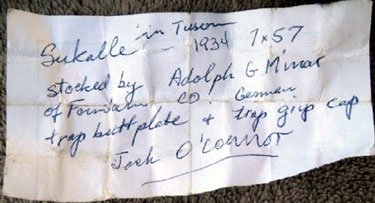
Minar died young in 1936 at the age of 56, and is believed to have stocked a total of 36 rifles. O’Connor owned more than one of them. Phil Shoemaker today has Jack O’Connor’s Minar .30-06. The Shoemaker rifle was previously given by O’Connor to Sports Afield Camping editor John Jobson, who wrote about it.
My rifle has some very distinctive engraving. I was wondering if there are any experts out there who would recognize the style of the engraver. Here is a photo of the floorplate:
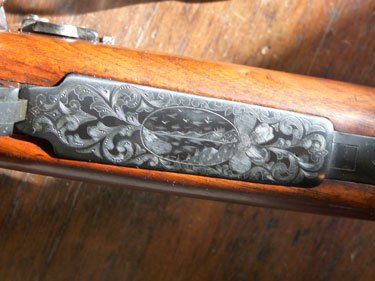
/div>

Feeds
|