Archive for October, 2018
09 Oct 2018

Recruiting sergeants, 1877. “Quick, sign up! There’s still time to get there for Isandhlwana.”
At Kuriositas.
Complete book here.
08 Oct 2018


Christopher Columbus (detail), from Alejo Fernández, La Virgen de los Navegantes, circa 1505 to 1536, Alcázares Reales de Sevilla.
In his magisterial biography, Admiral of the Ocean Sea, 1942, Samuel Elliot Morrison observes:
[Christopher Columbus did] more to direct the course of history than any individual since Augustus Caesar. …
The voyage that took him to “The Indies” and home was no blind chance, but the creation of his own brain and soul, long studied, carefully planned, repeatedly urged on indifferent princes, and carried through by virtue of his courage, sea-knowledge and indomitable will. No later voyage could ever have such spectacular results, and Columbus’s fame would have been secure had he retired from the sea in 1493. Yet a lofty ambition to explore further, to organize the territories won for Castile, and to complete the circuit of the globe, sent him thrice more to America. These voyages, even more than the first, proved him to be the greatest navigator of his age, and enabled him to train the captains and pilots who were to display the banners of Spain off every American cape and island between Fifty North and Fifty South. The ease with which he dissipated the unknown terrors of the Ocean, the skill with which he found his way out and home, again and again, led thousands of men from every Western European nation into maritime adventure and exploration.
The whole history of the Americas stem from the Four Voyages of Columbus; and as the Greek city-states looked back to the deathless gods as their founders, so today a score of independent nations and dominions unite in homage to Christopher the stout-hearted son of Genoa, who carried Christian civilization across the Ocean Sea.
An annual post.
08 Oct 2018

Amy Chua and Jed Rubenfeld.
If anybody doubts that #MeToo Feminism amounts to witch-hunting, he just needs to read this article in Slate, describing (with avidity) how Yale Law Professor Jed Rubenfeld (husband of “Tiger Mom” Amy Chua) needed to be investigated for making a young lady “uncomfortable” through personal conversations or by complimenting her (!) The beast!
One afternoon late in her first year at Yale Law School, Linda sat down to create a contemporaneous record of a conversation she’d had the night before. She’d met with one of her professors, Jed Rubenfeld, in his office after hours at his suggestion, following repeated attempts to see him in the afternoon about a paper she was working on for him. Rubenfeld had made her uncomfortable throughout the year, commenting on her appearance and asking her about his. While friends had told her she had reason to feel creeped out by his behavior, Linda wondered whether she was being too sensitive and agreed to the 8 p.m. meeting. She really needed to make progress on the paper, after all. But given the queasy feeling she already had, she asked her partner to pick her up that night, and to come looking for her if he hadn’t heard from her after a reasonable amount of time.
Per Linda’s record, written the next day and shared with us recently, her conversation with Rubenfeld that evening quickly veered away from her paper. The professor asked her, “Why aren’t you married?†When Linda tried to steer the conversation to safe ground—mentioning how young she was and inquiring about his own marriage to fellow Yale Law School professor Amy Chua—Rubenfeld brought the focus back to her. He asked if she’d been the smartest girl in her high school, then if she’d been the prettiest. When she again deflected, he asked if her smarts had made things tough with the guys in school. The conversation meandered from there and never returned to her paper. Eventually, Rubenfeld said they should get going. By the time they left, Linda’s partner had come to look for her.
Linda, who today is a recent YLS alum, spent the rest of that academic year agonizing over what to do about her uncomfortable interactions with Rubenfeld, and experiencing more of them. One in particular sticks out: The Saturday night after exams wrapped up, Rubenfeld called her cellphone—the first time he had ever done that, she says. He said they’d never gotten a chance to talk about that paper and asked if she was free to do that now. Linda said she was busy preparing to leave New Haven and couldn’t meet, but said she was happy to talk on the phone. They had what Linda describes as a 30-second conversation about the paper before Rubenfeld quickly ended the call, saying he’d see her in September.
That summer, Linda spoke to Yale Law School’s Title IX coordinator. (Linda is a pseudonym, and to preserve her anonymity, we have chosen not to name the Title IX coordinator at the time, as it would identify her class year.) Her goal was twofold: She wanted to start a paper trail about Rubenfeld’s behavior, and she was looking for advice on what her options were for engaging the school’s Title IX process, the government-mandated means of investigating and stopping gender-based discrimination. According to Linda, the Title IX coordinator at the time told her at the very beginning of the call that if Linda named the professor during their conversation and the allegations were sufficiently serious, the coordinator would have to file a formal report. Once that process began, the coordinator said, Linda’s anonymity could not be guaranteed.
This was several years before #MeToo, and the prevailing wisdom at the time was that women should just lean in and push through when things got weird.
This put Linda in an enormously tough position. Schools need to protect the accused as well as the accusers, so it makes sense that Yale would ask women, or anyone alleging misbehavior, to attach their names to allegations. But it also makes sense that attaching her name would be incredibly difficult for Linda: Rubenfeld hadn’t just advised her on a paper. He also taught one of her courses, and he’d been her “small group†professor during the fall semester. (At Yale, each first-year law student is assigned to a 16- or 17-person small group. Those students take all of their courses together, including one course with just their group that’s led by one professor.) Until that April late-night meeting, Linda had generally considered Rubenfeld her advocate. She was counting on him to be one of her references on her clerkship applications, which she needed to submit soon after returning to campus in the fall. She worried that if she made a report or even told the Title IX coordinator his name, it could get back to Rubenfeld and she’d lose his support. This could undermine her chance to earn a prestigious clerkship with a federal judge—which would then make it harder for her to continue to pursue competitive opportunities, like the holy grail for Yale Law School students: a clerkship on the Supreme Court.
Linda was left with two terrible options: She could protect her clerkship prospects by subjecting herself to more unwelcome flirtation, or she could ask Yale to investigate Rubenfeld.
RTWT
Amazing stuff.
When I was at Yale, I had a professor who had a wonderful voice and a superb accent in the poetry of another language. His seminar was filled with gorgeous female grad students beautiful enough to be models, who were commonly visibly aroused, breathing heavily, as he read aloud. He was a lady-killer, with a glint in his eye. The girls adored him, and he made one of them after another his lover. I suspect he left behind a lot of happy memories, but, it’s a good thing he’s gone. Boy! they’d string him up today.
07 Oct 2018

My 1983 arrest photo, taken at 4 in the morning. I look tired and disgruntled.
I’m a Baby Boomer and consequently, at this point, a geezer. My original Yale class arrived with short hair, wearing jackets and ties, at a non-coeducated Yale featuring strict parietal hours (meaning no girls in your room after 10 PM). I was, by the merest of accidents, at Woodstock.
I am going to confess, reluctantly, that I very recently turned 70. 35 years ago today, when I was 35-years-old, half a lifetime ago, I made a citizen’s arrest in New York City which involved reducing the culprit to possession by shooting him in the leg, causing me to be arrested, thrown into the NYC jail system, and charged with First Degree Armed Assault, plus some firearm possession charges (which –oddly enough– were never really discussed as the whole thing proceeded).
My shooting incident occurred a year earlier than the famous Bernhard Goetz Subway Shooting. I could easily have been what Bernhard Goetz became: a nationally-famous test case involving the private use of force against the then-epidemic minority violence terrorizing New York City.
I was, of course, smarter than Goetz. I used the threat of publicity to persuade the Manhattan DA’s office to back down and actually follow the law. Publicity was not in their interest. And it was not in my interest. Had the story broken, no doubt they would not have backed down, the Grand Jury would have indicted me, and I’d have been convicted, gotten a criminal record, and served time for something.
I saved the local CT newspaper article, some of the legal correspondence, and other material related to the event in a scrapbook at the time, and a few years ago, scanned the most interesting bits into my computer.
If anyone wants to read the story of all this, here it is: Shooting a Rapist.
07 Oct 2018

—————————–
Hyperallergenic:
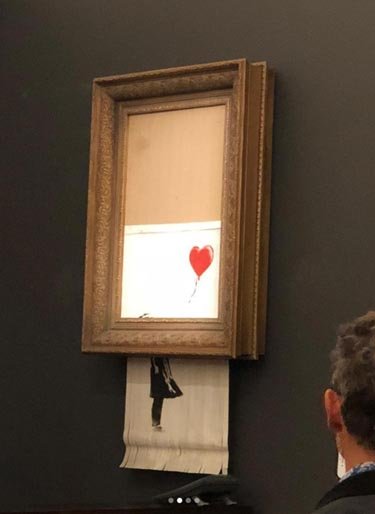
A Banksy artwork “self-destructed†at a Friday night Sotheby’s auction in London.
“Girl with a Balloon†(2006) was the final lot of the evening sale at Sotheby’s and ended things off with an impressive final price of £953,829 (~$1,251,423), or £1,042,000 with buyer’s premium (~$1,367,104). Maybe people should’ve suspected something was suspicious when the artwork sold for the exact same figure as the artist’s previous auction record in 2008.
Robert Casterline of Casterline Goodman gallery was in attendance and told Hyperallergic what happened next. He explained there was “complete confusion†and an “alarm inside the frame started going off as the gavel went down.â€
“[It] sold for over a million dollars and as we sat there…the painting started moving,†he said, and added that the painting’s frame, also made by Banksy, acted as a shredder and started to cut the canvas into strips. “[It was] all out confusion then complete excitement,†he explained.
Anny Shaw of the Art Newspaper spoke to Alex Branczik, the auction house’s head of contemporary art for Europe, who seemed as surprised as anyone. “It appears we just got Banksy-ed,†he said immediately after the sale. He is arguably the greatest British street artist, and tonight we saw a little piece of Banksy genius,†he said, adding that he was “not in on the ruse.â€
Shaw also reports that there was speculation “that the elusive artist had himself pressed the button that destroyed the work.â€
But is the work destroyed? Or is it transformed? Even Branczik isn’t sure. “You could argue that the work is now more valuable,†Branczik said.
RTWT
——————————-
06 Oct 2018

The Local (Sweden):
An eight-year-old Swedish-American girl came across an exciting find swimming at her local lake, when she pulled an ancient sword from its depths.
“It’s not every day that one steps on a sword in the lake!” Mikael Nordström from Jönköpings Läns Museum said when explaining the significance of the find.
But that’s exactly what happened to Saga Vanecek, who found the relic at the Vidöstern lake in TÃ¥nnö, SmÃ¥land earlier this summer.
“I was outside in the water, throwing sticks and stones and stuff to see how far they skip, and then I found some kind of stick,” Saga told The Local.
“I picked it up and was going to drop it back in the water, but it had a handle, and I saw that it was a little bit pointy at the end and all rusty. I held it up in the air and I said ‘Daddy, I found a sword!’ When he saw that it bent and was rusty, he came running up and took it,” she continued.
The water at the lake by the family’s summer house was low this year due to drought, which may have been part of the reason Saga was able to reach the sword. Because of this, the family was putting a buoy out in the lake to warn other boats of an underwater slab of concrete which was dangerous in the low water levels.
“I asked Saga to bring the buoy, but she was taking her time like a kid does, playing in the water,” her father, Andy Vanecek, recalled. “I was getting impatient because the World Cup game was about to start!”
At first he thought his daughter had found a stick or a branch, but realized from the way it bent that it could be a sword — although even then, he thought it could be a modern toy. The family asked their neighbours and one of Vanecek’s colleagues, who has an interest in history and archaeology, and they said the relic was likely authentic and should be reported to authorities, which the Vaneceks did.
It was initially reported that the sword was at least 1,000 years old, but the museum later contacted The Local to clarify that they believe it may be even older, estimated to date back to the 5th or 6th century AD, pre-Viking Age. The find has prompted huge interest from archaeologists and historians.
“It’s about 85 centimentres long, and there is also preserved wood and metal around it,” explained Mikael Nordström from the museum. “We are very keen to see the conservation staff do their work and see more of the details of the sword.”
Anyone hoping to see the sword will have to wait at least a year, Nordström told The Local, explaining: “The conservation process takes quite a long time because it’s a complicated environment with wood and leather, so they have several steps to make sure it’s preserved for the future.”
“Why it has come to be there, we don’t know,” he said. “When we searched a couple of weeks ago, we found another prehistoric object; a brooch from around the same period as the sword, so that means – we don’t know yet – but perhaps it’s a place of sacrifice. At first we thought it could be graves situated nearby the lake, but we don’t think that any more.”
RTWT
——————-
A number of people drew the obvious conclusion:

————-

————-

————-

HT: Karen L. Myers.
06 Oct 2018

Simone Stolzoff visits Facebook and concludes that cushy office perks Silicon-Valley-style are a trap.
I was there to see the headquarters of one of the most influential technology companies in the world, and it looked like a Lego fortress. The campus was all primary colors and serrated edges, as if cut from card stock for an elementary-school bulletin board.
Street art hung from the walls. Bicycles and scooters were strewn like forgotten toys. The corporate name was decapitalized. (Something about trying to be cool.)
“We repurposed the sign from the old Sun Microsystems campus,†my greeter said when she met me at the campus’ entrance. “We leave it as a reminder to stay motivated.â€
As we walked past the iconic thumbs up on the front of the sign, I turned around to see the faded “Sun†on the back of it.
“Welcome to Facebook.â€
For a company built on openness and connectivity, the office felt like the walled garden Facebook itself has become. My greeter walked me to one of the complex’s main arteries from Hacker Way toward Main Street. “The campus was designed to be a cross between Disneyland and downtown Palo Alto.†I could tell. Thousands of employees filled the streets of Facebook’s downtown area, a Main Street USA in a Magic Kingdom partial to hoodies and t-shirts.
There was a barbershop, a dental office, a bike shop.
If I worked here, I would never have to leave.
The gilded offices of Silicon Valley have both the amenities and exclusivity of a country club. The need to keep the outside world locked out is understandable—tourists come from halfway around the world just to take pictures from Google’s driveway—but I worry that the locks go both ways.
“Orwell warns that we will be overcome by an externally imposed oppression. But in Huxley’s vision, no Big Brother is required to deprive people of their autonomy, maturity, and history,†wrote media theorist Neil Postman. “As he saw it, people will come to love their oppression, to adore the technologies that undo their capacities to think.â€
The office is also a technology, a tool used to help get work done. And though there is something special about a workplace where you can get your dry-cleaning done between meetings, the blurring of work and not work can also veer toward oppression.
There’s no such thing as a free cupcake, as Robert A. Heinlein could have told you. All the good stuff in corporate headquarters is there to make you not want to leave, so that you’ll happily put in all sorts of unpaid overtime.
05 Oct 2018

—————————
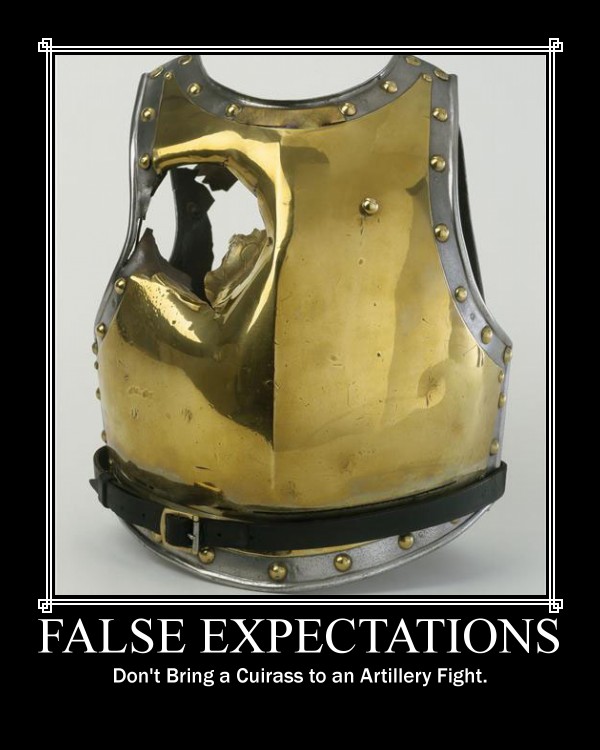
NYM blogged about this cuirass previously here.
05 Oct 2018

Joel Kaplan sat at the left, two rows back, during the Kavanaugh hearing.
The NY Times reports that a Facebook VP being a friend of Brett Kavanaugh’s has led to outrage at the California company.
“I want to apologize,†the Facebook executive wrote last Friday in a note to staff. “I recognize this moment is a deeply painful one — internally and externally.â€
The apology came from Joel Kaplan, Facebook’s vice president for global public policy. A day earlier, Mr. Kaplan had sat behind his friend, Judge Brett M. Kavanaugh, President Trump’s nominee for the Supreme Court, when the judge testified in Congress about allegations he had sexually assaulted Christine Blasey Ford in high school. Mr. Kaplan’s surprise appearance prompted anger and shock among many Facebook employees, some of whom said they took his action as a tacit show of support for Judge Kavanaugh — as if it were an endorsement from Facebook itself.
The unrest quickly spilled over onto Facebook’s internal message boards, where hundreds of workers have since posted about their concerns, according to current and former employees. To quell the hubbub, Facebook’s chief executive, Mark Zuckerberg, last Friday explained in a widely attended staff meeting that Mr. Kaplan was a close friend of Judge Kavanaugh’s and had broken no company rules, these people said.
Yet the disquiet within the company has not subsided. This week, Facebook employees kept flooding internal forums with comments about Mr. Kaplan’s appearance at the hearing. In a post on Wednesday, Andrew Bosworth, a Facebook executive, appeared to dismiss the concerns when he wrote to employees that “it is your responsibility to choose a path, not that of the company you work for.†Facebook plans to hold another staff meeting on Friday to contain the damage, said the current and former employees. …
The internal turmoil at Facebook — described by six current and former employees and a review of internal posts — illustrates how divisions over Judge Kavanaugh’s nomination to the Supreme Court have cascaded into unexpected places and split one of the world’s biggest tech companies.
Mr. Kaplan’s show of support for Judge Kavanaugh hits a particularly sensitive spot for Facebook. It has been weathering claims from conservatives and Mr. Trump that Facebook is biased against right-wing websites and opinions. The company has denied this, saying it is a neutral platform that welcomes all perspectives. By showing up at Judge Kavanaugh’s side, Mr. Kaplan essentially appeared to choose a political side that goes against the views of Facebook’s largely liberal work force.
Many employees also viewed it as a statement: Mr. Kaplan believed Mr. Kavanaugh’s side of the story rather than Dr. Blasey’s testimony. That felt especially hurtful to Facebook employees who were also sexual assault survivors, many of whom began sharing their own #MeToo stories internally.
The tensions add to a litany of other issues that have sapped employee morale. In the past few weeks alone, the company, based in Silicon Valley, has grappled with the departures of the co-founders of Instagram, the photo-sharing app owned by Facebook, plus the disclosure of its largest-ever data breach and continued scrutiny of disinformation across its network before the midterm elections.
“Our leadership team recognizes that they’ve made mistakes handling the events of the last week and we’re grateful for all the feedback from our employees,†Roberta Thomson, a Facebook spokeswoman, said in a statement on Thursday.
RTWT
Western Society has reached the interesting point at which fashionable class solidarity within capitalist organizations will punish ideological deviationism with as much alacrity as last century’s totalitarian regimes.
05 Oct 2018

Rod Dreher finds that the behavior of the Left has hit a new low in Madison, Wisconsin.
Matthew Schmitz posted this comment from Solzhenitsyn to Twitter just now:

Well. In Madison, Wisconsin, the city council has voted overwhelmingly to remove a cemetery marker noting the names of about 140 Confederates, most of whom died in a prisoner of war camp in the town. More:
“You don’t have discussion in a cemetery. You have reflection, and you have memories, and this (monument) brings up memories that are not so pleasant in our history,†said Council Vice President Sheri Carter.
These are Americans who died as prisoners of war. “They die off like rotten sheep,†said a Union soldier who worked at the camp, where conditions were bad. The “monument†is a tombstone large enough to feature the names of each of the dead. This is not a statue of a Confederate war hero. It is simply a grave marker noting the names of POWs who died far from home.
There is no longer equality before God of the fallen, not in Madison, Wisconsin. The city council spits on these dead men, who passed away not in combat, but in Union custody.
In Grace Church cemetery in my Louisiana hometown, you can visit the grave of Lt. Commander John Hart, US Navy, who captained a Union gunboat that was shelling the town and that very church in 1863. Cmdr Hart committed suicide on the boat during the battle. He was a Freemason, as many of the Confederates were. Hart’s men asked for a truce, and for the right to bury their commander in the Grace Church cemetery with full Masonic honors. The Confederate Masons agreed. So the war stopped while all the combatants gathered around the grave to commit Cmdr Hart to the earth.
Children in my hometown are often taken to Hart’s grave and told the story. His grave is treated with great respect locally, and always has been. That’s what decent people do for the dead. There is a brotherhood that defies mortal conflicts.
The leaders of Madison, Wisconsin, are manifestly not decent people.
04 Oct 2018

AFP:
An extremely rare bottle of whisky was sold for a new world record at auction in Edinburgh on Wednesday.
The 60-year-old Macallan Valerio Adami 1926 was sold at Bonhams for a total £848,750 (about $1.09 million, 947,000 euros) beating a previous bottle from the same cask that was sold in Hong Kong in May for £814,081.
Richard Harvey, a drinks expert at Bonhams, told AFP: “The buyer is from the Far East where there has been an enormous interest in whisky.
“Whisky bars are opening up in the Far East everywhere, so there is a huge interest,” he said.
In general, about “a third to 40 percent of our sales go out to buyers in the Far East,” he said.
Bonhams now holds the record for the three most valuable bottles of whisky ever sold at auction.
Martin Green, a Bonhams whisky specialist in Edinburgh, said: “It is a great honour to have established a new world record, and particularly exciting to have done so here in Scotland, the home of whisky.”
The whisky was distilled in 1926 and kept in a cask until it was bottled in 1986.
Just 24 bottles were produced with labels designed by two famous pop artists — 12 by Peter Blake and 12 affixed with the Valerio Adami label which features on the bottle sold in Edinburgh on Wednesday.
It was bought by the vendor direct from the Macallan distillery for an undisclosed sum in 1994 and was part of a wider collection from the same owner offered in the sale.
It is not known how many of them still exist but one is thought to have been destroyed in an earthquake in Japan in 2011, and another is believed to have been opened and drunk.
Bonham’s 3 October 2018 Whisky Sale
/div>

Feeds
|