Umberto Eco, who owned 50,000 books, had this to say about home libraries:
“It is foolish to think that you have to read all the books you buy, as it is foolish to criticize those who buy more books than they will ever be able to read. It would be like saying that you should use… pic.twitter.com/s9iTNtcLIR
—————————-
Edward Gibbon on the Victory of Charles Martel at Poitiers, 732 A.D., in his Decline and Fall of the Roman Empire, Chapter 52:
A victorious line of march had been prolonged above a thousand miles from the rock of Gibraltar to the banks of the Loire; the repetition of an equal space would have carried the Saracens to the confines of Poland and the Highlands of Scotland; the Rhine is not more impassable than the Nile or Euphrates, and the Arabian fleet might have sailed without a naval combat into the mouth of the Thames. Perhaps the interpretation of the Koran would now be taught in the schools of Oxford, and her pulpits might demonstrate to a circumcised people the sanctity and truth of the revelation of Mahomet.
It wasn’t enough for the treasonous intelligentsia to give away the British Empire, they next proceeded to give away Britain, too.
What do you suppose would Nicholson or Napier say, if you predicted that one fine day, Labour would be in power, the former Conservative Prime Minister would be a Merchant caste Punjabi and the head of the opposition Tory Party would be a female Yoruba?
My theory: The US experiences generational waves of a form of secularized puritan Great Awakening, continuing the prior pattern of religious Protestant awakenings. The waves hit every 20-30 years. Four in the last century: actual Communism in the 1920's-30's ("Red Decade"),… https://t.co/fxKYhoAeDh
I don’t think this pattern is quite so predictable and regular as all that, but I think Marc Andreessen is on to something real.
Religion, in both its better and worse forms, even including the famous heresies, strikes a chord in humanity by embodying universal truths and by satisfying perpetual human emotional needs.
The satisfaction of some of these emotional needs, consolation for mankind’s inevitable death and so on, are healthy and life-giving functions. Others, however, the fire-and-brimstone, penitential, and fanatical satisfactions leading to prohibition of pleasures, intolerance, and even bonfires of art and unbelievers are pathological yet equally regularly present.
The whole Environmental Movement, and especially its Catastrophist Junk Science component, obviously has all the features of the standard dualist heresy.
Zoe Strimpel laments one more appalling cultural contribution from the worst-ever generation.
If there’s one thing Generation Z can be relied on to do, it’s make things creepy and weird where they were previously straightforward and commonplace. Having weirded out romantic intimacy, they’ve come for Guinness. It has become so popular among Gen Z that pubs this December are experiencing a Guinness shortage. …
[Now] there is “splitting the G,” in which drinkers attempt a single first swig so the remaining liquid ends up intersecting the Guinness logo. It’s a trend that combines a lackluster approach to downing a pint with something that sounds vaguely sexualized. No doubt we’ll soon be told that “splitting the G” is problematic.
Sales of this bog-standard staple have been helped along by the sorts of influences (and influencers) that would have the dyed-in-the-wool pub-goers of old Dublin turning in their graves. Take Kim Kardashian and pop star Olivia Rodrigo, the former very publicly sporting a pint of Guinness while in London last year, and the latter wearing an excruciatingly uncool-cool T-shirt reading “Guinness is good 4U.”
The Guinness obsession is part of a wider fetishization of the mundane. There are now TikTok accounts that teach women how to dress their boyfriends in old-people clothes, the so-called “grandpa core” aesthetic. Young women are also increasingly searching out goodwill store interior fittings, in the hope that a battered old lamp will help them appear quirky. For those not involved, it looks more like an attempt to intellectualize the boring task of filling your home or dressing yourself.
Part of the reason for this is the explosion in university education. Teach millions of young people to analyze their lives, and they’ll start treating everything as though it must be filled with meaning. Each decision is now part of an aesthetic, a conscious choice to be a “Guinness drinker,” which no doubt comes laden with semiotic irony, rather than choosing things because — you know — you like them?
Javier Milei campaigned promising to “take a chainsaw to government regulations” in Argentina.
Kate Andrews, in the London Spectator, profiles Argentine President Javier Milei as he celebrates the completion of a triumphant first year in office,
‘I never wind down,’ says Argentina’s President Javier Milei when we meet in his Presidential Office at the Casa Rosada. ‘I work all day, practically… I get up at 6 a.m., I take a shower and at 7 a.m. I am already at my desk working. And I work all the way until 11 p.m. I enjoy my job. I enjoy cutting public spending. I love the chainsaw.’
It was a photo of Milei with a chainsaw – who was then the insurgent candidate – that propelled him to international fame last year. He waved it on the campaign trail as a symbol of what he would do to government regulations and bureaucracy if elected to the presidency. He had previously gone viral in a video showing him shouting ‘Afuera!’ (‘Out!’) while ripping names of government departments off a whiteboard.
‘That level of joy is too much for me. Removing 44 regulations within a single day is sheer bliss’
These stunts drew attention to his election promise: to wage war on socialism and bring free markets to Argentina. He started at 16 per cent in the polls, but his pledges to curb inflation, abolish price controls, shrink the state and get the country back on a strong fiscal footing won over the majority of Argentinians, who were ready for change. …
This month marks one year since Milei took office, elected with a mandate to overhaul 100 years of socialist rule – and he’s eager to trumpet the results.
‘Let me tell you a fun story. I was in a bilateral meeting with Indian Prime Minister [Narendra] Modi,’ he tells me through his official interpreter. In the meeting at the G20 in Brazil last month, Milei sang the praises of his deregulation minister Federico Sturzenegger, who was also in attendance. Milei told Modi that the minister had cut four regulations in Argentina that very day.
‘Minister Sturzenegger didn’t correct me, because if I had known the actual figure, I would probably have started to celebrate on top of the table. Because he hadn’t removed four regulations, but 44 of them.’
A proud, grateful look spreads across the President’s face. ‘I can assure you that if he had corrected me on the spot, I would have got up and given him a big hug, because that kind of level of joy is too much for me. Removing 44 regulations within a single day is sheer bliss.’
Slashing bureaucracy is his idea of a good time. ‘I derive pleasure from removing the state,’ he says. ‘I feel, that way, we become more free, that I am giving freedom back to the people.’
President of Argentina Javier Milei announced Wednesday that his administration is preparing a structural tax reform that will eliminate 90 percent of existing taxes in 2025.
Milei announced the plan, alongside other policies he seeks to implement in his second year in office, while marking the end of his first. Among them was a plan to negotiate a trade deal with President-elect Donald Trump’s administration once he takes office in January.
Tuesday marked one year since Milei took office on December 10, 2023, and became Argentina’s first libertarian president, succeeding socialist former President Alberto Fernández. At the time he took office, Argentina faced a severe economic crisis that dramatically worsened as a result of Fernández’s disastrous socialist policies. Milei implemented a series of drastic “shock therapy” measures to avert the collapse of the country’s economy and avoid a hyperinflation spiral.
Milei’s policies successfully reduced the inflation rate in Argentina, dropping it from 25.5 percent in December 2023 to 2.7 percent in October 2024 while also allowing the nation to experience ten months of continued trade surplus as of November.
Additionally, Milei spearheaded a dramatic overhaul of the Argentine government during his first year, reducing the number of ministries from 18 to nine on his first day and outright replacing other institutions — such as Argentina’s bloated AFIP revenue service, which was dissolved and substituted with a much smaller agency in November. The Argentine president also introduced a series of sweeping reforms that Congress passed in late June.
Milei marked his first year in office by delivering a speech in the evening hours of Tuesday in the company of his ministers and members of his administration. He reviewed the results of his policies and announced a series of upcoming measures.
Donald Trump should do so well!
If I were younger, I’d be brushing up my Spanish and packing to move to Argentina.
So when the rich kid who went to a $40K a year high school and hung out in Hawaii (allegedly) executes the University of Iowa graduate who worked his ass off for 25 years, the elites are really getting what they deserve, huh?
Cave Bison of Tuc d’Audoubert Sculptures of the Ice Age
These bison were prominently positioned at the centre of a small, difficult to reach chamber deep in the cave system of Tuc d’Audoubert. Made from unbaked clay, the composition depicts the larger bull positioned behind a cow. Their bodies were moulded by hand and still show finger marks. The details of the heads and necks were carved or incised using tools. The tail of the cow, now broken off, was raised ready for mating.
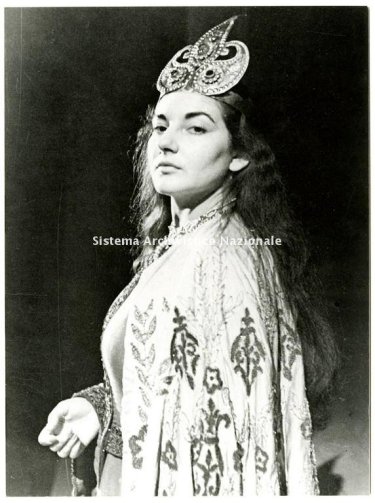
Maria Callas as Abigaille in Verdi’s Nabucco al Teatro San Carlo, Napoli 1949. (excerpt below)
In a genuinely brilliant 1995 New Yorker essay, musicologist Will Crutchfield describes her career and explicates why Maria Callas occupies an essentially unique position in the history of musical performance.
Callas performed vocal feats practically no soprano has equaled and single-handedly revived an entire operatic genre.
In the season of 1951-52, after triumphs up and down the peninsula, Callas established herself as prima donna at Milan’s La Scala, and made it her home theatre. For seven seasons, the house surrounded her with illustrious colleagues, conductors, directors, and designers, in revivals that were the news of the musical world. In familiar and unknown operas alike, Callas’s work almost always became the focus of the world’s thoughts about that role, and Callas herself became a celebrity. Then, in 1959, she went into sudden near-retirement, took up with Aristotle Onassis, and began the long professional and personal decline that still occasions deep regret and furious debate. Callas had been averaging fifty appearances a year; between her thirty-sixth and fortieth birthdays she sang in public only twenty-eight times. There was a flurry of troubled performances in 1964-65, and then silence until a disastrous concert tour in 1973-74.
Only one good decade, really. Callas’s entire stage career (excluding the Greek years) comprised just five hundred and thirty-nine performances. Enrico Caruso, who died at forty-eight, gave nearly two thousand. Chaliapin, one of the various singers who “invented” acting in opera before Callas “invented” it, made his début in 1890, and was still touring, recording, and singing gorgeously in 1937, just months before his death. The only other musician in this century to make anything like Callas’s impact in so few appearances was the Canadian pianist Glenn Gould. Both of them—like Chaliapin, Caruso, Arturo Toscanini, and Dietrich Fischer-Dieskau—permanently changed the way their successors understood the music they were most closely associated with. But Callas brought this about largely by conservative means, through the affirmation of tradition. Gould and the others were revolutionaries; she never was. …
What Callas was helping to restore was once the most popular music in the world: the operatic repertory of Italy in the first half of the nineteenth century—the primo ottocento, as the Italians call it. This was the heady moment when Classical virtuosity, inherited from the brilliant vocal rhetoricians of the eighteenth century, coexisted with high Romanticism. The novels of Walter Scott, the poetry of Byron, the music of Beethoven: the younger Italian poets and composers took all these like drugs, and the operas they created swept back over Europe and the world. Callas’s core repertory came from this school, which reaches from the serious operas of Rossini (she sang one, “Armida”) through Bellini and Donizetti, to “Il Trovatore” and “La Traviata,” where Verdi, already striking out on new paths, drew for the last time on the full expressive vocabulary of his predecessors. Bellini’s Norma was Callas’s most frequent role, followed by Verdi’s Violetta and Donizetti’s Lucia; more than half her stage career was devoted to music composed in the narrow span from 1830 to 1853.
With opera moving on in symphonic and naturalistic directions, the decline of the Classical bel-canto skills was inevitable, and by 1900 most of the great operas of the primo ottocento were forgotten. The few that remained in repertory tended to be treated as tired relics, or as surefire comedies and romances that would play themselves (in shamelessly cut and edited versions), while serious artistic effort was focussed elsewhere. Some of the light sopranos kept the bel-canto skills flickeringly alive. But there had been nothing like Callas’s alacrity and speed since about 1910, and what there had been then came with the haphazardness of a discipline no longer valued and slipping into disuse.
Callas had all the exactitude and purpose of a valiant restorer. She had mastered more fully than almost any of her Italian contemporaries the art of legato and portamento (“carrying” the voice smoothly from note to note), and she had an extraordinarily lambent projection, which allowed every word to tell without overpronunciation. Her concentrated focus of tone allowed every gradation of softness to carry through the hall, every minute manipulation of rhythm to register. In every role, on practically every page, there were phrases that Callas was able to trace with a calligrapher’s pen where audiences had become accustomed to a carpenter’s pencil.