Category Archive 'Uncategorized'
06 Dec 2024


St. Nicholas, bishop of Myra, d. 6 December 345 or 352
St. Nicholas was reportedly born in the city of Patara in Lycia in Asia Minor, heir to a wealthy family. He succeeded an uncle as bishop of Myra.
Nicholas left behind a legend of secret acts of benevolence and miracles (in Greek, he is spoken of as “Nikolaos o Thaumaturgos” — Nicholas the Wonder-Worker).
One of the saint’s prominent legends asserts that, in a time of famine, he foiled the crime of Fourth Century Sweeney Todd, an evil butcher who kidnapped and murdered three children, intending to market their remains as ham. St. Nicholas not only exposed the murder, but healed and resurrected the children intact.
Nicholas is also renowned for providing dowries for each of three daughters of an impoverished nobleman,who would otherwise have been unable to marry and who were about to be forced to prostitute themselves to live. In order to spare the sensibilities of the family, Nicholas is said to have secretly thrown a purse of gold coins into their window on each of three consecutive nights.
St. Nicholas’ covert acts of charity led to a custom of the giving of secret gifts concealed in shoes deliberately left out for their receipt on his feast day, and ultimately to the contemporary legend of Santa Claus leaving gifts in stockings on Christmas Eve.
St. Nicholas evolved into one of the most popular saints in the Church’s calendar, serving as patron of sailors, merchants, archers, thieves, prostitutes, pawnbrokers, children, and students, Greeks, Belgians, Frenchmen, Romanians, Bulgarians, Georgians, Albanians, Russians, Macedonians, Slovakians, Serbians, and Montenegrins, and all residents of Aberdeen, Amsterdam, Barranquilla, Campen, Corfu, Freiburg, Liverpool, Lorraine, Moscow, and New Amsterdam (New York).
His relics were stolen and removed to Bari to prevent capture by the Turks, and are alleged to exude a sweet-smelling oil down to the present day.
01 Dec 2024

The Albigensian massacre, chronicle of Saint-Denis, 14th century, London, British Library.
As Edward Feser astutely recognizes, perverse instincts apparently lurk in the depths of human nature causing repeated outbreaks of pathological religious impulses featuring the embrace of fanatical dualism, communal ownership of property, sexual deviance, and rejection of normality, tradition, and the existing order of society.
In the Middle Ages, they did not let the crazies take over the universities, the culture, and the arts, they went in and wiped them out.
In a Catholic World Report essay not too long ago, I argued that the so-called “woke” phenomenon, which has in recent years suddenly risen to enormous influence in Western politics and culture , is best understood as a new riff on the Gnostic-Manichean style of politics identified by Voegelin. There is the characteristic thesis that the everyday world is utterly suffused with evil – “systemic racism,” “white supremacy,” “patriarchy,” “heteronormativity,” “transphobia,” and the like, all interlocked to form a suffocating structure of “intersectional” oppression. There is the appeal to various forms of gnosis (Critical Race Theory, feminist theory, gender studies, etc.) that purportedlyallow the adept to perceive this oppression in a way others cannot. There is the Manichean divide between those who are enlightened by this gnosis and the wicked who resist it.
But attention to the details reveals disturbing further parallels with Catharism in particular, even if they manifest in secular rather than theological terms. For example, the “transgender”phenomenon evinces an alienation from the body and from the natural end of sex no less radical than that of the Cathars, and with comparable intellectual incoherence and moral disorder as its sequel. For the Cathar, the body is like a dark prison from which the spark of light that is the true self seeks release. For a “trans” person, his male body (for example) belies his true self as a “trans woman,” or as “non-binary,” or as having some other “gender identity.” For the Cathar not ready to advance to the status of the Perfect, the body’s appetites may nevertheless be freely indulged, even to the point of extreme debauchery, so long as procreation is avoided. For the trans person, the body’s sexual organs might be destroyed and refashioned so as to reflect his true gender identity, but they might instead be preserved and deployed in a manner that gratifies his governingsexual fetish. Thus do we have the bizarre claim that a “trans woman” is simply a “woman” full stop, even if “she” has male genitalia.
The Cathar hatred of corporeal life and its procreation also finds parallels in the extreme environmentalist component of the wokemovement, which regards the human race as a “cancer on the planet,” and in the normalization of abortion, euthanasia, and childlessness. The Cathar condemnation of state violence for the sake of upholding law and order finds a parallel in woke calls to “defund the police” and end the “carceral state.” The Cathar eschewal of meat and dairy products finds a parallel in the contemporary vogue for moralistic veganism (in the name of animal rights or sustainability or the like). The Cathar rejection of private property finds a parallel in woke refusal to enforce laws against vagrancy and shoplifting.
Like that of the Cathars, woke rhetoric often sounds superficially peaceful. But also like the Cathars, the wokenevertheless practice coercion and even violence when they judge it useful for advancing their cause. This includes doxxingand other forms of intimidation; rioting, looting, and even occupying large areas (as in 2020’s CHAZ protest in Seattle and the siege of the federal courthouse in Portland); the shutting down of roadways and the vandalism of paintings, public statuary, and the like as routine protest tactics; the mutilation of bodies in the name of “gender identity”; and the promotion of “gender transition” even among children, along with the imposition of extreme ideological curricula, against the wishesof parents.
In general, wokeness, like Catharism, is essentially about the radical subversion of normal human life in the name of a paranoid Fmetaphysical delusion. Like Catharism, its fashionableness has nevertheless found it support among a large segment of the wealthy and powerful. And like Catharism, its rise has been facilitated by the Church’s being in such a low state that it is unable to provide an effective counterbalance.
RTWT
* I was disappointed by the book, but I thought the title was very apt.
28 Nov 2024
They can do hilarious stuff with AI these days.
28 Nov 2024
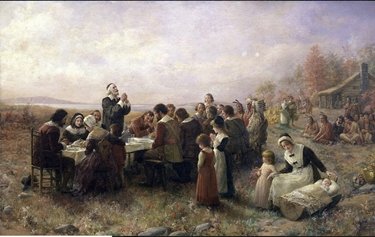
Mike Franc, at Human Events in 2005, identified the real reason for celebration at the first Thanksgiving.
Writing in his diary of the dire economic straits and self-destructive behavior that consumed his fellow Puritans shortly after their arrival, Governor William Bradford painted a picture of destitute settlers selling their clothes and bed coverings for food while others “became servants to the Indians,” cutting wood and fetching water in exchange for “a capful of corn.” The most desperate among them starved, with Bradford recounting how one settler, in gathering shellfish along the shore, “was so weak– he stuck fast in the mud and was found dead in the place.”
The colony’s leaders identified the source of their problem as a particularly vile form of what Bradford called “communism.’ Property in Plymouth Colony, he observed, was communally owned and cultivated. This system (“taking away of property and bringing [it] into a commonwealth’) bred “confusion and discontent” and “retarded much employment that would have been to [the settlers’] benefit and comfort.”
Just how did the Pilgrims solve the problem of famine? In addition to receiving help from the local Indians in farming, they decided allow the private ownership of individual plots of land.
On the brink of extermination, the Colony’s leaders changed course and allotted a parcel of land to each settler, hoping the private ownership of farmland would encourage self-sufficiency and lead to the cultivation of more corn and other foodstuffs.
As Adam Smith would have predicted, this new system worked famously. “This had very good success,” Bradford reported, ‘for it made all hands very industrious.” In fact, “much more corn was planted than otherwise would have been” and productivity increased. “Women,” for example, “went willingly into the field, and took their little ones with them to set corn.”
The famine that nearly wiped out the Pilgrims in 1623 gave way to a period of agricultural abundance that enabled the Massachusetts settlers to set down permanent roots in the New World, prosper, and play an indispensable role in the ultimate success of the American experiment.
A profoundly religious man, Bradford saw the hand of God in the Pilgrims’ economic recovery. Their success, he observed, “may well evince the vanity of that conceit–that the taking away of property– would make [men] happy and flourishing; as if they were wiser than God.’ Bradford surmised, ‘God in his wisdom saw another course fitter for them.”
The real story of Thanksgiving is the triumph of capitalism and individualism over collectivism and socialism, which is the summation of the story of America.
28 Nov 2024

As published in the Massachusetts Centinel, Wednesday, October 14, 1789
27 Nov 2024
He’s an Alpine folklore figure. And there’s only one of him. Butin Norway, unaccountably, they had a whole Krampus parade. Very strange.
Your are browsing
the Archives of Never Yet Melted in the 'Uncategorized' Category.
/div>

Feeds
|




