01 Jan 2023
Good Observation
Holiday Traffic Mess, Peter Buttigeig, Twitter

Pete Buttigieg is so awful at his job people actually know who the Sec. of Transportation is.
— thebradfordfile (@thebradfordfile) December 29, 2022
|
Category Archive 'Uncategorized'
01 Jan 2023
Good ObservationHoliday Traffic Mess, Peter Buttigeig, Twitter
01 Jan 2023
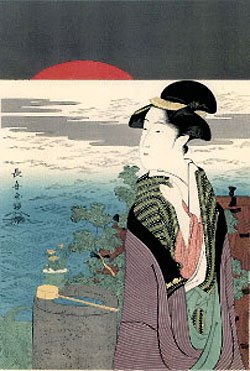
Choki: Sunrise at New YearEishosai Choki, New Years Day, Ukiyoe
A bijin (beautiful woman), presumably a courtesan, has risen early to greet the rising sun of the New Year at the waterfront at Fukagawa in Edo. The woman is adjusting the top of her kimono to protect against the chill of the early morning. In the lower-left is a blossoming fukujuso plant, emblematic of the New Year. 31 Dec 2022
New Year’s Eve or HogmanayHogmanay, New Year's Eve, Robert Burns, Traditions
From Robert Chambers, A Book of Days, 1869: NEW YEAR’S EVE, OR HOGMANAY As a general statement, it may be asserted that neither the last evening of the old year nor the first day of the new one is much, observed in England as an occasion of festivity. In some parts of the country, indeed, and more especially in the northern counties, various social merry-makings take place; but for the most part, the great annual holiday-time is already past. Christmas Eve, Christmas-day, and St. Stephen’s or Boxing Day have absorbed almost entirely the tendencies and opportunities of the community at large in the direction of joviality and relaxation. Business and the ordinary routine of daily life have again been resumed; or, to apply to English habits the words of an old Scottish rhyme still current, but evidently belonging to the old times, anterior to the Reformation, when Christmas was the great popular festival:
And we hae feasted weel; Sae Jock maun to his flail again, And Jenny to her wheel.’ Whilst thus the inhabitants of South Britain are settling down again quietly to work after the festivities of the Christmas season, their fellow-subjects in the northern division of the island are only commencing their annual saturnalia, which, till recently, bore, in the license and boisterous merriment which used to prevail, a most unmistakable resemblance to its ancient pagan namesake. The epithet of the Daft [mad] Days, applied to the season of the New Year in Scotland, indicates very expressively the uproarious joviality which characterized the period in question. This exuberance of joyousness—which, it must be admitted, sometimes led to great excesses—has now much declined, but New-year’s Eve and New-year’s Day constitute still the great national holiday in Scotland. Under the 1st of January, we have already detailed the various revelries by which the New Year used to be ushered in, in Scotland. It now becomes our province to notice those ceremonies and customs which are appropriate to the last day of the year, or, as it is styled in Scotland, Hogmanay. This last term has puzzled antiquaries even more than the word Yule, already adverted to; and what is of still greater consequence, has never yet received a perfectly satisfactory explanation. Some suppose it to be derived from two Greek words, άιαμηνη· (the holy moon or month), and in reference to this theory it may be observed, that, in the north of England, the term used is Hagmenu, which does not seem, however, to be confined to the 31st of December, but denotes generally the period immediately preceding the New Year. Another hypothesis combines the word with another sung along with it in chorus, and asserts ‘Hogmanay, trollolay!’ to be a corruption of ‘Homma est né’”Trois Rois lá¡’ (‘A Man is born ‘ — ‘ Three Kings are there ‘), an allusion to the birth of our Saviour, and the visit to Bethlehem of the Wise Men, who were known in medieval times as the ‘Three Kings.’ Read the rest of this entry » 30 Dec 2022
From the Trading PitCOMEX, Jeffrey Carter
Jeffrey Carter has a good posting, reminiscing about his days as a trader on the Chicago Commodities Exchange.
29 Dec 2022
“Es ist ein’ Ros’ Entsprungen”Christmas Carols, Dresdner_Kreuzchor, GermanyEs ist ein’ Ros’ Entsprungen is an early German Christmas carol and Marian hymn performed in a harmony written by Praetorius in 1609 by the Dresdner Kreuzchor. 29 Dec 2022
Spelling BeeBabylon Bee, Left Think
27 Dec 2022
“Ding! Dong! Merrily on High”Christmas Carols, Maddy PriorThe tune first appeared as a secular dance tune known under the title “Branle de l’Official” in Orchésographie, a dance book written by the French cleric, composer and writer Thoinot Arbeau, pen name of Jehan Tabourot (1519–1593). The words are by the English composer George Ratcliffe Woodward (1848–1934), and the carol was first published in 1924 in his The Cambridge Carol-Book: Being Fifty-two Songs for Christmas, Easter, And Other Seasons. Ding Dong! merrily on high E’en so here below, below Pray ye dutifully prime Welcome to
NEVER YET MELTED
Another Right-Wing Web Aggregator and Purveyor of Unpopular Opinions
 David Zincavage contact: jdz@usa.net blog advertising is good for General Bullmoose and good for the USA. 


Feeds
|