Dominic Van Allen was not just a spaced-out junkie. He worked, but found it impossible to earn enough to pay London rents. So he improvised, and in the process demonstrated major amounts of initiative, enterprize, and ingenuity. Unfortunately, in the end, he became a victim of contemporary urban tyranny. He was accused of ownership of a crude pipe gun found buried in the ground and convicted. Unless his appeal succeeds, he won’t have to deal witrh homelessness for five years.
Homeless Man Built His Own Secret Bunker
Dominic Van Allen, Hampstead Heath, London, The "Homeless"
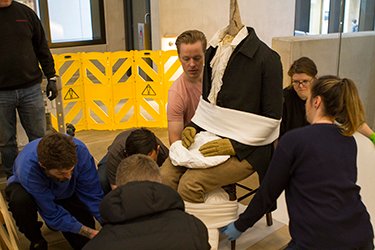
Jeremy Bentham, Who Died in 1832, Has Recently Visited New York
Bizarre, Jeremy Bentham
The Utilitarian philosopher Jeremy Bentham died in 1832 but, in accordance with his own instructions, he still gets to travel and to attend academic meetings. Atlas Obscura
“Kvinnors Minnen” (Womens’ Memories)
History, Rural Life, Sweden
Kvinnors minnen from Dalarnas museum on Vimeo.
In the old days, Swedish women would take the cattle and goats for summer grazing in the hills. It looks like the film footage would have been taken pretty late, in the 1950s or 1960s. Country people worked hard, but they also had a lot to enjoy that’s missing from the modern urban environment.
HT: Karen L. Myers.
Moutai
Baijiu, Bizarre, China, Liquor, Moutai
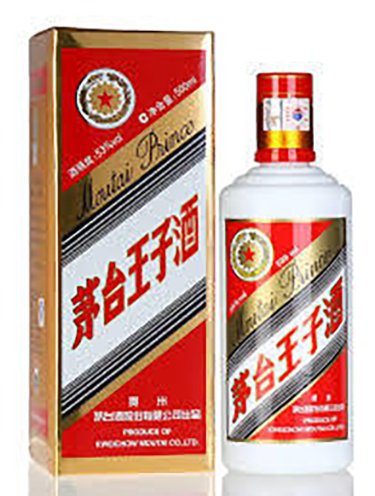
The Wall Street Journal introduces us to a Chinese spirit ranked high as a status symbol in the mystic East, whose taste is both admired and despised.
China’s Kweichow Moutai Co. has become the world’s most valuable liquor company thanks to a fiery spirit that can cost nearly $400 a bottle.
The spirit is baijiu, a Chinese liquor made by fermenting sorghum or other grains in brick or mud pits. The company’s version, known simply as Moutai, has a long association with China’s Communist leaders, and has become a homegrown status symbol for affluent Chinese.
One drawback: many people can’t stand it.
The taste is “very much like ethanol,†said Jenny Miao, a 26-year-old market researcher in Shanghai. At dinners with clients, she said she sometimes has to toast with Moutai, but will then drink water to wash away the aftertaste.
Baijiu detractors say the taste reminds them of paint stripper or kerosene, especially the cheap varieties. It does have many genuine fans, who laud baijiu’s complexity and distinct flavor varieties—strong, light, soy-sauce, and rice aroma.
One liquor website describes Moutai as having “a silky mouthfeel†and says it carries “an undertone of baking spice.†Other reviewers say the drink conjures tastes of nuts, sesame paste, mushrooms, cheese, and dark chocolate.
Moutai is usually served in tiny glasses that contain about a third of an ounce of the spirit. Shots are frequently downed to show respect for someone making a toast. People in China say “gan bei†before drinking, which literally means “dry cup.â€
Poor Hungry Polar Bear!
"Jaws" (1975), Photography, Polar Bear
While filming the BBC nature series The Polar Bear Family and Me, the adventurous wildlife filmmaker Gordon Buchanan found that a very hungry and very persistent polar bear really wanted bring him home for lunch. The nosy ursine tried every trick she knew in order to try to get into the reinforced cage holding Buchanan, using her massive paw and jaws to breach any possible opening.
Luckily, the polar bear backed off when realized that she was expending far too many calories for too little a reward. While he was able to get some absolutely brilliant photos from this encounter, it was probably one of the most terrifying moments in Buchanan’s long career.
———————–
Personally, I agree with Quint.
HT: Karen L. Myers.
1.8 billion Pixels New Mars Panorama
Mars, Photography
You and I may not live long enough to go there, but at least we get to look at it! Go Full Screen.
HT: Vanderleun.
Setters (Correction: Undocked Springers) and Handel
Dogs, English Setters, George Frideric Handel, Tilda Swinton, Videos
Tilda Swinton is apparently one of the creators.
HT: Karen L. Myers.
Not a Socialist, Just a Liar, a Thug, and a Crook
Joe Biden
If anyone has any doubt that Kevin D. Williamson has Joe Biden pegged precisely, just listen to what Biden said during the confirmation hearing of Judge Robert Bork.
What can we say for Joe Biden?
For one thing, he is not a socialist.
So, he is not a socialist.
What is he?
He is a vicious self-serving political hack, for one thing, one whose ambition leads him from time to time into shocking indecency. You may have heard that Biden lost his wife and daughter in a horrifying drunk-driving wreck, the fault of a monster of a man who irresponsibly “drank his lunch,†as Biden puts it.
Biden’s wife and daughter did, in fact, die in a car wreck. That is true. It is not true that the driver of the other car was drunk, that he had been drinking, or that there was any reason to believe he was drunk or had been drinking — or even that he was at fault. The late Mrs. Biden “drove into the path of [the] tractor-trailer,†the police report says. But Biden, like every other third-rate ward-heeler of his ilk, thinks and speaks only in terms of good guys and bad guys, white hats and black hats — and if something bad happens to good people, then it must be because somebody in a black hat did something nefarious. The driver of that truck went to his grave haunted by Biden’s lies, to the point where his children were forced to beg the vice president to stop defaming their late father. The casual cruelty with which Biden is willing to subordinate the lives of ordinary people to his political ambitions — for the sake of a petty tear-jerker line in one of his occasionally plagiarized stump speeches — is remarkable.
But that’s Joe Biden. Just a regular guy from Scranton who takes the train to work (with a 20-man security detail swarming the platform at every stop and the aisles roped off to separate him from the riffraff, as I have seen firsthand) whose kids ended up growing vastly wealthy from unpredictable business opportunities to which they had no especial claim beyond their proximity to political power.
The Illusion of Control
Financial Regulation, Recession, The Federal Reserve
Bob Henderson found that there is nothing like losing $200 million during the 2008 financial crisis to concentrate the mind.
[T]he Federal Reserve… has conducted stress tests on the biggest banks every year since the crisis [of 2008]. The Fed’s goal is the same as mine was in September 2008: to calculate how bad things might get. In the Fed’s case, that means testing what might happen to the banks’ capital (assets minus debts) in a crisis when assets depreciate. Negative capital is called insolvency. For a bank, insolvency is a fast track to bankruptcy. In “supervisory†stress testing, regulators like the Fed—this is being done in Europe too—posit one or more worst-case scenarios and compute the consequences for capital, similar to how I tried to calculate how much I’d lose in a crash.
The Fed’s first test in 2009 was an unmitigated success, widely credited with ending the most acute stage of the crisis. The test was based on a scenario in which the market tanked even further than it already had and a deep recession followed. The Fed concluded that several big banks would suffer capital shortfalls as a result, Bank of America leading the list with a deficit of $33 billion. The Treasury Department then topped off the needy banks with cash from its Troubled Asset Relief Program, reassuring markets and kick-starting a recovery.
Now, the Fed stress tests the big banks every year, partly because the chief piece of post-crisis financial regulation in the U.S., the 2010 Dodd-Frank Act, requires it. Banks have long operated under regulatory capital limits, such as minimum ratios of capital to assets. What’s new since the crisis is that those minima have increased and that stress testing is used to regulate banks’ capital plans—limiting share buybacks and dividend payments, for example—to try to guarantee that they’ll have sufficient capital no matter what.
The Fed’s test in 2015 concluded that the 31 largest bank holding companies in the U.S., which account for more than 80 percent of the country’s banking assets, would lose a grand total of $490 billion in its worst-case scenario. And yet, for the first time in the tests’ history, not a single bank failed the test by having its capital to asset ratio fall below the Fed’s 5 percent hurdle. The implication was that the banks were finally under control.
Or was it just an illusion of control?
I took a look at the Fed’s stress test scenario1 myself recently, on the bank’s website. My first reaction was that it seemed almost farcically fashioned to “fight the last warâ€: The Dow drops by about half, U.S. GDP dips around 5 percent, unemployment spikes to 10 percent—basically it’s the aftermath of 2008 all over again. It doesn’t account for other potential calamities, like a breakup of the Euro, for example, or an emerging market crisis, or hyperinflation, or shock-induced feedback effects like the ones I faced with fuel.
There’s also the inconvenient fact that both Fannie Mae and Freddie Mac were stress tested regularly by their regulator, and declared well capitalized—right up until they failed in 2008. The same was true for Iceland’s banks.
I’m not alone in my skepticism. The former Fed economist Til Schuermann, who had a hand in designing the Fed’s tests, thinks that they actually add risk to the system, rather than reduce it, a position he outlined in a 2013 Wall Street Journal op-ed. “The danger is that the financial system and its regulators are moving to a narrow risk-model gene pool that is highly vulnerable to the next financial virus,†he wrote. “By discouraging innovation in risk models, we risk sowing the seeds of our next systemic crisis.â€
In other words, the Fed, by centralizing stress testing around its own approach, is incentivizing banks to follow suit, which may push them to accumulate similar exposures to one another and to manage them in similar ways, resulting in decreased diversification and increased risk. This is a question raised by particularly prescriptive rules like the Fed’s 5 percent hurdle, which are simple to monitor but may be just as simple to game.
What’s more, the Fed’s own incentives may support an illusion of control.
“They’re grading their own papers and they always pass,†said Kevin Dowd recently on a Cato Institute podcast. Dowd, another Fed stress test skeptic, is a professor of finance and economics at Durham University in England. “A central bank stress test can never be credible because of the incentives built in to get a pass result,†he added.
Dowd reasons that, given the Fed’s mandate to keep the financial system safe, it’s motivated to find that it is safe, similar to the way that I was incentivized to get stress testing results that supported doing my potentially mega-profitable deal.
You don’t argue when someone’s handing you a big check, but I wondered what the hell he was thinking.
I got Dowd on the phone recently and asked him what the Fed could do to improve its tests.
“First off, don’t do them,†was his response. So what model should the Fed use instead?
“I would not use any model at all. I do not believe financial risk modeling works,†he replied.
“It takes a model to beat a model,†I challenged, plagiarizing a phrase I’d learned from another professor of finance when I started in banking and which became something of a mantra of mine thereafter.
Dowd chuckled, but was unmoved. “I would always go for history over a model,†he replied, before explaining that he’d look to what capital levels were in the 19th century, when banks were private companies and less subject to government regulation.

Siege of the Alamo
History, Texas, The Alamo

Robert Jenkins Onderdonk, Fall of the Alamo, 1903, Texas State Archives.
March 6, 1836: Following a thirteen-day siege, more than 2000 Mexican troops launched a pre-dawn attack from all four sides on the fortress defended by 180 men. The Mexicans were repulsed twice, but a third assault gained the north wall and broke through the west wall. After fierce fighting, the defenders were killed to a man. The casualties included Colonel William Barret Travis, James Bowie, and former Congressman from Tennessee David Crockett.
Plants & Pink: Millennial Interior Design
Fashion, Interior Decorating, Millennials
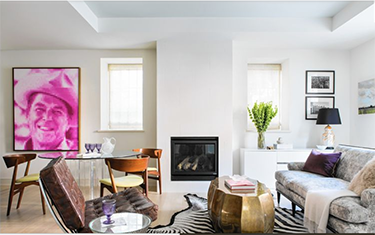
Molly Fischer, at the Cut, defines for us the millennial decor paradigm and wishes it would go away.
You walk beneath a white molded archway. You’ve entered a white room.
A basketlike lamp hangs overhead; other lamps, globes of brass and glass, glow nearby. Before you is a couch, neatly tufted and boxy, padded with an assortment of pillows in muted geometric designs. Circles of faded terra-cotta and pale yellow; mint-green and mustard confetti; white, with black half-circles and two little dots — aha. Those are boobs. You look down. Upon the terrazzo nougat of the coffee table, a glass tray trimmed in brass. It holds a succulent in a lumpy ceramic pot, a scented candle with a matte-pink label. A fiddle-leaf fig somewhere looms. Above a bookshelf (spines organized by color), a poster advises you to WORK HARD & BE NICE TO PEOPLE. In the far corner, within the shrine of an arched alcove, atop a marble plinth: one lonely, giant cartoon jungle leaf, tilting from a pink ceramic tube. You sense — in a way you could neither articulate nor explain — the presence of a mail-order foam mattress somewhere close at hand.
M
All that pink. All those plants. All that white. It’s so clean! Everything’s fun, but not too much fun. And there, in the round mirror above the couch: It’s you. You know where you are. Or do you?
SF’s New No Arrest Policy Has Had an Impact
Crime, No Arrest Policy, San Francisco
San Francisco’s no arrest policy has anarchic results. pic.twitter.com/3FqauPHUaM
— Ian Miles Cheong (@stillgray) March 3, 2020
HT: Vanderleun.