Scientists have re-created the face of a female Viking warrior who lived more than 1,000 years ago.
The woman is based on a skeleton found in a Viking graveyard in Solør, Norway, and is now preserved in Oslo’s Museum of Cultural History.
While the remains had already been identified as female, the burial site had not been considered that of a warrior ‘simply because the occupant was a woman’, archaelogist Ella Al-Shamahi told The Guardian.
But now British scientists have brought the female warrior to life using cutting-edge facial recognition technology.
Scientists reconstructed the face of the female warrior who lived more than 1,000 years ago by anatomically working from the muscles and layering of the skin
And scientists found the woman was buried with a hoard of deadly weaponry including arrows, a sword, a spear and an axe.
Researchers also discovered a dent in her head, which rested on a shield in her grave, that was consistent with a sword wound.
It is unclear whether the brutal injury was the cause of her death however it is believed to be ‘the first evidence ever found of a Viking woman with a battle injury’, according to Ms Al-Shamahi.
She added: I’m so excited because this is a face that hasn’t been seen in 1,000 years… She’s suddenly become really real.’
The British newspaper the Scottish Sun reports on a recent pronouncement from an “Instagram Influencer.” I know what Instagram is, but I had not been aware that it had “influencers.” I also had not really been aware that British millennials successfully rivaling ours in deficient masculinity. Wow!
Freddie Bentley, 22, said he thought the schools’ curriculum on the devastating conflict should be cut back because it was “so intenseâ€.
Bentley, who appeared on The Circle, told Good Morning Britain today: “It was a hard situation, World War 2, I don’t want anyone to think I’m being disrespectful.â€
He added: “I remember learning it as a child thinking ‘Oh my God it’s so intense’.â€
He thought that any mental health issues a youngster may have could be worsened by learning about the war that saw the Allied forces defeat Nazi Germany.
He told the show’s presenters Ben Shephard and Kate Garraway: “’I don’t think encouraging death or telling people how many people died in the world war is going to make it better.â€
Instead of youngsters learning about the horrendous war that claimed at least 70million lives, Bentley suggested schools could instruct pupils in topics such as understanding Brexit and how to get a mortgage.
He said: “There’s so many problems going on in the world, like Brexit, that’s not taught in schools.
“When I left school it hit me like a ton of bricks – I didn’t know anything to do with life.”
Currently, Key Stage 3 pupils learn about about the war, covering areas such as the rise of Adolf Hitler and the Nazis, the Battle of Dunkirk and Winston Churchill’s leadership.
Facebook political arguments with liberals prove, again and again, that the consensus of the community of fashion is built largely upon class marker signifying. In democratic society, the stupid and inferior eagerly adopt establishment-sanctioned opinions in order to identify themselves as “superior and intelligent.” They are too dumb to realize that intellectual conformism is anything but a sign of high intelligence.
And, of course, these educational failures simply do not recognize that the consensus they value so highly is nothing other than the mass culture of our time, and they have never learned enough to understand that mass culture consists primarily of popular delusions, fads, and temporary bouts of mass insanity.
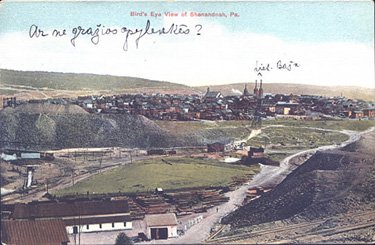
A view of my hometown, Shenandoah, Pennsylvania, from the southwest, in the vicinity of the West Shenandoah Colliery, overlooking the culm banks, circa 1910. The writing says in Lithuanian: “Ar ne grazios apylenkis?” (sarcastically) “Are not the surroundings beautiful?” The location of the Lithuanian church is also marked by hand.
The Economist quotes a British DNA study contending that it wasn’t brains or character or superior family culture that caused the lucky ones who got out to leave. No, it was deterministic genes.
To establish baselines for their work, Dr Abdellaoui, Dr Visscher and their colleagues turned first to 33 published studies that used a technique called genome-wide association study. This is intended to discern the contributions to a trait of large numbers of genetic differences that each have a small effect. It concentrates on so-called single-nucleotide polymorphisms (SNPs)—places in the DNA where an individual genetic “letter†routinely varies from person to person. There are, for example, about 100,000 SNPs that affect height. On average, each makes a contribution, either positive or negative, of 0.14mm to someone’s adult stature. This is in contrast to Mendelian variations, where a single difference between individuals has a pronounced effect—such as the difference between brown and blue eyes.
Each of the 33 baseline studies identified large numbers of SNPs that had positive or negative effects on a particular trait: extroversion, heart disease, height, body fat, age at menopause, recreational drug use and so on. The researchers then applied these SNP patterns to the records of 450,000 UK Biobank participants, and asked various questions. One thing they looked for was geographical clustering of SNPS related to individual traits. This, they discovered in abundance. Of the 33 traits under consideration, 21 showed evidence of SNP-related geographical clustering.
The most strongly clustered of all, they found were SNPS for educational attainment (ie, how many years an individual had spent at school and college). SNPs lowering educational attainment were particularly clustered in former coal-mining areas. These are places that have seen a lot of internal migration, both inward, when the mines were developed during the late 18th and 19th centuries, and outward, after the second world war, as mining shrank from being one of Britain’s biggest employers to its current state of near non-existence.
Dr Abdellaoui and Dr Visscher were able, from their studies of the biobank’s records, to chart the effects of the more recent, outward migration. They divided participants into four groups: those born in mining areas who had subsequently left; those born in mining areas who had stayed; those born outside mining areas who had moved into one; and those who had never lived in a mining area. The results were stark. People in the first group, outward migrants from mining areas, had significantly more educational-attainment-promoting SNPS, and fewer damaging ones, than any of the other groups, while people in the second group, stay-at-homes in mining areas, had the opposite.
Though not quite so sharply as with educational achievement, this pattern was also reflected in all but one of the other 20 SNP-related traits the researchers looked at. With the exception of bipolar disorder, the best outcomes were found in outward migrants from coalfields and the worst in stay-at-homes. The healthy, in other words, depart. The less healthy remain.
The upshot is a vicious spiral. That young, ambitious, healthy people tend to leave economically deprived areas is hardly news. But to see that written clearly in their DNA, which they take with them when they leave, while the converse is written in the DNA of those who stay behind, raises questions of nature and nurture that society is ill-equipped to answer, and possibly unwilling to confront.
From the #EasyFire in Simi Valley – this thoroughbred goes back into the blaze to get his family. Not all heroes wear capes…💪🐎😍 pic.twitter.com/BsU6PlBq8R
From Hermann Historica GmbH, November 13, 2019, 10:00 AM CET,
Grasbrunn / Munich, Germany, Lot 2275: A museum-quality ebony cabinet, Antwerp, mid-17th century. Starting bid: €25,000.
Recently, I saw a conversation between a few women I follow on Twitter about Fiona Apple, who was profiled by Vulture last month. In the course of her interview, Apple mentions that she’s stopped drinking, but has started smoking more weed instead: “Alcohol helped me for a while, but I don’t drink anymore,†she says. “Now it’s just pot, pot, pot.†This was the part of the interview the women were discussing. “Fiona Apple: Cali sober??†one wrote.
The term “Cali sober†here refers to people who don’t drink but do smoke weed, though internet definitions vary slightly: Urban Dictionary says it means people who drink and smoke weed but don’t do other drugs; an essay by journalist Michelle Lhooq uses it to refer to her decision to smoke weed and do psychedelics, but not drink. While the term is new to me, the behavior it describes is not. …
The auction sale of the Cimabue painting whose discovery made news last month shattered estimates and (understandably enough) hit record levels for Old Master paintings.
An tiny early Renaissance masterpiece found in a French woman’s kitchen during a house clearance has fetched more than €24m at auction, making it the most expensive medieval painting ever sold.
Christ Mocked, by the 13th-century Florentine painter Cimabue, had hung for decades above a cooking hotplate in the open-plan kitchen of a 1960s house near Compiègne, north of Paris. It had never attracted much attention from the woman, in her 90s, or her family, who thought it was simply an old icon from Russia. It might have ended up in a bin during the house move this summer had it not been spotted by an auctioneer who had come to value furniture.
At an auction outside Paris on Sunday, the unsigned work, measuring just 26cm by 20cm, fetched €19.5m under the hammer, rising to over €24m when fees were included.
As 800 people gathered in the auction hall in Senlis, the crowd fell silent during the nail-biting final moments of bidding. Some bids came in by telephone to agents. As the auctioneer brandished his hammer as the price crept up, he said: “There will never be another Cimabue at auction.â€
The painting had hung on the kitchen wall for so long that the woman, who asked to remain anonymous, told the auction house she had no idea where it had come from or how it had come into the family’s hands.
Cimabue, also known as Cenni di Pepo, was one of the pioneering artists of the early Italian Renaissance. Only 11 works painted on wood have been attributed to him, none of them signed.
Nat Morison, heir to Welbourne and uncrowned king of Northern Virginia Horse Country, passed away October 10th, aetatis 83.
He was a proud graduate of the University of Virginia who looked suspiciously at people tainted by association with such Yankee schools as Yale and Harvard.
His tastes were naturally antiquarian. After all, he ate his breakfast daily at the same table where George Washington (a regular guest at Welbourne) made notes for the Constitutional Convention of 1787. One window of his house’s second floor features a never-completed inscription by the “Gallant Pelham,” who was interrupted while writing with his diamond ring on the glass in 1862 with a call to arms.
Nat Morison commonly followed the practice notoriously associated with British peers of dressing with decided flair in century old suits and ties, and shirts, and even shoes, inherited from generations of gentleman ancestors.
His colorful eccentricity and his passionate aversion to change inspired the affectionate tribute of a 2004 film comedy, Crazy like a Fox, in which an impecunious 8th generation Virginia aristocrat loses his stately Virginia manse to a couple of crass Yankee speculators (named Sherman, no less) and then proceeds to wage a guerilla war of resistance.
Virginia and the world are duller places without Nat Morison.
Molliter ossa cubent!
Richard Roberts, Middleburg huntsman, formerly huntsman for the Piedmont Fox Hounds, blows “Gone Away” for Nat.
Blade Magazine has a feature illustrating 15 Bob Loveless knife designs that you and I will never own.
Loveless was, without doubt, the most brilliant and original custom knife maker of the last century. A decade or two ago, just about everybody making custom knives was doing copies of Bob Loveless’s Drop Point Hunter.
Success, however, went to Loveless’s head, to put it mildly. He hired an employee, who then actually made all the knives, and became an arrogant asshole. He did not even do a catalog. He sold you photos of his knives at so much a photo. He ran a three-to-five-year waiting list. And he gleefully charged (back in the 1980s) $100 an inch, plus an extra $100 for that rather vulgar naked lady stamping and that was $100 for each side of her.
I didn’t like his nude stamping and I did not like his “I can treat customers like dirt” attitude, so I did not even put in an order. And just as well. Goofy air-headed Loveless collectors have bid all his knives so far into the stratosphere that you’d feel crazy using one.
They are nice designs, but, alas! priced out of the world you and I live in.