Jacob Howland informs us that Kierkegaard long ago foresaw the damage to civilization and the human destruction that would be caused by ideologies of tyrannical equality.
Søren Kierkegaard considered the primary human good to be individual freedom: the freedom to judge for oneself, to speak and act for oneself, and to come to be oneself in the fullness of one’s concrete particularity. “The good cannot be defined at all,†he wrote in The Concept of Anxiety (1844). “The good is freedom. The difference between good and evil is only for freedom and in freedom, and this difference is never in abstracto but only in concreto.†The goodness of the natural world resides in the harmonious abundance of existing beings—this improbable lily, that joyful bird—each of which earnestly inhabits no more or less than its allotted place and time, spontaneously expressing, within these limits, its own rich particularity. The goodness and meaning of human life similarly consists in the irreducible particularity of individuals and communities—families, congregations, nations—that arise in freedom and are sustained by freedom.
As early as the 1840s, however, Kierkegaard warned that late modernity is animated by a crushing spirit of abstraction that poses the gravest threat to the human good. The Hegelian philosophy that dominated the age’s intellectual culture, he observed in Concluding Unscientific Postscript (1846), was of no use to actually existing human beings; it spoke absurdly “of speculation as if this were a man or as if a man were speculation,†and would perhaps someday find its “true readers†among “inhabitants of the moon.†But such philosophical lunacy was the least of the matter. Long before the revolutionary followers of Marx and Engels brought Hegel’s systematic science down from the heavens and settled it in the cities of men in a malignantly inhuman form—the reductive ideology of dialectical materialism—Kierkegaard prophesied the inevitable destruction of individual character and passion through an inherently reflective social process of “leveling.†The present age, he wrote in Two Ages (1846), is democratically “oriented to equality†and marked not by “the happy infatuation of admiration but the unhappy infatuation of envy,†a “censorious†passion that wants to “stifle†and “degrade†individual excellence rather than to emulate it. A constant bane of human existence, envy is particularly destructive in the present age because “the abstraction of leveling is related to a higher negativity: pure humanity.†Late-modern leveling, Kierkegaard predicted, would destroy all organic structures that mediate between living individuals and the bloodless abstraction of humanity as such. Nothing—no person, institution, or even “national individualityâ€â€”will be able to halt what he calls the “spontaneous combustion of the human race.â€
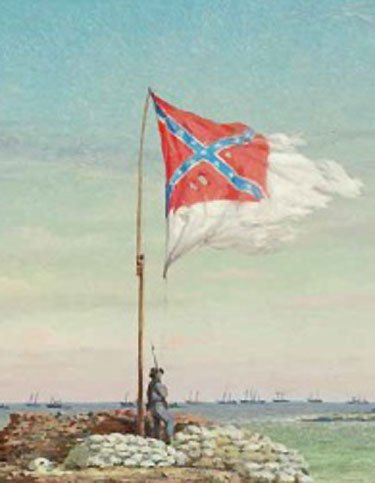
At Medium, Jonathan Clark explains that the Civil War was not really fought to end Slavery.
Viewing the Civil War as a crusade to end slavery is simply not correct; abolitionists never accounted for more than a sizeable minority in the North. The cause of war in 1861 wasn’t slavery. It was about the loss of millions in tax revenues.
Lincoln ultimately annexed Abolitionism to the War in order to cover a war of conquest with a nobler justification and to make it harder for European countries to recognize or ally with the Confederacy.
“The Confederate soldier did not go to war to perpetuate slavery. Most of them never owned a slave, and our hero, Gen. Robert E. Lee, said that if he owned every one of the slaves in the South he would give them for the preservation of the Union. It was not for the slaves they fought, but for principle, for their homes and native land.â€
–T.F. Goode , Confederate Banquet, January 19, 1893.
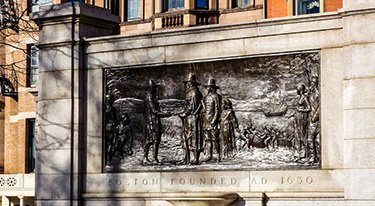
Daniel Flynn, in the American Spectator, says: Yes, you can blame Massachusetts.
William Blaxton, the city’s first settler who dwelled alone on Boston Common, invited the Puritans to settle on the Shawmut. They soon encouraged him to leave. “I have come from England because I did not like the Lord Bishops,†the first Bostonian lamented. “I cannot join you because I would not be under the lord brethren.â€
In the next generation, the Puritans, who depicted themselves as paragons of religious freedom (a bit of propaganda so effective that most fall for it today), executed four on Boston Common for the crime of Quakerism.
Beacon Hill, overlooking the Boston Common, served as the epicenter of the Know Nothing Party during its brief, 1850s heyday. The Know Nothings won every congressional seat, every seat in the state senate, every state constitutional office, and all but 3 of 379 seats in the state house of representatives in the 1854 elections in Massachusetts.
H.L. Mencken traveled from Baltimore to Boston in 1926 to sell a copy of The American Mercury, which contained a story about — gasp — a prostitute, to the Reverend J. Franklin Chase. The Watch and Ward Society head handed a half-dollar to Mencken, who hilariously bit the silver coin to affirm the honesty of the minister magazine buyer. He then handed over a copy of The American Mercury, which resulted in his immediate arrest — and the cigar-chomping Mencken throwing his remaining magazines in the air to the crowd gathered at Brimstone Corner at the edge of Boston Common where the entrance to the Park Street station stands.
Boston imagines itself as the Hub of the Universe and the Athens of America. Massachusetts executed more witches than the rest of the colonies combined, “banned in†regularly prefaces the name of its capital city, and Chik-fil-A, plastic bags, leaf blowers, and other annoyances of the enlightened today regularly face official opprobrium.
How to reconcile the former self-perception with the latter reality?
Today’s Proper Bostonians deny their ancestry. But a thread runs through the Puritans to the Know Nothings to the Watch and Ward Society to today’s do-gooders. Just as the Puritans, the Know Nothings, and the Watch and Ward Society regarded themselves as enlightened, progressive, and cultured, local parochial cosmopolitans imagine themselves as the vanguard of tolerance. Intolerant people remain most intolerant to the idea of their own intolerance.
“As politics have become more about identity than policy, partisan leanings have become more about how we grew up and where we feel like we belong,†the Atlantic, which commissioned the survey, points out. “Politics are acting more like religion, in other words.â€
God! how I detest narcissistic, self-important, leftist-conformist scribbling members of the international urban community of fashion. Heads inserted deeply up their fundaments, they go busily around the entire world applying their warped, twisted, and fundamentally wrong aggrieved-victim’s-eye-view of everything, then they insist on telling us all about it, in the process appointing themselves dictators-of-the-universe with every intention of imposing revolutionary change to everything they touch.
This Rachel Apsden is a sort of professional journalist chick, who studied Arabic in Cairo, and who in 2017 published her one big book, Generation Revolution, an account of the failed Arab Spring revolution “from the front line between tradition and change,” as shown through the viewpoints of four young Egyptians.
But, the role of wise, judgmental journalist rooting for change, man! was not enough, evidently. Off goes Rachel to South Africa to enroll in a two-month course qualifying her as a White Hunter/Safari Guide.
I wasn’t a guy, I had no idea how to use a gun, and the only wild dogs anywhere near my own home were part of a research project at London Zoo. But I was learning to change the tires on an old Land Cruiser and memorizing the birth weight of hyena pups because, at thirty-seven, I had burned out. I had just spent several years living in Egypt, reporting on the 2011 revolution and the cruelty and suffering of its aftermath. When I returned to work in the UK, I was angry, heartbroken, and guilty at being able to leave. Though my life in London was safe and easy, as I went through the motions of commuting and sitting in the office, everything felt dark. That was when the dreams began: huge open spaces, empty skies, light—places I’d seen when I’d visited friends in South Africa. That wild nature felt like a lifeline, something I could believe in as an absolute, uncomplicated good, a unifying and healing force that was somehow separate from the moral tangles created by humans. I didn’t think about where these beliefs had come from.
It seems unlikely that she intends to do any Safari guiding though. What this is about is judgmental and condescending tourism with an article in the New York Review of Books, to be followed by the second big book, as the real goal.
Her chief insight seems to have been that her instructors were unconsciously sexist and racist, and unreasonably resentful at finding themselves “at the bottom of the pile” in today’s South Africa.
Rachel knows better. She understands that any White Presence in Africa and Apartheid were terrible Wrongs, and Big Game Hunting a highly questionable part of the Culture of Masculine Machismo and Colonialism. Native Africans were treated unequally. Atonement is due.
“Black Africans just aren’t interested in nature,†a white South African student said, as we sat by the campfire one night. We’d been talking about how dominated the country’s safari industry still was by white people, who owned and managed most of its private reserves, and made up the vast majority of guests. “It’s not PC to say it, but it’s true.â€
Bit by bit, I pieced together the true nature of the land I was hiking and driving over every day. It was an Apartheid-era cattle farm that its owners had designated a game reserve in the 1990s when foot-and-mouth disease made beef farming unprofitable, and the law changed to allow landowners to “ownâ€â€”and therefore benefit from—wildlife. However wild it looked, it was as carefully managed as any London park: the conservation manager showed us his spreadsheets recording the number of animals on the reserve, each species kept in a precise balance with the others in rounds of buying, selling, and culling. As in the Kruger and Botswana’s reserves, elephants, which multiplied quickly thanks to the artificial water sources, posed a problem no one quite knew how to solve.
I admired the reserve owners’ efforts to rewild land that had once been exhausted by intensive farming: uprooting invasive vegetation, reintroducing wildlife, clearing the detritus of old fencing and machinery. This was the story of many South African protected areas (and a reason that some wealthy tourists dismissed the country as “not wild enough,†preferring the remote wildernesses of Zimbabwe and Botswana). But as elsewhere, the land’s human history was obscured. Empty, untouched wilderness was what tourists wanted to see, and this was the illusion the safari industry aimed to recreate.
It wasn’t the only hangover from the days of empire. Guides weren’t simply responsible for providing expert knowledge and ensuring their guests’ safety. They were also expected to administer first aid, mix drinks, change tires, host dinners, clean vehicles, defuse complaints, and assist their guests in every way. Our textbook offered blunt advice on everything from hosting what it called “Oriental clients†(“Do not call the Japanese ‘Chinese’ and vice versaâ€) to dealing with a client’s corpse (“Under no circumstance may the body be transported by the vehicle used for transporting other clientsâ€). Part of our training was to entertain our “guests†on each drive we led, serving up drinks, snacks, and small talk from behind a folding table.
I wondered whether these expectations began to explain the weirdly fluctuating sense of bravado and victimhood that seemed to dog our instructors. Part of it was economic. Guides worked in a luxury industry, but the majority of them were paid very little. A single night at a high-end safari lodge in South Africa could cost $2,000 (including game drives, but excluding French champagne), but the monthly wage of a guide might be less than a quarter of that, with the workers living in basic rooms hidden from the luxurious guest accommodation, working three-week stretches without a break.
Spending your days fixing 4x4s and tracking lions was also a way of avoiding some of the troubling consequences of being a white South African in general, and an Afrikaner in particular. One was the trappings of middle-class life in a high-crime country: the electrified fences and rapid-response signs, guard dogs, window-bars, and lockable internal gates that made me feel caged and edgy when I stayed in Johannesburg or Cape Town. Once past the fortified outer boundary of the game reserve, all these disappeared—along with much of the impact of the Black Economic Empowerment policies that the company official had alluded to, under which non-white South Africans were preferred for most business and employment opportunities. The safari industry, like agriculture and wine farming, had been shaped by historical patterns of land ownership and perceived expertise. At its senior levels, white men still faced little competition.
But the most significant escape, I thought, was probably psychological. In democratic South Africa, to be a member of the minority that had implemented Apartheid was to find yourself in a particular psychic bind. That uncomfortable sense wasn’t one of identity alone: pre-1994 South Africa had made military service compulsory for white young men, and now and again, the older instructors alluded in half-sentences to serving in the army or draft-dodging in small towns along the southern coast.
Although they seemed to have little compunction about the language they used toward others, these men were acutely resentful of even the possibility of being thought racist. When they taught us Zulu or Shangaan animal names, or explained how “local people†harvested honey from mopane trees, I understood that they saw themselves as liberal. And by the standards of the Afrikaner community, which tended to be socially, religiously, and politically conservative, they could well have been right. I thought of the small farming towns I’d driven through in the remote Northern Cape, where everyone seemed to drive Toyota Hilux pickups and listen to Afrikaans country music, and I saw signs for the controversial right-wing pressure group AfriForum, which focused on the ownership of farmland that lay at the heart of Afrikaner national identity. …
Though we had complained both to the staff members themselves and to company management, the behavior and demeanor of the instructors didn’t change, and Dionne and I spoke often about leaving the course. In the end, we resolved to qualify as guides. Perhaps, we thought, we could eventually help to change the industry. After studying and training every day for two months, we took our exams: drawing diagrams of katabatic and berg winds, describing the flagship species of the succulent karoo biome, and discussing the action of neurotoxic venom. Each of us then had to guide a four-hour game drive, with David as our assessor. I sat beside Dionne in the front of the 4×4 as she led her drive; later in the day, she did the same for me. We were both passed as competent to lead 4×4 safaris in dangerous game areas. When we returned to London and New York, both of us submitted detailed written complaints to the company.
Less than a century ago, Sweden’s remote forests and mountain pastures swelled with women’s voices each summer. As dusk approached, the haunting calls of kulning echoed through the trees in short, cascading, lyricless phrases. Though often quite melodic, these weren’t simply musical expressions. They were messages intended for a responsive audience: wayfaring cattle. Kulning was a surefire way to hurry the herds home at the end of the day.
According to Susanne Rosenberg, professor and head of the folk music department at the Royal College of Music in Stockholm and kulning expert, the vocal technique likely dates back to at least the medieval era. In the spring, farmers sent their livestock to a small fäbod, or remote, temporary settlement in the mountains, so cows and goats could graze freely. Women, young and old, accompanied the herds, living in relative isolation from late May until early October. Far from the village, they tended to the animals, knitted, crafted whisks and brooms, milked the cows, and made cheese—often working sixteen hour days. Life on the fäbod was arduous work, but it was freeing, too. “It was only women, and they had all this free space to make a lot of noise,†says Jinton. “They had their own paradise.â€
The herds grazed during the daytime, wandering far from the cottages, and thus needed to be called in each night. Women developed kulning to amplify the power of their voices across the mountainous landscape, resulting in an eerie cry loud enough to lure livestock from their grazing grounds.
One should always take caution when hanging out with someone kulning, as it can’t be done quietly. Rosenberg, who’s researched the volume of kulning, says it can reach up to 125 decibels—which, she warns, is dangerously loud for someone standing next to the source. Comparable to the pitch and volume of a dramatic soprano singing forte, kulning can be heard by an errant cow over five kilometers away. This explains how the song might reach a distant herd, but what prompts animals to trot over remains a bit of a mystery. “That we have to ask the cows!†says Rosenberg. “But it’s really no stranger than calling a dog.â€
Much like trained pets, cows feel loyalty to the humans who care for them. According to Rosenberg, it only takes one solid affinity between a cow and a woman to bring the whole herd home. “There’s always at least one cow that is the smart cow, in a herd,†she says. “She’s like the leader cow.†Once this particularly enlightened cow hears the call, Rosenberg suspects, she heads toward the source, encouraging the rest of the herd to follow suit.
To do this at such great volume requires learning the proper technique, which, it turns out, is a far cry from that of classical or popular singing. “It’s more like calling,†says Rosenberg. “Like if you see somebody on the other end of the street, it’s the way you would use your voice naturally to try to get their attention.†Kulning was taught orally. Young women learned from the old, imitating the songs of their elders and slowly adding individual flair and vocal ornamentation. Rosenberg, who now teaches kulning in a classroom setting, says the key to the call is improvisation. “You have to have variation, because you never know how long you’re going to be calling for.†In other words, you have to keep singing until the cows come home.
Cows, however, weren’t the only ones on the receiving end of kulning. The call could ward off predators in the woods, and served as a form of communication between women who were otherwise isolated from one another. If a cow went missing, for instance, a woman on one farm might cry out using a particular melody to pass the message to those within earshot. Once the cow had been located, her far-off neighbor would convey the news back to her in song.
Jacob Siegel, in American Affairs Journal, notes that the official policies of America’s large liberal cities have a rather merciless impact on the most unfortunate. The Left’s supposed dedication to welfare, compassion, and a government-provided safety net is largely wishful thinking, when it actually comes down to policy choices Big City Democrat Machines socially engineer high-priced living for those with very high incomes. They won’t actually let the cops prod the vagrant with his nightstick and tell him to move along, but they will reduce the total of number of public toilets in Los Angeles available to the homeless to under ten.
In Los Angeles, the cumulative consequences of decades of policy failures going back at least to the deinstitutionalization of the 1970s have settled like sediment at the bottom of an increasingly gilded city above. Homelessness hasn’t gotten worse in spite of LA’s wealth but because of it. A city where working families can’t afford to live has fewer of them—and the web of social connections they form—to catch people as they fall into desperate circumstances and patterns of self-destruction. Without family and community, all that’s left for some are the jails and shelters of the state, or the tent cities granted all the freedom of leper colonies. …
In a major city like Los Angeles, the housing market functions as an invisible messaging apparatus. It conveys the priorities of the government and powerful private interests, and signals to people where they do and do not belong. In this sense, the realtor may be more honest than the mayor or your neighbor about where you are welcome and what purpose, if any, you serve. The message in LA is clear: the working and middle classes are not necessary for the functioning of the city. Those who get the message leave or, if they stay, must adapt to conditions of precarity. The problem is that the homeless live outside the norms and reach of the messaging infrastructure. The city’s poorest and most disturbed people are the least tuned in to the frequency of the market’s signals and otherwise unequipped to respond.
From Sergei Bondarchuk’s 1967 film: The Russian Army enters Austria, just before the Battle of Austerlitz.
Gary Saul Morson, in New Criterion, pays tribute to what he considers “the greatest of all novels.”
Just 150 years ago, in 1869, Tolstoy published the final installment of War and Peace, often regarded as the greatest of all novels. In his time, Tolstoy was known as a nyetovshchik—someone who says nyet, or no, to all prevailing opinion—and War and Peace discredits the prevailing views of the radical intelligentsia, then just beginning to dominate Russian thought. The intelligentsia’s way of thinking is still very much with us and so Tolstoy’s critique is, if anything, even more pertinent today.
“If we concede that human life can be governed by reason, then the possibility of life is destroyed,†the book’s epilogue instructs. Even more than their Western European counterparts, Russians were obsessed with establishing a hard social science, as certain as physics. Any Western theory that promised such certainty found enthusiastic Russian supporters. In England, utilitarianism supported moderate liberalism, but by the 1860s Russians took it as proof of revolutionary socialism. The French positivist Auguste Comte, who coined the term “sociology,†originally planned to call his new discipline “social physics.†His Russian followers presumed that this “physics†already existed. Of course, Marxism—or “scientific socialismâ€â€”would eventually triumph over its rivals.
For Tolstoy, such aspirations were sheer nonsense. All purported social sciences held that, as with Newtonian astronomy, the complexity of observed phenomena was explicable by a few simple laws. But with society and individual psyches, Tolstoy insisted, the very opposite is the case: “the deeper we delve in search of these [fundamental] causes,†Tolstoy observes, “the more of them we find.†Things do not simplify, they ramify. Whatever regularities there may be are overwhelmed by sheer contingencies. Sometimes events happen just “for some reason,†a favorite phrase of Tolstoy’s indicating that no theory could ever predict them. And as contemporary chaos theory has rediscovered, sometimes apparently insignificant chance events can have concatenating effects and so make an enormous difference.
As the novel begins, its main hero, Prince Andrei, believes in a science of warfare, which German generals and theoreticians claim to have elaborated. Tolstoy allows this purported social science to stand for all others, existing or to come. At the council of war before the Battle of Austerlitz (1805), the Russians and their Austrian allies plan their campaign according to their supposed science and are certain that “every contingency has been foreseen.†They suffer a disastrous defeat.
This defeat does not in the least shake the generals’ confidence in their “science,†much as the failure of Marx’s predictions never dissuaded Marxists and the many failures of contemporary economists’ predictions have never made them less confident of their “science.†Tolstoy loves to show how many ways there are to ignore inconvenient facts. Some of the generals (and some economists) adjust their theories so that they fit what they had failed to foresee, as if the test of a theory were not the ability to predict but to retrodict the known past. Even astrologers can do that. Tolstoy refers to this way of thinking as “the fallacy of retrospection.â€
The German generals typically choose another common approach to disconfirming evidence by claiming that defeat, far from invalidating their science, offers yet another confirmation of it. General Pfühl attributes every loss to the failure to carry out his orders to the letter, and since such precision is never possible in battle, he can always argue that, just as he predicted, “ ‘the whole affair would go to the devil.’ . . . He positively rejoiced in failure, for failures resulting from deviations in practice from the theory only proved to him the accuracy of his theory.†As we would say today, his “science†is “nonfalsifiable.â€
By contrast, Prince Andrei, a person of absolute intellectual integrity, does learn from disconfirmation. When he enters the army, he attributes Napoleon’s success to two factors—his mastery of military science and his great physical courage under fire. Justly confident of his own courage and intellect, Andrei dreams of becoming the Napoleon who conquers Napoleon. Austerlitz teaches him that, whatever accounts for Napoleon’s success, it is not some purported military science. He concludes from his own experience “that in war the most deeply considered plans (as he had seen at Austerlitz) mean nothing, and that everything depends on the way unexpected movements of the enemy, which cannot possibly be foreseen, are met.â€
I first read it when I was in 9th grade, and I was terribly unhappy when it finished and I’d run out of “War and Peace” to read. I re-read it every decade or so. The last time, I had a try at looking at the original Russian.
On September 24th, 1980, a man wearing cowboy boots and carrying two brown suitcases entered Binion’s Horseshoe Casino in Las Vegas. One suitcase held $777,000 in cash; the other was empty. After converting the money into chips, the man approached a craps table on the casino floor and put everything on the backline. This meant he was betting against the woman rolling the dice. If she lost, he’d double his money. If she won, he’d lose everything. Scarcely aware of the amount riding on her dice, the woman rolled three times: 6, 9, 7.
“Pay the backline,†said the dealer. And just like that, the man won over $1.5 million. He calmly filled the empty suitcase with his winnings, exited Binion’s into the desert afternoon, and drove off. It was the largest amount ever bet on a dice roll in America.
“Mystery Man Wins Fortune,†the Los Angeles Times reported. No one knew the identity of the fair-haired young Texan who’d just made history, and so he became known as the “Phantom Gambler.†“He was cool,†said Jack Binion, president of the Horseshoe. “He really had a lot of gamble in him.†But it would be years before the phantom would be seen in Vegas again.
You’ll smile if you stop reading there. The story’s ultimate conclusion is sad.
Michael Rubin (DP ’94) provides a nearly complete list of Peter Salovey’s atrocities as President of Yale and reports that the chickens are finally coming home to roost: big donors are declining to support the Salovey regime.
He threw respect for free speech and decorum under the bus when he compelled the resignation of Silliman College master Nicholas Christakis in the face of the “shrieking girl†controversy. He legitimized violence when he rehired a dishwasher who smashed a historic stained glass window. In general, he catered to the loudest on campus, always willing to grease the squeaky wheel regardless of the consequence.
When students complained that the term “freshmen” disrespected women and “master” made African-Americans uncomfortable, he simply ordered their change, never mind that it was he who was racializing a term that had ancient collegiate roots. That Yale continues to issue master’s degrees only highlights the lack of intellectual consistency.
Then, when decades-long student protests persisted with regard to a residential college named after 19th century statesmen and Vice President John Calhoun due to the support Calhoun professed during his lifetime for slavery, Salovey first said he would keep the name out of respect for history but, when criticized by student activists, convened a handpicked and Orwellian “ Committee to Establish Principles on Renaming†which recommended changing the name of the college. The problem with such a move was not simply the willingness to erase history at one of the nation’s most elite universities, but also intellectual inconsistency: Calhoun may have provided intellectual sustenance to the pro-slavery south, a not uncommon position at the time, but Elihu Yale, after whom the entire university is named, actually traded slaves during his lifetime.
Salovey’s hostility toward history has extended further to university tradition. Yale long prided itself on being centered on its undergraduates. Admissions officers sang the merits of residential colleges, each a unique community within the broader university. But, Salovey, who did not attend Yale as an undergraduate, homogenized the colleges in order to eliminate any differences between them. While the freshmen class dined together in “University Commons†since 1901, he closed the iconic dining hall in order to build a student center whose need (or need in that location) most students (let alone alumni) continue to question. Most recently, Salovey has put the open stacks of Yale’s underground library on the chopping block.
Now, it seems that the university is paying the price for Salovey’s general gutlessness. Yale has, for years, been seeking to undertake a major capital campaign. Often, universities announce their campaigns after a silent stage in which they get high-profile donors to commit to the effort. According to staffers within Yale’s fundraising arm, the university was forced to delay its campaign for several years because big donors are rightly worried about Yale’s direction and its tendency to prioritize politics above academics.
Yale’s embrace of identity politics reinvigorates self-segregation and pits groups against each other. An ever-expanding array of ethnic deans spoon feeds ideology to students rather than make them organize for themselves. Yale administrators, largely for political reasons, increasingly seek to weigh in on the private lives of students off campus. Donations are declining as faculty and student antics increasingly hit national headlines or the courts. Giving in the first quarter of the last fiscal year, for example, is lower than in the period for the four previous years.
Yale is also falling behind in fundraising among its peer group of universities as alumni decide not to give. Older alum largely disagree with the direction of the university as it subordinates academe to social action, while the younger alumni whom Salovey sought to appease do not understand why they should donate to a university with a nearly $30 billion endowment. Rather than question fundamentally why the money is no longer rolling in, the university’s response is simply to cease reporting donation statistics.
While Yale cultivates a reputation as an educational and intellectual center, its emphasis under Salovey has been more about politics and social justice. The university trumpets ethnic, religious, and sexual orientation diversity, but shuns intellectual diversity which arguably should trump every other kind.
Perhaps the decline in donations is a sign that Yale’s, and, by extension, other elite universities’, ability to coast on reputation while treating its core education mission with disdain has come to an end. Perhaps it is time for Salovey to resign.
Michael Rubin was himself too-PC to include in Salovey’s list of crimes the naming of one of the two new residential colleges for a black lesbian communist whom nobody outside the Radical Left had ever heard of.
Salovey’s concession to Charles Johnson ’54 of Franklin Resources, who ponied up the $250 million to build two new residential colleges in naming one of the new colleges after Benjamin Frankin, a particular hero of Johnson’s unfortunately lacking any meaningful connection to Yale, was regrettable, but comprehensible. He who pays the piper calls the tune and all that. But a lot of us would rather have seen New Residential College 2 named for “Benjamin Franklin’s Dog” instead of for an obscure agitator with only the tenuous connection of a post-Law doctoral degree acquired at Yale Law at the age of 55. Only Peter Salovey would overlook the opportunity to name one of two new colleges located at the foot of Science Hill for Josiah Willard Gibbs.
Oh, me! Oh, my! Can Harvard students possibly bear up and survive in a climate in which their own House Master/Faculty Dean (and Law Professor) proposes to represent a cad like Harvey Weinstein accused of numberless cases of crude advances, sexual harrassment, and generally being a masher?
Harvard Crimson asks that important question, and apparently is asking it on behalf of the management of Harvard itself. Presumably in the case of unfavorable responses, Harvard’s Administration will lay in a copious supply of smelling salts, fainting couches, and gallon jugs of Lydia Pinkham’s. There will doubtless as well be long queues of desperate Harvard students lining up for counseling.
“Doctor, how could he? How could he represent that… that beast?”
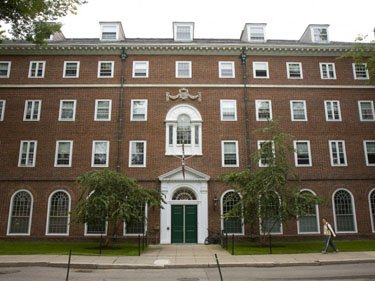
Harvard College’s institutional research office sent an anonymous, online survey to Winthrop House residents Tuesday as part of a review process aimed at addressing students’ concerns about Faculty Dean Ronald S. Sullivan, Jr.’s decision to represent Hollywood producer Harvey Weinstein as he faces charges of sexual assault.
The survey asks students a series of questions about whether they feel welcome in the House. It also asks them to score Winthrop on a five-point scale based on whether they believe the House is “hostile†or “friendly,†“contentious†or “collegial,†and “sexist†or “non-sexist,†among other metrics.
Dean of the College Rakesh Khurana announced that former Dean of Freshmen Thomas A. Dingman ’67 would lead a “climate review†in an email to Winthrop residents on Feb. 25. Khurana wrote that the College decided to launch the review after hearing concerns surrounding support structures for students in the House following Sullivan’s decision to defend Weinstein.
Harvard College Institutional Research wrote in its Tuesday email that in trying to examine the “climate†of Winthrop, the survey will use Pennsylvania State University professor Sue Rankin’s definition of climate: “the current attitudes, behaviors and standards of faculty, staff, administrators and students concerning the level of respect for individual needs, abilities and potential.â€
In response to Sullivan’s decision to join Weinstein’s defense team, some students started protests and wrote open letters calling for his removal as faculty dean.
The survey sent Tuesday begins with a question about students’ level of satisfaction with the House’s climate. It continues by asking students to indicate their level of agreement — from “Strongly Agree†to “Strongly Disagree†— with a series of statements evaluating their experiences in the House.
Some of the statements read “I feel I belong in Winthrop House†and “Winthrop House has a strong commitment to diversity, equity, and inclusion.â€
Another question asks students to rank the House on 12 different characteristics including disrespectful or respectful, elitist or non-elitist, homophobic or non-homophobic, and racist or non-racist.
The survey closes with two demographic questions and a space for additional comments.
The College will use the results gathered from Winthrop affiliates to guide any further action, Khurana wrote in his original email.
I try to imagine the Yale Daily News, back in 1966, inquiring if we “felt welcome” in our Yale freshman dorms or residential colleges, and I have to hold on to the arms of my chair not to fall out of it laughing.
Can you imagine not feeling welcome in one of the poshest, most luxurious undergraduate colleges in the country and the world?
I am reminded of the comedy film, in which the upper class mother points out to her unhappy adolescent daughter: “You know, you will never again, in the rest of your life, be this rich or this thin!”
A friend of mine used to remark ruefully that life after Yale amounted to constant struggle to try to live as well as you did as a Yale undergraduate.