
14 Nov 2018
Chico May Be in California, But It Is Still Part of America
Americana, Chico California, Disaster


Gerard van der Leun, now a refugee burned out of his home, with the loss of everything, by the fire that swept over Paradise, California, is in Chico and reports that the good people of that town are acting like real Americans.
Near closing time in the men’s Clothing Clearance Corner on the first floor of Penny’s at the Chico Mall, a young girl is replacing the piles of tossed clothing left by the numbed shoppers from Paradise frantic for cheap basic clothing. Some of them are camped in tents somewhere close by the mall; for how long nobody knows. But this young, quietly lovely girl is putting the Clothing Clearance Corner back in apple pie order as the store’s dismal day closes. I take my few finds from the Clothing Clearance Corner and, leaving, say, “That seems like a thankless task.â€
“Not at all,†she replies. “Not at all.â€
“Really? Why the hell not?â€
“Hey, I do this job every day in this store. It’s my assigned task and usually its okay but I only do it for the money because it gets really monotonous, meaningless.â€
She’s a student, I perceive.
“But today those people really needed these clothes in this corner because of the price. And tomorrow more people like that will really need them too. And so I want to make this the best I can for them. So I’m going to put it all back on hangers and arrange them by size. It will be right by the morning. You better go. We’re closing. Thank you for coming in.â€
Just a young girl working late in the Clothing Clearance Corner. Doing one of those little jobs; one of those jobs that actually make the world turn. She was leaving it all on the field.
At the ends of the neighborhood streets, I see people setting up tables and I see the people of the neighborhoods coming out onto the main streets and putting out whatever they have to give there for the taking if needed. They are literally leaving it all on the field.
At the Elks Lodge after I picked up some bedding and a few new pillows and looked out over acres of goods being laid out for the taking, from flats of pet food to cribs and playpens (someplace safe to rest your baby that is not on your hip). As I was leaving to see the East Avenue Church scene an Elk (My late father was a member of this lodge up until his death in 1972); a brother, I say, of my father waves me over and opens the back seat of my car and puts in two cases of one liter bottles of San Pellegrino . The Elks are leaving it all on the field.
In the 24-Hour Walgreens Pharmacy on East Avenue, the pharmacists have been working overlapping shifts since the fire swept over Paradise last Thursday. These people and their back up staff work seemingly rock solid for hours on end. They fill and file and dispense medications which people from Paradise do not have with them. This is a demanding and thankless and exhausting task. And yet — I am the witness — they have been doing this without letup. Many have come in from surrounding towns, from Redding, to help and to keep the medications needed by a town of 30,000 displaced into a city of 80,000. Yes, the Walgreens pharmacists are leaving it all on the field.
13 Nov 2018
Stan Lee: Dead at 95
Comic Books, Marvel Comics, Obituaries, Stan Lee, Superheroes
Stan Lee (born Stanley Martin Lieber; December 28, 1922 – November 12, 2018) was an American comic book writer, editor, and publisher. He was the editor-in-chief of Marvel Comics, and later its publisher and chairman, leading its expansion from a small division of a publishing house to a large multimedia corporation.
In collaboration with several artists—particularly Jack Kirby and Steve Ditko—he co-created fictional characters including Spider-Man, the Hulk, Doctor Strange, the Fantastic Four, Daredevil, Black Panther, the X-Men, and—with his brother, co-writer Larry Lieber—the characters Ant-Man, Iron Man, and Thor. In doing so, he pioneered a more complex approach to writing superheroes in the 1960s, and in the 1970s challenged the standards of the Comics Code Authority, indirectly leading to it updating its policies.
13 Nov 2018
WWI: Pictures Worth a Thousand Words
Cameron Highlanders, WWI

Above: Cameron Highlanders Regiment, 1914. Below: Cameron Highlanders, 1919.
13 Nov 2018
It Was Bound to Happen
Americana, Crass Commercialism, Donald Trump, Teddy Bears, Trumpy Bear
I’m wondering if Trump will feel complimented, or if he’ll sue the pants off them for brand infringment.
12 Nov 2018
Old English Manuscripts
Beowulf, British Library, Manuscripts, Old English
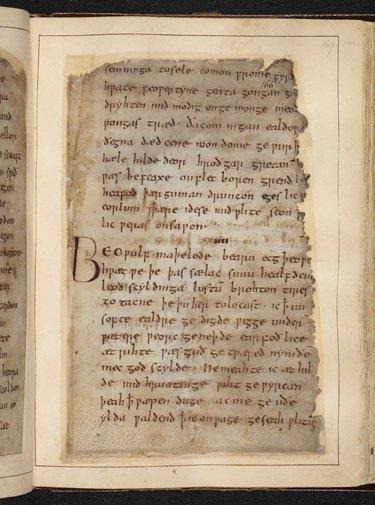
A page from Cotton Vitellius A. xv containing the epic poem Beowulf.
Josephine Livingstone got to see the four manuscripts of Old English poetry exhibited currently at the British Library. It would be nice to be in London right now.
There are four original manuscripts containing poetry in Old English—the now-defunct language of the medieval Anglo-Saxons—that have survived to the present day. No more, no less. They are: the Vercelli Book, which contains six poems, including the hallucinatory “Dream of the Roodâ€; the Junius Manuscript, which comprises four long religious poems; the Exeter Book, crammed with riddles and elegies; and the Beowulf Manuscript, whose name says it all. There is no way of knowing how many more poetic codices (the special term for these books) might have existed once upon a time, but have since been destroyed.
Until last week, I had seen two of these manuscripts in person and turned the pages of one. But then I visited “Anglo-Saxon Kingdoms: Art, Word, War,†a new show of artifacts at the British Library in London. It’s a vast exhibition, covering the art, literature, and history of the people whose kingdoms spread across Britain between the sixth and the eleventh centuries. The impetus for the show came from the library’s 2012 acquisition of the St Cuthbert Gospel, the “earliest intact European book,†in the words of the show’s catalog.
Seeing the earliest European book alone would be the event of a lifetime, for a certain kind of museum-goer. But for this viewer, the main attraction lay in a quiet little vitrine: all four Old English poetic codices, side by side. They don’t look that impressive to the casual eye. The exhibition room is dark and cold, to keep the books safe from damage. The manuscripts are brown, small, almost self-effacing. There’s no outward sign of how important they are, how unprecedented their meeting.
So why are these four books so special? It has to do, I think, with the concept of the original—a concept we have almost entirely lost touch with. The Beowulf Manuscript is not just composed of words that serve as the basis for every translation of the epic poem. It’s foremost an object, the only one of its kind. It is not merely a representation of a story; it is the story. In this respect, the manuscript resembles the Crown Jewels more than any document written in today’s world, any word that moves through the crazy fractal of the internet. The manuscripts confront us with a former version of our literary selves; identities that we barely recognize, and which estrange us from ourselves.
Each of the poetic codices has a specific history engraved into the text’s physical form. The very space they occupy on earth is meaningful. The Vercelli Book is named for Vercelli, a town in Northern Italy whose cathedral library holds the manuscript. Nobody knows for sure how the book got there, although the prevailing theory is that a pilgrim left it behind or gave it away on his travels. Who? Why? When? Unknown.
The Beowulf Manuscript’s permanent home is the British Library. Unlike Vercelli, we know exactly why it’s there. The manuscript’s pages have been remounted onto new ones, because the book was singed around the edges in a library fire in 1731. The fire consumed much of the collection of Robert Cotton—his unburned books were later all given to the British Museum, forming its foundational collection—but Beowulf only suffered a little. (The original Cotton collection was kept, with a horrible kind of accuracy, in a building called Ashburnham House.)
If we compare the Vercelli Book to the Beowulf Manuscript, we see different kinds of mysteries. The Vercelli Book is in fabulous condition, its English lines neatly written and sitting, inexplicably, in a region of Italy famous for its rice. The Beowulf Manuscript is a half-burned thing whose survival is a miracle. Its provenance is unknown: It was probably written down in the tenth or eleventh centuries, but it’s impossible to tell when it was actually composed.
12 Nov 2018
Camille Paglia Speaks Out
Camille Paglia, Colleges and Universities, Feminism, Left Think, Ressentiment, The Humanities

Yale Professor Cleanth Brooks 1906-1994, leading figure of the New Criticism.
In Quillette, Claire Lehmann interviews Camille Paglia on the current state of the Humanities in the universities, Leftist Ressentiment as Religion, and Feminism.
Claire Lehmann: You seem to be one of the only scholars of the humanities who are willing to challenge the post-structuralist status quo. Why have other humanities academics been so spineless in preserving the integrity of their fields?
Camille Paglia: The silence of the academic establishment about the corruption of Western universities by postmodernism and post-structuralism has been an absolute disgrace. First of all, the older generation of true scholars who still ruled the roost when I arrived at the Yale Graduate School in 1968 were not fighters, to begin with. American professors, unlike their British counterparts, had not been schooled in ferocious and satirical debate. They were courtly and genteel, a High Protestant middlebrow style. Voices were hushed, and propriety ruled at the Yale department of English: I once described it as “walking on eggs at the funeral home.â€
An ossified New Criticism was then still ascendant. I had been trained in college in that technique of microscopic close analysis of the text, and it remains a marvelous tool for cultural criticism: I have applied it to everything from painting to pop songs. However, my strong view at the time (from my early grounding in archaeology) was that literary criticism had to recover authentic historical consciousness and also to expand toward psychology, which was still considered vulgar. Harold Bloom and Geoffrey Hartman (whose Yale careers had begun amid tinges of anti-Semitism) were moving in a different, more conceptual direction, heavy on European philosophy.
By the early 1970s, when I was writing my doctoral dissertation (Sexual Personae, directed by Bloom), change suddenly arrived from outside: deconstruction was the hot new thing, hastened along by J. Hillis Miller, who left Johns Hopkins for Yale. I thought Derrida and DeMan and the rest of that crew were arrant nonsense from the start, a pedantic diversion from direct engagement with art. About the obsequious Yale welcome given to the pratlings of one continental “star†visitor, I acidly remarked to a fellow grad student sitting next to me, “They’re like high priests murmuring to each other.â€
The New Criticism desperately needed supplementation, but that opaque hash (so divorced from genuine art appreciation) was certainly not it. I was disgusted at the rapid spread of deconstruction and post-structuralism throughout elite U.S. universities in the 1970s, when I was teaching at my first job at Bennington College. The reason it happened is really quite prosaic: a recession hit in the 1970s, and the job market in academe collapsed. Fancy-pants post-structuralism was the ticket to ride for ambitious, beady-eyed young careerists on the make. Its coy, showy gestures and clotted lingo were insiders’ badges of claimed intellectual superiority. But the whole lot of them were mediocrities from the start. It is doubtful that much if any of their work will have long-term traction.
As I argued in my long attack on post-structuralism, “Junk Bonds and Corporate Raiders: Academe in the Hour of the Wolf†(Arion, Spring 1991; reprinted in my first essay collection, Sex, Art, and American Culture), Lacan, Derrida, and Foucault were already outmoded thinkers even in France, where their prominence had been relatively brief. There was nothing genuinely leftist in their elitist, monotonously language-based analysis. On the contrary, post-structuralism was abjectly reactionary, resisting and reversing the true revolution of the 1960s American counterculture, which liberated the senses and reconnected the body and personal identity to nature, in the Romantic manner. It is very telling that Foucault’s principal inspiration, by his own admission, was Samuel Beckett’s Waiting for Godot, which I loathed as a college student for its postwar passivity and nihilism. (As a teacher, I admire Godot as a play but still reject its parochial and at times juvenile world-view.)
Post-structuralism, along with identity politics, made huge gains in the 1970s, as the old guard professors proved helpless against a rising tide of rapid add-on programs and departments like women’s studies and African-American studies. The tenured professoriate seemed not to realize that change of some kind was necessary, and thus they failed to provide an alternative vision of a remodeled university of the future. I myself was lobbying for interdisciplinary innovation in the humanities—something that remained highly controversial right through the 1980s, when there were fierce battles over it where I was then teaching (during the merger of the Philadelphia College of Performing Arts with the Philadelphia College of Art to form the present University of the Arts). Another persistent proposal of mine has been for comparative religion to become the undergraduate core curriculum, an authentically global multiculturalism
Most established professors in the 1970s probably believed that the new theory trend was a fad that would blow away like autumn leaves. The greatness of the complex and continuous Western tradition seemed self-evident: the canon would surely stand, even if supplemented by new names. Well, guess what? Helped along by a swelling horde of officious, overpaid administrators, North American universities became, decade by decade, political correctness camps. Out went half the classics, as well as pedagogically useful survey courses demonstrating sequential patterns in history (now dismissed as a “false narrative†by callow theorists). Bookish, introverted old-school professors were not prepared for guerrilla warfare to defend basic scholarly principles or to withstand waves of defamation and harassment.
However, it is indeed difficult to understand why major professors already in safe, powerful positions avoided direct combat. For example, although he had made passing dismissive remarks about post-structuralism (“Foucault and soda waterâ€), Harold Bloom never systematically engaged or critiqued the subject or used his access to the general media to endorse debate, which was left instead to self-identified conservatives. The latter situation was clearly counterproductive, insofar as it enabled the bourgeois faux leftists of academe to define themselves and their reflex gobbledygook as boldly progressive.
In October 1990, I sat with my longtime mentor Bloom at a presidential dinner preceding his Shakespeare lecture at Bryn Mawr College in the Philadelphia suburbs. I told him about the exposé of post-structuralism that I was writing for Arion (and that took six months to do). He flatly replied, “You’re wasting your time.†I must suppose there was simply a generational divide: as a product of the 1960s, I still passionately believe in reform as an ethical imperative. Furthermore, most of my teaching career has been spent at small art schools, which have always spurned the conformist formulas and protocols of traditional universities.
Nevertheless, the poisons of post-structuralism have now spread throughout academe and have done enormous damage to basic scholarly standards and disastrously undermined belief even in the possibility of knowledge. I suspect history will not be kind to the leading professors who appear to have put loyalty to friends and colleagues above defending scholarly values during a chaotic era of overt vandalism that has deprived several generations of students of a profound education in the humanities. The steady decline in humanities majors is an unmistakable signal that this once noble field has become a wasteland.
Do you believe that politics and in particular social justice (i.e., anti-racism and feminism) are becoming cults or pseudo-religions? Is politics filling the void left by the receding influence of organized religion?
Paglia: This has certainly been my view for many years now. I said in the introduction to my art book, Glittering Images (2012), that secular humanism has failed. As an atheist, I have argued that if religion is erased, something must be put in its place. Belief systems are intrinsic to human intelligence and survival. They “frame†the flux of primary experience, which would otherwise flood the mind.
But politics cannot fill the gap. Society, with which Marxism is obsessed, is only a fragment of the totality of life. As I have written, Marxism has no metaphysics: it cannot even detect, much less comprehend, the enormity of the universe and the operations of nature. Those who invest all of their spiritual energies in politics will reap the whirlwind. The evidence is all around us—the paroxysms of inchoate, infantile rage suffered by those who have turned fallible politicians into saviors and devils, godlike avatars of Good versus Evil.
My substitute for religion is art, which I have expanded to include all of popular culture. But when art is reduced to politics, as has been programmatically done in academe for 40 years, its spiritual dimension is gone. It is coarsely reductive to claim that value in the history of art is always determined by the power plays of a self-referential social elite. I take Marxist social analysis seriously: Arnold Hauser’s Marxist, multi-volume A Social History of Art (1951) was a major influence on me in graduate school. However, Hauser honored art and never condescended to it. A society that respects neither religion nor art cannot be called a civilization.
Even well-educated people on the Left,like Paglia, recognize the disastrous state of contemporary culture.
11 Nov 2018
Martinmas aka Armistice Day, later Veterans Day
Armistice Day, Hagiography, History, Martinmas, Traditions, Veterans Day

–from last year–
WWI came to an end by an armistice arranged to occur at the eleventh hour of the eleventh day of the eleventh month of 1918. The date and time, selected at a point in history when mens’ memories ran much longer, represented a compliment to St. Martin, patron saint of soldiers, and thus a tribute to the fighting men of both sides. The feast day of St. Martin, the Martinmas, had been for centuries a major landmark in the European calendar, a date on which leases expired, rents came due; and represented, in Northern Europe, a seasonal turning point after which cold weather and snow might be normally expected.
It fell about the Martinmas-time, when the snow lay on the borders…
—Old Song.

From Robert Chambers, The Book of Days, 1869:
St. Martin, the son of a Roman military tribune, was born at Sabaria, in Hungary, about 316. From his earliest infancy, he was remarkable for mildness of disposition; yet he was obliged to become a soldier, a profession most uncongenial to his natural character. After several years’ service, he retired into solitude, from whence he was withdrawn, by being elected bishop of Tours, in the year 374.
The zeal and piety he displayed in this office were most exemplary. He converted the whole of his diocese to Christianity, overthrowing the ancient pagan temples, and erecting churches in their stead. From the great success of his pious endeavours, Martin has been styled the Apostle of the Gauls; and, being the first confessor to whom the Latin Church offered public prayers, he is distinguished as the father of that church. In remembrance of his original profession, he is also frequently denominated the Soldier Saint.
The principal legend, connected with St. Martin, forms the subject of our illustration, which represents the saint, when a soldier, dividing his cloak with a poor naked beggar, whom he found perishing with cold at the gate of Amiens. This cloak, being most miraculously preserved, long formed one of the holiest and most valued relics of France; when war was declared, it was carried before the French monarchs, as a sacred banner, and never failed to assure a certain victory. The oratory in which this cloak or cape—in French, chape—was preserved, acquired, in consequence, the name of chapelle, the person intrusted with its care being termed chapelain: and thus, according to Collin de Plancy, our English words chapel and chaplain are derived. The canons of St. Martin of Tours and St. Gratian had a lawsuit, for sixty years, about a sleeve of this cloak, each claiming it as their property. The Count Larochefoucalt, at last, put an end to the proceedings, by sacrilegiously committing the contested relic to the flames.
Another legend of St. Martin is connected with one of those literary curiosities termed a palindrome. Martin, having occasion to visit Rome, set out to perform the journey thither on foot. Satan, meeting him on the way, taunted the holy man for not using a conveyance more suitable to a bishop. In an instant the saint changed the Old Serpent into a mule, and jumping on its back, trotted comfortably along. Whenever the transformed demon slackened pace, Martin, by making the sign of the cross, urged it to full speed. At last, Satan utterly defeated, exclaimed:
Signa, te Signa: temere me tangis et angis:
Roma tibi subito motibus ibit amor.’In English—
‘Cross, cross thyself: thou plaguest and vexest me without necessity;
for, owing to my exertions, thou wilt soon reach Rome, the object of thy wishes.’The singularity of this distich, consists in its being palindromical—that is, the same, whether read backwards or forwards. Angis, the last word of the first line, when read backwards, forming signet, and the other words admitting of being reversed, in a similar manner.
The festival of St. Martin, happening at that season when the new wines of the year are drawn from the lees and tasted, when cattle are killed for winter food, and fat geese are in their prime, is held as a feast-day over most parts of Christendom. On the ancient clog almanacs, the day is marked by the figure of a goose; our bird of Michaelmas being, on the continent, sacrificed at Martinmas. In Scotland and the north of England, a fat ox is called a mart, clearly from Martinmas, the usual time when beeves are killed for winter use. In ‘Tusser’s Husbandry, we read:
When Easter comes, who knows not then,
That veal and bacon is the man?
And Martilmass beef doth bear good tack,
When country folic do dainties lack.’Barnaby Googe’s translation of Neogeorgus, shews us how Martinmas was kept in Germany, towards the latter part of the fifteenth century
‘To belly chear, yet once again,
Doth Martin more incline,
Whom all the people worshippeth
With roasted geese and wine.
Both all the day long, and the night,
Now each man open makes
His vessels all, and of the must,
Oft times, the last he takes,
Which holy Martin afterwards
Alloweth to be wine,
Therefore they him, unto the skies,
Extol with praise divine.’A genial saint, like Martin, might naturally be expected to become popular in England; and there are no less than seven churches in London and Westminster, alone, dedicated to him. There is certainly more than a resemblance between the Vinalia of the Romans, and the Martinalia of the medieval period. Indeed, an old ecclesiastical calendar, quoted by Brand, expressly states under 11th November: ‘The Vinalia, a feast of the ancients, removed to this day. Bacchus in the figure of Martin.’ And thus, probably, it happened, that the beggars were taken from St. Martin, and placed under the protection of St. Giles; while the former became the patron saint of publicans, tavern-keepers, and other ‘dispensers of good eating and drinking. In the hall of the Vintners’ Company of London, paintings and statues of St. Martin and Bacchus reign amicably together side by side.
On the inauguration, as lord mayor, of Sir Samuel Dashwood, an honoured vintner, in 1702, the company had a grand processional pageant, the most conspicuous figure in which was their patron saint, Martin, arrayed, cap-Ã -pie, in a magnificent suit of polished armour; wearing a costly scarlet cloak, and mounted on a richly plumed and caparisoned white charger: two esquires, in rich liveries, walking at each side. Twenty satyrs danced before him, beating tambours, and preceded by ten halberdiers, with rural music. Ten Roman lictors, wearing silver helmets, and carrying axes and fasces, gave an air of classical dignity to the procession, and, with the satyrs, sustained the bacchanalian idea of the affair.
A multitude of beggars, ‘howling most lamentably,’ followed the warlike saint, till the procession stopped in St. Paul’s Churchyard. Then Martin, or his representative at least, drawing his sword, cut his rich scarlet cloak in many pieces, which he distributed among the beggars. This ceremony being duly and gravely performed, the lamentable howlings ceased, and the procession resumed its course to Guildhall, where Queen Anne graciously condescended to dine with the new lord mayor.
10 Nov 2018
Crotchety Old White Lives Matter
Gun Control, Maryland, Police Misconduct, Protective Order Laws

This Baltimore Sun story shows how liberal “protective order” laws can give the relative you argue politics with during Thanksgiving Dinner the power to remove your constitutional rights and get you killed by the police.
Two Anne Arundel County police officers serving one of Maryland’s new “red flag†protective orders to remove guns from a house killed a Ferndale man after he refused to give up his gun and a struggle ensued early Monday morning, police said.
The subject of the protective order, Gary J. Willis, 60, answered his door in the 100 block of Linwood Ave. at 5:17 a.m. with a gun in his hand, Anne Arundel County police said. He initially put the gun down next to the door, but “became irate†when officers began to serve him with the order, opened the door and picked up the gun again, police said.
“A fight ensued over the gun,†said Sgt. Jacklyn Davis, a police spokeswoman.
One of the officers struggled to take the gun from Willis, and during the struggle the gun fired but did not strike anyone, police said. At that point, the other officer fatally shot Willis, police said.
Neither officer was injured, police said, and neither of their names was released.
Davis said she did not know whether anyone else was in the home at the time, and she did not know who had sought the protective order against Willis.
The “red flag†protective orders are officially known as emergency risk protection orders, and may be sought by family members, police or others to temporarily prohibit people’s access to firearms when they show signs that they are a danger to themselves or others. The law took effect Oct. 1.
A spokeswoman for the Maryland Judiciary denied a request to see any and all requests for protection orders made at the residence on Linwood Avenue, citing the law, which states that anything related to an order is confidential unless the court rules otherwise.
Police had come to the house Sunday night to speak with Willis, a longtime resident of the neighborhood, said Michele Willis, who was on the scene Monday morning and identified herself as his niece. She attributed that visit by police to “family being family†but declined to elaborate.
She said one of her aunts requested the protective order to temporarily remove Willis’ guns.
Michele Willis said she had grown up in the house and had been there Sunday night to move out her son, who had been helping to care for her grandmother.
Her uncle, Gary Willis, lived in an apartment above the garage; she said other family members, including her grandmother, another uncle, two aunts and Gary Willis’ girlfriend were also at the home Sunday night.
She said her uncle “likes to speak his mind,†but she described him as harmless.
“I’m just dumbfounded right now,†she said. “My uncle wouldn’t hurt anybody.â€
10 Nov 2018
Marine Corps Birthday
Marine Corps Birthday, Traditions, USMC

Founded November 10, 1775.
——————————
Maj. Gen. John A. Lejeune’s Birthday Message
RPS ORDERS
No. 47 (Series 1921)
HEADQUARTERS U.S. MARINE CORPS
Washington, November 1, 1921
759. The following will be read to the command on the 10th of November, 1921, and hereafter on the 10th of November of every year. Should the order not be received by the 10th of November, 1921, it will be read upon receipt.
(1) On November 10, 1775, a Corps of Marines was created by a resolution of Continental Congress. Since that date many thousand men have borne the name “Marine”. In memory of them it is fitting that we who are Marines should commemorate the birthday of our corps by calling to mind the glories of its long and illustrious history.
(2) The record of our corps is one which will bear comparison with that of the most famous military organizations in the world’s history. During 90 of the 146 years of its existence the Marine Corps has been in action against the Nation’s foes. From the Battle of Trenton to the Argonne, Marines have won foremost honors in war, and is the long eras of tranquility at home, generation after generation of Marines have grown gray in war in both hemispheres and in every corner of the seven seas, that our country and its citizens might enjoy peace and security.
(3) In every battle and skirmish since the birth of our corps, Marines have acquitted themselves with the greatest distinction, winning new honors on each occasion until the term “Marine” has come to signify all that is highest in military efficiency and soldierly virtue.
(4) This high name of distinction and soldierly repute we who are Marines today have received from those who preceded us in the corps. With it we have also received from them the eternal spirit which has animated our corps from generation to generation and has been the distinguishing mark of the Marines in every age. So long as that spirit continues to flourish Marines will be found equal to every emergency in the future as they have been in the past, and the men of our Nation will regard us as worthy successors to the long line of illustrious men who have served as “Soldiers of the Sea” since the founding of the Corps.
JOHN A. LEJEUNE,
Major General Commandant
————————————-
————————————-
The Old Corps
Tun Tavern, Philadelphia, Pennsylvania, November 10th 1775
Captains Nicholas and Mullens, having been tasked by the 2nd Continental Congress to form 2 battalions of Marines, set up the Corps’ first recruiting station in the tavern.
The first likely prospect was, in typical recruiters fashion, promised a “life of high adventure in service to Country and Corps”. And, as an extra bonus: If he enlisted now he would receive a free tankard of ale….
The recruit gladly accepted the challenge and, receiving the free tankard of ale, was told to wait at the corner table for orders.
The first Marine sat quietly at the table sipping the ale when he was joined by another young man, who had two tankards of ale.
The first Marine looked at the lad and asked where he had gotten the two tankards of ale?
The lad replied that he had just joined this new outfit called the Continental Marines, and as an enlistment bonus was given two tankards of ale.
The first Marine took a long hard look at the second Marine and said, ” It wasn’t like that in the old Corps.”
An annual post.
10 Nov 2018
Recounts in Florida and Arizona
Arizona, Democrats, Election Fraud, Florida, Recounts

“Why are there never any “newly discovered ballots” in close races that Democrats win? Why are there no “newly discovered ballots” in races that aren’t close? And why is it that all the “newly discovered ballots” in every race always contain a surprisingly disproportionate number of votes for the Democrat candidate?
We all know why.”
— Randy Spencer.
08 Nov 2018
Is This a Great Country or What?
2018 Election, Amusement, Bigfoot, Denver Riggleman, Ilhan Omar, Leslie Cockburn, Minnesota, Nevada, Virginia

In Virginia’s 5th Congressional District, Bigfoot erotica aficionado Denver Riggleman defeated Olivia Wilde’s mom, Leslie Cockburn (Yale ’74, married to Andrew Cockburn, son of the late British communist journalist Claude Cockburn).
If I were still in Virginia, I believe my last residence in Fauquier County would have been in his district.
——————————
In Minnesota’s 5th Congressional District, Ilhan Omar, a Muslim Somali democrat won a landslide 78.2% win, despite apparently being handicapped by having fraudulently and bigamously married her own brother in 2009 in order make it possible for him to immigrate to the United States. (Scott Johnson, 2016)
——————————
The best item, however, comes from Nevada’s 36th Assembly District.
Paraphrasing John Hinderaker: “You gotta like a district where voters prefer a dead pimp to a live Democrat.”



