Category Archive 'Archaeology'
18 Mar 2013


Just in time for yesterday’s St. Paddy’s Day celebration, Jeffrey P. Kahn, in the New York Times, cites recent theories that agriculture (and therefore civilization) developed earliest for the production of beer rather than food.
Human beings are social animals. But just as important, we are socially constrained as well.
We can probably thank the latter trait for keeping our fledgling species alive at the dawn of man. Five core social instincts, I have argued, gave structure and strength to our primeval herds. They kept us safely codependent with our fellow clan members, assigned us a rank in the pecking order, made sure we all did our chores, discouraged us from offending others, and removed us from this social coil when we became a drag on shared resources.
Thus could our ancient forebears cooperate, prosper, multiply — and pass along their DNA to later generations.
But then, these same lifesaving social instincts didn’t readily lend themselves to exploration, artistic expression, romance, inventiveness and experimentation — the other human drives that make for a vibrant civilization.
To free up those, we needed something that would suppress the rigid social codes that kept our clans safe and alive. We needed something that, on occasion, would let us break free from our biological herd imperative — or at least let us suppress our angst when we did.
We needed beer.
09 Feb 2013
“This university believes that the way of the amateur is the only one to provide satisfactory results.”
–Master of Caius College, “Chariots of Fire” (1981).
As the Wall Street Journal reports, a Baltimore hairdresser is proving the college master right.
By day, Janet Stephens is a hairdresser at a Baltimore salon, trimming bobs and wispy bangs. By night she dwells in a different world. At home in her basement, with a mannequin head, she meticulously re-creates the hairstyles of ancient Rome and Greece.
Ms. Stephens is a hairdo archaeologist.
Her amateur scholarship is sticking a pin in the long-held assumptions among historians about the complicated, gravity-defying styles of ancient times. Basically, she has set out to prove that the ancients probably weren’t wearing wigs after all.
“This is my hairdresserly grudge match with historical representations of hairstyles,” says Ms. Stephens, who works at Studio 921 Salon & Day Spa, which offers circa 21st-century haircuts.
Her coiffure queries began, she says, when she was killing time in the Walters Art Museum in Baltimore back in 2001. A bust of the Roman empress Julia Domna caught her eye. “I thought, holy cow, that is so cool,” she says, referring to the empress’s braided bun, chiseled in stone. She wondered how it had been built. “It was amazing, like a loaf of bread sitting on her head,” says Ms. Stephens.
A hairstylist by day, Janet Stephens has become a “hair archaeologist” studying the intricacies of ancient Greek and Roman hairstyles. As WSJ’s Abigail Pesta reports, she’s been published in the academic community on her research, which she says proves the intricate hairstyles were not wigs.
She tried to re-create the ‘do on a mannequin. “I couldn’t get it to hold together,” she says. Turning to the history books for clues, she learned that scholars widely believed the elaborately teased, towering and braided styles of the day were wigs.
She didn’t buy that. Through trial and error she found that she could achieve the hairstyle by sewing the braids and bits together, using a needle. She dug deeper into art and fashion history books, looking for references to stitching.
In 2005, she had a breakthrough. Studying translations of Roman literature, Ms. Stephens says, she realized the Latin term “acus” was probably being misunderstood in the context of hairdressing. Acus has several meanings including a “single-prong hairpin” or “needle and thread,” she says. Translators generally went with “hairpin.”
The single-prong pins couldn’t have held the intricate styles in place. But a needle and thread could. It backed up her hair hypothesis.
In 2007, she sent her findings to the Journal of Roman Archaeology. “It’s amazing how much chutzpah you have when you have no idea what you’re doing,” she says. “I don’t write scholarly material. I’m a hairdresser.”
John Humphrey, the journal’s editor, was intrigued. “I could tell even from the first version that it was a very serious piece of experimental archaeology which no scholar who was not a hairdresser—in other words, no scholar—would have been able to write,” he says.
He showed it to an expert, who found the needle-and-thread theory “entirely original,” says Mr. Humphrey, whose own scholarly work has examined arenas for Roman chariot racing.
Ms. Stephens’ article was edited and published in 2008, under the headline “Ancient Roman Hairdressing: On (Hair)Pins and Needles.” The only other article by a nonarchaeologist that Mr. Humphrey can recall publishing in the journal’s 25-year history was written by a soldier who had discovered an unknown Roman fort in Iraq.
Read the whole thing.
04 Feb 2013

BBC: “It is the academic conclusion of the University of Leicester that, beyond reasonable doubt, the individual exhumed at Greyfriars in September 2012 is indeed Richard III, the last Plantagenet King of England.”
Dr Jo Appleby, an osteo-archaeologist from the university’s School of Archaeology and Ancient History, revealed the bones were of a man in his late 20s or early 30s. Richard was 32 when he died.
His skeleton had suffered 10 injuries, including eight to the skull, at around the time of death. Two of the skull wounds were potentially fatal.
One was a “slice” removing a flap of bone, the other was caused by bladed weapon which went through and hit the opposite side of the skull – a depth of more than 10cm (4ins).
Dr Appleby said: “Both of these injuries would have caused an almost instant loss of consciousness and death would have followed quickly afterwards.
“In the case of the larger wound, if the blade had penetrated 7cm into the brain, which we cannot determine from the bones, death would have been instantaneous.”
Other wounds included slashes or stabs to the face and the side of the head. There was also evidence of “humiliation” injuries, including a pelvic wound likely to have been caused by an upward thrust of a weapon, through the buttock.
——————————-
BBC: At Bosworth Field:
On 22 August 1485, Richard met his rival Henry Tudor – the soon-to-be Henry VII – in fields near Market Bosworth in Leicestershire.
Most sources agree Richard’s army was larger, but it failed to sweep his enemy from the field.
Dr Steven Gunn, a fellow in modern history at Merton College, Oxford, said Tudor historian Polydore Vergil wrote a vivid account of Richard’s next, extraordinary, move.
He explained: “He says spies told Richard that Henry was riding with a small number of men, so when he sees this, Richard leads a charge straight at him.
“He then goes on to say: ‘In the first charge Richard killed several men; toppled Henry’s standard, along with the standard-bearer William Brandon; contended with John Cheney, a man of surpassing bravery, who stood in his way, and thrust him to the ground with great force; and made a path for himself through the press of steel.’
“Richard is then surrounded by enemy troops but Vergil only says he was killed ‘fighting in the thickest of the press’.
“More detail comes from a Burgundian historian Jean Molinet, who describes Richard’s horse becoming stuck in a marsh and then ‘unhorsed and overpowered, the king was hacked to death by Welsh soldiers’.”
——————————-
Results of mtDNA analysis: positive.
——————————-
Osteoanalysis slideshow & video.
——————————-
Earlier reports.
03 Jan 2013
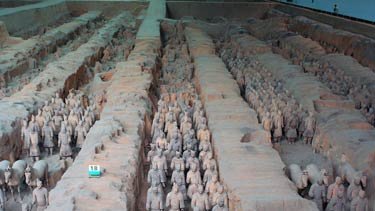
Shi Huang, China’s first emperor, is protected in the afterlife by an army of teracotta warriors.
Here’s an interesting item from Gizmodo, essentially translated from the Spanish-language paper El Pais:
(some typos corrected
After discovering a secret palace hidden in China’s first emperor massive burial complex, Chinese technicians are nervous. Not because Qin Shi Huang’s tomb is the most important archeological discovery since Tutankhamun, but because they believe his burial place is full of deadly traps that will kill any trespassers. Not to talk about deadly quantities of mercury. …
Talking to Spanish newspaper El Pais, the archeologists working at the excavation said that “it’s like having a present all wrapped at home, knowing that inside is what you always wanted, and not being able to open it.” But, at the same time, nobody wants to be the first to get inside because of the mausoleum’s dangerous traps—they’re detailed in the same texts that recount its abundant riches.
It’s not clear if the traps are really there, even while many texts describe them. …
[L]et’s assume that the Chinese … really installed booby traps that triggered deadly crossbows in the emperor’s tomb. Even if the old Chinese texts are correct, they might not still work after two thousand years. Perhaps the mechanisms are so rusty that the bolts won’t fire. Maybe the wood and the cords used the in the traps have long since been destroyed by bacteria.
Chinese historian Guo Zhikun argues the contrary. He is one of the main experts on Qinshihuang’s burial site, and says that it’s very possible that the traps are still active. He claims that the use of chrome in the figures may indicate that the traps received a similar protective treatment. He is sure that “the artisans who built the traps installed crossbows that will fire if any thief tries to get inside.”
Even if the traps don’t work, there is still the matter of the high, deadly concentration of mercury inside the tomb. On-site measurements indicate dangerous levels, which may come from another feature described in the scrolls: Imperial engineers created large rivers of quicksilver inside the tomb. So much that the level of mercury inside could be deadly for any unprotected adventurers.
The Chinese government hasn’t decided what to do with the hidden complex yet. The authorities will wait for some time because they believe that, with the current technology, you can’t get inside the tomb without destroying some of its contents.
If the Chinese archaeologists are indeed afraid of two-thousand-years-in-the-ground working crossbows and alleged “rivers of mercury,” I’ll be glad to enter the hidden palace first and take a look around for them. All they have to do is cover my expenses.
01 Nov 2012

Hurricane Sandy gave New Haven a little Halloween present.
The 16-acre New Haven Green was laid out in 1638 as the central square of a 9-square town layout. Reputedly, the size of the town green was intended to be sufficiently large as to accommodate all human beings saved at the time of the Day of Judgment, whose number was calculated by the Puritan divines on the basis of various theological considerations to amount to 144,000.
The New Haven Green served as a marketplace and militia parade ground and in the course of its history contained a watch house, a prison, a school, several churches, and a succession of statehouses during the period extending up to 1875 when New Haven shared the seat of government of the colony and later state with Hartford.
The Green also served as the colonial burying ground until 1821. Among those buried in the New Haven Green is the regicide John Dixwell. After the use of the Green as a cemetery was abandoned, the headstones were removed to Grove Street Cemetery, but the burials were undisturbed.
Winds from Hurricane Sandy knocked over an oak tree on Monday, October 29th, on the Upper Green. The following afternoon, a homeless woman recognized that a human skeleton was intertwined with the tree’s exposed roots. She called for the police, and detectives and the state medical examiner went to work, concluding that the remains were those of someone buried in the colonial era.
New Haven Independent story & photos.
20 Sep 2012
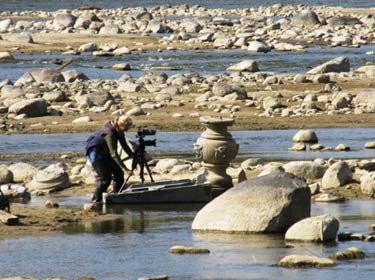
The small number of readers familiar with Henryk Sienkiewicz’s novel of the 17th Century Swedish Invasion of Poland-Lithuania The Deluge will have some sense of its devastating impact on the country. No one living today, however, realised that Swedish looting included the theft of Polish architecture on a massive scale.
A recent major drought in Poland caused the waters of the River Vistula to recede to levels unprecedented in living memory, revealing tons of architectural masonry looted by the Swedes and loaded onto barges for transport down the river to Gdansk, and thence across the Baltic to Sweden. The invaders’ greed apparently exceeded their navigational judgment, and one or more of the barges sank in the river, possibly as the result of overloading.
Reuters recently reported:
Low rainfall over the past few months has brought the Vistula, Poland’s longest river, to its lowest level since regular records began 200 years ago. …
Historians believed that the Swedes who invaded Poland in the 17th century planned to move the looted cargo up the Vistula to Gdansk, where the river joins the Baltic Sea, and from there transport it home. There is still no firm explanation of why the boats sank on the way.
Kowalski said he and his team had so far located up to 10 tonnes of stonework, but this was only the beginning. “The boats had a capacity of 50-60 tonnes (each), so we think that we should find much more,” he said.
Once it has been removed from the river bed and catalogued, the plan is to take the masonry to Warsaw’s Royal Castle, one of the sites from which, historians believe, it was looted by the Swedish invaders.
For now though, the low water levels that revealed the artefacts are hampering efforts to retrieve them. Regular lifting equipment would sink into the mud, but the river is too low for the researchers to bring in floating cranes.
“We need to wait until it gets higher,” Kowalski said.
——————————-
Gość Warszawski [Warsaw’s Guest] has a slideshow
There are also some photos at Archaeology News Network.
12 Sep 2012
The search in Leicester for the remains of Richard III, the last Plantagenet monarch of England slain August 22, 1485 at Bosworth Field, may have achieved success.
The Telegraph reports the finding of remains that may very possibly be those of Richard.
Over 500 years since he was killed in battle, archaeologists believe they have finally found the skeleton of King Richard III, buried deep beneath a council car park.
Experts said a fully intact skeleton matched much about what they knew about the medieval king, and are hoping that DNA tests will put their beliefs beyond doubt.
The remains were found three weeks into an archaeological dig by a team from Leicester University, which recently pinpointed the site of the ancient Grey Friars church, where Richard was believed to be buried after being killed in the Battle of Bosworth in August 1485, and which was razed to the ground in 1538 during the Dissolution of the Monasteries ordered by Henry VIII.
To their astonishment, an excavation unearthed a result which experts said were “beyond out wildest dreamsâ€.
Five key aspects underlined their belief that appears to have ended a decade-long search for his remains.
The skeleton was an adult male, who appeared fit and strong. He had suffered significant trauma to the head where a blade had cut away part of the back of his skull; an injury consistent with battle.
A barbed arrow head was found lodged between vertebrae in his upper back, and spinal abnormalities pointed to the fact that he had severe scoliosis, a form of spinal curvature. This would have made his right shoulder appear visibly higher than his left, which is consistent with contemporary accounts of Richard’s appearance.
Richard’s two year reign was the subject of one of William Shakespeare’s most famous plays, which portrayed him as an evil, ugly hunchback, and which helped cement the public perception of him.
The remains were found in the Choir area of the church, again consistent with historical record of where he was buried.
29 Aug 2012

Unknown artist, Richard III, mid-16th century, Society of Antiquaries, London
A search is on in Leicester for the remains of Richard III, slain in battle at Bosworth Field, and then buried at Greyfriars Church. The location of the burial, and even the exact location of the Franciscan Friary, have been lost to five centuries of development.
HuffPo UK reports:
Philippa Langley, from the Richard III Society which has been involved with the project, said: “We know he was buried here but the church disappeared after the dissolution of the monasteries as did his grave so today we begin the search for Richard.
“We know his body was led into Leicester and put on display for three days by Henry Tudor before he was buried.
“I hope we do find him because I want to give him a proper resting place and also to explode a lot of myths around Richard III.”
Richard Buckley, co-director of the Archaeology Service at the university, said: “It is quite a long shot but it’s a very exciting project. We don’t know the whereabouts of any of the friary buildings at the moment. We don’t know precisely where the body would have been buried but we suspect it would be in the choir or near the alter.”
If bones are found they will be assessed for trauma to the skeleton, as the monarch was killed in battle, then be subject to DNA analysis.
King Richard III, the last Plantagenet, ruled England from 1483 until he was defeated at the Battle of Bosworth in 1485.
Richard may never be found as there is also a tradition that the late king’s remains were thrown into the River Soar at the time of the Dissolution of the Monasteries.
———————-
Wikipedia:
On 22 August 1485, Richard met the outnumbered forces of Henry Tudor at the Battle of Bosworth Field. He was astride his white courser. The size of Richard’s army has been estimated at 8,000, Henry’s at 5,000, but exact numbers cannot be known. During the battle Richard was abandoned by Baron Stanley (made Earl of Derby in October), Sir William Stanley, and Henry Percy, 4th Earl of Northumberland. Despite his apparent affiliation with Richard, Baron Stanley’s wife, Lady Margaret Beaufort, was Henry Tudor’s mother. The switching of sides by the Stanleys severely depleted the strength of Richard’s army and had a material effect on the outcome of the battle. Also the death of John Howard, Duke of Norfolk, his close companion, appears to have had a demoralising effect on Richard and his men. Perhaps in realisation of the implications of this, Richard then appears to have led an impromptu cavalry charge deep into the enemy ranks in an attempt to end the battle quickly by striking at Henry Tudor himself. Accounts note that Richard fought bravely and ably during this manoeuvre, unhorsing Sir John Cheney, a well-known jousting champion, killing Henry’s standard bearer Sir William Brandon and coming within a sword’s length of Henry himself before being finally surrounded by Sir William Stanley’s men and killed. Tradition holds that his final words were “treason, treason, treason!”, when he found Lord Stanley had turned against him. The Welsh accounts state that Sir Wyllyam Gardynyr killed King Richard III with a poleaxe. The blows were so violent that the king’s helmet was driven into his skull. The account reads, “Richard’s horse was trapped in the marsh where he was slain by one of Rhys Thomas’ men, a commoner named Wyllyam Gardynyr.” Another account has Rhys ap Thomas himself slaying the king.
Polydore Vergil, Henry Tudor’s official historian, would later record that “King Richard, alone, was killed fighting manfully in the thickest press of his enemies”. Richard’s naked body was then exposed, possibly in the collegiate foundation of the Annunciation of Our Lady, and hanged by Henry Tudor, now King Henry VII, before being buried at Greyfriars Church, Leicester. In 1495 Henry VII paid £50 for a marble and alabaster monument. According to one tradition, during the Dissolution of the Monasteries his body was thrown into the nearby River Soar, although other evidence suggests that a memorial stone was visible in 1612, in a garden built on the site of Greyfriars.[18] The exact location is now lost due to over 500 years of subsequent development. On 24 August 2012, the University of Leicester and Leicester City Council, in association with the Richard III Society, have joined forces to begin a search for the mortal remains of King Richard III. Led by University of Leicester Archaeological Services (ULAS), experts will be seeking to locate the Greyfriars site and discover whether the remains of Richard III may still be found. There is currently a memorial plaque on the site of the Cathedral where he may have once been buried, as well as a stone plaque on the bridge where his remains were allegedly thrown into the Soar.
01 Aug 2012
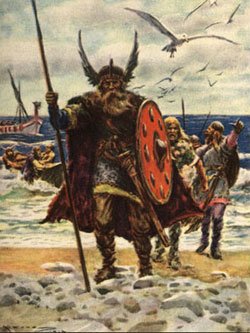
Irene Berg Sørenson, at Science Nordic, discusses five common contemporary opinions about the Vikings’ appearance.
Vikings were dirty and unkempt.
Vikings wore horned helmets.
Vikings looked like we do today.
Vikings’ clothing style was admired throughout the world.
Vikings’ appearance was marked by battle wounds.
26 Jul 2012
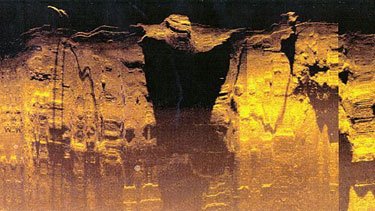
Sonar image thought to be a sunken German U-Boat.
Toronto Star:
Rumours of a World War II German submarine at the bottom of the river have been around for years, but a sonar image may prove that it’s more than just a bump on a log.
Brian Corbin, a diver from Happy Valley Goose Bay, and others were searching the river bottom with side-scanning sonar for three men lost over Muskrat Falls back in 2010 when they came across what appears to be a submarine.
“We were looking for something completely different, not a submarine, not a U-boat — I mean, no one would ever believe that was possible,†Brian Corbin told CBC News.
It certainly wasn’t unheard for German U-boat to be operating off the coast of Labrador and Newfoundland, Nova Scotia and New Brunswick during the war targeting convoys to Great Britain. One reached as far upriver on the St. Lawrence as Rimouski, some 300 km from Quebec City.
“I think it is possible,†Wyman Jacque, town manager for Happy Valley Goose Bay, told the Star Thursday.
Jacque said the U-boat could have quite easily made the trip inland on Labrador’s largest estuary to the shipping port of Happy Valley Goose Bay from the coast and he added the Churchill River before it was dammed back in the 1970s might well have been deep enough to allow the Germans sailors to get to the area of the Falls.
The Churchill River empties into what is known as Lake Melville, a salt water body of water where Happy Valley Goose Bay is located. Muskrat Falls is about 26 kilometres from Lake Melville.
“I can tell you that I have seen the sonar and the outline . . . and you can actually see an outline of what appears to be . . . a submarine,†Jacque said.
The German Embassy in Ottawa, which has been contacted about the possible find, has confirmed that as many as 50 U-boats were unaccounted for when the war ended in 1945.
———————
UPI:
[S]earchers believe they’ve found a World War II German submarine at the bottom of a Canadian river, 60 miles from the ocean.
What appears to be a German U-boat was first spotted at the bottom of the Churchill River in Labrador two years ago by searchers using sonar to locate three men who had gone over Muskrat Falls, the Canadian Broadcasting Corp. reported Wednesday.
“We were looking for something completely different, not a submarine, not a U-boat — I mean, no one would ever believe that was possible,” Brian Corbin told the CBC. “It was a great feeling when we found it.”
Corbin said the object appears to be a 150-foot-long vessel.
The German government says it would be “sensational and unusual” for one of its submarines to have ended up so far inland, though it concedes it’s possible, the CBC reported.
“We do know that German U-boats did operate in that region,” Georg Juergens, deputy head of mission for the German Embassy in Ottawa, told the CBC. “We must brace ourselves for surprises.”
Juergens said the whereabouts of more than a dozen WWII U-boats may still be unknown. He said it would be “against our tradition and our naval customs” to raise the wreckage if it does prove to be a German sub.
“This site then would be declared a war grave at sea,” he said.
———————
The loss of German U-boat personnel in WWII was something like 75%.
U-Boat losses
06 Jul 2012

The coins were mostly fused into a solid mass.
British hobbyists Reg Mead and Richard Miles searched for three decades on the basis of rumors of a farmer finding silver coins on his land before finding a massive hoard of 30,000-50,000 coins lying beneath a mound of clay under a hedge. The coins are believed to date from the first century B.C. and to have been struck by a tribe called the Coriosolitae who lived on the northern coast of modern-day Brittany. The theory is that the coins were buried to protect them from the Roman army advancing under the command of Julius Caesar.
Daily Mail
The Sun
The Guardian


Your are browsing
the Archives of Never Yet Melted in the 'Archaeology' Category.
/div>

Feeds
|



