This Model 1911 Colt .45 was found in the waistband of Clyde Barrow’s trousers by Texas Ranger Frank Hamer who brought the outlaws to justice via a high firepower ambush on a rural Louisiana road on May 23, 1934.
A breakout raid on a Texas prison farm by the Barrow gang in which two guards were shot (one of whom died) infuriated Texas state officials, who responded by hiring retired Ranger Captain Frank Hamer, a veteran of a hundred gun fights who had been shot 17 times and who had reputedly killed between 50 and 70 men, to track down the Barrow gang and out an end to their criminal careers.
Hamer’s commission was to deliver justice, not bring them back alive. He was encouraged to trap the gang, making sure the correctness of his identification of the suspects, and then to just “shoot everybody in sight.” Part of Hamer’s compensation for the manhunt included authorization to appropriate as trophies the weapons and personal effects of the criminals.
Hamer caught up with Bonnie and Clyde on a rural highway in Louisiana with an ambush by six lawmen, armed with a Browning Automatic Rifle, Winchesters, and two Remington semiautomatic rifles. The outlaws’ car was riddled with bullets before either had a chance to shoot back.
RR Auctions of New Hampshire is offering for sale next September 30, with documented provenance going back to Frank Hamer, two pistols found on the bodies of the deceased bandits, Bonnie Parker’s cosmetics case, and Clyde Barrow’s Elgin pocket watch.
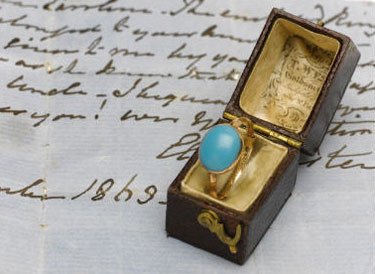
A turquoise and gold ring once belonging to Jane Austen sold yesterday at Sotheby’s in London for 152,450 pounds ($236,000) more than five times its pre-sale estimate.
The ring, which featured a large oval turquoise gemstone, was sold alongside a handwritten letter by her sister-in-law Eleanor Austen bequeathing the rare jewel to her niece Caroline.
The note, dated 1863, confirms the item belonged to the 19th-century British author.
“My dear Caroline,” Eleanor wrote. “The enclosed ring once belonged to your Aunt Jane. It was given to me by your Aunt Cassandra as soon as she knew that I was engaged to your uncle. I bequeath it to you. God bless you!”
The rare piece is the latest in a series of the writer’s pieces to be sold at auction.
Last year, a handwritten draft of an unpublished Jane Austen book was sold for just over £1 million. It was said to be the earliest surviving manuscript of the author’s work.
The sale of Miss Austen’s jewellery at more than five times its estimate yesterday appeared to demonstrate that fascination with the Pride and Prejudice writer has yet to wane.
After a tense battle between eight bidders, the item was eventually sold at £152,450 to an anonymous private collector over the phone.
“Jane Austen’s simple and modest ring is a wonderfully intimate and evocative possession,” said Dr Gabriel Heaton, a manuscript specialist at Sotheby’s auction house.
Militaria from the Vietnam War has a real collectors’ following, and the whimsically-engraved Zippo lighters commonly carried by US servicemen during the Vietnam conflict are popular enough as collectibles to be extensively counterfeited. But trying to sell a collection of 282 Vietnam-era Zippo lighters, even one which had been previously published as an art book (Vietnam Zippos: American Soldiers’ Engravings and Stories (1965-1973) by University of Chicago Press) as a single auction lot would never have been the best way to achieve optimal results, and with the economy in its current condition, there just were no buyers for $30,000-50,000 worth of lighters.
The owner should have sold them, one at a time, accompanied by a certificate of provenance and authenticity on Ebay. But, I’m not sure he could, even then, have counted on getting over $100 for every example.
I guess it’s not surprising to find that Leitz invented the the 35 mm format, and that the reason a smaller film format was created in Germany was to make photography more convenient when visiting the mountains.
The first Leica prototypes were built by Oskar Barnack at Ernst Leitz Optische Werke, Wetzlar, in 1913. Intended as a compact camera for landscape photography, particularly during mountain trips, the Leica was the first practical 35 mm camera that used standard cinema 35 mm film. The Leica transports the film horizontally, extending the frame size to 24×36 mm, with a 2:3 aspect ratio, instead of the 18×24 mm that cinema cameras use, as they transport the film vertically.
The Leica went through several iterations, and in 1923 Barnack convinced his boss, Ernst Leitz II, to make a pre-production series of 31 [other sources say 23 or 25 -JDZ] cameras for the factory and outside photographers to test. Though the prototypes received a mixed reception, Ernst Leitz decided in 1924 to produce the camera. It was an immediate success when introduced at the 1925 Leipzig Spring Fair as the Leica I (for Leitz camera). The focal plane shutter had a range from 1/20 to 1/500 second, in addition to a Z for Zeit (time) position.
Last month, at Westlicht Galleries in Vienna, one of the ten or eleven surviving Leica 0-series, a still-functional camera numbered 116, sold at auction on May 12th to an anonymous bidder for €2.16 million euros, or roughly $2.8 million dollars, setting a new record for camera prices.
HuffPo story.
The Scotsman, 28 December 2010, reported one very impressive result from Holt’s Auctioneers London Sale of December 16 instant.
A unique triple-barrelled shotgun made for a Scots aristocrat has been sold at auction for £43,000 [$66,000 at the time of the sale].
The shotgun – dubbed the “Holy Grail” – was made in April 1891 for John Adrian Louis Hope, 1st Marquess of Linlithgow and the seventh Earl of Hopetoun.
The three-barrelled ejector, 16-bore gun, with three triggers, was designed by renowned Edinburgh gun makers John Dickson & Son and is the only one of its kind. …
Holt’s founder, Nicholas Holt, said: “This is completely unique – the holy grail for any shotgun collector.
“The gun maker, which still exists in Edinburgh, looked back in their records and found this was the only single 16-bore, round action side by side by side ejector ever made. The mechanism was too complex to make more, but it still works fantastically well today and is capable of shooting three gamebirds with its three barrels.”
That is certainly an interesting gun, but it went, in my view, for a terrible amount of money all things considered. The auction catalogue description mentions a “slight crack at the hand” in the stock. It is nice to have three shots, but in return you get a gun weighing 7 lbs. when you could have a 16 gauge weighing 5 3/4 lb. (like my Greener). The gun is also chambered for old-fashioned 2 1/2″ 16 gauge shells, which until pretty recently had been neither loaded nor sold for decades in the United States.
The side-by-side configuration on this gun must surely be less handy than the alternative ways that the German gunmakers would arrange a drilling: either two barrels side-by-side atop one or two barrels over-and-under with the third to one side.
Why exactly three shots were wanted is unknown. It seems to me that a chap shooting driven grouse would be much better off with a better-balanced, better-handling pair of, or even one, 12 gauge gun. He’d have a better sight picture and a larger pattern.
Three shots are not essential in walking up shooting. If you can’t knock down the bird you just put up with two shots, you probably are not going to do it with three either.
The original owner was Governor-General of Australia, so perhaps there are particular circumstances hunting cockatoos or kangaroos, or in the event of convict rebellions, when a fellow simply has to have three quick shots.
Of course, in that event, he could purchase an American pump gun or semi-auto a lot cheaper.
On one strange and unique occasion, I actually personally scored a triple on ruffed grouse. I was just entering the end of patch of woods in Brush Valley, near Ringtown, Pennsylvania, which consisted of the remnant of an old orchard decayed and overgrown by surrounding forest, when I accidentally blundered into a ruffed grouse convention.
A grouse exploded from under my feet with my first step, and I fired and dropped him. I took another step, and a pair of grouse took flight on either side of me. I only had an open field of fire on the left hand bird, and I was again dead on target. When I moved forward to pick up the dead birds, more grouse exploded in all directions, and I managed to drop number three. Three was the daily bag limit, and I’d never taken the limit without reloading before. Grouse continued to launch from all around me as I recovered my birds. In those days, I was using a beat-up and downright elderly Remington Model 10 pump gun with a Full choke. I could not have done any better if I’d had that nice Dickson.
A $3 cold coin is expected to fetch $4 million when it goes up for auction next month.
The 1870-S is one of just two ever made and is one of the rarest coins in US history.
It was discovered in a San Francisco bookshop in 1997 by a European tourist, who found it glued to the inside pages of a souvenir book.
The collector sat on his unbelievable find for 15 years, before bringing it to auction at the Four Seasons Auction Gallery outside Atlanta, Georgia.
The coin was produced by the San Francisco mint on special order of the mint superintendent, originally meant to be placed in the cornerstone of a building in the city.
It was made from a special cast that had a unique ‘S’ hand-carved into it. The ‘S’ is what makes the coin so rare.
When the coin in the cornerstone was damaged and removed, a second copy was cast.
That duplicate is on display at the American Numismatic Association Museum in Colorado Springs, Colorado. In 2007, it was valued at $4 million.
Appraisers aren’t certain of the origin of the coin that is going on the auction block next month.
It could be the original that was taken from the cornerstone of the building. Or, it could be a third copy that was made and never reported.
I’ve found old stamps, stock certificates, and letters and inscriptions from famous people (Lord Grey of Fallodon and Siegfried Sasoon) in old books myself.
Sphragistics, the study of heraldic and other seals, is of considerable interest historically and genealogically.
A very impressive collection of seals belonging to Michel Neugarten (can these possibly have belonged to the race car and film stunt driver?) will be sold by Christie’s, Sale 4889, at their South Kensington, London salesrooms on April 25th.
The collection seems to have some very interesting and luxurious 19th century examples, and a number of earlier Western European seals. Ecclesiastical specimens seem to be well represented in the collection.
La Peregrina 16th century natural pearl; diamond bail early 19th century; natural pearl, diamond, ruby and cultured pearl necklace by Cartier 1972, formerly the property of Phillip II of Spain and his Spanish successors 1500s-1808, Joseph Bonaparte, Louis Napoleon, the Duke and Duchess of Abercorn, and Elizabeth Taylor.
Tomorrow night, at Rockefeller Center, Christie’s will be selling as the 12th lot of the Collection of Legendary Jewels Belonging to Elizabeth Taylor, the “La Peregrina” Pearl, one of the oldest and best-documented historical jewels.
La Peregrina, possibly the most valuable pearl in the world and certainly one of the absolutely largest (more than 50 carats) natural pear-shaped pearls ever recorded, was found near the island of Santa Margarita in the Gulf of Panama by an African slave sometime in the early to mid-16th century.
The story is that the pearl came from an oyster so small that its finder nearly did not bother to open it.
The Governor of Panama, Don Pedro de Temez, acquired the treasure and rewarded the slave with his freedom for finding it.
Temez presented the enormous pearl to King Phillip II of Spain who gave it to Mary I of England at the time of their marriage in 1554, but it returned to the possession of the Spanish crown after her death in 1558. It was one of the favorite and best-known pieces of the Spanish crown jewels, and is visible in portrait after portrait of Queen Consorts.
After Richard Burton bought it for $37,000 at a Sotheby’s sale and presented it to Taylor as a Valentine’s Day present, it fell into the jaws of one of the actress’s Lhasa Apsos. 2:33 video
The probable sales price, despite the economic times, will confirm just what a good investment Burton made.
A rare original draft printing, one of one hundred printed in 1861, and one of only four copies known to have survived of the Constitution of the Confederate States of America, presented to the Convention in Montgomery, Alabama on February 28, 1861 is to be sold by Heritage Auctions at a sale to be held at the Ukrainian Institute of America at The Fletcher-Sinclair Mansion, 2 East 79th Street, New York, NY 10075 on December 8-9, 2011.
This copy must have belonged originally to one of the delegates from Louisiana, Alexandre de Clouet, Charles M. Conrad, Duncan F. Kenner, or Henry Marshall. It is most likely the Kenner copy, as Kenner’s home was confiscated and his personal effects looted when New Orleans was captured May 1, 1862.
This copy descends from the estate of one Albert Gaius Hills, a Boston Journal correspondent, who was present during the capture and subsequent occupation of New Orleans.
Heritage is not posting an estimate of the sales price at the present time, but it will probably command an impressive price.
Heritage Auctions is selling some of the famous actor’s personal effects and papers in Los Angeles in a sale ending October 6-7th.
I have glanced through some of the catalogue, and there is some fascinating stuff: costumes, hats, and even scripts from famous movies, including his eye patch from True Grit, a tweed overcoat from The Quiet Man, a Marine Corps uniform from Sands of Iwo Jima . There are letters from Jimmy Stewart, Frank Sinatra, Ronald Reagan, and John F. Kennedy, and some very amusing letters from director John Ford, full of bawdy humor. They are even selling Wayne’s driver’s license and American Express card.
Lot 44129 is kind of interesting. It seems that, in 1977, just two years before his death, The People’s Almanac sent Wayne (along with other winners of the Academy Award) a poll questionnaire asking “who were and are the 5 best motion picture actors of all time…(and)…the 5 …best motion pictures of all time.”
John Wayne wrote down, as his list of actors: “1) Spencer Tracy 2) Elizabeth Taylor 3) Kathrine [sic] Hepburn 4) Laurence Olivier 5) Lionel Barrymore,” as his list of movies: “1) A Man for All Seasons 2) Gone with the Wind 3) The Four Horsemen of the Apocalypse 4) The Searchers 5) The Quiet Man.”
The lot includes the actual handwritten lists, signed by John Wayne, and is currently bid at $800.
I thought it was odd that John Wayne shared the fashionable critics’ high regard for The Searchers, among his own films. I would argue strenuously myself that She Wore a Yellow Ribbon featured his most impressive all-time job of acting.
A pair of singing-bird pistols made of gold and inlaid with gems sold for HK$45.5 million ($5.8 million) at a Christie’s International sale in Hong Kong [on May 30th].
A huge round of applause erupted after a 10-minute fight that Christie’s head of watches Aurel Bacs described as “an epic bidding war between two of the world’s most connoisseur collectors.†The only publicly known matching pair in the world were included in a 456-lot sale of timepieces that raised HK$164.7 million ($21.2 million), the highest tally for an Asian watch sale, the London-based auction house said. Two Patek Philippe watches sold for more than $1 million each.
William Koch (one of the notorious conservative donor Koch Brothers) bought the 2×3″ ferrotype taken by an unknown photographer in Fort Sumner, New Mexico in late 1879 or early 1880 at a Denver auction last Saturday.
This carte de visite image, commonly referred to as the Upham tintype (named for its longtime owner Frank Upham, a nephew of the original owner Dan Dedrick, one of Billy the Kid’s outlaw friends) is the only image of the famous Western gunfighter believed by experts to be authentic.
Wikipedia article on the Kid, which discusses the photograph.




 by University of Chicago Press) as a single auction lot would never have been the best way to achieve optimal results, and with the economy in its current condition, there just were no buyers for $30,000-50,000 worth of lighters.








