Eleven people have been arrested in eastern China for allegedly stealing women’s corpses for use in “ghost marriages”, it’s been reported.
They’re accused of exhuming a woman’s body from a village in Shandong province and selling it on the black market, the South China Morning Post reports. The “ghost marriage” ritual requires bachelors who have died to be buried next to a woman’s body “so that he won’t be alone in the afterlife”, the website says. It’s an increasingly rare practice in modern China, and now mainly happens in rural areas.
One of the accused was shown on Shandong’s local state TV channel saying a corpse could be sold for between 16,000 and 20,000 yuan ($2,600-$3,300; £1,600-£2,000), and that bodies are only valuable if they have been recently buried. “A body buried for years is worthless,” he says.
Are you a Chinese student with shaky English and a weak understanding of US college admission office culture who wants to go to Yale? You need to hire Eunice Park to write that application essay for you.
I’m a black market college admissions essay writer, and over the last three years I’ve written over 350 fraudulent essays for wealthy Chinese exchange students. Although my clients have varied from earnest do-gooders to factory tycoon’s daughters who communicate primarily through emojis, they all have one thing in common: They’re unable to write meaningful sentences.
Sometimes this inability has stemmed from a language barrier, but other times they have struggled to understand what American college admissions committees are looking for in a personal essay. Either way, they have all been willing to pay me way more than my old waitressing job ever paid me.
Although I’m a second-generation Korean American like some of my clients, I never felt pressured to become a doctor or a lawyer. I majored in art history at college, and after graduation, I found myself bouncing from retail jobs to temp work. Every day, I loafed about in bed. Reading my friends’ Facebook statuses about finishing law school and starting their dream jobs, I wondered if I should ever leave my house. I didn’t know what I wanted to do with my life or if I even possessed any skills someone could pay me to use—at least I didn’t know until my friend told me I could reap in a cash bonanza forging wealthy Asian students’ college essays.
Once I started ghostwriting essays, I quickly went from making $8.50 an hour as a waitress to making $2,000 in two weeks. In one admissions cycle, I wrote over a hundred essays and earned enough money to pay my bills for the rest of the year, pay off my car loan, and—as a treat for my hardworking hands—receive $150 Japanese manicures on a biweekly basis.
Each ghostwriting session starts with a daylong interview. I pry into every intimate corner of a client’s life: her family history, financial background, and childhood secrets. Then I try to pinpoint one relatable thread of pain or humanity, which I can make the focal point of an essay attached to a larger universal theme, like empathy or humility. …
The voice of a college admissions essay is very specific, especially when you’re writing from the perspective of a Chinese exchange student. You have to portray a lot of their expected characteristics while simultaneously fighting against some of their more negative stereotypes. You have to be timid yet idealistic, ambitious yet giving, and reserved yet honest. Selling personal stories of yourself written in the voice of strangers who lack empathy and humility will eventually dissolve you. At the end of every writing season, I always swear I will quit, but I’m still broke with no idea about the shape of my future. I can deny it all I want, but I know, come this fall, I will be in front of my computer at 2 AM mining my brain for another piece of myself to sell for $400.
An already decapitated cobra head was still able to bite a chef twenty minutes after the head was cut off from the snake’s body. The chef died immediately before being given an anti-venom medication.
In preparing for a specialty menu, known as the Snake Soup, chef Peng Fan severed the cobra’s head, left it aside while he diced its body.
Twenty-minutes after his preparation, he picked the cobra’s decapitated head and plans to throw it in the garbage can. This was when the head bit him, and injected its poisonous venom into the chef’s body.
The incident took place in a high-end restaurant in Guangdong province, southern China.
Restaurant guests said that they heard commotion from the kitchen. The staff at the restaurant then called for a doctor but the chef was already dead when the medical assistance arrived.
Edward Luttwak, in a very learned essay on “The Cycles—or Stages—of Chinese History,” published by the Hoover Institution, describes the Chinese version of “Balance of Power” theory.
The innermost circle of the Tianxia is formed by the rest of the Politburo and top Beijing officialdom, while its outermost circle comprises the Solomon Islands along with the twenty or so other utterly benighted “outer barbarian†countries that still do not recognize Beijing, preferring Taipei. In between, all other Chinese from officials and tycoons to ordinary subjects and overseas Chinese fit in their own circles, further and further from the imperial coreas do foreign states both large and small, both near and far, both already respectful (too few) and those still arrogantly vainglorious. It is the long-range task of China’s external policy to bring each and every state into a proper relationship with the emperor—that is, a tributary relationship, in which they deliver goods and services if only as tokens of fealty, in exchange for security and prosperity, but even more for the privilege of proximity to the globally benevolent emperor1. All this is of course nothing more than an exceptionally elaborate rendition of universal ambitions that are merely grander for the greater—the Byzantine ranking of foreign potentates by their proximity to the emperor was only slightly less elaborate.
Nor is there anything peculiarly Chinese about the desire to bring other states into a tributary relationship—often better than a full incorporation, which may be unwanted for any number of reasons, and obviously superior to an alliance however close and secure but between equals, whereby there must be reciprocity, a quid for every quo, usually costly or irksome in some way. Hence from time immemorial, stronger clans, tribes, potentates, and entire nations have done their best to impose tributary relations on weaker clans, tribes, potentates and nations, obtaining goods and services for their forbearance and perhaps protection, or at least tokens of respectful subordination. Chinese emperors wanted no more than that, and unlike most recipients, not infrequently gave gifts more valuable than the tribute they received (as did many Byzantine emperors, by the way).
What is peculiar to China’s political culture, and of very great contemporary relevance is the centrality within it of a very specific doctrine on how to bring powerful foreigners—indeed foreigners initially more powerful than the empire—into a tributary relationship.
Be sure to read on in order to find out how it would be applied to us.
A man tried to smuggle his pet turtle through security in Guangzhou Baiyun International Airport by hiding it in a KFC hamburger.
The incident occurred on the morning of July 29, when a man, surnamed Li, was about to board China Southern Airlines flight 345 to Beijing, Guangzhou Daily reported. As Li passed through airport security, X-ray screening machines detected a few “odd protrusions†sticking out of a KFC burger that the man had packed in his bag.
Airport staff determined that the protrusions looked suspiciously like turtle limbs, and asked to inspect Li’s luggage.
“There’s no turtle in there, just a hamburger,†Li reportedly insisted. “There’s nothing special to see inside.â€
Li finally acquiesced to an inspection after repeated requests from airport staff, who uncovered the pet turtle hidden inside the burger. When asked why he had devised this strange idea, Li said that he had only wanted to travel together with his “beloved†turtle.
After staff patiently explained that turtles could not be smuggled on board the plane, Li reluctantly agreed to allow a friend to care for his pet while he was away.
Certainly, one more piece of evidence that we live today in a world over-regulated by nincompoops. Why is it really a problem if a fellow carries a pet turtle on board an airplane, after all? The only problem is in the mind of the regulatory bureaucracy which reflexively takes the position that whatever is not compulsory must be forbidden.
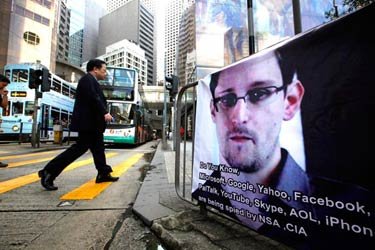
Today, the famous 30-year-old cuts a pathetic figure, presumably still marooned in the transit zone in Moscow’s Sheremetyevo International Airport. He has, we are told, remained there since June 23, when he arrived, without passport or Russian visa, on an Aeroflot flight from Hong Kong. Snowden, through the assistance of the WikiLeaks organization, has filed a reported 27 requests for asylum. Venezuela’s president, Nicolas Maduro, offered him refuge on Friday, and Bolivian leader Evo Morales followed suit on Saturday, but China has yet to welcome him.
Beijing’s refusal to accept Snowden suggests he is not a Chinese agent, at least if we accept the premise of his argument outlined for the readers of the Guardian. Nonetheless, there are aspects of his relationship with the People’s Republic of China that are, at the very least, unsettling.
As an initial matter, China may have helped him gather information from the National Security Agency. Sources in the American intelligence community suspect the famous “leaker” was really a “drop box,” receiving information from others in NSA who were working for China. It was his job to act as the courier.
This theory explains how Snowden could possess information to which he did not have access. It is possible he figured out how to bypass barriers in NSA’s systems, but it is more likely he had help. Eli Lake of the Daily Beast reports that the FBI is investigating whether Snowden obtained documents “from a leak inside the secret FISA court.” Similarly, Mike Rogers, chairman of the House Select Committee on Intelligence, has suggested Snowden probably had an accomplice in the NSA who gave him information.
Beijing may also have encouraged Mr. Snowden to leave Hawaii. One of my sources indicates that Chinese intelligence, either directly or through FBI personnel working for China, tipped Snowden off that NSA investigators were closing in on him.
There still is no proof of this allegation, but it is telling that Snowden chose to run to Hong Kong. At first glance, that city is a curious choice for someone trying to avoid American justice. It has the equivalent of an extradition agreement with the U.S. — as a non-sovereign it technically “surrenders” suspects, not extradites them — and a well-known history of close cooperation with American law enforcement. The Guardian, referring to Snowden, stated that “he believed that it was one of the few places in the world that both could and would resist the dictates of the U.S. government.” In view of Hong Kong’s record of regularly turning over suspects to America, this had to mean Snowden thought Beijing would step in to protect him.
Why would he ever think that? It seems clear that Snowden, if he did not actually work for the Chinese, at least did their bidding. He insisted, for instance, that the Washington Post time its initial disclosures so that they would occur on the eve of last month’s “shirtsleeves” summit between President Obama and his Chinese counterpart, Xi Jinping. When the Post refused to give a guarantee — we learned this from Wolf Blitzer’s June 10 interview with the paper’s Barton Gellman — Snowden dealt mostly with the Guardian, which evidently proved to be more pliable. The timing of the Guardian’s disclosures benefited the Chinese enormously, changing the global narrative from Chinese hacking to American surveillance. …
The Chinese then did their best to make sure that American officials did not get the opportunity to interrogate Snowden. The last thing they wanted was for the U.S. to have the opportunity to learn the extent of China’s penetration of the NSA and the FBI in Hawaii. Therefore, they ensured he left Hong Kong before the city could “surrender” him. Albert Ho, one of Snowden’s attorneys, has publicly stated that Beijing approached him through intermediaries who said his client should leave Hong Kong. And as we know by now, this is exactly what Snowden did.
By that time, there was no point for China to give him a Beijing palace where he could pet phoenixes. Ministry of State Security agents had been in contact with Snowden while he was in Hong Kong and probably obtained all they wanted from his four laptops and one thumb drive. Bill Gertz of the Washington Free Beacon reports that U.S. officials say Russian and Chinese intelligence operatives obtained access to, in the words of Gertz, “highly classified U.S. intelligence and military information contained on electronic media” held by Snowden.
At this moment, we do not know whether Snowden, during his time in Hong Kong, actually traveled to China, as some believe, and we do not know the extent of his dealings with the Chinese. Yet the information we do possess — and the suppositions we can reasonably make — point to troubling conclusions.
Emmy Chang reports: “As of 11:19 AM local time on June 4, according to the _South China Morning Post_: “‘Rubber duck’ has since been blocked as a search term on Sina Weibo.”
Multi-thousand foot drops, a one-foot-wide walkway comprised of wooden boards nailed together 700 hundred years ago, the Daily Mail profiles China’s Chang Kong Cliff Road on Mount Hau. The path was made by Taoist hermits in search of contact with Chinese Immortals.
Pacific Standard gets the scoop from Sebastian Acker and Phil Thompson, who traveled to China to document the Copy Town phenomenon in a new book.
Hallstatt, Austria, is in China. So is the Eiffel Tower, the Taj Mahal, Christ the Redeemer, and a soon-to-be-completed Manhattan. There are others, too, and it’s all part of this weird (at least to us Westerners, or this one Westerner who is writing this) proliferation of what are being called “copy towns.†They’re villages and buildings and cities in China that are being constructed as replicas of non-Chinese places from around the world—and people are living in them. Hallstatt, China, has an artificial lake, and they imported doves to make it more Hallstatt-like. …
There are many different reasons as to why these towns exist. No one reason seems to be fully responsible, rather it is culmination of many different circumstances. One of the main reasons is China’s developing middle and upper classes; a significant portion of people have become very wealthy, very quickly, and these people want a way to showcase their wealth. They are allowed to do so in modern China, but under the Mao regime public shows of wealth would not have been possible. However, given China’s recent history, it does not have a societal model for prosperity. Under Mao, class divisions were squashed and declarations of wealth were not usually allowed, and so they have turned to the West for ways in which to display their new-found fortunes. This adoption of Western styles may be an attempt to pick up an already established ready-made social attitude.
Another reason for the towns could be the huge building bubble that is taking place in China. Vast numbers of new buildings are being built, many of which have never been filled. In order to attract residents to their developments, the construction companies may be creating copy towns so that they stand out amongst the myriad buildings opening every day. Ironically, it is their copied nature that makes them unique in the market.
But generally China has a long history of copying, especially within architecture and the arts. For centuries the emperors would replicate lands that they had conquered within their own palace gardens. These constructs would often include fauna and plants from the conquered regions. This ability to replicate and maintain the distant land demonstrated the emperor’s control over the original region.
Then there is also China’s desire to replicate the West and become a first-world country. A lot of Chinese people look up to the West as an ideal, so the construction of these towns could be seen as a way of accelerating their progress; a quick way of achieving through emulation.
Thamestown: “a new town in Songjiang District, about 30 kilometres (19 mi) from central Shanghai, China. It is named after the River Thames in England. The architecture is themed according to classic English market town styles. There are cobbled streets, Victorian terraces and corner shops.”(photo: triplefivechina.)
2,000-year-old 100-layer sword, reputed to have been owed by Lui Bang (fl. circa 200 B.C.) first Emperor of the Han Dynasty, found originally covered with blood rust. The pattern shown in the bottom photo is known as leopard spots.
Collectors Weekly visits swordmaker Francis Boyd, learns the difference between Damascus layered and wootz steel, and gets to see a sword gifted in China by Marco Polo (or a close relative).
When I got this sword, it was completely covered in blood rust.†Sword maker Francis Boyd is showing me yet another weapon pulled from yet another safe in the heavily fortified workshop behind his northern California home.
“You can tell it’s blood,†he says matter-of-factly, “because ordinary rust turns the grinding water brown. If it’s blood rust it bleeds, it looks like blood in the water. Even 2,000 years old, it bleeds. And it smells like a steak cooking, like cooked meat. I’ve encountered this before with Japanese swords from World War II. If there’s blood on the sword and you start polishing it, the sword bleeds. It comes with the territory.â€
Blood rust: I hadn’t thought of that. I guess it would turn water red, but the steak comment is kind of creeping me out, as is the growing realization that if these swords could talk, I couldn’t stomach half the tales they’d have to tell.