Nils Parker‘s rant on the despicable hipsters and entitled 1%-ers who shop at Whole Foods is going viral because it’s so funny and so accurate.
The problem with Whole Foods is their regular customers. They are, across the board, across the country, useless, ignorant, and miserable. They’re worse than miserable, they’re angry. They are quite literally the opposite of every Whole Foods employee I’ve ever encountered. Walk through any store any time of day—but especially 530pm on a weekday or Saturday afternoon during football season—and invariably you will encounter a sneering, disdainful horde of hipster Zombies and entitled 1%ers.
They stand in the middle of the aisles, blocking passage of any other cart, staring intently at the selection asking themselves that critical question: which one of these olive oils makes me seem coolest and most socially conscious, while also making the raw vegetable salad I’m preparing for the monthly condo board meeting seem most rustic and artisanal?
If you are a normal human being, when you come upon a person like this in the aisle you clear your throat or say excuse me, hoping against hope that they catch your drift. They don’t. In fact, they are disgusted by your very existence. The idea that you would violate their personal shopping space—which seems to be the entire store—or deign to request anything of them is so far beyond the pale that most times all they can muster is an “Ugh!â€
Over the years I have tried everything to remain civil to these people, but nothing has worked, so I’ve stopped trying. Instead, I walk over to their cart and physically move it to the side for them. Usually, the shock of such an egregious transgression is so great that the “Ugh!†doesn’t happen until I’m around the corner out of sight. Usually, all I get is an incredulous bug-eyed stare. Sometimes I get both though, and when that happens, I look them square in the eye and say “Move. Your. Cart.†I used the same firm tone as Jason Bourne, with the hushed urgency of Jack Bauer and the
uncomfortable proximity of Judge Reinhold. From their reaction you’d think I just committed an armed robbery or a sexual assault. When words fail them, as they often do with passive aggressive Whole Foods zombies, the anger turns inward and they start to vibrate with righteous indignation. Eventually, that pent up energy has to go somewhere, and like solar flares it bursts forth into the universe as paroxysms of rage.
Outside the four walls of a Whole Foods, you might recognize these people as Gawker commenters or Twitter shamers. Inside, they are the breathless, self-important shoppers who just can’t believe!! that it’s taking this long to check out. They are busy, they have somewhere to be. Don’t these people in the other six open checkout lanes that are each 3 shoppers deep understand that, WTF??!?
Michael Schulson notes the inconsistency of the community of fashion’s supposed commitment to Science as demonstrated by the ability of Whole Foods, every fashionista’s preferred market, to vend an endless array of products promising better health on the basis of one form or other of pseudo-science.
Americans get riled up about creationists and climate change deniers, but lap up the quasi-religious snake oil at Whole Foods. It’s all pseudoscience—so why are some kinds of pseudoscience more equal than others?
If you want to write about spiritually-motivated pseudoscience in America, you head to the Creation Museum in Kentucky. It’s like a Law of Journalism. The museum has inspired hundreds of book chapters and articles (some of them, admittedly, mine) since it opened up in 2007. The place is like media magnet. And our nation’s liberal, coastal journalists are so many piles of iron fillings.
But you don’t have to schlep all the way to Kentucky in order to visit America’s greatest shrine to pseudoscience. In fact, that shrine is a 15-minute trip away from most American urbanites.
I’m talking, of course, about Whole Foods Market. From the probiotics aisle to the vaguely ridiculous Organic Integrity outreach effort (more on that later), Whole Foods has all the ingredients necessary to give Richard Dawkins nightmares. And if you want a sense of how weird, and how fraught, the relationship between science, politics, and commerce is in our modern world, then there’s really no better place to go. Because anti-science isn’t just a religious, conservative phenomenon—and the way in which it crosses cultural lines can tell us a lot about why places like the Creation Museum inspire so much rage, while places like Whole Foods don’t.
My own local Whole Foods is just a block away from the campus of Duke University. Like almost everything else near downtown Durham, N.C., it’s visited by a predominantly liberal clientele that skews academic, with more science PhDs per capita than a Mensa convention.
Still, there’s a lot in your average Whole Foods that’s resolutely pseudoscientific. The homeopathy section has plenty of Latin words and mathematical terms, but many of its remedies are so diluted that, statistically speaking, they may not contain a single molecule of the substance they purport to deliver. The book section—yep, Whole Foods sells books—boasts many M.D.’s among its authors, along with titles like The Coconut Oil Miracle and Herbal Medicine, Healing, and Cancer, which was written by a theologian and based on what the author calls the Eclectic Triphasic Medical System.
You can buy chocolate with “a meld of rich goji berries and ashwagandha root to strengthen your immune system,†and bottles of ChlorOxygen chlorophyll concentrate, which “builds better blood.†There’s cereal with the kind of ingredients that are “made in a kitchen—not in a lab,†and tea designed to heal the human heart.
Nearby are eight full shelves of probiotics—live bacteria intended to improve general health. I invited a biologist friend who studies human gut bacteria to come take a look with me. She read the healing claims printed on a handful of bottles and frowned. “This is bullshit,†she said, and went off to buy some vegetables. Later, while purchasing a bag of chickpeas, I browsed among the magazine racks. There was Paleo Living, and, not far away, the latest issue of What Doctors Don’t Tell You. Pseudoscience bubbles over into anti-science. A sample headline: “Stay sharp till the end: the secret cause of Alzheimer’s.†A sample opening sentence: “We like to think that medicine works.â€
At times, the Whole Foods selection slips from the pseudoscientific into the quasi-religious. It’s not just the Ezekiel 4:9 bread (its recipe drawn from the eponymous Bible verse), or Dr. Bronner’s Magic Soaps, or Vitamineral Earth’s “Sacred Healing Food.†It’s also, at least for Jewish shoppers, the taboos that have grown up around the company’s Organic Integrity effort, all of which sound eerily like kosher law. There’s a sign in the Durham store suggesting that shoppers bag their organic and conventional fruit separately—lest one rub off on the other—and grind their organic coffees at home—because the Whole Foods grinders process conventional coffee, too, and so might transfer some non-organic dust. “This slicer used for cutting both CONVENTIONAL and ORGANIC breads†warns a sign above the Durham location’s bread slicer. Synagogue kitchens are the only other places in which I’ve seen signs implying that level of food-separation purity.
Look, if homeopathic remedies make you feel better, take them. If the Paleo diet helps you eat fewer TV dinners, that’s great—even if the Paleo diet is probably premised more on The Flintstones than it is on any actual evidence about human evolutionary history. If non-organic crumbs bother you, avoid them. And there’s much to praise in Whole Foods’ commitment to sustainability and healthful foods.
Still: a significant portion of what Whole Foods sells is based on simple pseudoscience. And sometimes that can spill over into outright anti-science (think What Doctors Don’t Tell You, or Whole Foods’ overblown GMO campaign, which could merit its own article). If scientific accuracy in the public sphere is your jam, is there really that much of a difference between Creation Museum founder Ken Ham, who seems to have made a career marketing pseudoscience about the origins of the world, and John Mackey, a founder and CEO of Whole Foods Market, who seems to have made a career, in part, out of marketing pseudoscience about health?
But there really is no inconsistency. The truth of the matter is that the national elite is credentialed, but ill-educated and typically scientifically illiterate. It is demonstrably perfectly possible to get a graduate degree in a scientific field and to fail to understand that an unfalsifiable theory like Global Warming is not science, precisely because it is unfalsifiable.
Their beliefs about the supposed health benefits of various products are perfectly akin to their choices of belief in all other areas.
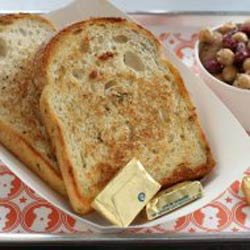
John Gravdis, in Pacific Standard, tracks down the strange, but oh-so-California, origin of the left coast’s latest food craze: $3-4 a slice artisanal toast.
All the guy was doing was slicing inch-thick pieces of bread, putting them in a toaster, and spreading stuff on them. But what made me stare—blinking to attention in the middle of a workday morning as I waited in line at an unfamiliar cafeÌ—was the way he did it. He had the solemn intensity of a Ping-Pong player who keeps his game very close to the table: knees slightly bent, wrist flicking the butter knife back and forth, eyes suggesting a kind of flow state.
The coffee shop, called the Red Door, was a spare little operation tucked into the corner of a chic industrial-style art gallery and event space (clients include Facebook, Microsoft, Evernote, Google) in downtown San Francisco. There were just three employees working behind the counter: one making coffee, one taking orders, and the soulful guy making toast. In front of him, laid out in a neat row, were a few long Pullman loaves—the boxy Wonder Bread shape, like a train car, but recognizably handmade and freshly baked. And on the brief menu, toast was a standalone item—at $3 per slice.
It took me just a few seconds to digest what this meant: that toast, like the cupcake and the dill pickle before it, had been elevated to the artisanal plane. So I ordered some. It was pretty good. It tasted just like toast, but better.
Behind every foodie breakthrough, there is a PC sob story. Go ahead and fork over $4 for that slice of toasted bread, it’s for a good cause!
I went to The Mill for breakfast today and got a black cup of coffee and a single slice of toast topped with butter and sour strawberry jam. For $6.
It was an experiment in upper-middle class lifestyle consumerism. In San Francisco, flaunting your wealth has been elevated to new lows, if you will. The labels aren’t the usual lineup of foreign design houses; rather, we pay $300 for simple denim jeans or $200 for plain black yoga pants. We don’t go to the opera; we overspend on the simplest facets of life.
Coffee. Water. Bread. Housing. The kinds of things our pioneer forebears made themselves and considered basic necessities or small comforts.
And the tech community is largely to blame, in this writer’s opinion.
Here’s the cycle:
Someone creates a business for consumers with too much money and pretensions of superior taste. It might be a physical good, like toast; it might be a service, like black-car, chauffeured rides.
Tech folks, being one of the largest demographics in the city with ample disposable income, patronize, promote, and even invest in said business. (See: Blue Bottle coffee.)
Aforementioned business prospers and grows its profile.
People both within and outside the tech community are inspired to create more bourgie businesses that cater to the bored and overprivileged, peppering their descriptions with buzzwords like “organic†and “fair trade†and “artisanal,†the most meaningless of them all. Rarely are these goods and services truly accessible and affordable.
San Francisco becomes saturated with overpriced crap that is comparable in quality to less overpriced crap.
Middle class and working class families and individuals in the community find themselves priced out of goods and services. Small businesses in those sectors languish.
Good toast and a plain cup of coffee shouldn’t cost $6. But I can’t imagine the tech community putting the brakes on this trend any time soon. We’re obsessed with false ideas of quality. We fetishize the precious processes and benchmarks and prices that, in reality, have no bearing on how good something is.
Some years ago, one broilingly hot July day, I was in New Haven going to the air-conditioned Sterling Memorial Library to do some research for a writing project.
Beside the front entrance steps, a colored Yale maintenance staff employee was working in the hot sun, perspiration pouring down his face, chipping out the aged mortar from between sandstone blocks in preparation for re-pointing them. It was a nasty job, picking out the old cement using a small sledgehammer and a cold chisel, and it was an exponentially nastier job when performed in 100+ degree weather under a bright sun.
As I approached, I couldn’t help noticing that the entire crowd of typically left-wing, conspicuously socially conscious liberals passing directly past the maintenance guy were utterly oblivious to his predicament and to his very existence. He might as well have been a potted plant or a steel trashcan standing beside the library’s elaborate oaken doors for all the attention he was receiving.
I also could not help but perceive that that workman was aware of how thoroughly he was being ignored (and implicitly despised). He was doing a man’s work, a difficult, painstaking, and unpleasant job under extraordinarily adverse conditions. Being only human, he naturally desired some kind of fraternal sympathy from his fellow man, and some recognition that he was doing an unusually tough job under unusually bad conditions. It was impossible not to see that finding himself invisible, divided from the dozens of fellow representatives of humanity passing with a few feet of him by barriers of class as obdurate and inflexible as the stones he was working on, was bitterly alienating and insulting. He was holding himself with an air of resentment, and I could see him muttering angrily to himself under his breath.
So I deliberately slowed, and paused next to him, and said: “It is sure a hot day to be doing that kind of work!” “Sho’ is,” he responded smiling happily and taking a moment to pull out his handkerchief and wipe his face. “Damn hot.” I nodded in the direction of the passing faculty and students. “Some people don’t know what a day’s work is like.” I said, and he laughed appreciatively.
It only took a few seconds, but I’d managed to give him the sense of human solidarity he obviously needed, while reassuring him that at least one passerby recognized the nature and cost of his personal contribution to physical survival of the University.
Anthony Esolen, who teaches English at Providence College, is also the kind of guy who has doubtless worked with his hands, and who is therefore capable of perceiving the yawning chasm between professoriate and the proletariat, between the people in America who actually work up a sweat and the members of the community of fashion elite who call all the shots.
We professors at Providence College have for two years now been working in the midst of invisible men, men… who in these times are almost as insane and as morally blinkered as the professors they serve. The men have built a large and handsome Center for the Humanities, out of brick and stone. They have had to transform a hill and a parking lot to get the project started. They have turned an old field into a new facility for soccer, field hockey, and track, complete with bleachers and a press house, and eighty foot tall lights for events at night. They have laid hundreds of yards of concrete pathways. They have cleared out a useless hill thicketed with scrub trees and made it into a decorative border for the campus. They have built temporary parking lots and torn them out again and replaced them with sod. They have dug out stumps and planted trees. They have worked with jackhammers, drills, chisels, backhoes, saws, scaffolding, trowels, wheelbarrows, sledges, and the indispensable hands, arms, legs, shoulders, and back. They have done all this while remaining as quiet and unobtrusive as they could be.
They work hard, at work that takes its toll on their bodies, in all seasons and in all but the filthiest weather. Yet I doubt that the feminist professor – and most professors are feminist – gives them a passing thought. Without men like them, we would have nothing; nothing to eat, no metal for our cars, no bricks, no stone, no wooden planks, no houses, no roads, no public buildings, no clean running water, nothing. They do work that is more than desirable. It is absolutely necessary. I teach English poetry; that is not necessary. I will not trouble to discuss sociology, feminist or otherwise.
We might be apt to shrug and say, “What of it? They are well paid,†and some of them are. Some of them are not, but then, don’t college graduates deserve to make more money than workers on the land, of the land, and under the land? And they do have the vote, don’t they? Everyone gets one vote, and that makes everyone equal.
Well, no, it doesn’t, no more than if everyone enjoyed the privilege of spitting once into a national spittoon. We are looking for equality as men, so that we can say what Mr. Morgan said. And the common laborers enjoy no such thing. They have virtually no influence over what their children are taught in school, and how. Their sons are regularly badgered for being boys, and bullied into ingesting drugs to conform their boyish natures to the ideal of mannerly servility. They are not pillars of their communities, because there are no more communities; there are political abstractions called “towns†and “cities,†whose leaders take their cultural instructions from the media and from the national government, and who themselves are less and less likely to have grease under their fingernails or freckles of carbon in their faces. They are not the masters in their own homes; the effeminate vices peddled by their “betters†have seen to that. They are likely to have fathered children out of wedlock, or to have been divorced, sometimes with good cause, far more often without. They ingest the poisons peddled by mass entertainment. Their sons surf the internet for porn, get fat, wear their pants around their thighs so as to look like dwarfs stretched on a rack, can’t dig a post-hole or sing a hymn, and are given comic books in school instead of Moby-Dick. Our need for these fathers is total, yet their authority is minuscule even in their own localities, and their influence upon national politics is zero.
If such men ever took it into their heads to strike, not against the owner of the coal mine, but against their masters in the media, the classrooms, the board rooms, the state capitols, and Washington, who knows what might happen? We might have a republic again. But I’m not holding my breath. A John Dickinson, mild-tempered though he was, would be at a loss for words to fathom the depth of our servility, both moral and political. What, after all, were a couple of pence on a bag of tea, compared with thousands of unread pages managing every facet of medical treatment for three hundred million people? Slaves do sometimes rise up. Pampered slaves, never.
“What do you call an Italian hooker? A pastatute!”
Adam Weinstein (It figures!), at Gawker, tries to console Obama-voting-bedwetters for the holiday prospect of encountering unassimilated-American, politically-incorrect relatives. He suggests that dining with his racist, sexist uncle will make the pillow-biting liberal stronger, if it does not destroy him.
We are nervous about our racist, sexist old uncles.
“America needs Obamacare like Nancy Pelosi needs a Halloween mask!”
We wish they’d go away, letting us enjoy the undercooked poultry and over-sugared ambrosia in some semblance of utopian progressive peace.
But let me tell you why that’s a terrible idea, America. Why you need your racist, sexist old uncle.
First, your racist sexist old uncle focuses your anger on the right things. Let’s face it: As socially liberal as you are, you will always find some reason to freak the fuck out on your family at the holidays. Holidays are stressful. They cost a lot. The weather sucks. The travel is hard. And at the end of it, there is your mother, offering unconditional love and advice on how to care for her beloved grandchild, your obvious neglect of whom has caused the flu in her, and that’s okay, because Nanna has drawn an ice bath with mustard seeds, because that’s how the Amish did it, and it was good enough for them, and of course you couldn’t know that. …
If you had no racist, sexist uncle, these perils would be more immediate. The holiday conversation might border on the minutiae of domesticity — your baby is so big! The yams are so big! Would you like to see Dad’s photos of our big Cozumel cruise? This ancient pyramid with these trinket-hawking natives is so big!
All the time, there would be no acknowledgement whatsoever of the fateful role in our lives played by Obamacare, Benghazi, Trayvon Martin, FEMA camps, the Fed, and those sorority girls with their silly accusations. You might be forced to acknowledge the gaping canyon of nothingness that stands between you and the alien zephyr of life that animates these blood relations, these strange meat sticks whom society holds up as the biological and ethical raison d’être of your person-ness.
Fuck that. Your racist, sexist uncle is throwing you a lifesaver. Don’t let yourself drown in a turbid sea of Updikean suburban malaise. Seek refuge in your racist, sexist uncle’s miasma of burped-up Jameson and slutty Italian jokes, the only thing that broke his six-month catatonia after Wife No. 3 went down the shore to Brigantine and never came back.
He is a sacrificial anode, your racist sexist old uncle is. Absent his intervention, we would be pitted and wasted away by the smaller destructive forces of the holiday season.
But beyond the blessed distraction that he provides you in his grace, your racist, sexist uncle makes you a better person, engaging you in an elaborate staged mimesis of the Hegelian master-slave dialectic. For if there is no racist, sexist uncle, then there is no comparative challenge, no middling standard of ugliness, against which to prove your culturally enlightened nature. Without the counterpoint of his rusted-out V8 Firebird with the “NO FAT CHICKS” bumper sticker, your low-emissions Subaru with the “YES WE CAN” magnet is just another car in the jammed-up driveway.
“What do you call two blacks on one bike? ORGANIZED CRIME.”
Your racist, sexist uncle is the oval track, and you are the sprinter. Your racist, sexist uncle is the bench-press bar, and you are the lifter. He is the open journal, and you are the pen. You are a master of your fate, of the dictates of racial and gender politeness, only because your other family members can see the reductio ad absurdum of their bigotry in your combed-over foil across the table, sitting there stuffed in a disintegrating Bill Blass dress shirt that Wife No. 2 bought him in the now-defunct Wanamaker’s for $8.95.
You sit, a paragon of yoga-loving, organic-banana-mashing-for-the-baby virtue, proving once and for all that, no, Obama is NOT a FUCKING Kenyan, all because he allows you to profess it as he strokes his mustache, the one he calls his “pussy tickler.”
Victor Davis Hanson is tired of all our national policy decisions being made by a coastal elite resident in urban bubbles of like-mindedness, far removed from the lives of ordinary Americans.
The problem is not just that the coasts determine how everyone else is to lead their lives, but that those living in our elite corridors have no idea about how life is lived just a short distance away in the interior — much less about the sometimes tragic consequences of their own therapeutic ideology on the distant, less influential majority.
In a fantasy world, I would move Washington, D.C., to Kansas City, Missouri. That transfer would not only make the capital more accessible to the American people and equalize travel requirements for our legislators, but also expose an out-of-touch government to a reality outside its Beltway.
I would transfer the United Nations to Salt Lake City, where foreign diplomats would live in a different sort of cocoon.
I would ask billionaires like Bill Gates, Warren Buffet and the Koch Brothers to endow with their riches a few Midwestern or Southern universities. Perhaps we could create a new Ivy League in the nation’s center.
I would suggest to Facebook and Apple that they relocate operations to North Dakota to expose their geeky entrepreneurs to those who drive trucks and plow snow. Who knows — they might be able to afford a house, get married before 35, and have three rather than zero kids.
America is said to be divided by red and blue states, rich and poor, white and non-white, Christian and non-Christian, old and new.
I think the real divide is between those who make our decisions on the coasts and the anonymous others who live with the consequences somewhere else.
Sullyblog recently found itself another humanitarian crusade to climb on board.
Bad enough our letting the Bush Administration roughly handle jihadi terrorists (Torture!). On top of that, we allow domestic cats to reproduce and then we “introduce” them into natural environments properly understood to be the park and preserve of rodents and small birds. We are kind of like God introducing Spaniards into the New World.
Disapproving Aunt Andrew quotes crusading vegan journalist Deanna Pan writing in Mother Jones about the findings of a study of feline atrocities by the University of Georgia.
About 30 percent of the sampled cats were successful hunters and killed, on average, two animals a week. Almost half of their spoils were abandoned at the scene of the crime. Extrapolating from the data to include the millions of feral cats brutalizing native wildlife across the country, the American Bird Conservancy estimates that kitties are killing more than 4 billion animals annually. And that number’s based on a conservative weekly kill rate, said Robert Johns, a spokesman for the conservancy.
“We could be looking at 10, 15, 20 billion wildlife killed (per year),” Johns said.
—————–
Doesn’t it seem fitting that the moralizing and modernizing representatives of the progressive community of fashion not only hasten to defend the Mussulman bombmaker, but also take time out from ordering the stars in their courses to champion the rights of mice, rats, pigeons, and house sparrows?
Spoilsport Deanna Pan (I bet she was not born with that surname) thinks we should bell and bib our cats in order to foil their hunting.
(Also quoted by Andrew Sullivan) Amanda Marcotte, writing in Slate, contends that helicopter-pet-ownership, i.e. persistent bien pensant human supervision and restricted access to the out-of-doors, is the solution.
One of my cats spent the first year of her life as a completely outdoor cat who slept in a barn, so getting her to stop begging to be let out took some spine, but now she’s perfectly happy to have her outdoor life limited to small amounts of time on the balcony. If I ever feel bad about exerting power over her in this way, I just remind myself I’m being much more generous to her than she’d be to small creatures that she comes across, which goes a long way toward relieving any guilt.
All of which proves, I think, that no limits to officious theorizing of the modern pseudo-intelligentsia can be found to exist.
Personally, I think all these self-appointed legislators’ pantries should be infested with hanta-virus-bearing mice and pigeons should target them whenever they go outside.
Jeffrey Lord describes how control of Academia, elite media, the entertainment industry, the foundations, and the mainstream Protestant denominations allows liberals to define the reality around them (most of the time) and to frame every debate in their own terms.
He uses as a metonymy the very apt comparison of the Downfall of Rush Limbaugh, perennially predicted by the liberals, with the recent sale of the (liberal) Washington Post. Rush continues to flourish, while pillars of the establishment MSM are failing everywhere, but none of this matters, because the MSM is able to define reality, at least within its own establishment bubble.
Let’s define… Liberal Privilege.
In four words?
“We make the rules.â€
Is Rush Limbaugh in trouble?
Is the Tea Party extremist?
Was Ronald Reagan dumb, the Soviet Union eternal, did Bush lie, are conservatives racists? Is Sarah Palin stupid, Hillary Clinton brilliant, global warming a scientific fact, and abortion overwhelmingly popular?
The answers? Yes, yes, yes, yes, of course, it’s obvious, absolutely, and everybody knows it without question.
Why? Because liberals say so, that’s why.
This is the Doctrine of Liberal Privilege that finally forced the Graham family to sell the Washington Post.
Using Liberal Privilege liberals make the rules, establish the common assumptions, send them forth into American society through the liberal media, liberal academia, liberal Hollywood, liberal religion, and other liberal venues.
So let’s define the Doctrine of Liberal Privilege more specifically, academic-style (and note, sources will be provided at the end of this article):
• “Liberal Privilege defines the societal norm, often benefiting those in the privileged group. Second, privileged group members can rely on their privilege and avoid objecting to oppression. The result of this societal norm is that everyone is required to live by the attributes held by the privileged. In society liberals define and determine the terms of success and failure; they are the norm. Thus, achievements by members of the liberal privileged group are viewed as meritorious and the result of individual effort, rather than as privileged.â€
• “Liberal Privilege is a form of racism that both underlies and is distinct from institutional and overt racism. It underlies them in that both are predicated on preserving the privileges of liberals (regardless of whether agents recognize this or not). But it is also distinct in terms of intentionality. It refers to the hegemonic structures, practices, and ideologies that reproduce liberals’ privileged status. In this scenario, liberals do not necessarily intend to hurt people of conservative or non-liberal belief, but because they are unaware of their liberal privilege, and because they accrue social and economic benefits by maintaining the liberal status quo, they inevitably do.â€
• “Liberal Privilege is an invisible package of unearned assets which liberals can count on cashing in each day, but about which they are ‘meant’ to remain oblivious. Liberal Privilege is like an invisible weightless knapsack of special provisions, maps, passports, codebooks, visas, clothes, tools, and blank checks.â€
When understood in this fashion, understanding the “invisible weightless knapsack†concept, the essence of everything from the liberal media to academia, mainline Protestant churches, the bureaucracies of Washington, DC, the NAACP, La Raza, the AFL-CIO, and so much more comes into 20/20 focus. Everyone involved, social, cultural, and political liberals one and all, has the requisite “maps, passports, codebooks, visas, clothes, tools, and blank checks†of Liberal Privilege.
When I came downstairs this morning, I found waiting in my overnight emails an Amazon offering of “Books by Dave Eggers.” I could not think why Amazon thought I wanted any titles by this particular author, but I did peruse the advertisement, and was intrigued by the title A Hologram for the King.
What could that be about, I asked myself, and clicked on the link to Amazon’s web-site.
Happily, my efforts to figure out what the book was all about led me to an utterly devastating review by one zashibis which refreshed my memory completely as to why I do not read books by Dave Eggers.
The Worst Book of 2012
About once a year I end up reading a book so resoundingly terrible, so utterly hackneyed and half-assed, so mysteriously lauded by a featherbrained coterie of newspaper review-writing hacks (here’s looking at you Michiko Katukani!) but so wonderfully devoid of any artistry or insight, that I end up finishing it out of something like the morbid fascination that makes a person rubber-neck at an especially horrific car accident. Congratulations, Mr. Eggers: in 2012 that book was yours. …
Discounting the fake setting entirely, let’s concentrate instead on Eggers’s four unforgivable failures that should be blindingly apparent to any reasonably sophisticated reader who has never even set foot in the Middle East:
1)Style. For its reliance on simple declarative sentences and its striking lack of figurative language of any sort, some are calling this novel “Hemingway-esque.” This is a terrible calumny on Papa Hemingway. The old master, it’s true, used a pared-down style to tell his stories, but the sum was always larger than the parts–a slowly pieced mosaic that (more often than not) created a striking picture of his life and times. Eggers language, in contrast, is just dumbed-down and drab, utterly lifeless on the page. A single page of Updike or Roth–nay, a single paragraph–has more artistry than you will find in this entire book. At first I thought Eggers might be trying to be “meta” by writing prose that is as sterile and color-starved as the Saudi landscape, but Eggers is too much the boy scout for that. Ever since A Heartbreaking Work of Staggering Genius his mantra has been “Irony is bad!” so it seems highly improbable that he should intentionally be writing in a prose style that is deathly boring to mirror the dullness of life in Saudi Arabia. It is, as other reviewers have noted, a “fast read,” but only because it is the sort of prose that requires no thought whatsoever.
2)Plot. Think about it for half a second. This book asks us to believe that a washed-up, superannuated bicycle company executive *with absolutely no expertise in IT* is being sent to a remote corner of the world as the point-man for a multi-million-dollar IT presentation. Eggers doesn’t even pretend that this makes any sense at all. A modern novelist who gave half a sh*t–let’s say a David Foster Wallace–would have researched holographic presentations and the Middle Eastern IT market and presented us with at least a semi-believable character who had some compelling reason to be in Saudi. Eggers can’t be bothered. Literally, the only work-related thing Clay does during the entire novel is to make one apologetic complaint about the lack of Wi-Fi and food in the tent where the other members of his team are slated, nonsensically, to give their presentation. That’s it. For this valuable service he is supposed to earn a six-figure commission. (Sign me up!)
Along the way Clay meets a young Arab driver named Yousef who instantaneously becomes his BFF (or, even more implausibly, Clay starts thinking of him “like a son” by about their third meeting) and who continues to call him even after Clay does something (I’ll avoid the clear spoiler) that most people would have a great deal of difficulty forgiving of someone they’d known intimately all their lives. Likewise, Clay has two women (one Danish, one mixed-blood Arab) throw themselves at him after acquaintanceships measured in minutes, as though he were Ryan Gosling, and hadn’t previously been described by Eggers as an awkward, balding, dumpy, schlub with an ugly growth on his back . With the desperate European sexpot it’s merely ridiculous; with the Arab woman we’ve firmly entered Harlequin Romance territory, where millennium-old cultural taboos are brushed away as easily and as thoughtlessly as cobwebs…and where a long-haired woman snorkeling topless is somehow supposed to be less conspicuous (and less identifiable as a woman) than she would be in an ordinary swimsuit. (How does that work, exactly?)
3)Characterization. The evidence has become overwhelming. Eggers can’t do it. When he’s describing real people (as in his memoir or his various stabs at non-fiction) he does adequately. But made-up people? Nope. Just awful. The central character, Clay, is believable in no respect, a gasping fish-out-of-water who has none of the self-confidence or worldliness you’d expect of a lifelong sales executive. Instead, he comes across as a seventeen-year-old naïf away from home for the first time in his life. But at least Clay is a “developed” character with a back-story, however improbable. The same cannot be said of any of the other characters in the novel. Clay’s three American coworkers, for instance, aren’t even one-dimensional–they’re just three random names that Eggers tosses out occasionally. He can’t even be bothered to figure out what their respective roles in the presentation for the king are supposed to be or a plausible reason why they would passively sit around a tent doing absolutely nothing day after day after day. Almost all the Arabs in the novel all have walk-on parts–so forgettable that I just finished the novel but I’ve already forgotten their names. The exception is Yousef, who Eggers seems to have thrown in just so that he can’t be accused of being completely anti-Arab. But Yousef is even less believable than Clay–no Saudi who had a) fluent English or b) a rich father–let alone both–would ever, in a million years, be an ordinary chauffeur, one of the least respected jobs in Saudi Arabia, generally performed by Pakistanis earning a pittance. He really exists only as crude plot device to get Clay out of Jeddah for a few days so he can demonstrate his haplessness and insecurity in a different setting.
4)Theme. An anemic, warmed-over Death of a Salesman, missing only the final coup de grace. Enough said? So very many authors have done the late-middle-age middle-manager crisis of conscience so very much better than this: Updike, Roth, Bellow, Ford for starters . Even Ian McEwan’s Solar a few years ago–one of McEwan’s weaker novels–is a masterpiece compared to this. Likewise, Begley’s About Schmidt. So, if you’re going to go down this path yet again you’d better have something fresh to say. Eggers doesn’t. Likewise, several positive reviews make a big deal that novel is a “parable” about outsourcing. But, what, exactly does Eggers have to say about outsourcing that will be news to anybody at all? What fresh or original insight does he offer into America’s self-induced industrial decline? Nothing and none.
Too, in choosing to make the demise of Schwinn bicycles emblematic of America’s decline in manufacturing Eggers has had to simplify the company’s story to the point of absurdity. In reality, Schwinn’s failure was much more one of marketing and not anticipating the shift toward specialized bikes (i.e. racing bikes, mountain bikes, dirt bikes) than it was in moving assembly overseas. Sad-sack Clay has hopeless pipedreams of starting his own high-end custom bicycle company, and is depicted as a ridiculous figure; however, the reality is that several American companies, like Specialized Bicycle Components and Moots, do precisely that. Therefore, besides being boringly banal (“We’ve given our jobs to China!”) Eggers has succeeded in being entirely one-sided as well. The novel amounts to nothing more than a 300-page pity party.
This shallow piece of sophomoric flimflam bears exactly the same relation to literature as Fruity Pebbles bears to fruit. If AHFTK were merely a trashy novel, it wouldn’t be worth complaining about. Trashy novels have their place, and their devotees, if they’re at all self-aware, at least understand that they’re reading disposable, escapist fluff. But Eggers clearly imagines he wrote a serious novel–as do virtually all of the positive reviewers here on Amazon and elsewhere–when nothing could be further from the truth. AHFTK is kitsch: the most pernicious and unnecessary sort of artistic production on the planet. Zero stars.
It is a real commentary on community of fashion pseudo-intellectual elite culture that this book was a National Book Award Finalist, was chosen as one of the New York Times Book Review’s 10 Best Books of the Year, and also selected as One of the Best Books of the Year by The Boston Globe and San Francisco Chronicle. The airheads and fraudsters stick together.
Nicholas Poussin, The Victory of Joshua Over the Amalekites, 1624-1625, Hermitage, St. Petersburg
Eratosthenes notices that the culture wars are being waged relentlessly and with unlimited persistence, by one side which is absolutely and unequivocally determined to win everything it wants every time and which, whenever it wins, will then proceed to move the goal posts even further.
Somehow, somewhere, it has been decided that this one culture should reign supreme. It must ALWAYS win; there can be no exceptions. What do we call this culture, now. We should try to define it, if it always has to win! That’s a lot of influence. We know it by the offenses it takes. Bullying, homophobic remarks, guns. It isn’t “politically correct,†for the politically-correct culture, while also defined according to the offenses it takes, is confined to offenses taken against verbal or written statements. Guns aren’t statements. Ass-kickings are not statements either, although I suppose that may be debatable. But this is not political-correctness, and it isn’t “women over men†since it takes just as vicious umbrage against a woman brandishing a firearm in self-defense, as against any man doing likewise.
It isn’t modern liberalism, either. It doesn’t have an opinion about labor-versus-management, or minimum wage, or affirmative action, or school vouchers. It holds a lot of appeal for people who do not self-identify as liberals. And its field of interest is very narrow. I can summarize it with a phrasing almost bumper-sticker-sized:
“When we make everything safe enough, nothing bad will happen, to anyone, ever again.â€
Just outside a school on a 55 mph county highway, it isn’t good enough to take the limit down to 25. My recent experiences here in upstate New York show it has to be 15. I guess twenty-five wouldn’t show how much we care. This culture cares about children arriving at adulthood with all their limbs and with their hearts still beating, but with not too much else.
Can we call it “the nanny state†and be done with it? There is certainly some overlap. The Mayor of New York City trying to ban soda sales fits into the object of my inspection here, and it is certainly part of the nanny state. Pondering it some more, though, I find this doesn’t quite work. There are differences, and the differences matter. The nanny state is an organization, and it is a sale. It is narcissists in office who have power, trying to accumulate some more. …
This culture — which always must win — is endangering our very society… As the nanny-state seeks to everlastingly grow by way of creating more and more rules, this culture seeks to everlastingly grow by altering the definition of “bad things happening.†It has progressed so far now, without anyone consciously noticing it evidently, that bad-feeling evidently qualifies. If nothing bad really happens, but someone feels slighted, then action is required. This, of course, has to be a selective thing. It’s okay to make a guy “feel bad†when he approaches the State Fair with a Leatherman on his belt, by commanding him to walk a mile and a half back to his car, and back again, to stow the threatening-looking device. And a twelve-year-old girl who wins a pistol shooting contest might feel good with a little bit of extra applause, but this feel-good-all-the-time culture will refrain from that, and command everyone else to refrain as well.
The Leatherman is not dangerous and the pistol is not dangerous. In some situations, they both have the potential to make someone safe.
So this culture is not concerned with safety or danger. It has definite ideas about individuals and what, or how, the individuals should be.
He’s perfectly right. It goes way beyond politics. It is a religious crusade and “the side which must always win” is determined to forcibly convert everyone else to its own entire worldview, values, and perspective.
No Piero della Francesca RESSURECTION, not even an Easter egg, or an Easter bunny, today Google’s search logo art is focusing on something much more important.
For those hoodie-wearing fashionistas down in Mountain View, billions of Christians celebrating the most important date in the Christian calendar are irrelevant, what is important about today’s date is it being the 86th (posthumous) birthday of leftist agitator Cesar Chavez.
So let’s all raise a middle finger to those communist heathens at Google and eat some grapes. (Cesar Chavez was famous, back in the day, for organizing a grape boycott.)
Tasteless and moronic video by Jim Carrey simultaneously sneering at rural America, insulting the late Charleton Heston, and blaming American gun owners for violence. If anyone ever doubted that Carrey is an asshole and an idiot, just watch this. He is so spectacularly stupid that he obviously thinks this is clever, and that the chain of consequences alluded to in the rapid patter, closing section of the song makes some kind of sense.