Poor Michael Brown was videotaped by a surveillance camera robbing a convenience store, shortly before he was shot by police.
Armed & Dangerous agrees with the general narrative contending that events in Ferguson, Missouri show that American police use too much military equipment and are ill-advisedly trained to employ military tactics, but –beyond all that– he feels obliged to defend police against knee-jerk accusations of racism.
[The] 2% [of the US population composed of black males aged 15 to 25] is responsible for almost all of 52% of U.S. homicides. Or, to put it differently, by these figures a young black or “mixed†male is roughly 26 times more likely to be a homicidal threat than a random person outside that category – older or younger blacks, whites, hispanics, females, whatever. If the young male is unambiguously black that figure goes up, about doubling.
26 times more likely. That’s a lot. It means that even given very forgiving assumptions about differential rates of conviction and other factors we probably still have a difference in propensity to homicide (and other violent crimes for which its rates are an index, including rape, armed robbery, and hot burglary) of around 20:1. That’s being very generous, assuming that cumulative errors have thrown my calculations are off by up to a factor of 6 in the direction unfavorable to my argument.
Now suppose you’re a cop. Your job rubs your nose in the reality behind crime statistics. What you’re going to see on the streets every day is that random black male youths are roughly 20 times more likely to be dangerous to you – and to other civilians – than anyone who isn’t a random black male youth.
Any cop who treated members of a group with a factor 20 greater threat level than population baseline “equally†would be crazy. He wouldn’t be doing his job; he’d be jeopardizing the civil peace by inaction.
Yeah, my all means let’s demilitarize the police. But let’s also stop screaming “racism†when, by the numbers, the bad shit that goes down with black male youths reflects a cop’s rational fear of that particular demographic – and not racism against blacks in general.
Malcolm Gladwell, in the New Yorker, looks a number of studies suggesting that crime used to be a viable path to social mobility. Modern intensity of policing and the absence of corruption, studies suggest, leave poor African American hoodlums today no “blind eye” under which they can prosper and become rich and respectable as their predecessors did.
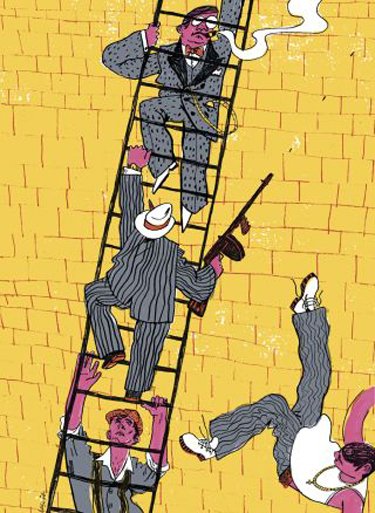
Six decades ago, Robert K. Merton argued that there was a series of ways in which Americans responded to the extraordinary cultural emphasis that their society placed on getting ahead. The most common was “conformityâ€: accept the social goal (the American dream) and also accept the means by which it should be pursued (work hard and obey the law). The second strategy was “ritualismâ€: accept the means (work hard and obey the law) but reject the goal. That’s the approach of the Quakers or the Amish or of any other religious group that substitutes its own moral agenda for that of the broader society. There was also “retreatism†and “rebellionâ€â€”rejecting both the goal and the means. It was the fourth adaptation, however, that Merton found most interesting: “innovation.†Many Americans—particularly those at the bottom of the heap—believed passionately in the promise of the American dream. They didn’t want to bury themselves in ritualism or retreatism. But they couldn’t conform: the kinds of institutions that would reward hard work and promote advancement were closed to them. So what did they do? They innovated: they found alternative ways of pursuing the American dream. They climbed the crooked ladder.
All three of the great waves of nineteenth- and early-twentieth-century European immigrants to America innovated. Irish gangsters dominated organized crime in the urban Northeast in the mid to late nineteenth century, followed by the Jewish gangsters—Meyer Lansky, Arnold Rothstein, and Dutch Schultz, among others. Then it was the Italians’ turn. They were among the poorest and the least skilled of the immigrants of that era. Crime was one of the few options available for advancement. The point of the crooked-ladder argument and “A Family Business†was that criminal activity, under those circumstances, was not rebellion; it wasn’t a rejection of legitimate society. It was an attempt to join in. …
[The most important thing] is not the cultural difference between being an Italian thug in the early part of the twentieth century and being an African-American thug today. It’s the role of law enforcement in each era. … Until the nineteen-seventies, outstanding warrants in the city of Philadelphia were handled by a two-man team, who would sit in an office during the evening hours and make telephone calls to the homes of people on their list. Anyone stopped by the police could show a fake I.D. Today, there are computers and sometimes even fingerprint machines in squad cars. Between 1960 and 2000, the ratio of police officers to Philadelphia residents rose by almost seventy per cent.
In the previous era, according to Goffman, the police “turned a fairly blind eye†to prostitution, drug dealing, and gambling in poor black neighborhoods. But in the late nineteen-eighties, she writes, “corruption seems to have been largely eliminated as a general practice, at least in the sense of people working at the lower levels of the drug trade paying the police to leave them in peace.â€
[Old-time Italian gangsters], of course, routinely paid the police to leave them in peace, as did the other crime families of their day. They got the benefit of law enforcement’s “blind eye.†…
The Federal Witness Protection Program did not yet exist; federal wiretaps weren’t admissible in court. Only the F.B.I. was properly equipped to tackle organized crime, and under J. Edgar Hoover the bureau saw targeting Communism and political subversion as its primary mandate. “As late as 1959, the FBI’s New York field office had only 10 agents assigned to organized crime compared to over one hundred and forty agents pursuing a dwindling population of Communists,†the attorney C. Alexander Hortis writes, in “The Mob and the City.†In the unlikely event that a mobster was arrested, Hortis points out, he could expect to walk. Between 1960 and 1970, forty-four per cent of indictments of organized-crime figures in courts around New York City were dismissed before trial. In that same ten-year period, five hundred and thirty-six mobsters were arrested on felony charges, but only thirty-seven ended up in prison. …
That’s why the crooked ladder worked as well as it did. The granddaughter could end up riding horses because the law—whether from indifference, incompetence, or corruption—left her gangster grandfather alone.
The idea that, in the course of a few generations, the gangster can give way to an equestrian is perhaps the hardest part of the innovation argument to accept. We have become convinced of the opposite trajectory: the benign low-level drug dealer becomes the malignant distributor and then the brutal drug lord. The blanket policing imposed on 6th Street is justified by the idea that, left unchecked, [low-level criminals] will get worse. Their delinquency will metastasize… [C]rooked-ladder theorists looked at the Mafia’s evolution during the course of the twentieth century, however, and reached the opposite conclusion: that, over time, the criminal vocation was inevitably domesticated.
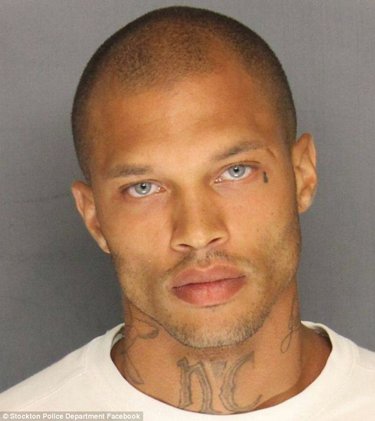
Jeremy Meeks, a blue-eyed 30-year-old ex-convict got arrested in Stockton, California last Wednesday during a weapons sweep, when police found a .45 pistol in the trunk of his car. Mr. Meeks previously served two years for grand theft, and has tattoos implying that he is affiliated with the Crips gang and has previously killed someone.
The Stockton police make a practice of posting their most recent mug shots on-line, and the arrest photo of Jeremy Meeks immediately went viral on the Internet, causing women (and Andrew Sullivan) to swoon over the convict’s ethnically-diverse good looks.
The story of the excitement over the photo even gained international coverage by British newspapers like the Daily Mail. And Meeks’ mugshot has also become the object of the latest Photoshop humor meme. Buzzfeed
Glenn Reynolds was amused the other day when he found the gun-running scandal involving Democrat State Senator Leeland Yee (who represents San Francisco & San Mateo County and who was, when the scandal broke, running for Secretary of State) was getting coverage from Popular Mechanics, while being studiously ignored by CNN.
Esquire magazine picked up the Popular Mechanics “Leeland Yee-supplied guns” feature, but the MSM is generally ignoring all this, classifying the matter as merely “local news.”
Leeland Yee was honored in 2006 by the Brady Campaign for “gun violence prevention” for his co-athoring a bill requiring semiautomatic handguns (not sold covertly by State Senator Yee) to include ballistics identification microstamping.
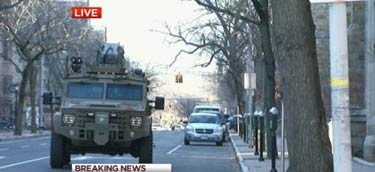
One of those armored vehicles (with unmanned machine-gun turret) can be seen sitting just outside the campus.
Around 9:30 A.M. this morning, an anonymous caller phoned New Haven Police warning them that his roommate was going to Yale to shoot people. There have been reports of a man being sighted carrying a long gun. Yale is on Thanksgiving break. Most people are not on campus. And police have swarmed the area between Chapel & Elm and High and College Streets.
NYC voted to go back to the 1970s, back to grafitti, squeegee men, and muggings. Dan Greenfield has some words of congratulation for NYC voters.
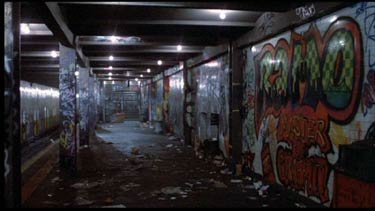
Do you miss the old New York City? Remember when subway trains were covered in graffiti, a news hour began with six shootings and everyone who lived in the city had been mugged at least once?
Remember when Times Square had more strip clubs than theaters and when you could afford an apartment in the village because it was a drug infested mess?
Remember when the city and everyone living in it were on the verge of bankruptcy and the only people who had money lived upstate or in a small cluster of Manhattan?
Remember when everything was grimy and had a layer of filth, when people moved to the city because they wanted to slum, when nothing worked and no one cared and the only difference between New York and Chicago was that it had taller buildings?
If you miss that classic New York, there’s good news because Bill de Blasio is bringing it back.
The muggers are coming back. The squeegee men are coming back. The crazy people randomly stabbing you on the subway, the gangs shooting each other over turf, the race rioters marching through neighborhoods and shouting, “Whose streets, our streets”– they’re all coming back.
Because the polls have spoken. And it’s De Blasio time now.
No more fascist cops hassling “innocent” people. Bill de Blasio won’t put up with any of that. De Blasio will put the cops in their place, inside a Dunkin Donuts and away from people. They’ll still get paid. They’re in a union. They just won’t lift a finger to help you because they’ll have more special monitors and civilian complaint review boards on their necks than they can handle.
And next time one of the innocent victims of Stop and Frisk is pounding your face into the sidewalk with one hand while digging through your pockets with the other, wave to the pair of beat cops sitting in the window of the coffee shop. And they’ll wave back without getting up. Because you voted for this. And you’re getting what you deserve.
Robert Stacy McCain explains that if Miami-Dade law enforcement had thrown his punk ass into juvie (as he richly deserved), then he would never have been suspiciously casing residences in the gated community of Sanford, or had occasion to try beating in the head of the Neighborhood Watch volunteer who annoyed him by subjecting poor Trayvon to undesired surveillance, and young Trayvon would still be alive today.
Trayvon Martin was not from Sanford, the town north of Orlando where he was shot in 2012 and where a jury acquitted Zimmerman of murder charges Saturday. Martin was from Miami Gardens, more than 200 miles away, and had come to Sanford to stay with his father’s girlfriend Brandy Green at her home in the townhouse community where Zimmerman was in charge of the neighborhood watch. Trayvon was staying with Green after he had been suspended for the second time in six months from Krop High School in Miami-Dade County, where both his father, Tracy Martin, and mother, Sybrina Fulton, lived.
Both of Trayvon’s suspensions during his junior year at Krop High involved crimes that could have led to his prosecution as a juvenile offender. However, Chief Charles Hurley of the Miami-Dade School Police Department (MDSPD) in 2010 had implemented a policy that reduced the number of criiminal reports, manipulating statistics to create the appearance of a reduction in crime within the school system. Less than two weeks before Martin’s death, the school system commended Chief Hurley for “decreasing school-related juvenile delinquency by an impressive 60 percent for the last six months of 2011.†What was actually happening was that crimes were not being reported as crimes, but instead treated as disciplinary infractions.
In October 2011, after a video surveillance camera caught Martin writing graffiti on a door, MDSPD Office Darryl Dunn searched Martin’s backpack, looking for the marker he had used. Officer Dunn found 12 pieces of women’s jewelry and a man’s watch, along with a flathead screwdriver the officer described as a “burglary tool.†The jewelry and watch, which Martin claimed he had gotten from a friend he refused to name, matched a description of items stolen during the October 2011 burglary of a house on 204th Terrace, about a half-mile from the school. However, because of Chief Hurley’s policy “to lower the arrest rates,†as one MDSPD sergeant said in an internal investigation, the stolen jewerly was instead listed as “found property†and was never reported to Miami-Dade Police who were investigating the burglary. Similarly, in February 2012 when an MDSPD officer caught Martin with a small plastic bag containing marijuana residue, as well as a marijuana pipe, this was not treated as a crime, and instead Martin was suspended from school.
Either of those incidents could have put Trayvon Martin into the custody of the juvenile justice system. However, because of Chief Hurley’s attempt to reduce the school crime statistics — according to sworn testimony, officers were “basically told to lie and falsify†reports — Martin was never arrested. And if he had been arrested, he might never have been in Sanford the night of his fatal encounter with Zimmerman.