The Guardian reports that new research methods have disclosed the ancient roots of classic European fairy tales.
Fairy stories such as Beauty and the Beast and Rumpelstiltskin can be traced back thousands of years to prehistoric times, with one tale originating from the bronze age, academics have revealed.
Using techniques normally employed by biologists, they studied common links between 275 Indo-European fairy tales from around the world and found some have roots that are far older than previously known, and “long before the emergence of the literary recordâ€.
While stories such as Beauty and the Beast and Rumplestiltskin were first written down in the 17th and 18th century, the researchers found they originated “significantly earlierâ€. “Both tales can be securely traced back to the emergence of the major western Indo-European subfamilies as distinct lineages between 2,500 and 6,000 years ago,†they write.
Durham University anthropologist Dr Jamie Tehrani, who worked with folklorist Sara Graça da Silva, from New University of Lisbon, believed the research – published in the Royal Society Open Science journal – has answered a question about our cultural heritage. …
Some of these stories go back much further than the earliest literary record and indeed further back than classical mythology – some versions of these stories appear in Latin and Greek texts – but our findings suggest they are much older than that.â€
Analysis showed Jack and the Beanstalk was rooted in a group of stories classified as The Boy Who Stole Ogre’s Treasure, and could be traced back to when eastern and western Indo-European languages split – more than 5,000 years ago. Beauty and the Beast and Rumpelstiltskin to be about 4,000 years old. A folk tale called The Smith and the Devil was estimated to date back 6,000 years to the bronze age.
The story, which involves a blacksmith selling his soul in a pact with the devil in order to gain supernatural ability, then tricking the evil power, is not so well known today, but its theme of a Faustian pact is familiar to many.
The study employed phylogenetic analysis, which was developed to investigate evolutionary relationships between species, and used a tree of Indo-European languages to trace the descent of shared tales on it, to see how far they could be demonstrated to go back in time.
Tehrani said: “We find it pretty remarkable these stories have survived without being written. They have been told since before even English, French and Italian existed. They were probably told in an extinct Indo-European language.â€
Da Silva believes the stories endure thanks to “the power of storytelling and magic from time immemorialâ€.
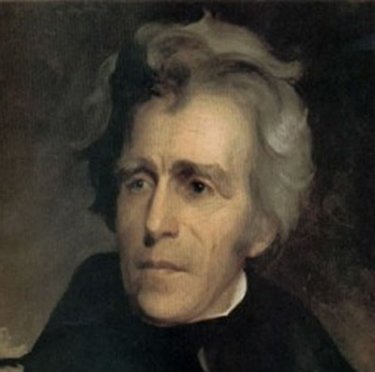
Walter Russell Mead warns that a spectre is haunting the election of 2016, the spectre is that of no less than Andrew By God! Jackson, and the Locofocos are again challenging the rule of the Bank and the Urban Elites.
Not since he fought with Nicholas Biddle over the future of the Bank of the United States has Andrew Jackson been this controversial or this central in American political life. Jacksonian populism, the sense of honor-driven egalitarianism and fiery nationalism that drove American politics for many years, has never been hated and reviled as often as it is today, and many American academics and intellectuals (to say nothing of Hollywood icons) are close to demanding that Jacksonian sentiment be redefined as a hate crime.
For President Barack Obama and his political allies in particular, Jacksonian America is the father of all evils. Jacksonians are who the then Senator had in mind when, in the campaign of 2008, he spoke of the ‘bitter clingers’ holding on to their guns and their Bibles. They are the source of the foreign policy instincts he most deplores, supporting Israel almost reflexively, demanding overwhelming response to terror attacks, agitating for tight immigration controls, resisting diplomacy with Iran and North Korea, supporting Guantanamo, cynical about the UN, skeptical of climate change, and willing to use ‘enhanced interrogation’ against terrorists in arms against the United States. …
The hate and the disdain don’t spring from anything as trivial as pique. Historically, Jacksonian America has been the enemy of many of what President Obama, rightly, sees as some of America’s most important advances. …
Virtually everything about progressive politics today is about liquidating the Jacksonian influence in American life. From immigration policy, touted as ending the era when American whites were the population of the United States, to gun policy and to regulatory policy, President Obama and his coalition aim to crush what Jacksonians love, empower what they fear, and exalt what they hate. …
What we are seeing in American politics today is a Jacksonian surge. …
Donald Trump, for now, is serving as a kind of blank screen on which Jacksonians project their hopes. Proposing himself as a strong leader who ‘gets’ America but is above party, Trump appeals to Jacksonian ideas about leadership. Trump’s Jacksonian appeal has left the Republican Party in deep disarray, demonstrating the gulf between contemporary conservative ideology and Jacksonian nationalism. Indeed, one of the reasons that Trump hasn’t been hurt by attacks that highlight his lack of long term commitment to the boilerplate conservative agenda (either in the social or economic conservative variant) is that Jacksonian voters are less dogmatic and less conservative than some of their would-be political representatives care to acknowledge. …
Whatever happens to the Trump candidacy, it now seems clear that Jacksonian America is rousing itself to fight for its identity, its culture and its primacy in a country that it believes it should own. Its cultural values have been traduced, its economic interests disregarded, and its future as the center of gravity of American political life is under attack. Overseas, it sees traditional rivals like Russia, China, North Korea and Iran making headway against a President that it distrusts; more troubling still, in ISIS and jihadi terror it sees the rapid spread of a movement aiming at the mass murder of Americans. Jacksonian America has lost all confidence in the will or the ability of the political establishment to fight the threats it sees abroad and at home. It wants what it has always wanted: to take its future into its own hands.
The biggest story in American politics today is this: Andrew Jackson is mad as hell, and he’s not going to take it anymore.
Born: Richard II, King of England, 1366; Joan d’Arc, 1402; Peter Metastasio, poet, 1698; Benjamin Franklin, philosopher, Boston, U.S., 1706; David Dale, philanthropist, 1739; George Thomas Doo, engraver, 1800.
Feast Day: St. Melanius, bishop, 490. St. Nilammon, Hermit. St. Peter, abbot of St. Austin’s, Canterbury, 608.
TWELFTH-DAY
This day, called Twelfth-Day, as being in that number after Christmas, and Epiphany from the Greek ‘‘ΕπιΦáνєια”, signifying appearance, is a festival of the Church, in commemoration of the Manifestation of Christ to the Gentiles; more expressly to the three Magi, or Wise Men of the East, who came, led by a star, to worship him immediately after his birth. (Matt. ii. 1-12.) The Epiphany appears to have been first observed as a separate feast in the year 813. Pope Julius I is, however, reputed to have taught the Church to distinguish the Feasts of the Nativity and Epiphany, so early as about the middle of the fourth century.
The primitive Christians celebrated the Feast of the Nativity for twelve days, observing the first and last with great solemnity; and both of these days were denominated Epiphany, the first the greater Epiphany, from our Lord having on that day become Incarnate, or made his appearance in “the flesh;” the latter, the lesser Epiphany, from the three-fold manifestation of His Godhead—the first, by the appearance of the blazing star which conducted Melchior, Jasper, and Balthuzar, the three Magi, or wise men, commonly styled the three Kings of Cologne, out of the East, to worship the Messiah, and to offer him presents of “Gold, Frankincense, and Myrrh”—Melchior the Gold, in testimony of his royalty as the promised King of the Jews; Jasper the Frankincense, in token of his Divinity; and Balthuzar the Myrrh, in allusion to the sorrows which, in the humiliating condition of a man, our Redeemer vouchsafed to take upon him: the second, of the descent of the Holy Ghost in the form of a Dove, at the Baptism: and the third, of the first miracle of our Lord turning water into wine at the marriage in Cana. All of which three manifestations of the Divine nature happened on the same day, though not in the same year.
‘To render due honour to the memory of the ancient Magi, who are supposed to have been kings, the monarch of this country himself, either personally or through his chamberlain, offers annually at the altar on this day, Gold, Frank-incense, and Myrrh; and the kings of Spain, where the Feast of Epiphany is likewise called the “Feast of the Kings,” were accustomed to make the like offerings. — Brady.
In the middle ages, the worship by the Magi was celebrated by a little drama, called the Feast of the Star:
‘Three priests, clothed as kings, with their servants carrying offerings, met from different directions before the altar. The middle one, who came from the east, pointed with his staff to a star. A dialogue then ensued; and, after kissing each other, they began to sing, “Let us go and inquire;” after which the precentor began a responsory, “Let the Magi come.” A procession then commenced; and as soon as it began to enter the nave, a crown, with a star resembling a cross, was lighted up, and pointed out to the Magi, with, “Behold the Star in the East.” This being concluded, two priests standing at each side of the altar, answered meekly, “We are those whom you seek;” and, drawing a curtain, shewed them a child, whom, falling down, they worshipped. Then the servants made the offerings of gold, frankincense, and myrrh, which were divided among the priests. The Magi, meanwhile, continued praying till they dropped asleep; when a boy, clothed in an alb, like an angel, addressed them with, “All things which the prophets said are fulfilled.” The festival concluded with chanting services, &c. At Soissons, a rope was let down from the roof of the church, to which was annexed an iron circle having seven tapers, intended to represent Lucifer, or the morning star; but this was not confined to the Feast of the Star.’ — Fosbroke’s Antiquities, ii. 700.
At Milan, in 1336, the Festival of the Three Kings was celebrated in a manner that brings forcibly before us the tendency of the middle ages to fix attention on the historical externals of Christianity. The affair was got up by the Preaching Friars. The three kings appeared, crowned, on three great horses richly habited, surrounded by pages, body guards, and an innumerable retinue. A golden star was exhibited in the sky, going before them. They proceeded to the pillars of St. Lawrence, where King Herod was represented with his scribes and wise men. The three kings ask Herod where Christ should be born, and his wise men, having consulted their books, answer, at Bethlehem. On which the three kings, with their golden crowns, having in their hands golden cups filled with frankincense, myrrh, and gold, the star going before, marched to the church of St. Eustorgius, with all their attendants, preceded by trumpets, horns, asses, baboons, and a great variety of animals. In the church, on one side of the high altar, there was a manger with an ox and ass, and in it the infant Christ in the arms of his mother. Here the three kings offer Him gifts. The concourse of the people, of knights, ladies, and ecclesiastics, was such as was never before beheld.
In its character as a popular festival, Twelfth-Day stands only inferior to Christmas. The leading object held in view is to do honour to the three wise men, or, as they are more generally denominated, the three kings. It is a Christian custom, ancient past memory, and probably suggested by a pagan custom, to indulge in a pleasantry called the Election of Kings by Beans. In England, in later times, a large cake was formed, with a bean inserted, and this was called Twelfth-Cake. The family and friends being assembled, the cake was divided by lot, and who-ever got the piece containing the bean was accepted as king for the day, and called King of the Bean.
In England, it appears there was always a queen as well as a king on Twelfth-Night. A writer, speaking of the celebration in the south of England in 1774, says:
‘After tea, a cake is produced, with two bowls containing the fortunate chances for the different sexes. The host fills up the tickets, and the whole company, except the king and queen, are to be ministers of state, maids of honour, or ladies of the bed-chamber. Often the host and hostess, more by design, than accident, become king and queen. According to Twelfth-Day law, each party is to support his character till midnight.’
In the sixteenth century, it would appear that some peculiar ceremonies followed the election of the king and queen. Barnaby Goodge, in his paraphrase of the curious poem of Nagcorgus, The Popish Kingdom, 1570, states that the king, on being elected, was raised up with great cries to the ceiling, where, with chalk, he inscribed crosses on the rafters to protect the house against evil spirits.
A Twelfth-Day custom, connected with Paget’s Bromley in Staffordshire, went out in the seventeenth century. A man came along the village with a mock horse fastened to him, with which he danced, at the same making a snapping noise with a bow and arrow. He was attended by half-a-dozen fellow-villagers, wearing mock deers’ heads, and displaying the arms of the several chief landlords of the town. This party danced the Hays, and other country dances, to music, amidst the sympathy and applause of the multitude. There was also a huge pot of ale with cakes by general contribution of the village, out of the very surplus of which ‘they not only repaired their church, but kept their poor too; which charges are not now, perhaps, so cheerfully borne.’
On Twelfth-Night, 1606, Ben Jonson’s masque of Hymen was preformed before the Court; and in 1613, the gentleman of Gray’s Inn were permitted by Lord Bacon to perform a Twelfth-Day masque at Whitehall. In the masque the character of Baby cake is attended by ‘an usher bearing a great cake with a bean and all with good will have spared unto your lordship, please.’
On Twelfth-Day, 1563, Mary Queen of Scots celebrated the French pastime of the King of the Bean at Holyrood, but with a queen instead of a king, as more appropriate, in consideration of herself being a female sovereign. The lot fell to the real queen’s attendant, Mary Fleming, and the mistress good-naturedly arrayed the servant in her own robes and jewels, that she might duly sustain the mimic dignity in the festivities of the night. The English resident, Randolph, who was in love with Mary Beton, another of the queen’s maids of honour, wrote in excited terms about this festival to the Earl of Leicester.
‘Happy was it,’ says he, ‘unto this realm, that her reign endured no longer. Two such sights, in one state, in so good accord, I believe was never seen, as to behold two worthy queens possess, without envy, one kingdom, both upon a day. I leave the rest to your lordship to be judged of. My pen staggereth, my hand faileth, further to write.’
The queen of the bean was that day in a gown of cloth of silver; her head, her neck, her shoulders, the rest of her whole body, so beset with stones, that more in our whole jewel-house were not to be found. . . The cheer was great. I never found myself so happy, nor so well treated, until that it came to the point that the old queen [Mary] herself, to show her mighty power, contrary unto the assurance granted me by the younger queen [Mary Fleming], drew me into the dance, which part of the play I could with good will have spared unto your lordship, as much fitter for the purpose.”
Charles I had his masque on Twelfth-Day, and the Queen hers on the Shrovetide following, the expenses exceeding £2000; and on Twelfth-Night, 1633, the Queen feasted the King at Somerset House, and presented a pastoral, in which she took part.
Down to the time of the Civil Wars, the feast was observed with great splendour, not only at Court, but at the Inns of Court, and the Universities (where it was an old custom to choose the king by the bean in a cake), as well as in private mansions and smaller households.
Then, too, we read of the English nobility keeping Twelfth-Night otherwise than with cake and characters, by the diversion of blowing up pasteboard castles; letting claret flow like blood, out of a stag made of paste; the castle bombarded from a pasteboard ship, with cannon, in the midst of which the company pelted each other with egg-shells filled with rose-water; and large pies were made, filled with live frogs, which hopped and flew out, upon some curious person lifting up the lid.
Twelfth-Night grew to be a Court festival, in which gaming was a costly feature. Evelyn tells us that on Twelfth-Night, 1662, according to custom, his Majesty [Charles II] opened the revels of that night by throwing the dice himself in the Privy Chamber, where was a table set on purpose, and lost his £100. [The year before he won £1500.] The ladies also played very deep. Evelyn came away when the Duke of Ormond had won about £1000, and left them still at passage, cards, &c., at other tables.
The Rev. Henry Teonge, chaplain of one of Charles’s ships-of-war, describes Twelfth-Night on board:
‘Wee had a great kake made, in which was put a beane for the king, a pease for the queen, a cloave for the knave, &c. The kake was cut into several pieces in the great cabin, and all put into a napkin, out of which every one took his piece as out of a lottery; then each piece is broaken to see what was in it, which caused much laughter, and more to see us tumble one over the other in the cabin, by reason of the ruff weather.’
The celebrated Lord Peterborough, then a youth, was one of the party on board this ship, as Lord Mordaunt.
The Lord Mayor and Aldermen and the guilds of London used to go to St. Paul’s on Twelfth-Day, to hear a sermon, which is mentioned as an old custom in the early part of Elizabeth’s reign.
A century ago, the king, preceded by heralds, pursuivants, and the Knights of the Garter, Thistle, and Bath, in the collars of their respective orders, went to the Royal Chapel at St. James’s, and offered gold, myrrh, and frankincense, in imitation of the Eastern Magi offering to our Saviour. Since the illness of George III, the procession, and even the personal appearance of the monarch, have been discontinued. Two gentlemen from the Lord Chamberlain’s office now appear instead, attended by a box ornamented at top with a spangled star, from which they take the gold, frankincense, and myrrh, and place them on an alms-dish held forth by the officiating priest.
In the last century, Twelfth-Night Cards represented ministers, maids of honour, and other attendants of a court, and the characters were to be supported throughout the night. John Britton, in his Autobiography, tells us he ‘ suggested and wrote a series of Twelfth-Night Characters, to be printed on cards, placed in a bag, and drawn out at parties on the memorable and merry evening of that ancient festival. They were sold in small packets to pastrycooks, and led the way to a custom which annually grew to an extensive trade. For the second year, my pen-and-ink characters were accompanied by prints of the different personages by Cruikshank (father of the inimitable George), all of a comic or ludicrous kind.’ Such characters are still printed.
The celebration of Twelfth-Day with the costly and elegant Twelfth-cake has much declined within the last half-century. Formerly, in London, the confectioners’ shops on this day were entirely filled with Twelfth-cakes, ranging in price from several guineas to a few shillings; the shops were tastefully illuminated, and decorated with artistic models, transparencies, &c. We remember to have seen a huge Twelfth-cake in the form of a fortress, with sentinels and flags; the cake being so large as to fill two ovens in baking.
In 79 A.D. in Herculaneum a baker put a loaf of bread into his oven. The oven was opened in the course of excavations in 1930. In 2013, the British Museum asked Georgio Locatelli to recreate the recipe.
As a general statement, it may be asserted that neither the last evening of the old year nor the first day of the new one is much, observed in England as an occasion of festivity. In some parts of the country, indeed, and more especially in the northern counties, various social merry-makings take place; but for the most part, the great annual holiday-time is already past. Christmas Eve, Christmas-day, and St. Stephen’s or Boxing Day have absorbed almost entirely the tendencies and opportunities of the community at large in the direction of joviality and relaxation. Business and the ordinary routine of daily life have again been resumed; or, to apply to English habits the words of an old Scottish rhyme still current, but evidently belonging to the old times, anterior to the Reformation, when Christmas was the great popular festival:
Yule’s come and Yule ‘s gane,
And we hae feasted weel;
Sae Jock maun to his flail again,
And Jenny to her wheel.’
Whilst thus the inhabitants of South Britain are settling down again quietly to work after the festivities of the Christmas season, their fellow-subjects in the northern division of the island are only commencing their annual saturnalia, which, till recently, bore, in the license and boisterous merriment which used to prevail, a most unmistakable resemblance to its ancient pagan namesake. The epithet of the Daft [mad] Days, applied to the season of the New Year in Scotland, indicates very expressively the uproarious joviality which characterized the period in question. This exuberance of joyousness—which, it must be admitted, sometimes led to great excesses—has now much declined, but New-year’s Eve and New-year’s Day constitute still the great national holiday in Scotland. Under the 1st of January, we have already detailed the various revelries by which the New Year used to be ushered in, in Scotland. It now becomes our province to notice those ceremonies and customs which are appropriate to the last day of the year, or, as it is styled in Scotland, Hogmanay.
But two additional conjectures seem much more plausible, and the reader may select for himself what he considers the most probable. One of these is, that the term under notice is derived from Hoggu-nott, Hogenat, or Hogg-night, the ancient Scandinavian name for the night preceding the feast of Yule, and so called in reference to the animals slaughtered on the occasion for sacrificial and festal purpose word hogg signifying to kill. The other derivation of Hogmanay is from ‘Au gui menez’ (‘To the mistletoe go’), or ”Au gui ľan neuf’ ‘ (‘To the mistletoe this New Year ‘), an allusion to the ancient Druidical ceremony of gathering that plant. In the patois of Touraine, in France, the word used is Aguilanneu; in Lower Normandy, and in Guernsey, poor persons and children used to solicit a contribution under the title of Hoguinanno or 0guinano; whilst in Spain the term, Aguinaldo, is employed to denote the presents made at the season of Christmas.
In country places in Scotland, and also in the more retired and primitive towns, it is still customary on the morning of the last day of the year, or Hogmanay, for the children of the poorer class of people to get themselves swaddled in a great sheet, doubled up in front, so as to form a vast pocket, and then to go along the streets in little bands, calling at the doors of the wealthier classes for an expected dole of oaten-bread. Each child gets one quadrant section of oat-cake (some-times, in the case of particular favourites, improved by an addition of cheese), and this is called their hogmanay. In expectation of the large demands thus made upon them, the housewives busy themselves for several days beforehand in preparing a suitable quantity of cakes. The children on coming to the door cry, ‘Hogmanay!’ which is in itself a sufficient announcement of their demands; but there are other exclamations which either are or might be used for the same purpose. One of these is:
‘Hogmanay, Trollolay,
Give us of your white bread, and none of your gray.’
And another favourite rhyme is:
Get up, goodwife, and shake your feathers,
And dinna think that we are beggars;
For we are bairns come out to play,
Get up and gie’s our hogmanay!’
The following is of a moralising character, though a good deal of a truism:
Get up, goodwife, and binna sweir,
And deal your bread to them that ‘s here;
For the time will come when ye’ll be dead,
And then ye’ll neither need ale nor bread.’
The most favourite of all, however, is more to the point than any of the foregoing :
My feet’s cauld, my shoon’s thin;
Gie’s my cakes, and let me rin!’
It is no unpleasing scene, during the forenoon, to see the children going laden home, each with his large apron bellying out before him, stuffed full of cakes, and perhaps scarcely able to waddle under the load. Such a mass of oaten alms is no inconsiderable addition to the comfort of the poor man’s household, and enables him to enjoy the New-year season as much as his richer neighbours.
In the primitive parish of Deerness, in Orkney, it was customary, in the beginning of the present century, for old and young of the common class of people to assemble in a great band upon the evening of the last day of the year, and commence a round of visits throughout the district. At every house they knocked at the door, and on being admitted, commenced singing, to a tune of its own, a song appropriate to the occasion. The following is what may be termed a restored version of this chant, the imagination having been called on to make up in several of the lines what was deficient in memory. The ‘Queen Mary’ alluded to is evidently the Virgin:
‘This night it is grid New’r E’en’s night,
We’re a’ here Queen Mary’s men;
And we ‘re come here to crave our right,
And that’s before our Lady.
The very first thing which we do crave,
We ‘re a’ here Queen Mary’s men;
A bonny white candle we must have,
And that’s before our Lady.
Goodwife, gae to your butter-ark,
And weigh us here ten mark.
Ten mark, ten pund,
Look that ye grip weel to the grund.
Goodwife, gae to your geelin vat,
And fetch us here a skeet o’ that.
Gang to your awmrie, gin ye please,
And bring frae there a yow-milk cheese.
And syne bring here a sharping-stane,
We’ll sharp our whittles ilka ane.
Ye’ll cut the cheese, and eke the round,
But aye take care ye cutna your thoom.
Gae fill the three-pint cog o’ ale,
The maut maun be aboon the meal.
We houp your ale is stark and stout,
For men to drink the auld year out.
Ye ken the weather’s snow and sleet,
Stir up the fire to warm our feet.
Our shoon’s made o’ mare’s skin,
Come open the door, and let’s in.’
The inner-door being opened, a tremendous rush was made ben the house. The inmates furnished a long table with all sorts of homely fare, and a hearty feast took place, followed by copious libations of ale, charged with all sorts of good-wishes. The party would then proceed to the next house, where a similar scene would be enacted. How they contrived to take so many suppers in one evening, heaven knows ! No slight could be more keenly felt by a Deerness farmer than to have his house passed over unvisited by the New-year singers.
The doings of the guisers or guizards (that is, masquers or mummers) form a conspicuous feature in the New-year proceedings throughout Scotland. The favourite night for this exhibition is Hogmanay, though the evenings of Christmas, New-year’s Day, and Handsel Monday, enjoy like-wise a privilege in this respect. Such of the boys as can lay any claim to the possession of a voice have, for weeks before, been poring over the collection of ‘excellent new songs,’ which lies like a bunch of rags in the window-sill; and being now able to screech up ‘Barbara Allan,’ or the ‘Wee cot-house and the wee kail-yardie,’ they determine upon enacting the part of guisers. For this purpose they don old shirts belonging to their fathers, and mount mitre-shaped casques of brown paper, possibly borrowed from the Abbot of Unreason; attached to this is a sheet of the same paper, which, falling down in front, covers and conceals the whole face, except where holes are made to let through the point of the nose, and afford sight to the eyes and breath to the mouth. Each vocal guiser is, like a knight of old, attended by a sort of humble squire, who assumes the habiliments of a girl, ‘with an old-woman’s cap and a broomstick, and is styled ‘Bessie: Bessie is equal in no respect, except that she shares fairly in the proceeds of the enterprise. She goes before her principal, opens all the doors at which he pleases to exert his singing powers; and busies herself, during the time of the song, in sweeping the floor with her broomstick, or in playing any other antics that she thinks may amuse the indwellers. The common reward of this entertainment is a halfpenny, but many churlish persons fall upon the unfortunate guisers, and beat them out of the house. Let such persons, however, keep a good watch upon their cabbage-gardens next Halloween!
The more important doings of the guisers are of a theatrical character. There is one rude and grotesque drama which they are accustomed to perform on each of the four above-mentioned nights; and which, in various fragments or versions, exists in every part of Lowland Scotland. The performers, who are never less than three, but sometimes as many as six, having dressed themselves, proceed in a band from house to house, generally contenting themselves with the kitchen for an arena; whither, in mansions presided over by the spirit of good-humour, the whole family will resort to witness the spectacle. Sir Walter Scott, who delighted to keep up old customs, and could condescend to simple things without losing genuine dignity, invariably had a set of guisers to perform this play before his family both at Ashestiel and Abbotsford. The drama in question bears a close resemblance, with sundry modifications, to that performed by the mummers in various parts of England, and of which we have already given a specimen.
Such are the leading features of the Hogmanay festivities in Scotland. A similar custom to that above detailed of children going about from house to house, singing the Hagmena chorus, and obtaining a dole of bread or cakes, prevails in Yorkshire and the north of England; but, as we have already mentioned, the last day of the year is not in the latter country, for the most part, invested with much peculiar distinction. One or two closing ceremonies, common to both countries—the requiem, as they may be termed, of the dying year—will be more appropriately noticed in the concluding article of this work.
Born: Jesus Christ, Saviour of the world; Sir Isaac Newton, natural philosopher, 1642, Woolsthorpe, near Grantham; Johann Jacob Reiske, oriental scholar, 1716, Zorbig, Saxony; William Collins, poet, 1720, Chichester; Richard Person, Greek scholar, 1759, East Ruston, Norfolk.
and my wife, Karen.
Feast Day: St. Eugenia, virgin and martyr, about 257. St. Anastasia, martyr, 304. Another St. Anastasia.
Christmas Day
The festival of Christmas is regarded as the greatest celebration throughout the ecclesiastical year, and so important and joyous a solemnity is it deemed, that a special exception is made in its favour, whereby, in the event of the anniversary falling on a Friday, that day of the week, under all other circumstances a fast, is transformed to a festival.
That the birth of Jesus Christ, the deliverer of the human race, and the mysterious link connecting the transcendent and incomprehensible attributes of Deity with human sympathies and affections, should be considered as the most glorious event that ever happened, and the most worthy of being reverently and joyously commemorated, is a pro-position which must commend itself to the heart and reason of every one of His followers, who aspires to walk in His footsteps, and share in the ineffable benefits which His death has secured to mankind. And so though at one period denounced by the Puritans as superstitious, and to the present day disregarded by Calvinistic Protestants, as unwarranted by Scripture, there are few who will seriously dispute the propriety of observing the anniversary of Christ’s birth by a religious service. …
Towards the close of the second century, we find a notice of the observance of Christmas in the reign of the Emperor Commodus; and about a hundred years afterwards, in the time of Dioclesiaun an atrocious act of cruelty is recorded of the last named emperor, who caused a church in Nicomedia, where the Christians were celebrating the Nativity, to be set on fire, and by barring every means of egress from the building, made all the worshippers perish in the flames. Since the, end of the fourth century at least, the 25th of December has been uniformly observed as the anniversary of the Nativity by all the nations of Christendom.
Thus far for ancient usage, but it will be readily comprehended that insurmountable difficulties yet exist with respect to the real date of the momentous event under notice. Sir Isaac Newton, indeed, remarks in his Commentary on the Prophecies of Daniel, that the feast of the Nativity, and most of the other ecclesiastical anniversaries, were originally fixed at cardinal points of the year, without any reference to the dates of the incidents which they commemorated, dates which, by the lapse of time, had become impossible to be ascertained. Thus the Annunciation of the Virgin Mary was placed on the 25th of March, or about the time of the vernal equinox; the feast of St. Michael on the 29th of September, or near the autumnal equinox; and the birth of Christ and other festivals at the time of the winter-solstice. Many of the apostles’ days –such as St. Paul, St. Matthias, and others– were determined by the days when the sun entered the respective signs of the ecliptic, and the pagan festivals had also a considerable share in the adjustment of the Christian year.
To this last we shall shortly have occasion to advert more particularly, but at present we shall content ourselves by remarking that the views of the great astronomer just indicated, present at least a specious explanation of the original construction of the ecclesiastical calendar. As regards the observance of Easter indeed, and its accessory celebrations, there is good ground for maintaining that they mark tolerably accurately the anniversaries of the Passion and Resurrection of our Lord, seeing that we know that the events themselves took place at the period of the Jewish Passover. But no such precision of date can be adduced as regards Christmas, respecting which the generally received view now is, that it does not correspond with the actual date of the nativity of our Saviour. One objection, in particular, has been made, that the incident recorded in Scripture, of shepherds keeping watch by night on the plains of Bethlehem, could not have taken place in the month of December, a period generally of great inclemency in the region of Judea.
Though Christian nations have thus, from an early period in the history of the church, celebrated Christmas about the period of the winter-solstice or the shortest day, it is well known that many, and, indeed, the greater number of the popular festive observances by which it is characterized, are referable to a much more ancient origin. Amid all the pagan nations of antiquity, there seems to have been a universal tendency to worship the sun as the giver of life and light, and the visible manifestation of the Deity. Various as were the names bestowed by different peoples on this object of their worship, he was still the same divinity. Thus, at Rome, he appears to have been worshipped under one of the characters attributed to Saturn, the father of the gods; among the Scandinavian nations he was known under the epithet of Odin or Woden, the father of Thor, who seems after-wards to have shared with his parent the adoration bestowed on the latter, as the divinity of which the ‘sun was the visible manifestation; whilst with the ancient Persians, the appellation for the god of lights was Mithras, apparently the same as the Irish Mithr, and with the Phoenicians or Carthaginians it was Baal or Bel, an epithet familiar to all students of the Bible.
Concurring thus as regards the object of worship, there was a no less remarkable uniformity in the period of the year at which these different nations celebrated a grand festival in his honour. The time chosen appears to have been universally the season of the New Year, or, rather, the winter-solstice, from which the new year was frequently reckoned. This unanimity in the celebration of the festival in question, is to be ascribed to the general feeling of joy which all of us experience when the gradual shortening of the day reaches its utmost limit on the 21st of December, and the sun, recommencing his upward course, announces that mid-winter is past, and spring and summer are approaching. On similar grounds, and with similar demonstrations, the ancient pagan nations observed a festival at mid-summer, or the summer-solstice, when the sun arrives at the culminating point of his ascent on the 21st of June, or longest day.
By the Romans, this anniversary was celebrated under the title of Saturnalia, or the festival of Saturn, and was marked by the prevalence of a universal license and merry-making. The slaves were permitted to enjoy for a time a thorough freedom in speech and behavior, and it is even said that their masters waited on them as servants. Every one feasted and rejoiced, work and business were for a season entirely suspended, the houses were decked with laurels and evergreens, presents were made by parents and friends, and all sorts of games and amusements were indulged. in by the citizens. In the bleak north, the same rejoicings had place, but in a ruder and more barbarous form. Fires were extensively kindled, both in and out of doors, blocks of wood blazed in honour of Odin and Thor, the sacred mistletoe was gathered by the Druids, and sacrifices, both of men and cattle, were made to the savage divinities. Fires are said, also, to have been kindled at this period of the year by the ancient Persians, between whom and the Druids of Western Europe a relationship is supposed to have existed.
In the early ages of Christianity, its ministers frequently experienced the utmost difficulty in inducing the converts to refrain from indulging in the popular amusements which were so largely participated in by their pagan countrymen. Among others, the revelry and license which characterized the Saturnalia called for special animadversion. But at last, convinced partly of the inefficacy of such denunciations, and partly influenced by the idea that the spread of Christianity might thereby be advanced, the church endeavored to amalgamate, as it were, the old and new religious, and sought, by transferring the heathen ceremonies to the solemnities of the Christian festivals, to make them subservient to the cause of religion and piety. A compromise was thus effected between clergy and laity, though it must be admitted that it proved anything but a harmonious one, as we find a constant, though ineffectual, proscription by the ecclesiastical authorities of the favorite amusements of the people, including among others the sports and revelries at Christmas.
Ingrafted thus on the Romani Saturnalia, the Christmas festivities received in Britain further changes and modifications, by having superadded to them, first, the Druidical rites and superstitions, and then, after the arrival of the Saxons, the various ceremonies practiced by the ancient Germans and Scandinavians. The result has been the strange medley of Christian and pagan rites which contribute to make up the festivities of the modern Christmas. Of these, the burning of the Yule log, and the superstitions connected with the mistletoe have already been described under Christmas Eve, and further accounts are given under separate heads, both under the 24th and 25th of December.
The name given by the ancient Goths and. Saxons to the festival of the winter-solstice was Jul or Yule, the latter term forming, to the present day, the designation in the Scottish dialect of Christmas, and preserved also in the phrase of the ‘Yule log.’ Perhaps the etymology of no term has excited greater discussion among antiquaries. Some maintain it to be derived from the Greek, συλσι, or, ισυλσς, the name of a hymn in honor of Ceres; others say it comes from the Latin jubilum, signifying a time of rejoicing, or from its being a festival in honour of Julius Caesar; whilst some also explain its meaning as synonymous with ol or oel, which in the ancient Gothic language denotes a feast, and also the favorite liquor used on such occasion, whence our word ale. But a much more probable derivation of the term in question is from the Gothic giul or hiul, the origin of the modem word wheel, and bearing the same signification. According to this very probable explanation, the Yule festival received its name from its being the turning-point of the year, or the period at which the fiery orb of day made a revolution in his annual circuit, and entered on his northern journey. A confirmation of this view is afforded by the circumstance that in the old clog almanacs, a wheel is the device employed for marking the season of Yule-tide.
Throughout the middle ages, and down to the period of the Reformation, the festival of Christmas, ingrafted on the pagan rites of Yule, continued throughout Christendom to be universally celebrated with every mark of rejoicing. On the adoption of a new system of faith by most of the northern nations of Europe in the sixteenth century, the Lutheran and Anglican churches retained the celebration of Christmas and other festivals, which Calvinists rejected absolutely, denouncing the observance of all such days, except Sunday, as superstitious and unscriptural. In reference to the superstition anciently prevalent in Scotland against spinning on Christmas or Yule day, and the determination of the Calvinistic clergy to put down all such notions, the following amusing passage is quoted by Dr. Jamieson from Jhone Hamilton’s Facile Tractise:
‘The ministers of Scotland — in contempt of the vther halie dayes obseruit be England — cause their wyfis and seruants spin in oppin sicht of the people upon Yeul day; and their affectionnate auditeurs constraines their tennants to yok thair pleuchs on Yeul day in contempt of Christ’s Natiuitie, whilk our Lord has not left vnpunisit: for thair oxin ran wod [mad], and brak their nekis, and leamit [lamed] sum pleugh men, as is notoriously knawin in sindrie partes of Scotland.’
In consequence of the Presbyterian form of church-government, as constituted by John Knox and his coadjutors on the model of the ecclesiastical polity of Calvin, having taken such firm root in Scotland, the festival of Christmas, with other commemorative celebrations retained from the Romish calendar by the Anglicans and Lutherans, is comparatively unknown in that country, at least in the Lowlands. The tendency to mirth and jollity at the close of the year, which seems almost inherent in human nature, has, in North Britain, been, for the most part, transferred from Christmas and Christmas Eve to New-year’s Day and the preceding evening, known by the appellation of Hogmenay. …
The geniality and joyousness of the Christmas season in England, has long been a national characteristic. The following poem or carol, by George Wither, who belongs to the first-half of the seventeenth century, describes with hilarious animation the mode of keeping Christmas in the poet’s day:
‘So now is come our joyful feast;
Let every man be jolly;
Each room with ivy leaves is drest,
And every post with holly.
Though some churls at our mirth repine,
Round your foreheads garlands twine;
Drown sorrow in a cup of wine,
And let us all be merry.
Now all our neighbours’ chimneys smoke,
And Christmas blocks are burning;
Their ovens they with baked meat choke,
And all their spits are turning.
Without the door let sorrow lye;
And if for cold it hap to die,
We’ll bury’t in a Christmas-pie,
And evermore be merry.
Now every lad is wond’rous trim,
And no man minds his labour;
Our lasses have provided them
A bagpipe and a tabor;
Young men and maids, and girls and boys,
Give life to one another’s joys;
And you anon shall by their noise
Perceive that they are merry.
Rank misers now do sparing shun;
Their hall of music soundeth;
And dogs thence with whole shoulders run,
So all things then aboundeth.
The country-folks, themselves advance,
With crowdy-muttons out of France;
And Jack shall pipe and Jyll shall dance,
And all the town be merry.
Ned Squash hath fetcht his bands from pawn,
And all his best apparel
Brisk Nell hath bought a ruff of lawn
With dropping of the barrel.
And those that hardly all the year
Had bread to eat, or rags to wear,
Will have both clothes and dainty fare,
And all the day be merry.
Now poor men to the justices
With capons make their errants;
And if they hap to fail of these,
They plague them with their warrants:
But now they feed them with good cheer,
And what they want, they take in beer,
For Christmas comes but once a year,
And then they shall be merry.
Good farmers in the country nurse
The poor, that else were undone;
Some landlords spend their money worse,
On lust and pride at London.
There the roysters they do play,
Drab and dice their lands away,
Which may be ours another day,
And therefore let’s be merry.
The client now his suit forbears;
The prisoner’s heart is eased;
The debtor drinks away his cares,
And for the time is pleased.
Though others’ purses be more fat,
Why should we pine or grieve at that?
Hang sorrow! care will kill a cat,
And therefore let’s be merry.
Hark! now the wags abroad do call,
Each other forth to rambling;
non you’ll see them in the hall,
For nuts and apples scrambling.
Hark! how the roofs with laughter sound,
Anon they’ll think the house goes round,
For they the cellar’s depth have found,
And there they will be merry.
The wenches with their wassel-bowls
About the streets are singing;
The boys are come to catch the owls,
The wild mare in it bringing,
our kitchen-boy hath broke his box,
And to the dealing of the ox,
Our honest neighbors come by flocks,
And here they will be merry.
Now kings and queens poor sheepcotes have,
And mate with every body;
The honest now may play the knave,
And wise men play the noddy.
Some youths will now a mumming go,
Some others play at Rowland-ho,
And twenty other game boys mo,
Because they will be merry.
Then, wherefore in these merry daies,
Should we, I pray, be duller?
No, let us sing some roundelayes,
To make our mirth the fuller.
And, while thus inspired we sing,
Let all the streets with echoes ring;
Woods and hills and every thing,
Bear witness we are merry.’
At present, Christmas-day, if somewhat shorn of its ancient glories, and unmarked by that boisterous jollity and exuberance of animal spirits which distinguished it in the time of our ancestors, is, nevertheless, still the holiday in which of all others throughout the year, all classes of English society most generally participate. Partaking of a religious character, the forenoon of the day is usually passed in church, and in the evening the re-united members of the family assemble round the joyous Christmas-board. Separated as many of these are during the rest of the year, they all make an effort to meet together round the Christmas-hearth. The hallowed feelings of domestic love and attachment, the pleasing remembrance of the past, and the joyous anticipation of the future, all cluster round these family-gatherings, and in the sacred associations with which they are intertwined, and the active deeds of kindness and benevolence which they tend to call forth, a realization may almost be found of the angelic message to the shepherds of Bethlehem—’Glory to God in the highest, and on earth peace, good-will toward men.’
The Independent, earlier this year, published an intriguing graphic.
The genetic map shows 17 clusters of similarities in the DNA of modern-day people that echo major moments in history, such as the collapse of the Romano-British culture in the 5th Century and the subsequent rise of the Anglo-Saxons, and the Norse Viking invasion of the Orkneys in the 9th Century.
It also reveals much older movements and separations of people, such as the ancient ancestry of the Celtic people of North Wales who are probably descended from some of the oldest inhabitants of Britain, and the clear genetic division between the people of Cornwall and Devon that still persists along the county boundary of the River Tamar.
“It has long been known that human populations differ genetically, but never before have we been able to observe such exquisite and fascinating detail,†said Professor Peter Donnelly, director of the Wellcome Trust Centre for Human Genetics at Oxford University….
One of the most intriguing signatures seen in the genetics of present-day English is the arrival of the Anglo-Saxons from southern Denmark and northern Germany after the end of Roman rule in 410AD. The DNA samples showed this migration involved intermarriage with the Romano-British Celts rather than wholesale ethnic cleansing, as some historians have suggested.
“The results give an answer to the question we had never previously thought we would be able to ask about the degree of British survival after the collapse of Roman Britain and the coming of the Saxons,†said Professor Mark Robinson, an archaeologist at Oxford University.
“This has allowed us to see what has happened. The established genetic makeup of the British Isles today is reflecting events that took place 1400 years ago,†Professor Robinson said.
Other major events in history, such as the Roman invasion and occupation between 43AD and 410AD, the large-scale invasion by the Viking Danes in 865AD and the subsequent establishment of Danelaw, as well as the Norman invasion of 1066, cannot be seen in the genetic profiles of Britons today.
This probably reflects the fact that often major cultural shifts are carried out by relatively few people within an elite who do not leave their genetic mark on the conquered masses, said Sir Walter Bodmer, the veteran population geneticist who first had the idea of the study.
Mid-16th century Spanish artifacts discovered at the site of Tristan de Luna’s 1559 settlement in Pensacola. (photo: University of West Florida)
The Pulse reports that archaeologists have identified the site of the first European settlement in America.
For centuries, the exact location of Tristán de Luna y Arellano’s 1559 settlement in Pensacola — the first multi-year European settlement in the United States — has been a mystery.
Not anymore.
Archaeologists from the University of West Florida announced on Thursday the discovery of one of the most significant historical sites in the nation: the archaeological site of the de Luna settlement, hidden just beneath the surface in the city’s East Pensacola Heights neighborhood.
“Our archaeological team has discovered and can support the statement that the land settlement site of Tristan de Luna has been located within the city limits of Pensacola, Florida,†said Dr. Judy Bense, the university’s current president and founder of its archaeology program. “And we are telling the world today.â€
In October, Pensacola native Tom Garner discovered Spanish colonial and Native American artifacts at a privately owned residential lot within view of two previously discovered shipwrecks in Pensacola Bay. The so-called “Emmanuel Point shipwrecks,†located in 1992 and 2006, have also been linked to the de Luna expedition.
The artifacts Garner discovered are definitive evidence of de Luna’s settlement, which lasted from 1559 to 1561 — the earliest multi-year European colonial settlement ever archaeologically identified in the United States. De Luna’s Pensacola settlement predates the Spanish settlement in St. Augustine, Fla. by six years, and the English settlement in Jamestown, Va. by 48 years.
After collecting several artifacts, Garner brought them to the UWF archaeology lab on October 30. Dr. John Worth, associate professor of historical archaeology, is an archaeology and ethnohistory expert and focuses on the Spanish colonial era in the southeastern United States.
“What we saw in front of us in the lab that day was an amazing assemblage of mid-16th century Spanish colonial period artifacts,†said Worth. “These items were very specific to this time period. The University conducted fieldwork at this site in the mid-1980s, as have others since then, but no one had ever found diagnostics of the sort that Tom found on the surface. People have looked for this site for a long time.â€
Various artifacts, including Native American beads, have been discovered at the site of Tristan de Luna’s 1559 settlement in Pensacola. (University of West Florida/Special to the Pulse)
Various artifacts, including Native American beads, have been discovered at the site of Tristan de Luna’s 1559 settlement in Pensacola. (University of West Florida/Special to the Pulse)
With the cooperation and support of residents and property owners, UWF began test excavations at the site was able to recover other artifacts. Archaeologists recovered numerous shards of broken 16th century Spanish ceramics found undisturbed beneath the ground’s surface. They are believed to be pieces of assorted cookware and tableware, including liquid storage containers called olive jars. Small personal and household items were also among the findings — a lead fishing line weight, a copper lacing aglet, and wrought iron nail and spike fragments. Additionally, the team recovered beads known to have been traded with Native Americans. These items are consistent with materials previously identified in the shipwrecks offshore in Pensacola Bay.
The artifacts were linked to the Spanish expedition led by de Luna, who brought 1,500 soldiers, colonists, slaves, and Aztec Indians in 11 ships from Veracruz, Mexico, to Pensacola to begin the Spanish colonization of the northern Gulf Coast in 1559. One month after they arrived, the colony was struck by a hurricane, sinking many of their ships and devastating their food supplies. After two years, the remnants of the colony were rescued by Spanish ships and returned to Mexico.
St. Nicholas, bishop of Myra, d. 6 December 345 or 352
St. Nicholas was reportedly born in the city of Patara in Lycia in Asia Minor, heir to a wealthy family. He succeeded an uncle as bishop of Myra.
Nicholas left behind a legend of secret acts of benevolence and miracles (in Greek, he is spoken of as “Nikolaos o Thaumaturgos” — Nicholas the Wonder-Worker).
One of the saint’s prominent legends asserts that, in a time of famine, he foiled the crime of Fourth Century Sweeney Todd, an evil butcher who kidnapped and murdered three children, intending to market their remains as ham. St. Nicholas not only exposed the murder, but healed and resurrected the children intact.
Nicholas is also renowned for providing dowries for each of three daughters of an impoverished nobleman,who would otherwise have been unable to marry and who were about to be forced to prostitute themselves to live. In order to spare the sensibilities of the family, Nicholas is said to have secretly thrown a purse of gold coins into their window on each of three consecutive nights.
St. Nicholas’ covert acts of charity led to a custom of the giving of secret gifts concealed in shoes deliberately left out for their receipt on his feast day, and ultimately to the contemporary legend of Santa Claus leaving gifts in stockings on Christmas Eve.
St. Nicholas evolved into one of the most popular saints in the Church’s calendar, serving as patron of sailors, merchants, archers, thieves, prostitutes, pawnbrokers, children, and students, Greeks, Belgians, Frenchmen, Romanians, Bulgarians, Georgians, Albanians, Russians, Macedonians, Slovakians, Serbians, and Montenegrins, and all residents of Aberdeen, Amsterdam, Barranquilla, Campen, Corfu, Freiburg, Liverpool, Lorraine, Moscow, and New Amsterdam (New York).
His relics were stolen and removed to Bari to prevent capture by the Turks, and are alleged to exude a sweet-smelling oil down to the present day.
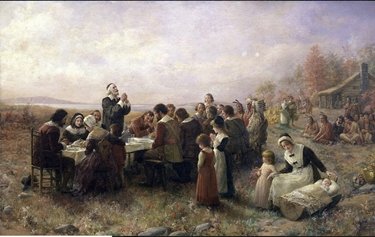
Mike Franc, at Human Events in 2005, identified the real reason for celebration at the first Thanksgiving.
Writing in his diary of the dire economic straits and self-destructive behavior that consumed his fellow Puritans shortly after their arrival, Governor William Bradford painted a picture of destitute settlers selling their clothes and bed coverings for food while others “became servants to the Indians,†cutting wood and fetching water in exchange for “a capful of corn.†The most desperate among them starved, with Bradford recounting how one settler, in gathering shellfish along the shore, “was so weak … he stuck fast in the mud and was found dead in the place.â€
The colony’s leaders identified the source of their problem as a particularly vile form of what Bradford called “communism.†Property in Plymouth Colony, he observed, was communally owned and cultivated. This system (“taking away of property and bringing [it] into a commonwealthâ€) bred “confusion and discontent†and “retarded much employment that would have been to [the settlers’] benefit and comfort.â€
Just how did the Pilgrims solve the problem of famine? In addition to receiving help from the local Indians in farming, they decided allow the private ownership of individual plots of land.
On the brink of extermination, the Colony’s leaders changed course and allotted a parcel of land to each settler, hoping the private ownership of farmland would encourage self-sufficiency and lead to the cultivation of more corn and other foodstuffs.
As Adam Smith would have predicted, this new system worked famously. “This had very good success,†Bradford reported, “for it made all hands very industrious.†In fact, “much more corn was planted than otherwise would have been†and productivity increased. “Women,†for example, “went willingly into the field, and took their little ones with them to set corn.â€
The famine that nearly wiped out the Pilgrims in 1623 gave way to a period of agricultural abundance that enabled the Massachusetts settlers to set down permanent roots in the New World, prosper, and play an indispensable role in the ultimate success of the American experiment.
A profoundly religious man, Bradford saw the hand of God in the Pilgrims’ economic recovery. Their success, he observed, “may well evince the vanity of that conceit…that the taking away of property… would make [men] happy and flourishing; as if they were wiser than God.†Bradford surmised, “God in his wisdom saw another course fitter for them.â€
The real story of Thanksgiving is the triumph of capitalism and individualism over collectivism and socialism, which is the summation of the story of America.