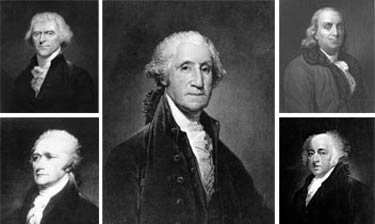
Daily Caller reports that the US Defense Department recently identified another unsavory group of dangerous extremists: our founding fathers.
A Department of Defense teaching guide meant to fight extremism advises students that rather than “dressing in sheets†modern-day radicals “will talk of individual liberties, states’ rights, and how to make the world a better place,†and describes 18th-century American patriots seeking freedom from the British as belonging to “extremist ideologies.â€
The guide comes from documents obtained by Judicial Watch and is authored by the Defense Equal Opportunity Management Institute, a DoD-funded diversity training center.
Under a section titled “extremist ideologies,†the document states, “In U.S. history, there are many examples of extremist ideologies and movements. The colonists who sought to free themselves from British rule and the Confederate states who sought to secede from the Northern states are just two examples.â€
The standard’s symbol of a maiden comes a 1388 poem by Bouden or Baudouin van der Loore, De maghet of Ghend (The Maiden of Ghent), a poem of 240-odd verses, which allegorically describes a war between the city of Ghent and Lodewijk van Maele, Count of Flanders fought between 1379 and 1385.
In a dream, the poet sees a beautiful arbor, located in the middle of a wilderness where two rivers come together: an allusion to the city of Ghent. In the arbor is seated a graceful lady, resplendent in black fur and wearing on her right arm fine gems spelling out the letters: G, H, E, N and D. The maiden is accompanied by a silver lion with golden crown and necklace — the defender of the city. In a clear voice, the maiden sings a heavenly song. But the maiden is soon threatened by a gang of soldiers who covet her purity and her freedom. Across the river appears the leader of the army who turns out to be none other than the father of the beleaguered virgin, i.e., the Count of Flanders. On his banner, he bears a black lion rampant on gold. The poet now warns the lady that they are surprised and surrounded by many enemies. She replies that she has ​​much good company which can come to the rescue if necessary. And when the poet looks around he sees emerging out of the mists from the North East, Christ, St. Jacob, St. Bavo, St. Macharius, and from the East came Saint George and Saint John, and from all directions, all the saints to whom were dedicated in Ghent churches from their exact geographical directions. With the protection of this heavenly host, the maiden has nothing to fear. Still, she hopes for a peaceful end to the conflict with her ​​father. The poet, now awakened, closes with a short prayer to God and the Virgin and all the saints to save the maiden and reconcile her with her ​​father.
Soviet consumers used to dread receiving a car or appliance produced by a Russian factory in the waning days of the month, when the workers, who had idled away their time day after day, suddenly sprang into action to meet the monthly production quota by “storm producing” everything. Production speed went up stratospherically and quality control went down precipitously.
I never knew the Russian word for “storm production,” but M.H. Forsyth supplies it.
[T]oday I discovered a word that is so useful that it describes most, if not all, of my futile life. The word is shturmovshchina, and it may even be worth learning how to spell it.
Shturmovshchina is the practice of working frantically just before a deadline, having not done anything for the last month. The first element means storm or assault, the second is a derogatory suffix.
Shturmovschina originated in the Soviet Union. Factories would be given targets and quotas and other such rot by the state. However, they often weren’t given any tools or raw materials. So they would sit around with their feet up and their tools down waiting until the necessaries arrived, and it was only when the deadline was knocking at the door and the gulag beckoned that they would panic, grab whatever was to hand, and do a really shoddy, half-arsed heap of work.
Gendai-to made in 1929 by Ikkansai Kasama Shigetsugu, formerly owned by General Tomoyuki Yamashita, Conqueror of Singapore, “The Tiger of Malaya.”
Yesterday, one of the correspondents on a Japanese sword email list shared this current commercial offering.
The sword was once carried by General Tomoyuki Yamashita, one of the most successful Japanese commanders of WWII, who captured Malaya and Singapore and who received the largest surrender of British forces on history. General Yamashita was hanged in 1946 for war crimes committed under his command for which many thought he bore no real personal responsibility.
The sword was made in 1929 by Ikkansai Kasama Shigetsugu, arguably the most important and influential swordsmith of the Showa period.
Kurihara Hikosaburo (Akihide) [charged with reviving the craft of swordmaking by the Japanese Prime Minister] invited one of the most famous smiths of the period, Ikkansai Kasama Shigetsugu, to become the chief instructor of Nipponto Tanren Denshu Jo (Japanese Sword Forging Institute) on the grounds of his estate in Akasaka, Tokyo. Shigetsugubecame perhaps the most influential smith to teach there in its entire history, and had the greatest impact on students and teachers alike.
Shigetsugu, born Kasama Yoshikazu on April 1, 1886 in Shizuoka, started his apprenticeship under his uncle Miyaguchi Shigetoshi in 1899. In 1903 he entered the Tokiwamatsu Token Kenkyujo, on the estate of Toyama Mitsuru, to study under Morioka Masayosh. Later he went on to study metallurgy whilst collaborating with Dr. Tawara Kuniichi in formal research on the composition of
Japanese swords. Tazawa built a special laboratory in Tokyo University for the project. The results were published in a book called Nihonto no Kagakuteki Kenkyu (Scientific Research of the Japanese Sword), which remains to this day a definitive scientific work on the subject.
Shigetsugu worked mainly in the Bizen and Soshu traditions of swordmaking, which influenced many of the Denshujo’s students’ later work.
The sword has an origami (authentication paper) from the NBTHK (Nihon Bijutsu Token Hozon Kai), the premier Japanese sword preservation and study society, testifying to its correct attribution and awarding it a rank of HOZON – “Worthy of Preservation.”
Origami ranks are commonly awarded in a step-by-step process, and it seems likely to me that this sword could very possibly receive higher rankings if re-submitted.
The asking price is 2,800,000 JPY, roughly equal to $28,000.
For every Southern boy fourteen years old, not once but whenever he wants it, there is the instant when it’s still not yet two o’clock on that July afternoon in 1863, the brigades are in position behind the rail fence, the guns are laid and ready in the woods and the furled flags are already loosened to break out and Pickett himself with his long oiled ringlets and his hat in one hand probably and his sword in the other looking up the hill waiting for Longstreet to give the word and it’s all in the balance, it hasn’t happened yet, it hasn’t even begun yet, it not only hasn’t begun yet but there is still time for it not to begin against that position and those circumstance which made more men than Garnett and Kemper and Armistead and Wilcox look grave yet it’s going to begin, we all know that, we have come too far with too much at stake and that moment doesn’t need even a fourteen-year-old boy to think This time. Maybe this time with all this much to lose than all this much to gain: Pennsylvania, Maryland, the world, the golden dome of Washington itself to crown with desperate and unbelievable victory the desperate gamble, the cast made two years ago.
As I began to write this, at 4:00 am on May 31, protests against Turkish police—prompted by their crackdown on demonstrators opposing the demolition of Taksim Square’s Gezi Park—were spreading from the heart of Istanbul to the entire country. As of today, the headline on Drudge reads—not inaccurately—TURK BERSERK.
The story began when the government in Ankara decided that Gezi Park, in the center of Istanbul, should be demolished and replaced by a shopping mall. Now, Gezi Park is hardly the Jardins de Luxembourg. It’s a shabby rat trap that you wouldn’t walk through alone at night, and you’re more apt to find used condoms on its lawns than daisies and cowslips. But it is, all the same, one of the last remaining spaces with trees in the neighborhood. …
Of late, almost every sector of the electorate has felt unease about one part or another of ErdoÄŸan’s agenda. Restrictive new alcohol legislation, rammed through parliament, as usual, with contempt for the minority opposition, has prompted outrage; the so-called peace process with the PKK, which no one understands, has caused great unease. Anxiety is growing as well, not only about press censorship, but also about the prosecution of those who insult government officials or “Islamic values†on social media. …
ErdoÄŸan, it seems, severely underestimated the degree of his subjects’ displeasure, confident that God, a strong economy, and a weak opposition were all he needed to ensure his hegemony. He brusquely dismissed the tree protesters’ concerns: “We’ve made our decision, and we will do as we have decided.†An AKP parliamentarian then unwisely announced that some young people “are in need of gas.â€
So the Robocops once again used pepper spray and water cannon against the protesters. A photographer captured them spraying tear gas directly into the face of a vulnerable, middle-aged woman in a pretty red dress. The photo went viral and enraged the public: she was clearly no hooligan. As one conservative journalist noted, she looked “decent.â€
Rather than dispersing for good, the protesters returned—and more gathered to support them. This wasn’t supposed to happen. The police panicked. At dawn, they attacked with pronounced violence, injuring not only students, but also journalists and opposition members of parliament who had come to show their support.
Jason Goodwin gives us a history lesson which explains the form taken by Turkish protests.
One lesson that can be drawn from Ottoman history is that if the people require tribunes, so do their rulers. For many centuries the janissaries, despite their growing licentiousness and arrogance, performed that function: soldiers, who dominated civic society, could now and then express the popular mood. Their method was to overturn their great regimental cauldrons, and beat on them with spoons: the terrible sound of the janissaries in mutiny drifted from the barracks to the palace, and the sultan took note. Then in 1826 Sultan Mahmud II destroyed them, to a man.
Today, housewives in Beyoglu bang their pots and pans together at their windows. But Erdogan doesn’t seem to be listening.
Once the janissaries were eradicated, Mahmud and his successors were less beholden to the people. They furiously modernised the Ottoman Empire, running roughshod over popular disquiet, and collapsed unlamented in a puff of smoke at the end of World War I.
The Janissaries had their own tree, and their own traditions – and they, like the empire they served, are gone. Erdogan – like Mahmud II – still wants his mall.
————————————-
TENCERE TAVA HAVASI (Sound of Pots and Pans) / Kardeş Türküler
In 1905, we had gold money, like this $20 Double Eagle.
I’m right about Immigration, and unfortunately much of the rest of the Right, El Rushbo, Michelle Malkin, Victor Davis Hanson, Charles Krauthammer, John Hinderaker, and so on ad inifinitum are wrong, and I’m prepared to prove it.
Lights on in your heads, so-called conservatives, and pay attention. I’m going to deliver a series of arguments, and I’m going to demolish the nativist arguments one by one.
Let’s start off by properly identifying what kind of policy on immigration is the authentic American traditional policy and what is the nature and etiology of our current immigration laws.
One common rubric in my own thinking on American politics and public policy consists of asking myself: How did we used to do things?
I am firmly persuaded that, in all sorts of areas, Americans used to do things right, but along came Progressivism, small-l liberalism, socialism, crankery, and Modernism, and today we go around living under dysfunctional institutions, operated commonly on the basis of illusions and bad ideas, and we live buried under a colossal pile of taxes and regulations which our ancestors would never have put up with.
What is the correct policy on the currency? We ought to have the kind of currency we had back in 1905, real money minted in gold and silver or paper certificates immediately exchangeable for real money, ideally with images of Indians, Liberty, and Big Game animals on all our coins.
So, tell me, nativists, how did we used to handle immigration in the good old days when America was America and the country was free and ruled by common sense?
The answer is that, before 1900, immigration (with the exception of non-European racial groups believed in the period to be unassimilable) was unregulated. If you weren’t Chinese or Japanese and you wanted to come to the USA to get ahead, the door was wide open. In 1903, the kind of terrorism afflicting Europe and America at the time produced the Anarchist Exclusion Act. That act prohibited immigration to the United States by Anarchists, epileptics, beggars, and pimps.
We didn’t even have standard Naturalization forms and procedures until the passage of the Naturalization Act of 1906, which for the first time required some knowledge of English for Naturalization and which formalized and federalized the Naturalization process.
So, federal administration of immigration really began in 1906. And the really meaningful restrictions on Immigration were passed, out of panic inspired by the rise of Bolshevism and the Russian Revolution, in 1921 (the Emergency Quota Act) and in 1924 (the Johnson Act). It was these laws which set annual limits on the numbers of people who could enter, which limits were originally small percentages of the numbers of persons from particular countries already resident in the United States.
Here’s a major news flash, fellow conservatives. The 1920s laws placed no quotas on immigration from the Western Hemisphere. All the Mexicans and Salvadorans who wanted to come here could do so, until the Hart-Callar Act of 1965, which repealed the old racial exclusions and the 1920s quota system. Limiting immigration racially and on the basis of current representation in the US population was, in the Civil Rights era, deemed politically incorrect and “an embarrassment.” The new law opened the door to immigration from Africa, Asia, and the Middle East.
So, what is the real status of our respective positions?
I favor going back to the old, traditional American virtually-unregulated pre-1906 regime. I’d favor going back farther, but I think we have a need to exclude Muslims resembling the need in the early 1900s to exclude Anarchists. I support the real historical, traditional American open door immigration policy.
The rest of you folks are jumping up and down, supporting federally-managed population engineering, federal interference with the free movement of labor, and federal violation of the basic right to offer and accept employment, and government coercive resistance to organic and voluntary economic processes, all on behalf of some kind of half-baked notions of preserving an imaginary and impossible-to-preserve point of population and cultural stasis. You are enthusiastically supporting Progressive Era Statism and, even worse, the policies of a really bad 1960s democrat-passed immigration law, while I want to go right back to 1905. Obviously, I’m the real conservative, and the rest of you fellows, even poor old Rush, have gotten yourselves muddled and confused about what the real conservative position actually is.
This is long enough for now. I’ll discuss some of the anti-immigration arguments, like the “law-and-order” argument, in later postings.