Category Archive 'History'
09 Dec 2011


Obama first tried to emulate Truman by running against a Republican (majority holding one house of) Congress. More recently, he tried imitating Teddy Roosevelt in his last, sad, radical incarnation, going to Osawatomie, Kansas and delivering a divisive, populist, class warfare-themed speech harkening back to to turn of the last century Progressivism.
When Paul A. Rahe looks at Obama, though, he isn’t reminded of Harry Truman or Teddy Roosevelt so much as of John V. Lindsay, a similar glamor boy wimp with a similarly polished Ivy League style, who similarly chose to represent a coalition of the establishment elite and minority canaille in waging class warfare against the middle and the working class.
[I]t was Lindsay who had spent the city into the ground. In 1967, the city budget was $4.6 billion; in 1971, it was $7.8 billion. By 1974, the year Beame took over, it was $10 billion. Lindsay introduced the city’s first income tax and commuter tax, but the revenues he raised were never enough. By 1974, the annual budget deficit had climbed to $1.5 billion. Fred Siegel got it right when he described Lindsay as the worst Mayor New York had in the twentieth century and went on to remark that he “wasn’t incompetent or foolish or corrupt, but he was actively destructive.”
Lindsay’s natural constituency was the socially liberal WASP elite and those within the Jewish community who had joined them at the top of the social pyramid or aspired to do so. To win election and re-election as Mayor, he had to hold onto that constituency, split the Democratic Party, and win over one of the more substantial elements composing it. This he did by driving a wedge between working-class and lower middle class whites, on the one hand, and African-Americans and Puerto Ricans, on the other – and he managed to attract support from the latter by massively expanding the welfare rolls and increasing dramatically the patronage that found its way into their hands. To secure his re-election, Lindsay was prepared to bring the city to its knees.
And exactly like John Lindsay, Barack Obama is leaving spectacular and unprecedented economic ruin in his wake and will be remembered as the most despised holder of the same office in a century.

05 Dec 2011
It’s vital that public schools teach Evolution. Otherwise, children might grow up unable to follow the plotline of this video.
Hat tip to Colossal Art & Design.
29 Nov 2011

The discovery of a new mitochondrial DNA (mtDNA) subclade (C1e) in Iceland of Haplogroup C, characteristic of population groups found in Northeast Asia and of Amerindians is identified in a new paper in the American Journal of Physical Anthropology as likely evidence of the presence in Iceland of matrilineal descent from American Indians encountered by Viking explorers of North America around the year 1000 A.D.
Abstract
Although most mtDNA lineages observed in contemporary Icelanders can be traced to neighboring populations in the British Isles and Scandinavia, one may have a more distant origin. This lineage belongs to haplogroup C1, one of a handful that was involved in the settlement of the Americas around 14,000 years ago. Contrary to an initial assumption that this lineage was a recent arrival, preliminary genealogical analyses revealed that the C1 lineage was present in the Icelandic mtDNA pool at least 300 years ago. This raised the intriguing possibility that the Icelandic C1 lineage could be traced to Viking voyages to the Americas that commenced in the 10th century. In an attempt to shed further light on the entry date of the C1 lineage into the Icelandic mtDNA pool and its geographical origin, we used the deCODE Genetics genealogical database to identify additional matrilineal ancestors that carry the C1 lineage and then sequenced the complete mtDNA genome of 11 contemporary C1 carriers from four different matrilines. Our results indicate a latest possible arrival date in Iceland of just prior to 1700 and a likely arrival date centuries earlier. Most surprisingly, we demonstrate that the Icelandic C1 lineage does not belong to any of the four known Native American (C1b, C1c, and C1d) or Asian (C1a) subclades of haplogroup C1. Rather, it is presently the only known member of a new subclade, C1e. While a Native American origin seems most likely for C1e, an Asian or European origin cannot be ruled out.
Discovery.com
Hat tip to Karen L. Myers.
24 Nov 2011

As published in the Massachusetts Centinel, Wednesday, October 14, 1789
24 Nov 2011

Mike Franc, at Human Events in 2005, identified the real reason for celebration at the first Thanksgiving.
Writing in his diary of the dire economic straits and self-destructive behavior that consumed his fellow Puritans shortly after their arrival, Governor William Bradford painted a picture of destitute settlers selling their clothes and bed coverings for food while others “became servants to the Indians,†cutting wood and fetching water in exchange for “a capful of corn.†The most desperate among them starved, with Bradford recounting how one settler, in gathering shellfish along the shore, “was so weak … he stuck fast in the mud and was found dead in the place.â€
The colony’s leaders identified the source of their problem as a particularly vile form of what Bradford called “communism.†Property in Plymouth Colony, he observed, was communally owned and cultivated. This system (“taking away of property and bringing [it] into a commonwealthâ€) bred “confusion and discontent†and “retarded much employment that would have been to [the settlers’] benefit and comfort.â€
Just how did the Pilgrims solve the problem of famine? In addition to receiving help from the local Indians in farming, they decided allow the private ownership of individual plots of land.
On the brink of extermination, the Colony’s leaders changed course and allotted a parcel of land to each settler, hoping the private ownership of farmland would encourage self-sufficiency and lead to the cultivation of more corn and other foodstuffs.
As Adam Smith would have predicted, this new system worked famously. “This had very good success,†Bradford reported, “for it made all hands very industrious.†In fact, “much more corn was planted than otherwise would have been†and productivity increased. “Women,†for example, “went willingly into the field, and took their little ones with them to set corn.â€
The famine that nearly wiped out the Pilgrims in 1623 gave way to a period of agricultural abundance that enabled the Massachusetts settlers to set down permanent roots in the New World, prosper, and play an indispensable role in the ultimate success of the American experiment.
A profoundly religious man, Bradford saw the hand of God in the Pilgrims’ economic recovery. Their success, he observed, “may well evince the vanity of that conceit…that the taking away of property… would make [men] happy and flourishing; as if they were wiser than God.†Bradford surmised, “God in his wisdom saw another course fitter for them.â€
The real story of Thanksgiving is the triumph of capitalism and individualism over collectivism and socialism, which is the summation of the story of America.

16 Nov 2011

Chairs were made from bears
From Buzz Feed: “30 Ways (some facetious) That the World Used to be Cooler.”
14 Nov 2011
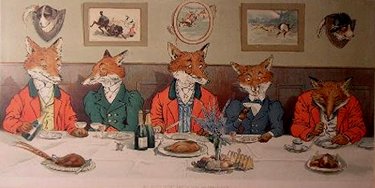
Harry B. Nielson, Mr. Fox’s Hunt Breakfast on Christmas Day, chromolithograph print published in Vanity Fair, Christmas, 1897
The hunter characteristically admires, and even identifies with, his quarry, and that sense of identification commonly leads to the visualization in the hunter’s imagination of the animal object of the chase as a fellow sportsman, participating in the hunt with equal pleasure and enthusiasm and equal relish of tradition.
The fantasy of the quarry-sportsman gives rise to one of the most popular and best-loved genres of sporting art, images of La Chasse Renversé, the roles of hunters and hunted reversed. No foxhunter’s den is completely furnished without a humorous print like A.C. Havell’s Foxhunter’s Dream or the beloved Mr. Fox’s Hunt Breakfast (above).
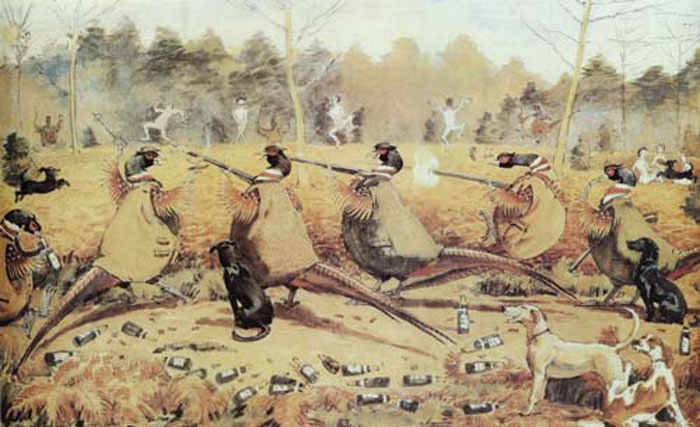
The same comedic effect, and the same sportsman’s pleasure in thinking of his adversary in the field as fellow sportsman, can be found in shooting prints, like the very well-known contemporary print by Alexander Charles-Jones “Cocks Only,” which gleefully depicts a line of Ringnecked Pheasants in hunting vests, smoking cigars and drinking while peppering a discomfited group of incoming naked men.
Another classic example of the same humorous genre by Snaffles, published in Hoghunter’s Annual in the 1930s, depicts a couple of senior ranking boars smoking cigars and admiring trophy mounts of British officers acquired in the hunting field.
I had assumed, without any special investigation or thought on the matter, that this genre of sporting humor was specifically British and Victorian, but I was decidedly wrong.
What I have referred to as La Chasse Renversé is, at least, a common medieval artistic humorous subject, found in all sorts of forms and expressions, in paintings, sculpture, manuscript illuminations, and even tiles, representing a variation of all kinds of humorous reversals referred to in general as Le Monde Renversé. I feel sure, at this point, that a thorough search would produce similar examples of sporting facetiae from Classical Antiquity.
Some excellent examples of the hare turning the tables on the hunter were posted at Archivalia.

The Hunter’s Doom,” marginal illumination to The Romance of Alexander by Jehan de Grise and his atelier, 1338-44, Bodleiana Ms. 264, fol. 81v
11 Nov 2011

—this post is repeated annually—
WWI came to an end by an armistice arranged to occur at the eleventh hour of the eleventh day of the eleventh month of 1918. The date and time, selected at a point in history when mens’ memories ran much longer, represented a compliment to St. Martin, patron saint of soldiers, and thus a tribute to the fighting men of both sides. The feast day of St. Martin, the Martinmas, had been for centuries a major landmark in the European calendar, a date on which leases expired, rents came due; and represented, in Northern Europe, a seasonal turning point after which cold weather and snow might be normally expected.
It fell about the Martinmas-time, when the snow lay on the borders…
—-Old Song.

From Robert Chambers, The Book of Days, 1869:
St. Martin, the son of a Roman military tribune, was born at Sabaria, in Hungary, about 316. From his earliest infancy, he was remarkable for mildness of disposition; yet he was obliged to become a soldier, a profession most uncongenial to his natural character. After several years’ service, he retired into solitude, from whence he was withdrawn, by being elected bishop of Tours, in the year 374.
The zeal and piety he displayed in this office were most exemplary. He converted the whole of his diocese to Christianity, overthrowing the ancient pagan temples, and erecting churches in their stead. From the great success of his pious endeavours, Martin has been styled the Apostle of the Gauls; and, being the first confessor to whom the Latin Church offered public prayers, he is distinguished as the father of that church. In remembrance of his original profession, he is also frequently denominated the Soldier Saint.
The principal legend, connected with St. Martin, forms the subject of our illustration, which represents the saint, when a soldier, dividing his cloak with a poor naked beggar, whom he found perishing with cold at the gate of Amiens. This cloak, being most miraculously preserved, long formed one of the holiest and most valued relics of France; when war was declared, it was carried before the French monarchs, as a sacred banner, and never failed to assure a certain victory. The oratory in which this cloak or cape—in French, chape—was preserved, acquired, in consequence, the name of chapelle, the person intrusted with its care being termed chapelain: and thus, according to Collin de Plancy, our English words chapel and chaplain are derived.
The canons of St. Martin of Tours and St. Gratian had a lawsuit, for sixty years, about a sleeve of this cloak, each claiming it as their property. The Count Larochefoucalt, at last, put an end to the proceedings, by sacrilegiously committing the contested relic to the flames. …
The festival of St. Martin, happening at that season when the new wines of the year are drawn from the lees and tasted, when cattle are killed for winter food, and fat geese are in their prime, is held as a feast-day over most parts of Christendom. On the ancient clog almanacs, the day is marked by the figure of a goose; our bird of Michaelmas being, on the continent, sacrificed at Martinmas. In Scotland and the north of England, a fat ox is called a mart, clearly from Martinmas, the usual time when beeves are killed for winter use. In ‘Tusser’s Husbandry, we read:
When Easter comes, who knows not then,
That veal and bacon is the man?
And Martilmass beef doth bear good tack,
When country folic do dainties lack.’
Barnaby Googe’s translation of Neogeorgus, shews us how Martinmas was kept in Germany, towards the latter part of the fifteenth century
‘To belly chear, yet once again,
Doth Martin more incline,
Whom all the people worshippeth With roasted geese and wine.
Both all the day long, and the night, Now each man open makes
His vessels all, and of the must, Oft times, the last he takes,
Which holy Martin afterwards Alloweth to be wine,
Therefore they him, unto the skies, Extol with praise divine.’
A genial saint, like Martin, might naturally be expected to become popular in England; and there are no less than seven churches in London and Westminster, alone, dedicated to him. There is certainly more than a resemblance between the Vinalia of the Romans, and the Martinalia of the medieval period.
Indeed, an old ecclesiastical calendar, quoted by Brand, expressly states under 11th November: ‘The Vinalia, a feast of the ancients, removed to this day. Bacchus in the figure of Martin.’ And thus, probably, it happened, that the beggars were taken from St. Martin, and placed under the protection of St. Giles; while the former became the patron saint of publicans, tavern-keepers, and other ‘dispensers of good eating and drinking. In the hall of the Vintners’ Company of London, paintings and statues of St. Martin and Bacchus reign amicably together side by side.
On the inauguration, as lord mayor, of Sir Samuel Dashwood, an honoured vintner, in 1702, the company had a grand processional pageant, the most conspicuous figure in which was their patron saint, Martin, arrayed, cap-Ã -pie, in a magnificent suit of polished armour; wearing a costly scarlet cloak, and mounted on a richly plumed and caparisoned white charger: two esquires, in rich liveries, walking at each side. Twenty satyrs danced before him, beating tambours, and preceded by ten halberdiers, with rural music. Ten Roman lictors, wearing silver helmets, and carrying axes and fasces, gave an air of classical dignity to the procession, and, with the satyrs, sustained the bacchanalian idea of the affair.
A multitude of beggars, ‘howling most lamentably,’ followed the warlike saint, till the procession stopped in St. Paul’s Churchyard. Then Martin, or his representative at least, drawing his sword, cut his rich scarlet cloak in many pieces, which he distributed among the beggars. This ceremony being duly and gravely performed, the lamentable howlings ceased, and the procession resumed its course to Guildhall, where Queen Anne graciously condescended to dine with the new lord mayor.
10 Nov 2011

Founded November 10, 1775.
——————————
Maj. Gen. John A. Lejeune’s Birthday Message
RPS ORDERS
No. 47 (Series 1921)
HEADQUARTERS U.S. MARINE CORPS
Washington, November 1, 1921
759. The following will be read to the command on the 10th of November, 1921, and hereafter on the 10th of November of every year. Should the order not be received by the 10th of November, 1921, it will be read upon receipt.
(1) On November 10, 1775, a Corps of Marines was created by a resolution of Continental Congress. Since that date many thousand men have borne the name “Marine”. In memory of them it is fitting that we who are Marines should commemorate the birthday of our corps by calling to mind the glories of its long and illustrious history.
(2) The record of our corps is one which will bear comparison with that of the most famous military organizations in the world’s history. During 90 of the 146 years of its existence the Marine Corps has been in action against the Nation’s foes. From the Battle of Trenton to the Argonne, Marines have won foremost honors in war, and is the long eras of tranquility at home, generation after generation of Marines have grown gray in war in both hemispheres and in every corner of the seven seas, that our country and its citizens might enjoy peace and security.
(3) In every battle and skirmish since the birth of our corps, Marines have acquitted themselves with the greatest distinction, winning new honors on each occasion until the term “Marine” has come to signify all that is highest in military efficiency and soldierly virtue.
(4) This high name of distinction and soldierly repute we who are Marines today have received from those who preceded us in the corps. With it we have also received from them the eternal spirit which has animated our corps from generation to generation and has been the distinguishing mark of the Marines in every age. So long as that spirit continues to flourish Marines will be found equal to every emergency in the future as they have been in the past, and the men of our Nation will regard us as worthy successors to the long line of illustrious men who have served as “Soldiers of the Sea” since the founding of the Corps.
JOHN A. LEJEUNE,
Major General Commandant
————————————-
The Magic of “a Few Good Men”
————————————-
The Old Corps
Tun Tavern, Philadelphia, Pennsylvania, November 10th 1775
Captains Nicholas and Mullens, having been tasked by the 2nd Continental Congress to form 2 battalions of Marines, set up the Corps’ first recruiting station in the tavern.
The first likely prospect was, in typical recruiters fashion, promised a “life of high adventure in service to Country and Corps”. And, as an extra bonus: If he enlisted now he would receive a free tankard of ale….
The recruit gladly accepted the challenge and, receiving the free tankard of ale, was told to wait at the corner table for orders.
The first Marine sat quietly at the table sipping the ale when he was joined by another young man, who had two tankards of ale.
The first Marine looked at the lad and asked where he had gotten the two tankards of ale?
The lad replied that he had just joined this new outfit called the Continental Marines, and as an enlistment bonus was given two tankards of ale.
The first Marine took a long hard look at the second Marine and said, ” It wasn’t like that in the old Corps.”
An annual post.
06 Nov 2011

Ready to charge.
William Kristol rather eloquently expresses American conservatives’ yearning for a decisive, game-changing victory next year, a decisive victory capable of renewing both the country’s morale and economic prospects and delivering the country for another generation from socialism and the misrule of sophisters, calculators, and economists, but warns that the fates are not going to be as kind as we would wish.
For every Southern boy 14 years old, not once but whenever he wants it, there is the instant when it’s still not yet two o’clock on that July afternoon in 1863, the brigades are in position behind the rail fence, the guns are laid and ready in the woods and the furled flags are already loosened to break out and Pickett himself with his long oiled ringlets and his hat in one hand probably and his sword in the other looking up the hill waiting for Longstreet to give the word and it’s all in the balance, it hasn’t happened yet, it hasn’t even begun yet, it not only hasn’t begun yet but there is still time for it not to begin against that position and those circumstances which made more men than Garnett and Kemper and Armstead and Wilcox look grave yet it’s going to begin, we all know that, we have come too far with too much at stake and that moment doesn’t need even a 14-year-old boy to think This time. Maybe this time with all this much to lose and all this much to gain: Pennsylvania, Maryland, the world, the golden dome of Washington itself to crown with desperate and unbelievable victory the desperate gamble, the cast made two years ago .  .  .
—William Faulkner, Intruder in the Dust
For every American conservative, not once but whenever he wants it, it’s always the evening of November 4, 1980, the instant when we knew Ronald Reagan, the man who gave the speech in the lost cause of 1964, leader of the movement since 1966, derided by liberal elites and despised by the Republican establishment, the moment when we knew—he’d won, we’d won, the impossible dream was possible, the desperate gamble of modern conservatism might pay off, conservatism had a chance, America had a chance. And then, a decade later—the Cold War won, the economy revived, America led out of the abyss, we’d come so far with so much at stake—conservatism vindicated, America restored, a desperate and unbelievable victory for the cast made so many years ago against such odds.
But that was then, and this is now. Now is 2012, and it seems clear that 2012 isn’t going to be another 1980.
He’s right. We haven’t got a Reagan. I think we are going to have to hope that any Republican can decisively defeat Barack Obama and that any Republican (even one from Massachusetts) will be obliged to run and govern as an arch conservative. While we will not have a Reagan, we can have an administration, like Reagan’s, drawn heavily from the Conservative Movement and dedicated to bringing about a fundamental change in direction.
Fortunately, the democrats have not the ground, the advantage in strength, or the artillery that General Meade had, and if 2012 is not going to be 1980, I think we can feel safe that neither will it be July 3, 1863.
03 Nov 2011

A piece of Iceland spar.
A paper published on Tuesday in Proceedings of the Royal Society A: Mathematical Physical & Engineering Sciences may offer the explanation of how Viking mariners a thousand years ago were able to navigate the North Atlantic between Europe and the Old World, traveling great distances by sea in high latitudes in which cloudy weather frequently denied visibility of the sun.
Yahoo News explains:
Before the invention of the magnetic compass, navigating with a sundial would have been difficult, particularly on overcast days. Ancient Viking lore suggests that they had a magical tool to find the sun, even when the star was hidden.
Researchers have now discovered the crystal that would have made such a magical apparatus possible. The Vikings could have used a common calcite crystal, called an Icelandic spar, to find the sun in the high latitudes where they would have had to battle long twilights and cloudy skies to navigate. This special “sunstone” could find the direction of the sun even when it was out of view because it plays a trick with the light.
“The Vikings could have discovered this, simply by choosing a transparent crystal and looking through it through a small hole in a screen,” study researcher Guy Ropars wrote in an email to LiveScience. “The understanding of the complete mechanism and the knowledge of the polarization of light is not necessary.”
To use the crystal, the Vikings would have held the stone up to the center of the sky (from their perspective). When sunlight hits the crystal, that light gets polarized and broken into an “ordinary” and an “extraordinary” beam.
On a clear day, the Vikings would have rotated the crystal until the two beams lined up. Since these two beams line up and have the same brightness at only one angle, by noting where the sun is when this happens the Vikings could establish a reference point that could be used even when the sun wasn’t visible.
There are several other types of crystal that have this same property, but they wouldn’t have been too useful because they aren’t as clear or as common, the researchers said. The Icelandic spar that the researchers analyzed is very common along the coasts of Iceland, and is also common today in Brazil and Mexico.
While none of these Icelandic spar crystals has been found in a Viking settlement, one was recently discovered in an Elizabethan shipwreck from 1592 in the English Channel.
Guy Ropars, Gabriel Gorre, Albert Le Floch, Jay Enoch and Vasudevan Lakshminarayanan, “A depolarizer as a possible precise sunstone for Viking navigation by polarized skylight:”
Summary
Viking navigation from Norway to America in the northern latitudes remains a mystery for physicists, historians and archaeologists. Polarimetric methods using absorbing dichroic crystals as polarizers to detect a hidden Sun direction using the polarized skylight have led to controversies. Indeed, these techniques may lack in sensitivity, especially when the degree of polarization is low. Here, we demonstrate theoretically and experimentally that using the transparent common Iceland spar as a depolarizer, the Vikings could have performed a precise navigation under different conditions. Indeed, when simply rotated, such a birefringent crystal can completely depolarize, at the so-called isotropy point, any partially polarized state of light, allowing us to guess the direction of the Sun. By equalizing the intensities of the ordinary and extraordinary beams at the isotropy point, we show that the Sun direction can be determined easily, thanks to a simple sensitive differential two-image observation. A precision of a few degrees could be reached even under dark crepuscular conditions. The exciting recent discovery of such an Iceland spar in the Alderney Elizabethan ship that sank two centuries before the introduction of the polarization of light in optics may support the use of the calcite crystal for navigation purposes.
24 Oct 2011

Gramarrian Henry Hitchings, in the Wall Street Journal, takes an interesting look at the history (and future) of punctuation marks.
Early manuscripts had no punctuation at all, and those from the medieval period suggest haphazard innovation, with more than 30 different marks. The modern repertoire of punctuation emerged as printers in the 15th and 16th centuries strove to limit this miscellany.
Many punctuation marks are less venerable than we might imagine. Parentheses were first used around 1500, having been observed by English writers and printers in Italian books. Commas were not employed until the 16th century; in early printed books in English one sees a virgule (a slash like this /), which the comma replaced around 1520.
Other marks enjoyed briefer success. There used to be a clunky paragraph sign known as a pilcrow ; initially it was a C with a slash drawn through it. Similar in its effect was one of the oldest punctuation symbols, a horizontal ivy leaf called a hedera . It appears in 8th-century manuscripts, separating text from commentary, and after a period out of fashion it made an unexpected return in early printed books. Then it faded from view.
Another mark, now obscure, is the point d’ironie, sometimes known as a “snark.” A back-to-front question mark, it was deployed by the 16th-century printer Henry Denham to signal rhetorical questions, and in 1899 the French poet Alcanter de Brahm suggested reviving it. More recently, the difficulty of detecting irony and sarcasm in electronic communication has prompted fresh calls for a revival of the point d’ironie. But the chances are slim that it will make a comeback. …
How might punctuation now evolve? The dystopian view is that it will vanish. I find this conceivable, though not likely.
Read the whole thing.
I liked that hedera and I mean to start using it.
/div>
Feeds
|