Almost as many countries arrogate the honour of having been the natal soil of St. Patrick, as made a similar claim with respect to Homer. Scotland, England, France, and Wales, each furnish their respective pretensions: but, whatever doubts may obscure his birthplace, all agree in stating that, as his name implies, he was of a patrician family. He was born about the year 372, and when only sixteen years of age, was carried off by pirates, who sold him into slavery in Ireland; where his master employed him as a swineherd on the well-known mountain of Sleamish, in the county of Antrim. Here he passed seven years, during which time he acquired a knowledge of the Irish language, and made himself acquainted with the manners, habits, and customs of the people. Escaping from captivity, and, after many adventures, reaching the Continent, he was successively ordained deacon, priest, and bishop: and then once more, with the authority of Pope Celestine, he returned to Ireland to preach the Gospel to its then heathen inhabitants.
The principal enemies that St. Patrick found to the introduction of Christianity into Ireland, were the Druidical priests of the more ancient faith, who, as might naturally be supposed, were exceedingly adverse to any innovation. These Druids, being great magicians, would have been formidable antagonists to any one of less miraculous and saintly powers than Patrick. Their obstinate antagonism was so great, that, in spite of his benevolent disposition, he was compelled to curse their fertile lands, so that they became dreary bogs: to curse their rivers, so that they produced no fish: to curse their very kettles, so that with no amount of fire and patience could they ever be made to boil; and, as a last resort, to curse the Druids themselves, so that the earth opened and swallowed them up. …
The greatest of St. Patrick’s miracles was that of driving the venomous reptiles out of Ireland, and rendering the Irish soil, for ever after, so obnoxious to the serpent race, that they instantaneously die on touching it. Colgan seriously relates that St. Patrick accomplished this feat by beating a drum, which he struck with such fervour that he knocked a hole in it, thereby endangering the success of the miracle. But an angel appearing mended the drum: and the patched instrument was long exhibited as a holy relic. …
When baptizing an Irish chieftain, the venerable saint leaned heavily on his crozier, the steel-spiked point of which he had unwittingly placed on the great toe of the converted heathen. The pious chief, in his ignorance of Christian rites, believing this to be an essential part of the ceremony, bore the pain without flinching or murmur; though the blood flowed so freely from the wound, that the Irish named the place St. fhuil (stream of blood), now pronounced Struill, the name of a well-known place near Downpatrick. And here we are reminded of a very remarkable fact in connection with geographical appellations, that the footsteps of St. Patrick can be traced, almost from his cradle to his grave, by the names of places called after him.
Thus, assuming his Scottish origin, he was born at Kilpatrick (the cell or church of Patrick), in Dumbartonshire. He resided for some time at Dalpatrick (the district or division of Patrick), in Lanarkshire; and visited Crag-phadrig (the rock of Patrick), near Inverness. He founded two churches, Kirkpatrick at Irongray, in Kireudbright; and Kirkpatrick at Fleming, in Dumfries: and ultimately sailed from Portpatrick, leaving behind him such an odour of sanctity, that among the most distinguished families of the Scottish aristocracy, Patrick has been a favourite name down to the present day.
Arriving in England, he preached in Patterdale (Patrick’s dale), in Westmoreland: and founded the church of Kirkpatrick, in Durham. Visiting Wales, he walked over Sarn-badrig (Patrick’s causeway), which, now covered by the sea, forms a dangerous shoal in Carnarvon Bay: and departing for the Continent, sailed from Llan-badrig (the church of Patrick), in the island of Anglesea. Undertaking his mission to convert the Irish, he first landed at Innis-patrick (the island of Patrick), and next at Holmpatrick, on the opposite shore of the mainland, in the county of Dublin. Sailing northwards, he touched at the Isle of Man, sometimes since, also, called. Innis-patrick, where he founded another church of Kirkpatrick, near the town of Peel. Again landing on the coast of Ireland, in the county of Down, he converted and baptized the chieftain Dichu, on his own threshing-floor. The name of the parish of Saul, derived from Sabbal-patrick (the barn of Patrick), perpetuates the event. He then proceeded to Temple-patrick, in Antrim, and from thence to a lofty mountain in Mayo, ever since called Croagh-patrick.
He founded an abbey in East Meath, called Domnach-Padraig (the house of Patrick), and built a church in Dublin on the spot where St. Patrick’s Cathedral now stands. In an island of Lough Deng, in the county of Donegal, there is St. Patrick’s Purgatory: in Leinster, St. Patrick’s Wood; at Cashel, St. Patrick’s Rock; the St. Patrick’s Wells, at which the holy man is said to have quenched his thirst, may be counted by dozens. He is commonly stated to have died at Saul on the 17th of March 493, in the one hundred and twenty-first year of his age. …
The shamrock, or small white clover (trifolium repens of botanists), is almost universally worn in the hat over all Ireland, on St. Patrick’s day. The popular notion is, that when St. Patrick was preaching the doctrine of the Trinity to the pagan Irish, he used this plant, bearing three leaves upon one stem, as a symbol or illustration of the great mystery. To suppose, as some absurdly hold, that he used it as an argument, would be derogatory to the saint’s high reputation for orthodoxy and good sense: but it is certainly a curious coincidence, if nothing more, that the trefoil in Arabic is called skamrakh, and was held sacred in Iran as emblematical of the Persian Triads. Pliny, too, in his Natural History, says that serpents are never seen upon trefoil, and it prevails against the stings of snakes and scorpions. This, considering St. Patrick’s connexion with snakes, is really remarkable, and we may reasonably imagine that, previous to his arrival, the Irish had ascribed mystical virtues to the trefoil or shamrock, and on hearing of the Trinity for the first time, they fancied some peculiar fitness in their already sacred plant to shadow forth the newly revealed and mysterious doctrine. …
In the Galtee or Gaultie Mountains, situated between the counties of Cork and Tipperary, there are seven lakes, in one of which, called Lough Dilveen, it is said Saint Patrick, when banishing the snakes and toads from Ireland, chained a monster serpent, telling him to remain there till Monday.
The serpent every Monday morning calls out in Irish, ‘It is a long Monday, Patrick.’
That St Patrick chained the serpent in Lough Dilveen, and that the serpent calls out to him every Monday morning, is firmly believed by the lower orders who live in the neighbourhood of the Lough.
An iron battle axe of Viking type with its original wooden haft still intact. Circa 10th /11th century in date, it was recovered from the Robe River, Co Mayo, Ireland.
James Delingpole is not on board with the celebrations for the victory of the Irish Gay Marriage Referendum.
Which is worse:
a) opposing gay marriage
or
b) abducting a mother of ten in front of her weeping children, suffocating her with a plastic bag, shooting her in the head and burying her in an unmarked grave?
Well, obviously we know the answer is a) because we can see it in the above heartwarming picture, taken during the recent Irish referendum on same sex marriage.
It shows gay rights activist Rory O’Neill (aka drag queen Panti Bliss) sharing a lovely group hug with David Norris (an Irish Senator who lobbied for the 1993 decriminalisation of gay sex) and, of course, with the unmistakably vulpine figure of Gerry Adams, the sinister Sinn Fein president who continues to deny he was ever a member of the IRA.
Aaaahhh. Doesn’t it make you feel all warm and gooey inside?
Well it doesn’t have that effect on me, I’m afraid. In fact, if I’d voted “yes†in the Irish referendum and someone had subsequently showed me that photo, I’m pretty sure I’d want to stick an orange in my mouth, tie a noose around my neck and top myself for the very shame of it.
For, if a picture is worth a thousand words, that particular one is worth more like a hundred-thousand-word book entitled “Absolutely Everything That Is Wrong With The Modern World.â€
In the course of revelling over the referendum victory of sodomitical matrimony in Ireland, the editorial board of the New York Times proved that the appointment of Caligula’s horse as Roman consul could actually be outdone in modernity.
In a statement conceding defeat, the Iona Institute, the main opposition group, said it would continue to affirm “the importance of biological ties and of motherhood and fatherhood.†The absurdity of that statement speaks for itself.
The alleged absurdity of that statement may be obvious to deranged (and probably sexually perverted) members of a community of fashion in the last stages of decadence, but normal people would describe a reference to “the importance of the biological ties of parenthood” as patently obvious, rather than absurd.
The unlimited arrogance and egomanaical grandiosity of these kinds of people, who routinely demonstrate their own total moral and intellectual unfitness for any positions of influence or responsibility, cries out to heaven for vengeance.
This anonymous poem is written in the margins of an Early Irish manuscript that now resides in the monastery of St. Gall in Switzerland. Most likely dating from around 850 AD, the text may have been complied in a northern Irish monastery such as Nendrum or Bangor (both in Co. Down). In a just a few, short words it conveys the sense of dread that was permeating through Irish monastic communities in the 9th century AD. During this period Viking raids were an every present danger and the Irish Annals’ record numerous attacks on monasteries.
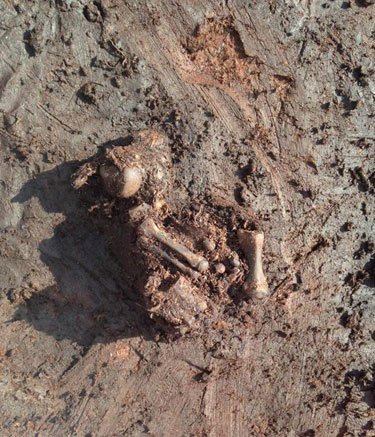
Utility workers discovered the lower leg bones of an adult in Rossan Bog. “The exact date of the remains is not known at this time but we will be conducting research in the coming months,†archaeologist Maeve Sikora of the National Museum of Ireland told The Irish Examiner. Two years ago, the remains of another adult, dubbed Moydrum Man, were found nearby. Those remains dated to between 700 and 400 B.C. “Every new find helps to bring us closer to understanding the lives and belief systems of our ancestors,†said Raghnall Ó Floinn, director of the National Museum of Ireland.
A former workhouse built in the 1840s, later the Mother/Baby Home in Tuam, County Galway, Ireland
At the beginning of this month, a story based upon nothing but old news and unsupported allegations originating from an amateur local historian with an axe to grind rapidly became international news. Left-wing bloggers like Andrew Sullivan leapt aboard, taking the story as good evidence of the Roman Catholic Church’s crimes against humanity via that church’s disapproval of (what it considers the mortal sin of) extra-marital sex.
The story is, of course, simply an echoing of the popular culture meme created by the 2002 film The Magdalene Sisters, which depicted unwed mothers as innocent victims grossly abused by a greedy and sadistic nun and sexually exploited by a priest at the asylum to which unmarried pregnant women were consigned by an unsympathetic Irish society in the bad old days before the 1960s Revolution.
A vast number of news stories tell us that close to 800 bodies of babies were discovered consigned to a “septic tank” and infer, on the basis of pure speculation, a few anecdotes, and a single war-time health inspection report that children were mistreated and starved into early deaths.
What Was the Mother/Baby Home?
The Tuam Mother/Baby Home was a former workhouse converted by the Irish Free State in 1925 into a county-owned home for unwed mothers, obstetric facility, and orphanage operated by the Order of Bon Secours, a French Order of Nursing Sisters founded in 1799 to provide “good help to those in need,” and especially to furnish free nursing for the poor. The Bon Secours sisters first came to Ireland to provide medical assistance during the Great Potato Famine. The county supplied funding on a per capita basis for mothers and babies housed at the facility and also paid the salaries of doctors attending them.
The long abandoned site made headlines around the world this week when it was revealed that a nearby septic tank contained the bodies of up to eight hundred infants and children, secretly buried without coffins or headstones on unconsecrated ground between 1925 and 1961.
No Septic Tank ever Existed
When the Mother/Baby Home closed down in 1961, the property and all records of births and deaths were turned over by Bon Secours Sisters to the state. The buildings were demolished in the early 1970s and the seven acre property was developed into a housing estate. Two boys from the estate playing on the property in the mid-1970s discovered a mass grave in the area behind the former Home.
The grave was discovered in the 1970s by 12-year-old friends, Barry Sweeney and Francis Hopkins.
Mr Sweeney said: ‘It was a concrete slab and we used to play there but there was always something hollow underneath it so we decided to bust it open and it was full to the brim of skeletons.
‘The priest came over and blessed it. I don’t know what they did with it after that. You could see all the skulls.’
No one exhumed nearly 800 bodies of babies. What actually happened is that Catherine Corless, a local amateur historian (with the conventional modernist animus against the Roman Catholic Church) became interested and investigated the history of the Home.
When I started my research into the Home, I spoke to some of the residents who had moved into this housing estate on the Dublin/Athenry road, and they indicated that there was an unmarked graveyard in an area at the rear of where the Home once stood. It was believed that it was an angels plot for unbaptised babies, but further in my research I discovered that in fact, many children and young babies were also buried here. I was astonished to find that there was no formal marking or plaque to indicate that these children were buried there. I decided to contact the Registration Office in Galway to check for deaths in the Home. I was dismayed to find that in fact the number of children who died in the Home during its existence 1925-1961 numbered nearly 800. I now have all those children’s names, date of death, and age at death, which will be recorded into a special book.
It just did not seem right that all those children lay there unnamed and forgotten. Hence, I made contact with the Western Traveller and Intercultural Development (WTID) and a committee of interested people emerged, all with the view that some sort of Memorial should be erected in this children’s graveyard in dedication to their memory. Our committee is named: ‘The Children’s Home Graveyard Committee’.
We introduced our Project to erect a Memorial to the children, to the Tuam Town Council at one of their meetings, and got a unanimous decision that they would help us with some funding when they get their 2014 Grant Allowance. The Heritage Council have also promised to help but have cautioned us that Heritage Grants have been cut for 2014. Our fundraising is ongoing as it will take a large sum to complete the whole Project, i.e. to erect a proper Monument, clear the pathways into the graveyard, and to maintain the area with flowers and shrubs etc.
The babies were usually buried in a plain shroud without a coffin in a plot that had housed a water tank attached to the workhouse that preceded the mother and child home.
No memorial was erected to the dead children and the grave was left unmarked.
The real substance of all the hoo-hah is that apparently baptized babies and small children who died at the Home may possibly have been buried in the same “Angels’ Plot” as premature unbaptized infants, and without markers.
The generality of readers have been led by irresponsible journalism to believe on the basis of garbled information and a few anecdotes that the Sisters of Bon Secours starved hundreds of children to death, abused and neglected babies and their mothers, and then tossed the bodies of their victims contemptuously into a septic tank.
Andrew Sullivan was typical of left-wing bloggers, though possibly even a bit keener than most:
These children were treated as sub-human because their births violated a Catholic doctrine that there can be no sex outside of marriage. The young women – denied contraception, of course – were equally subject to horrifying stigmatization, hatred, and inhumane rules that took their children away from them.
Providing support and education for, and arranging the adoption of the children of unwed mothers who have no ability to support them does necessarily involve taking those unwed mothers’ children away from them. This sort of thing used to be looked upon as a good deed, not as a crime against humanity. But people used to have a lesser sense of self-entitlement.
Reading anecdotes testifying that a stone institutional building in early 20th century Ireland was cold fails to surprise. I could collect even larger numbers of first-hand accounts testifying to harsh treatment and bad food from the young men consigned to such secular institutions as Eton and Harrow during precisely the same period. Where I differ from Andrew Sullivan and other champions of the Press would be in my declining to have any part in attempting to adjudicate alleged pre-1961 complaints on the basis of a few anecdotes from disgruntled people.
The Health Report quoted by Ms. Corless is unflattering undoubtedly, but it was written in 1944 we must recognize. WWII was going on in 1944. Food supplies, even in neutral Ireland, were disrupted, and people all over Europe were living on short rations. The records indicate that the Tuam unwed mothers’ asylum and orphanage was filled well over-capacity. Just like increased promiscuity, food shortages and over-crowding are inevitable results of war-time conditions. I don’t know that you can blame the nuns. Why not blame the County? If there were shortages of food or heat in 1944, the monies to pay for them were not being provided by the government. The nuns were doubtless living on the same rations and shivering in the same cold.
Sid Vicious plus William Butler Yeats equals Shane MacGowan.
Matthew Hennessey, meanwhile, in the City Journal notes that you couldn’t kill Shane MacGowan with a stick.
They say God takes care of fools and drunks. If so, he’s been working overtime the last few decades taking care of Shane MacGowan. As the frontman and principal songwriter of the Irish rock band the Pogues, MacGowan is as famous for his lyrics and whiskey-timbered voice as for his unlikely longevity, despite a Homeric appetite for intoxicating substances, especially, but not limited to, alcohol. Though he cuts a shambolic figure, MacGowan is still upright at 56, a feat many view as a minor miracle. His rheumy eyes and distinctive throat-clearing cackle suggest not genius, necessarily, but late-stage dipsomania; there is nary a tooth left in his head. God or something like God must be taking care of MacGowan. He’s not been doing the job himself.