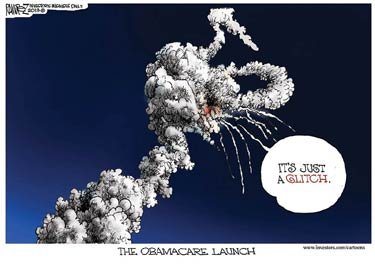
Cheryl Campbell, senior vice president of CGI Federal, left, testifies on Capitol Hill in Washington on Thursday. CGI will earn at least $290 million from its Obamacare contract to design the site.
Mark Steyn identifies the Canadian Company which got the no-bid contract to build the botched Obamacare web-site. Who knew? They were already famous for their achievements on behalf of the Canadian Government.
CGI is… a Canadian corporate behemoth. Indeed, CGI is so Canadian their name is French: Conseillers en Gestion et Informatique. Their most famous government project was for the Canadian Firearms Registry. The registry was estimated to cost in total $119 million, which would be offset by $117 million in fees. That’s a net cost of $2 million. Instead, by 2004 the CBC (Canada’s PBS) was reporting costs of some $2 billion — or a thousand times more expensive.
Yeah, yeah, I know, we’ve all had bathroom remodelers like that. But in this case the database had to register some 7 million long guns belonging to some two-and-a-half to three million Canadians. That works out to almost $300 per gun — or somewhat higher than the original estimate for processing a firearm registration of $4.60. Of those $300 gun registrations, Canada’s auditor general reported to parliament that much of the information was either duplicated or wrong in respect to basic information such as names and addresses.
CNN Money describes the problems and quotes technicians about what it will take to fix it.
Experts say the major problems with the Obamacare website can’t reasonably be solved before the end of 2013, and the best fix would be to start over from scratch.
After assessing the website, Dave Kennedy, the CEO of information-security company Trusted Sec, estimates that about 20% of Healthcare.gov needs to be rewritten. With a whopping 500 million lines of code, according to a recent New York Times report, Kennedy believes fixing the site would probably take six months to a year.
But would-be Obamacare enrollees only have until Dec. 15 to sign up for coverage starting at the beginning of 2014. Nish Bhalla, CEO of information-security firm Security Compass, said it “does not sound realistic at all” that Healthcare.gov will be fully operational before that point.
“We don’t even know where all of the problems lie, so how can we solve them?” Bhalla said. “It’s like a drive-by shooting: You’re going fast and you might hit it, you might miss it. But you can’t fix what you can’t identify.”
Several computer engineers said it would likely be easier to rebuild Healthcare.gov than to fix the issues in the current system. But it’s unlikely that the government would toss out more than $300 million worth of work.
The sheer size of Healthcare.gov is indicative of a major rush job. Rolling the site out too quickly likely increased the number of errors, and that makes the fixes more difficult to implement.
“Projects that are done rapidly usually have a lot of [repetitive] code,” said Arron Kallenberg, a software engineer and tech entrepreneur. “So when you have a problem, instead of debugging something in a single location, you’re tracking it down all through the code base.”
To put 500 million lines of code into perspective, it took just 500,000 lines of code to send the Curiosity rover to Mars. Microsoft’s (MSFT, Fortune 500) Windows 8 operating system reportedly has about 80 million lines of code. And an online banking system might feature between 75 million and 100 million lines. A “more normal range” for a project like Healthcare.gov is about 25 million to 50 million lines of code, Kennedy said.
“The [500 million lines of code] says right off the bat that something is egregiously wrong,” said Kennedy. “I jumped back when I read that figure. It’s just so excessive.” …
..The New York Times report said five million lines of code need to be replaced just so the site can run properly.
But the Obamacare website has bigger problems than simply getting people registered for health care. The code is also riddled with security holes, according to Kennedy, who outlined his cybersecurity concerns on Trusted Sec’s company blog.
“If someone can’t register, that’s obviously bad — but if the information gets hacked, you’re talking about one of the biggest breaches in American history,” Kennedy said. “I think security is an afterthought at this point.”
Adam Garfinkle, writing at The American Interest, debunks the egalitarian rhetoric used to promote federalizing health care.
[N]o one seems willing to call what is going on by its real name: class-based triage, or rationing, of medical care.
We can see this more clearly if we put these two data points together: We are slowly (or not-so-slowly) but surely moving toward a much more finely gradated class-based system of healthcare. Compared to where we were before Obamacare passed, the top is moving up and the bottom is moving down faster than ever, leaving a thinner middle where most Americans with employer-provided health insurance have typically been—somewhere in the murk between HMOs and PPOs of various descriptions. Now, those who can afford it will increasingly pay more and get more. Those who cannot afford it will pay less and get less.
Now, there is nothing surprising about this, and it’s what happens in most countries with some form of government-mandated universal health care. There are always private healthcare options in those countries, for people who can afford it, to detour around the public option. But it is not what Obamacare advertised.
Actually they will pay more and get less. When they do pay less, they will be paying more for less services. It may not be obvious to them, but the insurers will have done the math.
The problem is that triage of this sort is inevitable.
The market naturally rations products and services. There’s no way to get around that. Even in a totalitarian state with a planned economy, national health care and price controls, professionals will just go to the most rewarding fields.
And there’s always a class structure. Soviet academics lived much better than their colleagues lower down on the ladder. Meanwhile Soviet medicine was pretty terrible. The smart people were going into research and then not doing any research because the entire system was too far behind to catch up.
The more the system is tampered with, the more the middle, which is a product of the free market collapses, reverting everything back to the 99 percent and 1 percent model that the left pretends we have now. Except it’s really more like a 67%, 9% and 24% model.
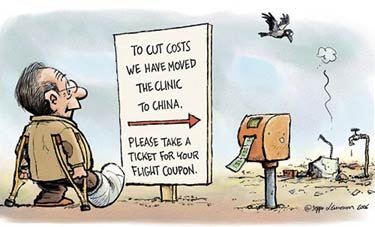
ObamaCare forces more doctors to become completely inaccessible to anyone other than the wealthy. The process began with HMOs, that original ingenious plan to solve the health care problem, which instead made it more expensive and less rewarding for doctors to do business. Costs kept going up and so did health care.
This is just one of the final steps on the rung before we end up with no middle ground. This won’t just have an impact on the people in the middle, it will eventually destroy the quality of medicine in general.
There’s only so much room at the top. If the only way to really make money is by treating the rich, that requires far fewer doctors and that means there’s much less room in medicine.
Medical schools will turn out more mediocrities, Third World students who excel at rote memorization but have no interest in patient care, and the top tier of medicine will continue shrinking down. There will be some good people at the top, but their numbers will diminish with each generation.
And then American medicine will die. But you’ll always be able to go and see a Nurse Practitioner for some obesity counseling.
Jeffrey T. Kuhner observes that the left may be celebrating now, but reality is on the side of the Tea Party.
The conventional wisdom is wrong. The mainstream media — and their parrots in the Republican establishment — are claiming that President Obama decisively won the government shutdown battle. In fact, the narrative being peddled is that the GOP brand has been badly damaged, paving the way for a possible Democratic Party takeover of the House of Representatives in the 2014 elections. This is puerile nonsense. Tea Party Republicans, led by Texas Sen. Ted Cruz, may have lost the battle, but they are poised for a major victory in the larger Obamacare war. …
This is myth and propaganda masquerading as analysis. The legislative deal simply does one thing: kick the can down the road. Yet the same, enduring problems remain — the very problems identified by Mr. Cruz and Tea Party Republicans. America is sitting on a ticking debt bomb, Obamacare — the most destructive law in modern memory — is a disaster, and our ruling elites are incapable of reining in out-of-control public spending.
America is increasingly dominated by one seminal reality: We are the most indebted nation in history. The national debt is approaching $17 trillion. By 2016, the debt is expected to hit $20 trillion. That will be Greece-like levels, a debt load so crippling that Washington will have trouble simply paying the interest on the debt payments. Our creditors will realize we are sliding toward the United States of Argentina — a fiscal basket case unable to live within our means. The value of the dollar will plunge. Interest rates will soar. Taxes will have to be increased. The social safety net will be shredded. Unless Congress immediately confronts the reckless spending and near-record trillion-dollar deficits, the United States will go bankrupt. The question is no longer if, but when.
Mr. Obama’s massive health care overhaul is precipitating the impending economic collapse. Nearly every aspect of Obamacare has turned out to be a lie. The real price tag is not less than a $1 trillion; rather, it is a multitrillion-dollar entitlement program that America cannot afford. Rather than lowering premium costs for the average family, it dramatically raises them — sometimes by thousands of dollars a year. Millions of citizens have lost their health benefits or are unable to keep their doctor. People seeking to enroll in Obamacare’s marketplace exchanges are stunned at the high costs of the health insurance plans. In fact, the Congressional Budget Office acknowledges that the law will not achieve its stated goal: universal coverage. Instead, about 30 million Americans will still not have health care. Hence, one-sixth of the U.S. economy will have been revolutionized essentially to put only 17 million new recipients on the Obamacare rolls. The complex law also undermines economic growth and job creation, compelling employers to either slash employees’ hours or not hire new workers. In short, Obamacare is a cancer, slowly devouring our economic dynamism, individual liberties and medical care.
As the law is implemented, its devastating effects will be increasingly felt. By next year, the government shutdown will be a fading memory. What the public will remember, though, is that a band of Tea Party patriots sought to thwart the oncoming disaster. Mr. Cruz, along with Sens. Rand Paul of Kentucky and Mike Lee of Utah, represent the future. The question is no longer ideological — small government versus big government, free-market-based health care versus nationalized health care, or capitalism versus socialism. Rather, it is about something more simple — and profound: basic arithmetic.
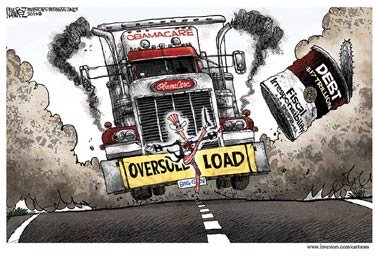
The United States is a giant bus that is rushing toward an economic precipice. A few more years of Mr. Obama’s borrow-and-spend policies and America will crash upon the rocks of fiscal reality and national insolvency. The Democrats are keeping their foot on the gas pedal, full speed ahead. The Republican establishment thinks we may need to slow down — at least a little. The bus, however, will still go off the cliff. Only the Tea Party is saying — in fact, yelling — to hit the brakes. They’re right, and they will be vindicated. The only question is this: Will Americans wake up before it’s too late?
William Galston, in the Wall Street Journal, sees the recent shutdown struggle as evidence of a crucial internal struggle for the soul of the Republican Party.
More than a decade ago, before the post-9/11 national fervor set in, Walter Russell Mead published an insightful essay on the persistent “Jacksonian tradition” in American society. Jacksonians, he argued, embrace a distinctive code, whose key tenets include self-reliance, individualism, loyalty and courage.
Jacksonians care as passionately about the Second Amendment as Jeffersonians do about the First. They are suspicious of federal power, skeptical about do-gooding at home and abroad; they oppose federal taxes but favor benefits such as Social Security and Medicare that they regard as earned. Jacksonians are anti-elitist; they believe that the political and moral instincts of ordinary people are usually wiser than those of the experts and that, as Mr. Mead wrote, “while problems are complicated, solutions are simple.”
That is why the Jacksonian hero defies the experts and entrenched elites and “dares to say what the people feel” without caring in the least what the liberal media will say about him. (Think Ted Cruz. )
The tea party is Jacksonian America, aroused, angry and above all fearful, in full revolt against a new elite—backed by the new American demography—that threatens its interests and scorns its values. …
Supporters of the tea party… see President Obama as anti-Christian, and the president’s expansive use of executive authority evokes charges of “tyranny.” Mr. Obama, they believe, is pursuing a conscious strategy of building political support by increasing Americans’ dependence on government. A vast expansion of food stamps and disability programs and the push for immigration reform are key steps down that road.
But ObamaCare is the tipping point, the tea party believes. Unless the law is defunded, the land of limited government, individual liberty and personal responsibility will be gone forever, and the new America, dominated by dependent minorities who assert their “rights” without accepting their responsibilities, will have no place for people like them.
For the tea party, ObamaCare is much more than a policy dispute; it is an existential struggle. …
Many tea-party supporters are small businessmen who see taxes and regulations as direct threats to their livelihood. Unlike establishment Republicans who see potential gains from government programs such as infrastructure funding, these tea partiers regard most government spending as a deadweight loss. Because many of them run low-wage businesses on narrow margins, they believe that they have no choice but to fight measures, such as ObamaCare, that reduce their flexibility and raise their costs—measures to which large corporations with deeper pockets can adjust.
It’s no coincidence that the strengthening influence of the tea party is driving a wedge between corporate America and the Republican Party. It’s hard to see how the U.S. can govern itself unless corporate America pushes the Republican establishment to fight back against the tea party—or switches sides.
They had three years to build it. They spent $634,320,919, more than it cost to build Facebook. They were able to build the Pentagon in just under one year and four months (11 September 1941 — 15 January 1943) for half the cost. And it was still dysfunctional a week after its scheduled opening.
Digital Trends described the fiasco:
The site itself, which apparently underwent major code renovations over the weekend, still rejects user logins, fails to load drop-down menus and other crucial components for users that successfully gain entrance, and otherwise prevents uninsured Americans in the 36 states it serves from purchasing healthcare at competitive rates – Healthcare.gov’s primary purpose. The site is so busted that, as of a couple days ago, the number of people that successfully purchased healthcare through it was in the “single digits,†according to the Washington Post.
And our liberal friends believe we ought to be happy to turn over our healthcare choices, and a one sixth portion of the American economy, to the same government which demonstrably could not even satisfactorily develop a website in three years?
Dan Greenfield views Obamacare as a major landmark on our establishment elite’s route from Problemtown to Solutionville, and they are taking all of the rest of us along for the ride whether we like it or not.
You, sitting right there in your chair, watching these words move across your screen, are the problem. A problem 311,591,917 human souls strong.
You eat too much or you don’t pay enough taxes, you drive your car too often, you haven’t bought solar panels for your roof, you browse extremist websites when you should be browsing government informational sites for tips on how to do or not do all of the above. Most of all, you don’t understand what a great problem you are for the people running this country into the ground between the Atlantic and the Pacific.
They keep trying to solve you, but you don’t go away.
There is no neutrality when dealing with people who reject the very concept of opting out of a solution. There is no middle ground with people who don’t believe there is a middle ground, believing instead that every human on earth is part of the problem and can only stop being the problem by following their directives.
We confront the Great Solvers of the Human Problem who are determined to rearrange everyone to their liking. They began by controlling everything that people did. Now, they have moved on to controlling what people don’t do. If you live, if you breathe, if you stir, move your muscles, track moving objects with your eyes, then there are obligations imposed on you.
ObamaCare is one of the final declarations that there is no opting out. Even if you don’t drive, own a home, own a business, own a dog, or do one of the infinite things that bring you into mandatory contact with the apparatus of your government, you are committed to a task from maturity to death. Your mission is to obtain health insurance, and, in a system in which you become the ward of the government as soon as you taste air, it is the price that you pay for being alive.
In a free country, you are not obligated to do things simply for the privilege of breathing oxygen north of the Rio Grande and south of Niagara Falls.
But this isn’t a free country anymore; this is a country in which you get things for free. And there is a big difference between those two things.
“The House of Representatives cannot only refuse, but they alone can propose, the supplies requisite for the support of government. They, in a word, hold the purse that powerful instrument by which we behold, in the history of the British Constitution, an infant and humble representation of the people gradually enlarging the sphere of its activity and importance, and finally reducing, as far as it seems to have wished, all the overgrown prerogatives of the other branches of the government. This power over the purse may, in fact, be regarded as the most complete and effectual weapon with which any constitution can arm the immediate representatives of the people, for obtaining a redress of every grievance, and for carrying into effect every just and salutary measure.”