Regular readers may possibly recall that I am currently blogging from our vacation place/300-acre farm in Central Pennsylvania.
Yesterday, the sounds of low-flying aircraft were heard from our cabin in the morning, and when Karen went into town, late in the afternoon, to get mail from the post office, the small town of Tyrone was buzzing with stories of a shooting in our own neighborhood.
The 10/27 Daily Herald (serving Tyrone, Bellwood, and Surrounding Areas since 1866, but not on-line) reported:
State Police at Hollidaysburg have confirmed a shooting at 260 Van Scoyoc Hollow Road in Snyder Township this morning.
Unconfirmed reports say that a 13-year-old female Tyrone student has been shot in the chest or shoulder at her bus stop near the Tyrone Sportsman’s Club. Reportedly the weapon was believed to be a shotgun.
The Tyrone Area School District went on full exterior lockdown as a precaution.
The school web-site said: “Based on conversation with the state police we have been informed that there is no threat to the school. We are merely taking precautionary measures by instituting the secure exterior lockdown
Due to shooting in the community, which is currently believed to be a hunting accident, the district is currently in a secure exterior lockdown.”
State Police were still investigating the area with metal detectors and ran infrared by helicopter looking for possible suspects around the Sportsman’s Club at 10:30 a.m. The bus stop and a wooded area across the road were heavily investigated.
The victim has reportedly been taken to UPMC Altoona and is in stable condition. State Police and the Game Commission were still on the scene, the shooter was not located and no further information was available at the time of press other that it is believed to have been a hunting accident.
So… What struck me about all this was the craziness of a school lockdown off in the borough of Tyrone, miles away from the scene of a shooting thought to be a hunting accident. This kind of response typifies a contemporary style of “cover your ass at any cost” bureaucratic formalism which characteristically reacts, not so much to threats, as to memes, with preposterous and pretentious brain-damaged forms of completely useless gestures.
I needed, of course, to investigate the facts, so I phoned up the State Police in Hollidaysburg this morning, explaining that I was inquiring about the Snyder Township shooting in my capacity as an Internet journalist.
I learned that what happened was: a 12-year-old girl accidentally dropped a .22 rifle while in the process of putting it away inside her house. The rifle went off, and the girl was struck by a bullet in the abdomen. The young lady is recovering from her unfortunate accident in hospital.
——————————-
Oddly enough, some news agency was actually reporting the story accurately this morning:
Police: Girl, 12, shot after mishandling rifle
TYRONE, Pa. (AP) – State police say a 12-year-old girl was accidentally shot in the abdomen after mishandling a .22-caliber rifle in her home.
Police aren’t releasing the name of the girl who authorities first believed had been shot outside her home Monday as she left for school about 7 a.m. That prompted the Pennsylvania Game Commission to investigate whether the girl might have been wounded by a hunter’s stray bullet.
But police now say the girl had grabbed the rifle and was returning it to a safe when it fell and discharged in her Snyder Township home.
The Tyrone Area School District was on an exterior lockdown after the shooting, meaning classes operated normally but no visitors were allowed on school property. The lockdown was lifted about 11 a.m. Monday.
Police were continuing to investigate Tuesday.
——————————-
All of which demonstrates the propensity of all forms and flavors of American officialdom these days to react Pavlovianly to popular cultural memes (e.g., “Child Shooting!” — “School Shooting!”) demonstrating a pathologically overly-enthusiastic eagerness to wield authority, deploy personnel and equipment, play with gadgets and weapons, and to act out fantasies in public.
Yesterday, we had two government agencies sending armed men scurrying about the landscape, helicopters searching the forest with infrared, and a school system, miles away, undergoing lockdown (“Sorry, Mr. Jones, you can’t deliver milk for the school lunch today. We’re on lockdown!”), along with a grand search for an imaginary hunter, all in response to a one-party accident that took place inside a private home.
Perhaps we all tend to idealize the past. I could be wrong but, when I think back to when I was young, decades ago, I have a lot of trouble picturing the American adults I grew up among getting into lathers of this kind and responding to emergencies with so much panic and excessive overreaction in defiance of all the facts.
I do think that if somebody came along and said to Sister Daniel, the principal of St. George School in Shenandoah back in 1960, “Hey! you better lockdown the school. There has been a hunting accident over in Brandonville.”, Sister Daniel would have said, “What are you, some kind of a nut?”
I noticed that the one remaining door on our unused, and long-neglected, outhouse had become open recently. Yesterday, when returning from running an errand, Karen found the culprit who obviously somehow opened that door. It was a Screech owl, who has evidently taken up residence. Karen managed to grab a photo with her cell phone, and put our new neighbor’s picture up on her own blog.
That outhouse was used once briefly a very long time ago, when a major storm knocked out the power for days and days. No power, no well. No well, no flush toilets in the house. My father, at one point, repaired it and had it in excellent order. But we had not visited the farm for over a decade until recently, and a lot of the outbuildings need repairs and a fresh coat of paint.
My father, cigarette butt in mouth, Mauser rifle in hand, poses with a nice buck at his farm in Locust Valley. Very damaged photo is labeled “Nove 1947.”
We’re having a very traditional, cold (low 30s), snow on the ground, opening day of deer season here in Pennsylvania.
It has been possible to hunt deer legally with long bow, crossbow, and muzzle-loaders for varying periods since late September, but today is Pennsylvania’s national holiday: opening day of rifle season for bucks. This morning the Commonwealth of Pennsylvania fields the sixth largest army in the world, some 750,000 rifles, coming in right behind Russia in numbers (though generally better armed).
The Opening Day of Deer Season (first Monday after Thanksgiving) and the Opening Day of Trout Season (the Saturday closest to April 15th) are sacred dates in the Keystone State’s calendar. Just as the Christian Church is traditionally full of lukewarm members who attend Mass only at Christmas and Easter, the sporting community is similarly full of participants who collect guns and tackle and who read Field & Stream, but who actually go afield only on opening day.
Opening Day of Deer Season was a de facto holiday for boys in my high school. We were not officially excused attendance, but everyone knew that at least half of the male population would be missing that Monday, and since boys were skipping school with their father’s blessing, there was nothing officialdom could do about it.
Deer were just beginning to come back to the nearby woodlands when I was a boy. Before WWII, it had been necessary to travel to the deep woods, the tall timber, of the few remaining wilderness fastnesses of the Poconos, of Sullivan or Potter County to find deer. Today, of course, deer are suburban pests, thriving everywhere in the East, and they’ve been joined recently in their return by the black bear and the wild turkey. In New England, moose have been showing up in the suburbs of Connecticut and Rhode Island, and I like to think it’s only a matter of time before we have Woodland Bison again.
Karen and I luxuriously slept in this morning, and we heard no gun shots, though our woods are undoubtedly full of hunters. Looking out at the morning fog brought the memories flowing back. I remembered tossing and turning, eyes closed, but unable really to sleep with the excitement of the upcoming hunt.
I remembered being officially awakened at the unprecedented hour of 3:30 AM; the elaborate preparations, laboriously dressing in countless layers of insulation; the unshaven men brewing the coffee and making baloney sandwiches; then the long-awaited appearance of the totemic hunting rifles, gleaming with fresh gun oil; the distribution of hunting knives, binoculars, flashlights, and aluminum hand-warmers inside which a metallic mesh soaked in lighter fluid smoldered flamelessly away for many hours.
Deer hunting always involved a drive of half an hour to an hour to a special forested location where our relationship with some farmer provided the privilege of hunting access. Deer hunting, the opening day variety, consisted of taking up ambush positions along some pole line or timber road or fire trail which the deer could be expected to cross at first light when they would be returning to the mountain after feeding in the farm fields all night.
We would stumble into the woods by flashlight in the dark, being positioned by the hunting party leader, and then we’d get to stand, shivering, hands in pockets, waiting for daylight, listening for the sound of large animals approaching, for an hour and half or so.
If you were lucky, just as it became light enough to see, you’d hear them coming, and a small group of does, accompanied by a buck lurking behind, would come slowly into view, giving you time to line up your shot. More commonly, you’d hear a tremendous racket while it was still dark and a group of deer you couldn’t really make out would charge past you.
Occasionally, after dawn, you would hear a rifle shot. If you heard a single shot, you would figure that it was 50-50 whether he’d got that deer. If you heard BOOM! followed after a short interval by one more decisive BOOM!, you knew that someone had killed his buck. If you heard BOOM!–BOOM!–BOOM! and BOOM!–BOOM!, you knew your idiot uncle with the pump gun had missed again.
There was a serious chance of a shot at a buck at first light on opening day. We used to joke that all the bucks then assembled at the Trailways Bus Station, and went on vacation to Florida thereafter. What really happened, of course, is that deer in general, and bucks in particular, on finding their woods invaded by armed humans, went totally nocturnal, and took care to pass through pole lines, timber roads, and fire trails while it was still pitch dark. There they snoozed away the daylight hours, deep inside the densest thickets of buck laurel they could find.
You generally had about as good a chance of getting a shot at a buck after the morning of opening day as you did of winning the lottery.
But there was an answer, I discovered a few years along in my hunting career. The answer was, after opening day, to drive deer with the gang from the Brandonville Fire House. It did bucks no good to hide deep the laurels and the greenbriars, if along came a line of hunters spaced 50 feet apart, hollering, stomping, and blowing horns.
I later fell in with an even crazier gang of deer drivers from Aristes who made a practice of driving straight through the roughest country in Northern Schuylkill County. We used to drive right down and straight up the sides of mountains. We’d go right through narrow, untenanted valleys solid with laurel. I was a teenage boy, and consequently always a driver. Standing posted at the end of the drive was a privilege of the old men. So I didn’t get a lot of shooting. But it certainly was a lot of fun.
I went looking at property lines with my surveyor on a used Polaris Ranger I recently bought. I couldn’t restart it after I accidentally turned the engine off by throttling down while we were deciding which way to go around an obstacle. We pushed it a little ways, then rolled it down a slope to where my surveyor could walk through a neighbor’s field for assistance. My neighbor drove out and gave us a jump.
We were worried about coming back through the deep woods so we decided to motor down the road to an entrance to my farm that would give us a shorter route back. Thereupon, Ooops! we ran out of gas.
Another neighbor came by with a five-gallon can of gas and the first neighbor jumped our battery again.
We made another half a mile before the battery again completely died. A third neighbor towed the Polaris into his garage with his pickup trick, then gave us a lift home.
There are obvious problems with relying on unfamiliar used vehicles for transportation.
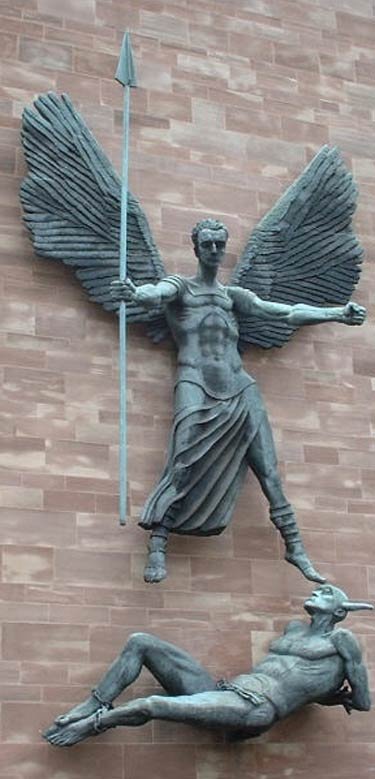
Michaelmas Day, the 29th of September, properly named the day of St. Michael and All Angels, is a great festival of the Church of Rome, and also observed as a feast by the Church of England. In England, it is one of the four quarterly terms, or quarter-days, on which rents are paid, and in that and other divisions of the United Kingdom, as well as perhaps in other countries, it is the day on which burgal magistracies and councils are re-elected. The only other remarkable thing connected with the day is a widely prevalent custom of marking it with a goose at dinner.
Michael is regarded in the Christian world as the chief of angels, or archangel. His history is obscure. In Scripture, he is mentioned five times, and always in a warlike character; namely, thrice by Daniel as fighting for the Jewish church against Persia; once by St. Jude as fighting With the devil about the body of Moses; and once by St. John as fighting at the head of his angelic troops against the dragon and his host. Probably, on the hint thus given by St. John the Romish church taught at an early period that Michael was employed, in command of the loyal angels of God, to overthrow and consign to the pit of perdition Lucifer and his rebellious associates—a legend which was at length embalmed in the sublimest poetry by Milton.
Sometimes Michael is represented as the sole arch-angel, sometimes as only the head of a fraternity of archangels, which includes likewise Gabriel, Raphael, and some others. He is usually represented in coat-armour, with a glory round his head, and a dart in his hand, trampling on the fallen Lucifer. He has even been furnished, like the human warriors of the middle ages, with a heraldic ensign—namely, a banner hanging from a cross. We obtain a curious idea of the religious notions of those ages, when we learn that the red velvet-covered buckler worn by Michael in his war with Lucifer used to be shewn in a church in Normandy down to 1607, when the bishop of Avranches at length forbade its being any longer exhibited.
Angels are held by the Church of Rome as capable of interceding for men; wherefore it is that prayers are addressed to them and a festival appointed in their honour. Wheatley, an expositor of the Book of Common Prayer, probably expresses the limited view of the subject which is entertained in the Church of England, when he says, that ‘I the feast of St. Michael and All Angels is observed that the people may know what blessings are derived from the ministry of angels.’
Amongst Catholics, Michael, or, as he has been named, St. Michael, is invoked as ‘a most glorious and warlike prince,’ chief officer of paradise,’ I captain of God’s hosts,’ receiver of souls,’ ‘the vanquisher of evil spirits,’ and ‘the admirable general.’ It may also be remarked, that in the Sarum missal, there is a mass to St. Raphael, as the protector of pilgrims and travellers, and a skilful worker with medicine; likewise an office for the continual intercession of St. Gabriel and all the heavenly militia. Protestant writers trace a connection between the ancient notion of tutelar genii and the Catholic doctrine respecting angels, the one being, they say, ingrafted on the other. …
these notions of presiding angels and saints are what have led to the custom of choosing magistracies on the 29th of September. The history of the middle ages is full of curious illogical relations, and this is one of them. Local rulers were esteemed as in some respects analogous to tutelar angels, in as far as they presided over and protected the people. It was therefore thought proper to choose them on the day of St. Michael and All Angels. The idea must have been extensively prevalent, for the custom of electing magistrates on this day is very extensive,
‘September, when by custom (right divine)
Geese are ordained to bleed at Michael’s shrine’
says Churchill. This is also an ancient practice, and still generally kept up, as the appearance of the stage-coaches on their way to large towns at this season of the year amply testifies. In Blount’s Tenures, it is noted in the tenth year of Edward IV, that John de la Hay was bound to pay to William Barnaby, Lord of Lastres, in the county of Hereford, for a parcel of the demesne lands, one goose fit for the lord’s dinner, on the feast of St. Michael the archangel. Queen Elizabeth is said to have been eating her Michaelmas goose when she received the joyful tidings of the defeat of the Spanish Armada. The custom appears to have originated in a practice among the rural tenantry of bringing a good stubble goose at Michaelmas to the landlord, when paying their rent, with a view to making him lenient. In the poems of George Gascoigne, 1575, is the following passage:
And when the tenants come to pay their quarter’s rent,
They bring some fowl at Midsummer, a dish of fish in Lent,
At Christmas a capon, at Michaelmas a goose,
And somewhat else at New-year’s tide, for fear their lease fly loose.’
We may suppose that the selection of a goose for a present to the landlord at Michaelmas would be ruled by the bird being then at its perfection, in consequence of the benefit derived from stubble-feeding. It is easy to see how a general custom of having a goose for dinner on Michaelmas Day might arise from the multitude of these presents, as land-lords would of course, in most cases, have a few to spare for their friends. It seems at length to have become a superstition, that eating of goose at Michaelmas insured easy circumstances for the ensuing year. In the British Apollo, 1709, the following piece of dialogue occurs:
‘Q: Yet my wife would persuade me (as I am a sinner)
To have a fat goose on St. Michael for dinner:
And then all the year round, I pray you would mind it,
I shall not want money—oh, grant I may find it!
Now several there are that believe this is true,
Yet the reason of this is desired from you.
A: We think you’re so far from the having of more,
That the price of the goose you have less than before:
The custom came up from the tenants presenting
Their landlords with geese, to incline their relenting
On following payments, &c.’
In late medieval Christianity, Michael, together with Saint George, became the patron saint of chivalry and is now also considered the patron saint of police officers, paramedics, and the military.
In mid to late 15th century, France was one of only four courts in Western Christendom without an order of knighthood. Later in the 15th century, Jean Molinet glorified the primordial feat of arms of the archangel as “the first deed of knighthood and chivalrous prowess that was ever achieved.” Thus Michael was the natural patron of the first chivalric order of France, the Order of Saint Michael of 1469. In the British honours system, a chivalric order founded in 1818 is also named for these two saints, the Order of St Michael and St George. The Order of Michael the Brave is Romania’s highest military decoration.
Apart from his being a patron of warriors, the sick and the suffering also consider Archangel Michael their patron saint. Based on the legend of his 8th century apparition at Mont-Saint-Michel, France, the Archangel is the patron of mariners in this famous sanctuary. After the evangelisation of Germany, where mountains were often dedicated to pagan gods, Christians placed many mountains under the patronage of the Archangel, and numerous mountain chapels of St. Michael appeared all over Germany. Since the victorious Battle of Lechfeld against the Hungarians in 955, Michael was the patron saint of the Holy Roman Empire and still is the patron saint of modern Germany and other German speaking regions formerly covered by the realm.
He has been the patron saint of Brussels since the Middle Ages. The city of Arkhangelsk in Russia is named for the Archangel. Ukraine and its capital Kiev also consider Michael their patron saint and protector.
An Anglican sisterhood dedicated to Saint Michael under the title of the Community of St Michael and All Angels was founded in 1851. The Congregation of Saint Michael the Archangel (CSMA), also known as the Michaelite Fathers, is a religious order of the Roman Catholic Church founded in 1897.
————————————-
The tradition of celebrating the feast day of the warrior angel saint persists in Central Pennsylvania up to today, particularly in Mifflin County, which is holding a Community Goose Day Dinner today at 3:00 at the Brooklyn Firehouse on Main Street in Lewistown.
Our dogs had fewer quills above the nose, but more overall.
Our dogs get an outdoors “last call” every evening just before we retire for the night. Last night, shortly after they went out, cries of pain erupted from out of doors. Karen hurried to retrieve the dogs who were found both engaged in close combat with a particularly large, fat porcupine.
The dogs arrived back indoors with mouths and noses loaded with quills. The tazy had a load in his upper mouth and was particularly in pain. The basset hound, despite all the quills, was reluctant to give up the chase and came in grudgingly. Even his chest was loaded with quills.
We are, by no means, unpacked and well organized here at the Pennsylvania farm we have not visited for over a decade. Fortunately, Karen managed to come up with a pair of needle-nosed pliers. We were then handicapped by Presbyopia and limited lighting on the stairs, where we tried pinning down our first victim. It was a struggle de-quilling the basset hound. The most painful quills to remove were those in the mouth and nose, and Cadet put up a surprisingly effective resistance (for a French dog). Finally, we got down to one deeply buried small quill in the lower jaw (which it was impossible to grip) and gave up and turned to work on the tazy.
Poor Uhlan had been up dancing on our bed, bleeding and drooling, and driving in his quills deeper. The struggle was fiercer with Uhlan. There were only two of us, and there was one of him. Moreover, Cadet started returning to his rescue, barking at us for hurting his brother, and intruding into the growing pile of pulled quills littering the stairs. There I was, on the middle landing, trying to pin the tazy’s body against the stone wall with mine, using my hands to try hold his head still, as Karen worked on capturing the quills. There were blood and quills everywhere. He was relatively cooperative about letting us take the quills out of his upper mouth. But when we got down to the last half dozen or so quills, largely concentrated in his nose and lips, he just went wild, shaking his head furiously, squirming out of my wrestling holds, and not in the least cooperating. Cadet also continued to interfere. Uhlan proved to be just too strong for us and, eventually, dogs and humans were all exhausted.
Miraculously though, when Karen began to try calling 24-hour veterinary services, one, just a few miles away in Warriors Mark, quickly returned her call. What do you know? You can get hold of a vet at 11:30 at night in Central Pennsylvania. Uhlan is still unused to cars, so Karen sat holding him in the back seat of the BMW, but Cadet is a veteran automobile traveler and actually has been hankering recently for more rides in the car. Warriors Mark is less than 10 miles away, just over the Bald Eagle Ridge in Sinking Valley.
The vet gave Uhlan good drugs, a sleeping potion followed by a pain-killing opiate. He sank slowly in the West, as the vet tried unsuccessfully to get that last under-the-chin quill out of poor Cadet. It is going to have to work its way out over time. Meanwhile, Cadet will be taking antiseptic medication. Uhlan resisted the drugs, but the second dose did for him. His eyes rolled white, his tongue hung limp, and he lolled there unresisting as the vet (a Polish lady from the same Eastern Pennsylvania Coal Region as myself with a degree from Michigan State) plucked out the remaining quills with a hemostat. Like Cadet, Uhlan had driven one small quill in so deep that it could not be grasped, and he, too, will have to let it work itself out. The vet then gave Uhlan another shot which turned off his sleeping potion, and in just a few minutes he woke back up.
It was a late and gruelling evening for everyone. Karen heroically policed up fallen porcupine quills before letting the dogs ascend the stairs to bed. She even cleaned up most of the blood. We found, when we finally arrived upstairs, that Uhlan had managed to cover Karen’s pillow with drool and blood, while we were working on Cadet.
There was a certain amount of nocturnal wimpering coming out of the dog kennels in the bedroom during the night, and Cadet woke up eventually demanding an outdoor lavatory break, but things were more peaceable over night on the whole than one might have expected. By morning, the dogs actually seemed no worse for wear, though when they came back from their morning run, both dogs took their customary milk bone dog biscuit from my hand very slowly and very carefully. Sore mouths.
I grew up in Shenandoah, which is only a couple of miles north of Gilberton.
I did not know that Gilberton (with its whopping population of 867, as of 2000) was actually a borough. I would have said that it was a patch settlement in Mahanoy Township, but what do I know?
I guess they must have incorporated it as a borough back in 1873 in order to gain some kind of political advantage pertaining to access to the Anthracite coal under the ground nearby.
Anyway, Gilberton is a borough and apparently even has its own police force (which I never knew). And the current police chief, Mark Kessler, has been posting some profanity-laced videos on YouTube, which have the kind of people he refers to as “libtards” at Raw Story decidedly upset.
———————————-
Example 1:
———————————-
Example 2, in response to libtard reaction to number 1:
———————————-
I’m willing to grant that Mr. Kessler’s political commentary seems to fall a little short of Edmund Burke’s, but I am naturally amused, and even a little proud, to find that the political views of a resident of today’s Schuylkill County, which I left over 40 years ago, still when you come right down to it so much resemble my own.
I do think that Police Chief Kessler is additionally a walking advertisement for Radley Balko’s new book on the Rise of the Warrior Cop: The Militarization of America’s Police Forces. That is some expensive ordinance that Police Chief Kessler is playing with in the second video. It was undoubtedly paid for by somebody’s tax dollars. And that kind of firepower, though obviously terrific fun to play with, is absolutely preposterous in relation to the character and levels of crime in as poor and little-populated a settlement as Gilberton.
The big news in Clearfield was the Elk that took a plunge off the bridge.
This ~ 1,000 lb. bull elk jumped off of the Clearfield Bypass bridge near the mall this afternoon. Numerous crews including the Game Commission were called in to retrieve the bull from the water. It is unknown what caused him to jump. He died on impact.
———————————–
Pennsylvania’s elk descend from a herd of elk presented as a gift from President Theodore Roosevelt to PA Governor Gifford Pinchot.
General readers will need to bear with me. One of the basic functions of my blog is to pass along items I would otherwise be emailing to friends.
I grew up in the Anthracite region of Northeastern Pennsylvania, one of the principal centers of Lithuanian settlement in the United States. The coal mining industry expired after WWII. Americans had en masse converted to oil for domestic heating, and new post-War environmental regulations made extracting coal below the water-table impossible.
Nothing ever replaced Anthracite coal mining. Over the next 60 years after the last colliery shut down for good, essentially everyone who could walk left after graduating from high school. Populations dwindled, and once prosperous towns became almost ghost towns.
One renowned local institution after another closed down as the years went by.
A friend from back home, now living in Maryland, last night, sent me this video remembering our long-gone local amusement park.
———————————–
At least the fine old Lakewood carousel survives and is today still being enjoyed by young and old in Grand Rapids, Michigan. Would you believe that I can look at this video and find the particular horse I preferred as a small child?
This Hopper-esque painting of houses in Manayunk, a neighborhood in the northwest section of Philadelphia, viewed from the Cynwyd Trail by Nancy Herman reminded me very powerfully of the view of house roofs I saw looking out the attic window of my boyhood home in Shenandoah, Pennsylvania. I was startled and a bit moved by nostalgia. It seems that densely built, working class Pennsylvania neighborhoods have a pretty strong degree of architectural similarity.
The artist writes:
This is the last painting from the Cynwyd Trail for now. I know I will be returning to these close-ups of Manayunk from the trail sooner or later as I love the shapes created by the roof tops. While I am painting them I imagine living in these houses, which adds to the fun. Everything looks so cheery on this sunny afternoon but what is it really like to live there?
She actually sells these for only $125. If that one weren’t already sold, I’d have liked to have acquired it.
Hat tip to Vanderleun. How did he find it, I wonder?
It started out, a few days ago, when an inattentive woman walking and texting in a mall near Reading, Pennsylvania obliviously proceeded to walk into the side of a decorative fountain and fell in. Her minor, but embarrassing, mishap, recorded on security cameras, was posted on YouTube and became the viral humor item of the week. At that point, it was simply mildly funny.
——————————–
But add the mainstream media, represented by George Stephanopolous and ABC News, and a local lawyer talking about investigating who is responsible, and we have a sad commentary on today’s America.
The inattentive woman eagerly embraces victim status, her lawyer pompously promises to investigate who exactly was responsible (as if that was not perfectly evident from the video itself), and finally George Stephanopolous, having listened to all this, proceeds to congratulate her for being a good sport. If she is a good sport, you certainly wouldn’t want to run into a whining idiot.