15 Sep 2013
Wittgenstein, Ph.D., Episode 9
Humor, Ludwig Wittgenstein, Philosophy, Wittgenstein



From Hugging the Horse via
Ratak Monodosico.
|
Category Archive 'Philosophy'
15 Sep 2013
Wittgenstein, Ph.D., Episode 9Humor, Ludwig Wittgenstein, Philosophy, Wittgenstein
From Hugging the Horse via 14 Sep 2013
Are Your Children Safe?Humor, Philosophy, Post-Structuralism
Hat tip to Ratak Monodosico. 21 Jun 2013
The “Law-and-Order” ArgumentEthics, Illegal Immigration, Immigration, Law-and-Order Argument, Philosophy, The Law
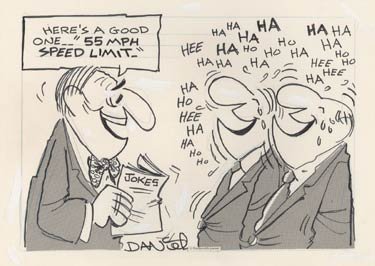
The Immigration debate has a tendency to turn red-blooded conservatives into censorious old ladies, who are shocked, shocked and indignant and offended that Hispanic immigrant laborers would have the temerity to violate THE LAW. Sophisticated people realize that there are laws and there are laws. During first year of law school, the distinction is universally explained between Malum in se, actions, like murder and theft, which are genuinely wrong and violative of Natural Law, and Malum prohibitum, things, like overtime parking, which are illegal only because of some arbitrary regulatory enactment. Entering the United States in order to improve one’s condition through honest work is obviously merely Malum prohibitum, the violation of a regulation, not something evil in and of itself. As I remarked in a previous posting, a lot of freedom-loving Americans (and even conservatives) are notorious for their lack of respect for mere regulation. They had to repeal Prohibition because so many Americans ignored the law. The 55 mph speed limit is nearly universally flouted by American motorists. Americans commonly violate current drug laws in much the same way they used to violate liquor laws. What percentage of graduates of elite universities have never smoked pot? The number must be very very small. It is just plain silly, and not especially manly or becoming, to go around striking sanctimonious poses and ranting about “enforcing the law.” The philosopher Robert Paul Wolff wrote a small monograph in 1970, titled In Defense of Anarchism, in which he demonstrated that, really, everyone has some point of independent moral judgement at which he will cease to obey the edicts of the State. TYPICAL EXAMPLE: The Gestapo Standartenführer demands that you reveal the hiding place of some Jews. Sometimes “the law is an ass,” sometimes the law is immoral, sometimes the law is simply obtrusive and inconvenient, and we ignore it. When our sclerotic, unprincipled, and embodying-no-useful-purposes contemporary immigration regulations provide no opportunity for desperate people to enter the country, and some, determined to support themselves and their families and to better their condition, ignore those regulations and enter anyway, my sympathies are with them. America was founded by, and for, the enterprising, the daring, and the rebellious. The country came into being as the result of a general inclination toward resistance to arbitrary regulation and authority. I’ve read indignant editorial after indignant editorial complaining about illegal immigrants “jumping ahead in the line” and “not playing by the rules.” Frankly, I think those arguments represent nothing more than opportunistic poses. Why do we even need a line? People come here to work because we need their services and we hire them. The market is a self-correcting mechanism. If we do not need more low-skilled Hispanic laborers, jobs will not exist, and they won’t come here. We do not need a quota system and a line to keep someone from mowing my lawn. I do not care if Jose Jimenez violated some pointless federal regulations, which as far as I am concerned do not need to exist. If he stands up, sits down, turns around, says “Simon says,” and goes through all the rigmarole required, none of that benefits me or anybody else at all. What benefits me and the country generally is the availability of affordable labor. I don’t need some federal form filled in. I need yard work and some roof shingling done. Real morality is on the side of the illegal immigrants. Spouting law-and-order-ism and demanding that everyone follow pointless and arbitrary rules is the function of busybodies and old ladies and Statists. 05 Jun 2013
Donald Kagan’s Farewell AddressConservatism, Donald Kagan, Education, History, Philosophy
Donald Kagan, Sterling Professor of Classics and History, retired last month after 44 years at Yale. He delivered a memorable Farewell Address, previously only available as a very, very long video, which now may be read at one’s own convenience thanks to the New Criterion.
Read the whole thing. 19 Apr 2013
H.P. Lovecraft… Philosopher??Bizarre, H.P. Lovecraft, Philosophy
In Salon, Brian Kim Stefans discusses a new book by “Speculative Realist” philosopher Graham Harman (who teaches at the American University in Cairo, not at Miskatonic), which attempts to identify the early 20th century author of pulp horror stories as a literary philosophic opponent of Kantian Phenomenalism, materialism, and linguistic analysis. Evidently, Wovon man nicht sprechen kann, darüber muss man gibber und kreischen über von einer Band aus amorphem Flötenspieler Begleitet. What we cannot speak about, we must gibber and shriek about, accompanied by a band of amorphous flute-players.
26 Mar 2013
Cheering For the Nanny StateMichael Bloomberg, Nanny State, Philosophy, Sara O. Conly, Sarah O. Conly
Bowdoin’s aspiring Platonic Guardian Sara O. Conly recently published a great big book arguing in favor of Nanny State paternalism over Liberty. Not surprisingly, we now find her defending Mayor Bloomberg’s soda ban in the New York Times.
La Conly’s argument (in both her book and this editorial) really boils down to the claim (based on behaviorist social science, no less) that people are incompetent, make bad choices, and have difficulty recognizing their own best interests. Therefore, Conly says these other people over here, the ones who attended Princeton, who have important official titles and positions, know better what is good for everyone; and you ordinary people over there, you dimbulbs and dufi, should be willing to surrender (just a little) liberty here and some other liberty there, when those wiser and better, and more prestigiously and officially placed, than you decide that it is time to lay down the law and tell you what to do, for your own good. Speaking philosophically, I went to Yale (which outranks Princeton all day long), so I get to point out to Professor Conly that in reality, the behaviorist social sciences prove that our Mandarins, politicians, and experts are just as fallibly human as everyone else, and are also subject to errors produced by biases toward short-term satisfaction and unrealistic optimism, particularly –in their case– optimism about their own capacities, objectivity, and motivations. Platonic Guardians tend to think that they are being disinterested and only trying to maximize everyone’s well being, while all the while they are busily gathering greater powers and control over the lives and fortunes of others to themselves. The best political philosophers are those, like Jefferson and Madison, who recognize the fact that no one enjoys the kind of superiority of perspective which entitles him or her to prescribe to someone else what he ought to do inside his own private sphere of liberty. 21 Feb 2013
The Next Big Leftist Book"Against Autonomy", John Stuart Mill, Liberalism, Liberty, Philosophy, Political Theory, Sarah O. Conly
Sarah Conly recently had a full-year sabbatical, which she spent vacationing at the University of St. Andrews in Scotland and in Oaxaca, Mexico. When not engaged in tourism or dining out, Ms. Conly busied herself with writing the next big leftist book. Her opus, titled Against Autonomy: Justifying Coercive Paternalism is intended to reject explicitly the famous thesis of John Stewart Mills’ On Liberty: That the only purpose for which power can be rightfully exercised over any member of a civilized community, against his will, is to prevent harm to others. His own good, either physical or moral, is not a sufficient warrant . . . Over himself, over his body and mind, the individual is sovereign. Sarah Conly went to Princeton, did her graduate work at Cornell, and teaches Philosophy at Bowdoin. Professor Conly consequently believes that she knows better than you do. She believes that your personal freedom, your right to make your own decisions in areas affecting only yourself is “overrated.” The notion that you are entitled to liberty and autonomy, you see, is based, according to Ms. Conly on grossly exaggerated estimates of your personal competence and rationality. Ms. Conly can prove that you are an idiot using evidence from psychology and behavioral economics which she concludes demonstrates that most of you out there –the people who don’t get fellowships to St. Andrews or write books while vacationing in Oaxaca– are clueless dolts afflicted with “present bias” and unrealistic optimism. There you have it. Social science proves that you are unworthy and unfit, and that you need the guidance of superior and more enlightened beings, like Sarah O. Conly, to keep you from playing with matches or cutting yourself with sharp objects. In the Conlyian state, application of coercive force by government is not only desirable, but obligatory, anytime it can be established by the sophistry, calculations, or economic analysis of people like herself that the benefits justify the costs. How is coercive paternalistic intervention justified? Conly offers four supposed tests: (1) the personal liberty being banned must be genuinely destructive of people’s self-defined long-term ends. (2) The coercive measures must be successful. (3) Their benefits must exceed their costs. (4) The coercive measures under contemplation must be more effective than non-coercive alternatives. I’m working from Cass Sunstein’s New York Review of Books review, and I do not have Professor Conly’s actual text on-hand. (I’m certainly not going to pay $95 for it either.) But, even without her complete argument in view, it seems obvious to me that her criteria are intrinsically open-ended. In the case of Number 1, the proposed coercer will always have to usurp the privilege of reading the coercees’ minds and defining those long-term ends. In reality, long-term ends vary, some people would perversely reject long-term ends in favor of short-term ends, and long-term ends may, sometimes, conflict. I think I know that Professor Conly would be disposed, for example, to ban private gun ownership… for all our own good. But owning lots of guns is, in my view, very decidedly part of my long-term ends, and I would reject Professor Conly’s perspective that private ownership of guns is so dangerous that it must inevitably be inimical to my long-term goals of personal survival and public safety. She and I are bound to disagree on item one. In the case of 2, libertarians like myself would argue that most forms of paternalistic coercion will inevitably prove unsuccessful. Look at Alcohol Prohibition. Look at Drug Prohibition. Look at Immigration Prohibition. With regard to Number 3, we are bound again to disagree on costs, because it is perfectly obvious that some of us consider the violation of personal autonomy, the elimination of liberties, and coercion generally to represent prohibitive costs per se. In the case of Number 4, coercion is inevitably always going to be more effective than persuasion. If the Gestapo practices a firm policy of taking anyone caught smoking out, standing him up against a wall, and shooting him, it will definitely do a more effective job of discouraging smoking than any number of public service advertisements about health hazards. Frankly, philosophically speaking, I think Profesor Conly’s four criteria deserve to fall directly into the departmental waste container labeled: “meaningless, trivial, or simply false.” I have an equally negative view of her use of “social science” studies, aka bullsh*t, to refute John Stuart Mill. Anybody can prove anything with social science studies. Professor Conly’s philosophy features also the notable defect that behavioral economics and psychology apply to you and me, the intended victims of her paternalist regime, but not to her and the other Platonic Guardians drafting the regulations. Quis custodiet ipsos custodes? If man in general is too incompetent and irrational to manage his own life, he is certainly also too incompentent and irrational, too biased and selfish in perspective, too vainglorious and self-important to dictate to others how to live. 23 Jan 2013
From Wittgenstein to DennettC.S. Lewis, Calculators, Daniel Dennett, Decadence, Decline of the West, Economists, Ludwig Wittgenstein, Philosophy, Sophisters
Daniel Dennett is a distinguished philosopher, at least, with respect to Philosophy of Mind. As a kind of philosophical sideline, however, he follows the unfortunate example of certain other contemporary professors and operates as a polemicist on behalf of bien pensant liberalism. Dennett recently offered this supposedly well-tempered response to the horrifying militarism of the barbarous administration of George W. Bush.
————————– I could not avoid reflecting that, philosophically speaking, Mr. Dennett is a member of the school of Analytic Philosophy founded, twice essentially, in the course of the first half of the last century by Ludwig Wittgenstein. Wittgenstein was, indubitably, a neurasthenic and neurotic, a homosexual, a crank and a wet liberal goo-goo, hostile to wealth, prone to romanticizing the poor, indifferent or actively hostile to formality and tradition (try to find a photograph of Wittgenstein wearing a tie). But all his personal demons, all the balderdash that Ludwig Wittgenstein embraced did not prevent him from volunteering to serve as an officer in Austrian Army when WWI broke out. Wittgenstein served as an artillery officer, fought on both the Russian and Italian fronts, and was awarded three major Imperial Austrian medals for valor. One commendation spoke of “[h]is exceptionally courageous behaviour, calmness, sang-froid, and heroism”, which had “won the total admiration of the troops.” Wittgenstein actually wrote much of the Tractatus Logico-Philosophicus while serving in the trenches. What has happened to separate Dennett from Wittgenstein? Much more indoctrination in bad Moral Philosophy and religious heresy from which not even professional training and expertise in Analytic Philosophy suffices to inoculate the potential victim and secure immunity. C.S. Lewis wrote a famous essay, titled The Abolition of Man, in which he describes the mind-and-soul-numbing impact of a typical liberal elementary school textbook (which he calls “The Green Book,” which systematically denies the objectivity of values, which –in other words– trains the young to be (sophisters, calculators, and) “economists,” i.e. liberal materialist conformists like Dennett.
16 Nov 2011
The Severed WaspGeorge Orwell, Modernism, Philosophy, Soren Kierkegaard, The Severed Wasp, Virginia Woolf
David Wemyss takes an anecdote from George Orwell as the title of a thoughtful essay on alienation (which he refers to as “insularity”) as seen in the writings Orwell, Woolf, and Kierkegaard, man’s alienation from his fellow man (particularly those of other classes and conditions) and the alienation of some modern intellectuals from values and self. Virginia Woolf is treated harshly.
Hat tip to Bird Dog. 05 Oct 2011
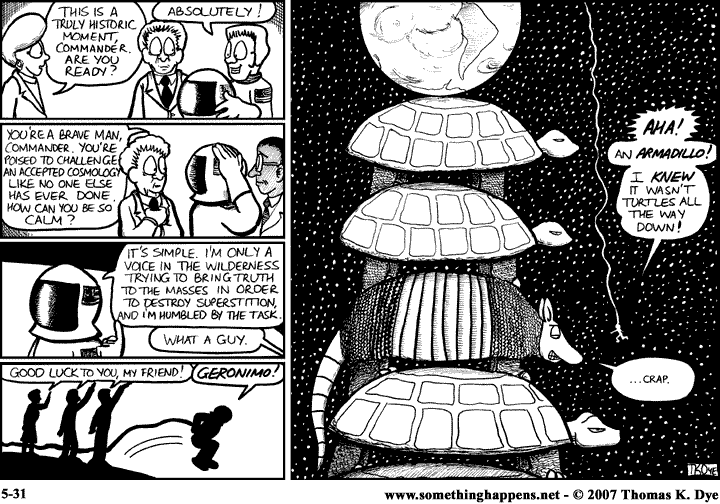
A Personal Favorite Old StoryOld Stories, Philosophy, Turtles All the Way DownA well-known scientist (some say it was Bertrand Russell) once gave a public lecture on astronomy. He described how the earth orbits around the sun and how the sun, in turn, orbits around the center of a vast collection of stars called our galaxy. At the end of the lecture, a little old lady at the back of the room got up and said: “What you have told us is rubbish. The world is really a flat plate supported on the back of a giant tortoise.†The scientist gave a superior smile before replying, “What is the tortoise standing on?†“You’re very clever, young man, very clever,†said the old lady. “But it’s turtles all the way down! Hat tip to Vanderleun. Wikipedia tried to trace its origins. 05 Jun 2011
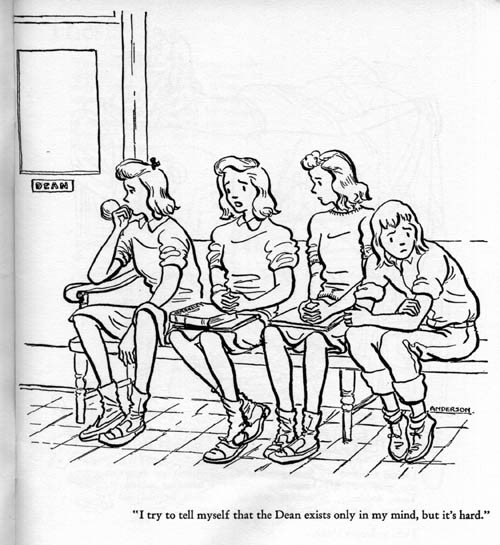
Vassar CartoonCartoon, Philosophy, VassarThe Worcester College disciplinary crackdown story inspired one of our readers to forward the cartoon below. JKB describes it as depicting Vassar in the 1930s, but I think it looks more like the 1950s.
Welcome to
NEVER YET MELTED
Another Right-Wing Web Aggregator and Purveyor of Unpopular Opinions
 David Zincavage contact: jdz@usa.net blog advertising is good for General Bullmoose and good for the USA. 


Feeds
|








 †led eight years later to “
 â€, with its insistence that Britain in the thirties was a tyranny as bad as Nazi Germany, that all loyalties were false (except those emanating from the virgin forest of course), that all uniforms were evil, and that war was a male desire to dominate brought about by competitive education.