Diving in the Patanal in Brazil, Daniel de Granville films a 23-foot long yellow anaconda (Eunectes notaeus). These are smaller anacondas which do not grow as large as the green anaconda (Eunectes murinus). (!)
They are shy creatures, we are told, with more to fear from us than we from them. It is a tolerant animal (after all, it didn’t eat the photographer), but we are cautioned “that it is still important to treat them with respect.” Personally, I have plenty of respect for 23-foot long serpents.
The text is pitiful drivel, but the photographs are interesting. You don’t see one of these every day.
Jo Teeuwisse of Amsterdam has overlaid WWII photographs over many identical locations today in France, the Netherlands, and Italy with startlingly evocative results.
The chicken man, 1967, Maxwell Street Market and skid row on West Madison Street in Chicago. (Photograph by Vivian Maier/Courtesy Cityfiles Press)
The street photography of Vivian Maier made a sensation when her cache of photos was discovered and the images began to be made public early last year. NYM story with links.
The new book is a compilation of images from rolls of film which the photographer never even printed (!). As usual, her work is completely fascinating.
I came across a spectacular Daily Mail feature on the interior photography of Massimo Listri.
I had not previously heard of the remarkable work of Listri, but I was thoroughly impressed at both the technical quality and the aesthetic sensibility of this extraordinary artist’s work.
Listri’s photography of historic and aristocratic interiors has attracted extravagant, and entirely justified, praise.
“Loosing oneself in Massimo Listri’s images, strong oneiric webs entwine themselves in one’s thoughts. Mainly they are dreams, dreams which in any case, contrary to what happens normally when we realise to be dreaming, are inexpungeable from our minds forevermore…” — Cesare Cunaccia
————————-
The central and frontal perspective of his photos involves the spectator in the silence of the rooms, in the magnificence of the constructions bringing to memory known spaces but ever visited in reality. Listri’s photographs, examples of technical perfection and formal rigor, testify his own personal aspiration to capture and to exalt the beauty, even where it doesn’t apparently seem to be present, and the desire to understand and to disclose the secrets of each human creation.
————————-
What makes his work unique is how he has made interiors look so absolutely vivid, as if they had a secret life of their own that only he knows how to portray. Listri has the extraordinary ability to capture all the small details that make the difference and reveal all the stories that remain hidden behind the surface. When asked about his distinctive approach, he reveals: ”It is purely a question of sensibility. The secret is in the light which highlights the details. That’s why I definitely prefer to use natural light when possible”. Listri’s photos transmit an almost deafening silence, as if time had stopped and humans had suddenly disappeared and the only thing reminiscent of them are the interiors they’ve left behind, the remains of their lives and their passions, their art and their culture. –Apostolos Mitsios
————————-
The Daily Mail feature seems to have been drawn from a tribute to Listri published in Yatzer last May.
————————-
Apparently, it is possible to purchase copies of Listri’s photographs which are published in very small editions (of 4 or 5) by Maison d’Art/Piero Corsini Inc. in Monaco.
The Arizona Game and Fish Department is currently analyzing a recent trail camera photo of either a jaguar or an ocelot sighted southeast of Tucson.
The photo includes only the tail and a small portion of a hind quarter of the animal, making positive identification more difficult. Game and Fish is now consulting with outside experts about the photo, taken Sept. 23 and submitted by a sportsman, to better identify the species.
“We have definitively determined that it is either a jaguar or an ocelot, but we need to do further analysis of the animal’s spot patterns and size to try to positively identify which species it is,” said Game and Fish Nongame Branch Chief Eric Gardner.
Arizona game officials are consulting with seven outside experts to determine if a photo recently submitted by a hunter shows the tail of a jaguar or an ocelot sighted southeast of Tucson.
While those experts’ conclusions aren’t in yet, two longtime cat biologists who work as volunteers for the Sky Island Alliance conservation group said Wednesday they believe it’s a jaguar.
The predominant opinion among those responding to the State Game and Fish Department so far is also that the tail is of a jaguar, “but it is not the only opinion,†said Eric Gardner, Game and Fish’s non-game branch chief. The U.S. Fish and Wildlife Service has reached out to an eighth expert, Gardner said today.
“We do have an individual who believes it is inconclusive, but if pressed would probably go the ocelot route,†Gardner said. “It’s still premature. Most of it is a lot of opinion without a lot of reasoning behind it, based on experience. We have some statements based on size and length of the tail and the bushy tip of tail. But it’s still being discussed in the professional arena. I think we have to let that discussion occur.â€
Gardner said he hopes to have heard from all the experts by early next week.
The photo was taken Sept. 23. As is typical, the state Game and Fish Department did not release the animal’s specific location and Gardner declined this morning to say what county the photo was taken in.
This striking photo of a Pittsburgh street at night in 1900 kind of reminded me of the gritty Pennsylvania coal town where I grew up. We didn’t have steel mills though, only coal mines.
I thought for a moment this might be an amazingly sharp photo of the surface of Jupiter or Saturn or one of their moons, but, no, that couldn’t possibly be right. It had to be some sort of art.
I tracked it down and found it was an image created by Markus Mrugalla, an artist, photographer, and graphic designer, born in Poland in 1985, who currently lives in Germany.
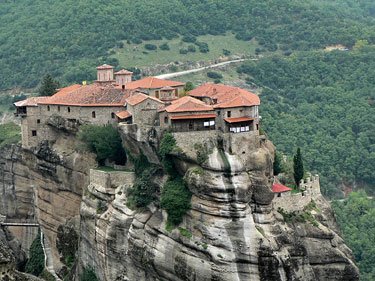
Greek Orthodox monks built 20 monasteries atop rock pillars at Meteora overlooking the Thessalian Plain, from the 10th to the 16th century, in order to get away from Byzantine politics and raiding Turks.
Wikipedia says:
Access to the monasteries was originally (and deliberately) difficult, requiring either long ladders lashed together or large nets used to haul up both goods and people. This required quite a leap of faith – the ropes were replaced, so the story goes, only “when the Lord let them break”. In the words of UNESCO, “The net in which intrepid pilgrims were hoisted up vertically alongside the 373 metres (1,224 ft) cliff where the Varlaam monastery dominates the valley symbolizes the fragility of a traditional way of life that is threatened with extinction.” In the 1920s there was an improvement in the arrangements. Steps were cut into the rock, making the complex accessible via a bridge from the nearby plateau. During World War II the site was bombed. Many art treasures were stolen.
Until the 17th century, the primary means of conveying goods and people from these eyries was by means of baskets and ropes.
Six of the monasteries remain today. Of these six, four were inhabited by men, and two by women. Each monastery has fewer than 10 inhabitants. The monasteries are now tourist attractions.
A photo of a gun-wielding, bikini-clad woman standing on a crowded Tel Aviv beach has become an Internet sensation, with thousands of viewers curious about whether the brunette beauty is part of Israel’s military and why she wasn’t in uniform with her weapon in tow.
The young woman, dressed only in a black-and-white string bikini, was captured chatting with a friend, rifle (with its magazine removed) slung casually behind her back. Though there’s no uniform to identify her, the woman appears to be part of the Israel Defense Forces. Two years of IDF service is mandatory for most Israeli women at age 18. Men serve three years.
The photo was viewed 650,000 times in one day and was posted on sites including Facebook, Reddit and Gizmodo under titles like “Only in Israel,” and “Badass Chicks in Israel Don’t Go To the Beach Without Their Assault Rifles.” It garnered a series of lascivious comments from male admirers but almost as many questions about the IDF’s weapons policy for off-duty soldiers.
The Czech photographer Miroslav Tichy produced his own cameras from whatever parts he could find in the garbage. From that source came everything – from camera bodies to glass lenses. He was considered a mad hermit, but he did not care. Covertly, Miroslav Tichy wandered around the city in tatters and photographed women with his home-made camera. Years passed and he was “discovered” – the former tramp became a celebrity, and his pictures are now worth tens of thousands of euros and are exhibited in top galleries.
———————————————– One of Tichy’s home-made cameras.
———————————————– One of Tichy’s characteristic soft focus female images.
Miroslav Tichy… from the 1960s until 1985 took thousands of surreptitious pictures of women in his hometown of Kyjov in the Czech Republic, using homemade cameras constructed of cardboard tubes, tin cans and other at-hand materials. Most of his subjects were unaware they are being photographed. A few struck beauty-pageant poses when they sighted him, perhaps not realizing that the parody of a camera he carried was real.
His soft focus, fleeting glimpses of the women of Kyjov are skewed, spotted and badly printed — flawed by the limitations of his primitive equipment and a series of deliberate processing mistakes meant to add poetic imperfections.
Of his technical methods, Tichy has said, “First of all, you have to have a bad camera”, and, “If you want to be famous, you must do something more badly than anybody in the entire world.”
During the Communist regime in Czechoslovakia, Tichý was considered a dissident and badly treated by the government. His photographs remained largely unknown until an exhibition was held for him in 2004.



 published late last year, to be joined next week by
  .
.