Category Archive 'Racial Politics'
21 Jul 2010

When a tasty news item confirming one’s own prejudices and assumptions and wreaking injury upon one’s political adversaries comes along, it is only natural that the partisan blogger will seize upon it with a certain glee and give it prominent coverage in a major posting.
I almost simply referenced Andrew Breitbart’s video published yesterday of Shirley Sherrod apparently giving a tutorial on successful discrimination in federal program administration in a simple sarcastic posting, but it was short and I happened to watch it a second time, and then I began wondering about its editing.
A day later, everyone knows that all the wheels have come off of Andrew Breitbart’s discrimination story. (the Politico)
Breitbart was doing damage control, telling Talking Points Memo that he didn’t do the editing and was not even in possession of the full video when he launched the story. (sigh)
But the silver-lining in this unfortunate episode is that NYM was not alone in noticing the tricky editing. It was only to be expected that many blogs would be fooled. The truth is that everyone sometimes posts hastily without deep consideration of the material being passed along.
But the right-side of the blogosphere really does differ from the left with respect to honesty and responsibility.
The Anchoress was also paying attention yesterday, and her reservations received major attention because they were linked by Instapundit.
[Here’s] what is troubling me.
Doesn’t it seem like, after all of that sort of winking, “you and I know how they really are†racist crap wherein Sherrod–intentionally or not–indicts her own narrow focus, she was heading to a more edifying message? What did it open her eyes about? Was she about to say “I took him to one of his own, but it shouldn’t have mattered about that; my job was to serve all the farmers who needed help.â€
Was she about to say, “I learned about myself and about how far we still have to go?â€
Was she about to say “it’s not poor vs those who have, because we are not at war, we are just in the same human reality that ever was?â€
Was she about to say, “poor is poor, hungry is hungry and the past is the past when a family can’t eat?â€
I want to know. Because it seemed like Sherrod was heading somewhere with that story, and the edit does not let us get there. I want the rest of the story before I start passing judgment on it. …
I want to see the rest of the tape. I cannot believe Sherrod ended on “I took him to one of his own.†Either she said something much worse after that (which we would have seen) or she said something much better.
If it was something “better†then we should have seen that, too.
Before long, her skepticism was being echoed throughout the right side of the blogosphere. So much for Andrew Sullivan‘s “virulence of the far right.”
—————————————
UPDATE
James Taranto, on the editorial page of the Wall Street Journal, also noticed that editing and he had no doubts.
It seems to us that Sherrod got a bum deal in all this. While her description of her attitude toward the white farmer is indeed appalling, even in Breitbart’s video it is clear by the end that the story was one of having learned the error of her ways.
Hat tip to Karen L. Myers.
—————————————
Congratulations to Shirley Sherrod on her vindication.
20 Jul 2010

Shirley Sherrod
Andrew Breitbart seemingly catches the black audience at the NAACP nodding approvingly as Shirley Sherrod describes discriminating against a white farmer, deliberately doing as little as possible for him while avoiding getting into trouble and shuffling him along to be assisted by “one of his own kind.”
The 2:36 video seems shocking evidence of cynical, calculating racism and discrimination, until one watches it again and notices how craftily it is edited.
Watching it the second time, it seemed clear to me that Sherrod was not, in fact, presenting a tutorial to black NAACP members, advising them to take federal jobs and then covertly take out racial resentments on white applicants for federal services. She was telling a story, I think, of personal repentance and enlightenment, in which she was ultimately going to describe how, in the course of grudgingly providing the minimum help she could get away with to a white farmer, she suddenly realized that racial divisions didn’t matter, and it was helping people in economic distress that mattered.
Sherrod is cut off very abruptly. I don’t think she had reached her punch line, but I suspect I can guess where she must have been going.
If I’m right, Andrew Breitbart manipulatively edited her morally uplifting and inspirational speech and turned it around 180 degrees into a boastful account of successful discrimination. If I’m correct about this, I fear that it demonstrates that Breitbart is unethical and is an unreliable source.
Fox News reports that Sherrod was forced to resign as the result of the Breitbart video.
————————-
One of (now leftwing) Little Green Football’s commenters argues that the Chapter 12 bankruptcy reference can be taken to establish the time of the incident as 1986, at which time Sherrod was managing a black farm cooperative in Georgia. If so, she would not have been a government employee at all, and her discriminatory impulses would have been perfectly reasonable. This theory is, of course, unproven.
25 Jun 2010

anonymous primitive artist, Slave Wedding Celebration, watercolor, 18th century
One particularly notable manifestation of the post-1960s ascendancy of the left in education that is easily noticed is the fact that younger people emerge from school today firmly persuaded that Antebellum American slavery ranks as one of the preeminent crimes in human history. They do not watch older films or read novels like Gone With the Wind depicting affectionate, familial relations between masters and slaves without indignation. Joel Chandler Harris’s once classic stories of Uncle Remus are universally banned.
Ironically, Ta-Nehisi Coates, a liberal and an African-American writer not notoriously moderate on the subject of the politics of race, discovered the reminiscences, recorded by the Depression era Federal Writers’ Project, of an elderly woman who remembered life under slavery… and said with moving eloquence that she wished she was back there.
Coates (who carefully edited away all the dialect in the version he quoted) assures his readers that he was not surprised to find a first person account offering a positive perspective on life in servitude. He acknowledges that (inevitably) conditions under “slavery differed, as all things differ.”
Coates evidently still intends to reject firmly any and all literary portraits of affectionate relationships between masters and servants and depictions of servant life before emancipation as less than intolerable, but he admits that he found Aunt Clara’s words “beautiful. Not pleasing [but] Beautiful.”
Aunt Clara Davis (Library of Congress, Federal Writers’ Project, July 6, 1937):
pdf
I was bawn in de year 1845, white folks,” said Aunt Clara, “on the Mosley Plantation in Bellvy jus’ nawth of Monroeville. Us had a mighty pretty place back dar. Massa Mosley had near ’bout five hundred acres an’ mos’ near to one hundred slaves.
“Was Marse Mosley good to us? Lor, honey, how you talk. Co’se he was! He was de bes’ white man in de lan’. Us had eve’y thing dat we could hope to eat: turkey, chicken, beef, lamb, poke, vegetables, fruits, aigs, butter, milk…we jus’ had eve’ything. Dem was de good ole days. How I longs to be back dar wit’ my ole folks an’ a playin’ wit’ de chilluns down by de creek. ‘Tain’t nothin’ lak it today, nawsuh. An’ when I tell you ’bout it you gwine to wish you was dar too.
White folks, you can have your automobiles, an’ paved streets an’ electric lights. I don’t want ’em. You can have de buses, an’ street cars, and hot pavement and high buildin’ ‘caze I ain’t got no use for ’em no way. But I’ll tell you what I does want–I wants my old cotton bed an’ de moonlight shinin’ through de willow trees, and de cool grass under my feets as I runned aroun’ ketchin’ lightnin’ bugs. I wants to hear the sound of the hounds in de wods arter de ‘possum, an’ de smell of fresh mowed hay. I wants to feel the sway of de ol’ wagon, a-goin’ down de red, dusty road, an’ listen to de wheels groanin’ as they rolls along. I wants to sink my teeth into some of dat good ol’ ash cake, an’ suck de good ol’ sorghum offen my mouth. White folks I wants to see de boats a-passin’ up an’ down de Alabamy ribber an’ hear de slaves a-singin’ at dere work. I wants to see de dawn break over de black ridge an’ de twilight settle over de place spreadin’ a certain orange hue over de place. I wants to walk de paths th’ew de woods an’ watch de birds an’ listen to de frogs at night. But dey tuk me away f’um dat a long time ago. Twern’t long befo’ I ma’ied an’ had chilluns, but don’t none of ’em ‘tribute to my suppote now. One of ’em was killed in the big war wid Germany, an’ the res’ is all scattered out–eight of ’em. Now I jus’ lives f’om han’ to mouth, here one day, somewhere else the nex’. I guess we’s all a-goin to die iffin this dis ‘pression don’t let us alone. Maybe someday I’ll git to go home. They tells me that when a pusson crosses over dat river, de Lord gives him whut he wants. I done tol’ the Lawd I don’t wants nothin’ much—only my home, white folks. I don’t think dat’s much to ax for. I suppose he’ll send me back dar. I been a-waitin’ a long time for him to call.
Decades ago, American writers loved to record rustic dialects, and the flavorful speech of Southern African Americans in particular. Long stretches of dialect writing slow down the reader, causing him frequently to have to sound out the words in his head to decipher the meaning. Political correctness has eradicated that kind of dialectical prose. It is perceived as condescending rather than affectionate. I have been wondering how troublesome younger people will find reading Aunt Clara and just how offended they will be by all the “de-s,” “dar-s,” and s-form verbs. That sort of prose must read very differently to generations that did not grow up reading it all the time.
24 Jun 2010
In the aftermath of Appomatox, the process of reunifying the country naturally came to include a chivalrous recognition by victorious Northerners that their Southern adversaries had fought bravely and honorably on behalf of a sectional political perspective which, though defeated in a decisive contest of strength, had been legitimately defended.
The academic left today, of which Christopher Clausen, writing in Wilson Quarterly, is a typical example, is determined to rewrite history and delegitimize the War for Southern Independence by insisting on reducing the Southern cause to a failed battle to preserve Slavery. Any sympathetic view of Southern motivations is dismissed as “Lost Cause-ism,” the Lost Cause being defined as a false post-War romantic narrative constructed to obfuscate Southern guilt for treason and unjustified revolution on behalf of the indefensible crime of slavery.
All this is arrant nonsense and radical agitprop, not history.
Slavery was certainly a cause for secession and the Civil War, but it was what Aristotle would have referred to as the material cause. The efficient cause of secession was States’ Rights and the cause for which most Southerners fought was merely defense of family, home, and fire-side against armed invasion.
Lincoln promised in his First Inaugural Address that he had “no purpose, directly or indirectly, to interfere with the institution of slavery in the States where it exists.” He assured Americans that he had “no lawful right to do so” as well as no inclination.
It is important to remember that, at that point, only seven states had seceded. It might be argued that the seven Deep South cotton states seceded on the basis of a determination to preserve a social and economic system including slavery, but Virginia, North Carolina, Tennessee, and Arkansas seceded only after Lincoln’s April 15 call for troops to invade and subjugate the states which had previously voted to leave the Union.
The most important states of the Confederacy in size of population, including Virginia which became the seat of the Confederate capital, did not secede for slavery at all, but to defend the right of self determination of the citizens of individual states against federal power.
—————————————-

The rather Goreyesque Civil War Monument in front of the courthouse in the nearby county where our fox hunt’s kennels is located says on its base:
ERECTED TO THE MEMORY OF THE SONS OF CLARKE WHO GAVE THEIR LIVES IN DEFENSE OF THE RIGHTS OF THE STATES AND OF CONSTITUTIONAL GOVERNMENT
There is no mention of slavery.
—————————————-
So demented with self-righteous infatuation with the politics of race have historians become, that the staggering corruption and misgovernment of the Reconstruction Era, in which suddenly-emancipated illiterate primitives in league with looting outsiders and corrupt locals were given control of the governments of conquered states at the point of the bayonet, has become a Golden Age of racial justice sadly ended by the electoral compromise of 1876.
When I was in school, so many decades ago, we still used to be informed of the staggering debt burdens piled up in a few short years by Reconstruction Era black governments, which kept many Southern states impoverished and unable to fund more than the most rudimentary educational systems right up to the time of WWII.
Today, we are advised by scholars like C. Vann Woodward that “the North had fought the war and imposed Reconstruction for three reasons: to save the Union, to abolish slavery, and, more equivocally, to bring about racial equality. The first two aims were achieved and soon accepted, however grudgingly, by the South. The third, seemingly assured by constitutional amendments and supporting legislation, was bargained away for most of another century.”
Most Union soldiers, certainly Grant (who tried to buy the island of Hispaniola to settle all the freed slaves upon) and Sherman (who was morally indifferent to slavery) and Lincoln himself (who intended to deport the emancipated slaves to Africa) would have been astonished to have ascribed to them the goal of racial equality. In so far as ending slavery was a major motivation to Northern soldiers, it most often took the form a desire to eliminate slavery and with it the presence of a colored population on US soil. One could argue that for a majority of Northern soldiers the Civil War was a war being fought to assure the future existence of a whites-only United States.
Clausen’s article is a disgrace, anachronistically contorting 19th century reality into a useful narrative for post-1960s racial politics.
04 May 2010
Last year, a third-year Harvard Law Student sent a private email to two friends, continuing a dinner-table conversation about the genetic basis of (and possible racial differences in) intelligence.
She said:
I absolutely do not rule out the possibility that African Americans are, on average, genetically predisposed to be less intelligent. I could also obviously be convinced that by controlling for the right variables, we would see that they are, in fact, as intelligent as white people under the same circumstances. The fact is, some things are genetic. African Americans tend to have darker skin. Irish people are more likely to have red hair. (Now on to the more controversial:) Women tend to perform less well in math due at least in part to prenatal levels of testosterone, which also account for variations in mathematics performance within genders. This suggests to me that some part of intelligence is genetic, just like identical twins raised apart tend to have very similar IQs and just like I think my babies will be geniuses and beautiful individuals whether I raise them or give them to an orphanage in Nigeria. I don’t think it is that controversial of an opinion to say I think it is at least possible that African Americans are less intelligent on a genetic level, and I didn’t mean to shy away from that opinion at dinner.
I also don’t think that there are no cultural differences or that cultural differences are not likely the most important sources of disparate test scores (statistically, the measurable ones like income do account for some raw differences). I would just like some scientific data to disprove the genetic position, and it is often hard given difficult to quantify cultural aspects.
This young woman ought to have gotten away scot-free with saying the unsayable and thinking the unthinkable in private, but more recently she reproached one of those two friends about sleeping with another person’s boyfriend. Her interlocutor promised “to ruin her life,” and proceeded on a program of revenge worthy of the Jacobean Theater.
The vengeful strumpet forwarded the six-month-old email to members of the Harvard Black Law Student Association, who were definitely not amused.
Someone then passed it along to the legal blog Above the Law. Gawker and HuffPo picked up the story, and soon it was everywhere.
TaxProf has collected links.
Before very long, the Dean of Harvard Law School, Martha Minow was issuing official statements assuring Black law students that “Here at Harvard Law School, we are committed to preventing degradation of any individual or group, including race-based insensitivity or hostility.”
The PC-criminal, an editor at the Harvard Law Review, had already received a clerkship with colorful Ninth Circuit Judge Alex Kozinski. Indignant demands that her clerkship should be rescinded followed.
But they teach young people well at today’s elite schools. When you blot your copybook, it is still possible to save yourself by performing the appropriate prostrations and affirming loudly that the sun does move around the earth. Look at Bill Clinton.
Our guilty student did the necessary thing, she wrote a thoroughly PC letter of apology, and took complete responsibility. (laugh)
Boston Globe:
“I am deeply sorry for the pain caused by my e-mail. I never intended to cause any harm, and I am heartbroken and devastated by the harm that has ensued. I would give anything to take it back,’’ [Name withheld by me] said in the apology, obtained by the Globe.
“I emphatically do not believe that African-Americans are genetically inferior in any way. I understand why my words expressing even a doubt in that regard were and are offensive.’’ …
In her statement yesterday, Minow called the incident “sad and unfortunate’’ but said she was heartened by the student’s apology. She added: “We seek to encourage freedom of expression, but freedom of speech should be accompanied by responsibility.’’
————————————-
UPDATE: May 4:
Jonathan David Farley, Harvard ’91, Ph.D. Oxford ’95, reiterates his demand that the young lady be expelled and expresses the opinion that Eugene Volokh (who argued against her expulsion) should never have been admitted to the United States.
12 Apr 2010
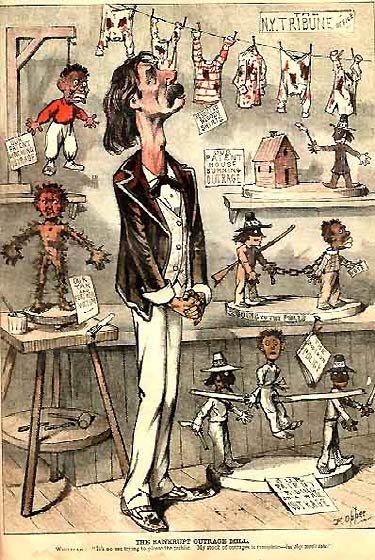
1880 Frederick Burr Opper Cartoon from Puck, titled: The Bankrupt Outrage Mill (showing bloody shirts, lynchings, and other forms of racial violence)
Virginia Governor Bob McDonnell’s break with political correctness and resumption of the practice avoided by two democrat party predecessors of declaring April to be “Confederate History Month” provoked the American left to open fire with all the batteries of the establishment media and the progressive blogosphere.
The contemporary left enthusiastically identifies with the 19th century radical abolitionist movement (which had so much to do with starting the Civil War) and is determined to ruthlessly suppress any expression of enthusiasm or affection for the Lost Cause.
The theoretical defense of the Southern political perspective and the rights of the states, remembrance of Confederate military victories, admiration for Confederate leaders, and any defense of the Southern Antebellum way of life are all treated as the gravest of thought crimes.
From the point of view of the Left, the politics of Slavery is all. Just as Harry Reid declared opposition to the Health Care Bill to be equivalent to opposing Civil Rights, the liberal commentariat characteristically treats any form of positive perspective on the Confederate Cause as tantamount to racism and an active defense of the Peculiar Institution.
Jon Meacham, in the New York Times, lays down the liberal law, insisting on the absolute centrality of Slavery to any interpretation of Civil War history.
If the slaves are erased from the picture [of the Civil War], then what took place between Sumter and Appomattox is not about the fate of human chattel, or a battle between good and evil. It is, instead, more of an ancestral skirmish in the Reagan revolution, a contest between big and small government.
We cannot allow the story of the emancipation of a people and the expiation of America’s original sin to become fodder for conservative politicians playing to their right-wing base. That, to say the very least, is a jump backward we do not need.
In other words, if the issues of states rights, popular sovereignty, and Constitutional limitations on federal power going back one hundred and fifty years are allowed to be raised, discussed, and argued, there is no telling what might come of it. Who knows? Some more complex interpretation beyond a simple drama featuring wicked slave owners and oppressed darkies might interfere with universal acceptance of the American left’s self-justifying narrative of radical leadership first overthrowing Slavery, then marching on to deliver first Civil Rights, then National Health Care.
It is vital to enforce a politically correct, crudely simplified version of history, so that history can be used as a credential by those who claim to be enforcing History’s will and decrees on the rest of us.
Invoking racial politics and inflaming sectional animosity at the expense of the South is a very old political game, as the 1880 cartoon above testifies. Americans were already tired of the practice in the 19th century. In the immediate aftermath of the Civil War, the radical Benjamin Butler, then a Congressman, exhibited on the floor of the House of Representative a blood-stained shirt belonging to an Ohio carpetbagger who had been whipped by night riders in Mississippi. This kind of divisive and manipulative politics of accusation came to be referred to derisively as “waving the bloody shirt.”
Bob McDonnell is just the most recent victim of the left’s habit of waving the bloody shirt in order to bully and intimidate its opponents.
Like myself, John R. Guardino had no relatives in the United States at the time of the Civil War. He discusses at some length, quoting Senator James Webb along the way, why the attacks on Governor McDonnell are so dishonest.
And, just for the record, I’d like to note that Virginia obviously did not secede to defend Slavery. Virginia seceded in order to avoid supplying troops to be used to conquer and invade her fellow states. Virginia went to war only to defend herself and other fraternal states from invasion.
08 Apr 2010
April 15th: “[F]or nearly half of U.S. households it’s simply somebody else’s problem.
About 47 percent will pay no federal income taxes at all for 2009. Either their incomes were too low, or they qualified for enough credits, deductions and exemptions to eliminate their liability. That’s according to projections by the Tax Policy Center, a Washington research organization.”
————————————-
St. Vincent’s Hospital in Greenwich Village on Manhattan’s West Side, the last Roman Catholic hospital in New York City, is closing after 160 years.
Via Walter Olson and Matt Lehrer,
————————————-
Guilty and White once more:
Jonathan Kay, managing editor of the National Post, attends a workshop on racism at the Toronto Women’s Bookshop:
The central theme of the course was that this twinned combination of capitalism and racism has produced a cult of “white privilege,” which permeates every aspect of our lives. “Canada is a white supremacist country, so I assume that I’m racist,” one of the students said matter-offactly during our first session. “It’s not about not being racist. Because I know I am. It’s about becoming less racist.”
————————————-

It is difficulty to shoot an AK missing its buttstock accurately
The Taliban are compensating for bad equipment and poor marksmanship with well-planned ambushes. Captain Grace describes their tactics.
We operated the entire deployment, on every patrol, in the horns of a dilemma. Insurgent forces would engage our forces from a distance with machine-gun fire and sporadic small arms and carefully watch our immediate actions. From day one, at the sound of the sonic pop of the round, Marines are taught to seek immediate cover and identify the source/location of the fire. Cover is almost always available in Afghanistan in the form or dirt berms, dry/filled canals and buildings. Marines tend to gravitate toward the aforementioned terrain features. So what the insurgents would do was booby-trap those areas with I.E.D.s. Whether they were pressure plates or pressure release, they were primed to detonate as Marines dove for cover. Back to the horns of a dilemma. Do I jump for the nearest cover? Run to the nearest building? Jump in the nearest canal? Do I take my chances and stand where I am and drop in place? Not necessarily the things you need to be contemplating as rounds are impacting all around you.
Hat tip to Isegoria.
30 Mar 2010
Victor Davis Hanson notices with alarm all the changes a year under the current regime as produced in America. It’s like waking up in an Invasion of the Bodysnatchers movie for him. Part of the strangeness is a new bipolar concept of racial tolerance, entirely different for Republicans and democrats.
There is a new racial tension not present a year ago, one having nothing to do with the election of the nation’s first President of partial African ancestry. Instead, never in my experience have officials of the federal government, both in the campaign leading up to their governance and once in office, so deliberately chosen to polarize the country along racial lines.
In retrospect, it seems a sort of nightmare these now serial outbursts of our officials — “typical white person,†“clingers,†“cowards,†police who “stereotype†and act “stupidly,†“wise Latina,†“white polluters,†framed by the President’s pastor and once spiritual Audacity-of-Hope mentor screaming “God D— America,†bookended by hyper-racial comments of a Harry Reid or Joe Biden about Negro accents and cleanliness.
And, of course, soon followed the slurs and smears of those in the media accusing almost every opponent at sometime of being a “racist,†a word that now has as much currency as a German Mark around 1929.
Opposition to health care, cap and trade, illegal immigration, everything I think soon, is being reformulated as antipathy to some sort of Civil Rights issues akin to the legislation of the 1960s. Almost daily now a major media columnist writes an essay alleging someone is racist, or there are subtle racist thoughts behind a type of opposition or protest. “Racist†is a 1950s sort of allegation, an instantaneous judge/jury/executioner/no-appeal condemnation. How Orwellian that the most racist members of American society, who built entire careers of fabricating evidence and defaming opponents — an Al Sharpton, for example — have become go-to national referees of suspected bias. How weirder that one just pledges allegiance to the new agenda, and suddenly one is both more likely to say something racist in Reid- or Biden-fashion, and yet it is not racist at all.
27 Mar 2010

The seal of the Confederate States of America
The Southern Legal Resource Center wants to use the Civil Rights Bill of 1964 to protect the civil rights of a generally unrecognized minority. It wants persons of Southern Confederate ancestry to be recognized as a racial group. Sounds fair to me. But what about more recently arrived Confederates like myself? I was born in Pennsylvania, and my ancestors were all residing in Lithuania at the time of the late unpleasantness, but I currently do claim citizenship in the Commonwealth of Virginia. Shouldn’t more recent immigrants be able to claim “Confederate Southern American” status via naturalization?
I guess I’ll just have to fill out my census form as suggested, and take my chances.
Via Federal Eye.
3:35 video
09 Mar 2010

Laugh of the morning: former CBS anchor Dan Rather has one of those inadvertent Freudian moments in which liberals reveal their inner viewpoints on matters racial. Like President Clinton reminding Teddy Kennedy that, a short while ago, the likes of Barack Obama “would have been getting us coffee.”
HDNet’s Dan Rather stepped on one mine after another in the racial minefield that exists when talking about the nation’s first black President as the former CBS anchor, on the syndicated Chris Matthews Show over the weekend, uttered the following take on the President’s ability to get health care passed and how the GOP and independents would view it.
DAN RATHER: Part of the undertow in the coming election is going to be President Obama’s leadership. And the Republicans will make a case and a lot of independents will buy this argument. “Listen he just hasn’t been, look at the health care bill. It was his number one priority. It took him forever to get it through and he had to compromise it to death.” And a version of, “Listen he’s a nice person, he’s very articulate” this is what’s been used against him, “but he couldn’t sell watermelons if it, you gave him the state troopers to flag down the traffic.”
While Rather may not have been being intentionally racist one has to wonder what the reaction would be if a conservative had used similiar language on the show.
0:40 video
———————————————–
As a commentary on all this, let’s have a viewing of Robert Nelson’s 1965 experimental film short Oh Dem Watermelons.
19 Feb 2010
James Lewis, at American Thinker, identifies precisely what Barack Obama is all about.
The United States today has slipped toward race-based socialism: That’s the true name for an overwhelming bias for one race above others, in employment, promotion, and educational opportunities. Our media are constantly stirring the witch’s brew of racial grievances, constantly making black people feel aggrieved and white people feel accused. Our schools drive that lesson home with young and innocent kids in a totally ruthless way. Repeat that for twelve years of schooling and TV, and you have a brainwashed kid.
That is what European socialists have done with class envy for the last hundred years: whip up the poor against the middle and the rich. It’s in their standard bag of tricks. The American Left has just added racial grievances to class anger and resentment, always feeding more and more power to the racial socialists to buy peace for the very grievances they have whipped up in the first place. …
We are no longer a society run by talent, work, and opportunity. Like ancient Egypt and Sumer, we are a society where the ruling class exploits its productive workers by taxing their labor, talent, and ability to recognize and use new opportunities.
Barack H. Obama is the logical outcome of racial socialism. You can see it in his words and actions, and his very physical stance, all signaling his sense of superiority, the flip-side of feelings of inferiority he is reacting against. Obama’s core support came from the Leftist alliance of grievance groups in spite of his total lack of relevant experience. Obama is objectively the least qualified person to be elected to the presidency. But the media could not say that, because it would have been non-P.C. to tell the truth.
Obama’s election was a kind of guilt propitiation by the American people for the history of slavery. But that is bizarre. Living people are not responsible for what others did two hundred years ago.
Read the whole thing.
11 Jan 2010

All sorts of people, several I’d never have suspected of being quite so racially sensitive, gleefully piled onto Harry Reid yesterday taking advantage of the scandalous revelation in Game Change, a new book about the 2008 presidential election contest, that Reid had expressed the opinion that Obama was electable because he was “light-skinned” with “no Negro dialect, unless he wanted to have one.”
“Negro” was suddenly discovered to be a vulgar and nasty pejorative, off limits in respectable society. And GOP Chairman (and opportunistic African-American) Michael Steele promptly called for Reid’s resignation from his Senate leadership post on grounds of PC taboo violation.
David Horowitz had the decency to express disgust.
[It’s] hard not to bathe in schadenfreude at the hammering [Harry Reid] is now getting over an interview he gave to John Heilemann and Mark Haperin during 2008 for their new book… But it is also hard not to be disgusted by the politically correct sanctimony of Republicans like the RNC’s Michael Steele who are acting as if they just caught the Nevada senator in a Klan costume.
“Negro†is the new n-word now? And is it not true that Obama’s light skin color and the half-white background that produced it was indeed an electoral asset? And didn’t the ability to talk like a brother as well as a Harvard grad sharpen the President’s ineffable hipness and post-racial appeal? Can the lexicon of the politically taboo have become such a fat book as this?
Instead of standing back with folded arms and watch the Democrats wallow in the squalor they created by forcing Reid to grovel for redemption from Al Sharpton, Julian Bond, the execrable Cong. Barbara Lee, and other race hustlers, Steele has demanded a leading role in this nasty spectacle. He says that the situation Reid created is similar to the one in 2002 when Republican Majority Leader Trent Lott was forced out of his leadership position for praising Strom Thurmond. Right. No doubt about it. But it was also the Republicans, cowering under the Democrats ludicrous charges of “racism,†who caved and forced Lott out. And while there is obviously a gleeful temptation to require Reid and the Democrats to endure the same standards now that took Lott down back then, Steele and the Republicans are taking the shabby way out again. If they don’t know that getting leverage by calling an opponent a racist (a term like “McCarthyite,†which no longer describes a pathology but is no more than a way of stigmatizing someone on the cheap) debases our political culture, who does? How many times have they been hit over the head with this charge? How can they not know that this is a game in which Republicans might score a run now and then but can never win. Nobody beats the Democrats at race-baiting!
By pointedly not doing to Reid what was done to Lott and making it into one of those “teachable moments†our President likes to talk about, Steele could have done the country a service. Instead, he supported a status quo in our politics in which the race card is always the first one dealt and always from the bottom of the deck.
—————————————-
Patterico favors proceeding with the un-PC hunt, pointing out how often Harry Reid has played this game himself.
My own favorite example of Reid playing the race card occurred this fall, when Reid compared congressional Republican opposition to healthcare to the 19th-century debate over slavery.
—————————————-
You can’t resign from being a former president, so William Jefferson Clinton will have to be allowed to get away with revealing his true racial perspective to the late Senator Edward Kennedy, remarking upon the incongruity of the upstart Obama challenging Mrs. Clinton for the democrat party nomination by noting: “A few years ago, this guy would have been getting us coffee.”
—————————————-
Disgraced former Illinois governor Rod Blagojevich (who resigned after trying to sell Obama’s senate seat) chimed in, too, with the following comparison.
I’m blacker than Barack Obama. I shined shoes. I grew up in a five-room apartment. My father had a little laundromat in a black community not far from where we lived. I saw it all growing up.”
Your are browsing
the Archives of Never Yet Melted in the 'Racial Politics' Category.
/div>

Feeds
|




