CNN Money describes the problems and quotes technicians about what it will take to fix it.
Experts say the major problems with the Obamacare website can’t reasonably be solved before the end of 2013, and the best fix would be to start over from scratch.
After assessing the website, Dave Kennedy, the CEO of information-security company Trusted Sec, estimates that about 20% of Healthcare.gov needs to be rewritten. With a whopping 500 million lines of code, according to a recent New York Times report, Kennedy believes fixing the site would probably take six months to a year.
But would-be Obamacare enrollees only have until Dec. 15 to sign up for coverage starting at the beginning of 2014. Nish Bhalla, CEO of information-security firm Security Compass, said it “does not sound realistic at all” that Healthcare.gov will be fully operational before that point.
“We don’t even know where all of the problems lie, so how can we solve them?” Bhalla said. “It’s like a drive-by shooting: You’re going fast and you might hit it, you might miss it. But you can’t fix what you can’t identify.”
Several computer engineers said it would likely be easier to rebuild Healthcare.gov than to fix the issues in the current system. But it’s unlikely that the government would toss out more than $300 million worth of work.
The sheer size of Healthcare.gov is indicative of a major rush job. Rolling the site out too quickly likely increased the number of errors, and that makes the fixes more difficult to implement.
“Projects that are done rapidly usually have a lot of [repetitive] code,” said Arron Kallenberg, a software engineer and tech entrepreneur. “So when you have a problem, instead of debugging something in a single location, you’re tracking it down all through the code base.”
To put 500 million lines of code into perspective, it took just 500,000 lines of code to send the Curiosity rover to Mars. Microsoft’s (MSFT, Fortune 500) Windows 8 operating system reportedly has about 80 million lines of code. And an online banking system might feature between 75 million and 100 million lines. A “more normal range” for a project like Healthcare.gov is about 25 million to 50 million lines of code, Kennedy said.
“The [500 million lines of code] says right off the bat that something is egregiously wrong,” said Kennedy. “I jumped back when I read that figure. It’s just so excessive.” …
..The New York Times report said five million lines of code need to be replaced just so the site can run properly.
But the Obamacare website has bigger problems than simply getting people registered for health care. The code is also riddled with security holes, according to Kennedy, who outlined his cybersecurity concerns on Trusted Sec’s company blog.
“If someone can’t register, that’s obviously bad — but if the information gets hacked, you’re talking about one of the biggest breaches in American history,” Kennedy said. “I think security is an afterthought at this point.”
Down in Somerset County, next Saturday, the John Henry Mellot auction company will be holding an estate auction at a local farm.
Since they posted a photo of this round object mounted decoratively at the gable of the barn, I expect it will probably be for sale.
I’m not actually looking to own one of these myself, but I am curious as to what is the identity of this large, obviously antique, article of agricultural technology?
They had three years to build it. They spent $634,320,919, more than it cost to build Facebook. They were able to build the Pentagon in just under one year and four months (11 September 1941 — 15 January 1943) for half the cost. And it was still dysfunctional a week after its scheduled opening.
Digital Trends described the fiasco:
The site itself, which apparently underwent major code renovations over the weekend, still rejects user logins, fails to load drop-down menus and other crucial components for users that successfully gain entrance, and otherwise prevents uninsured Americans in the 36 states it serves from purchasing healthcare at competitive rates – Healthcare.gov’s primary purpose. The site is so busted that, as of a couple days ago, the number of people that successfully purchased healthcare through it was in the “single digits,†according to the Washington Post.
And our liberal friends believe we ought to be happy to turn over our healthcare choices, and a one sixth portion of the American economy, to the same government which demonstrably could not even satisfactorily develop a website in three years?
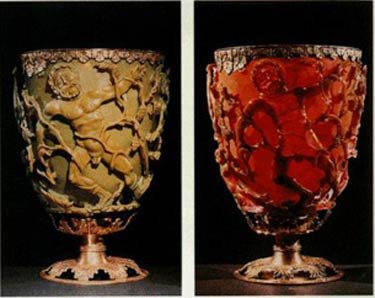
The colorful secret of a 1,600-year-old Roman chalice at the British Museum is the key to a superÂsensitive new technology that might help diagnose human disease or pinpoint biohazards at security checkpoints.
The glass chalice, known as the Lycurgus Cup because it bears a scene involving King Lycurgus of Thrace, appears jade green when lit from the front but blood-red when lit from behind—a property that puzzled scientists for decades after the museum acquired the cup in the 1950s. The mystery wasn’t solved until 1990, when researchers in England scrutinized broken fragments under a microscope and discovered that the Roman artisans were nanotechnology pioneers: They’d impregnated the glass with particles of silver and gold, ground down until they were as small as 50 nanometers in diameter, less than one-thousandth the size of a grain of table salt. The exact mixture of the precious metals suggests the Romans knew what they were doing—“an amazing feat,†says one of the researchers, archaeologist Ian Freestone of University College London.
The ancient nanotech works something like this: When hit with light, electrons belonging to the metal flecks vibrate in ways that alter the color depending on the observer’s position. Gang Logan Liu, an engineer at the University of Illinois at Urbana-Champaign, who has long focused on using nanotechnology to diagnose disease, and his colleagues realized that this effect offered untapped potential. “The Romans knew how to make and use nanoparticles for beautiful art,†Liu says. “We wanted to see if this could have scientific applications.â€
When various fluids filled the cup, Liu suspected, they would change how the vibrating electrons in the glass interacted, and thus the color. (Today’s home pregnancy tests exploit a separate nano-based phenomenon to turn a white line pink.)
The cup was “perhaps made in Alexandria” or Rome in about 290-325 AD, and measures 16.5 x 13.2 cm. From its excellent condition it is probable that, like several other luxury Roman objects, it has always been preserved above ground; most often such objects ended up in the relatively secure environment of a church treasury. Alternatively it might, like several other cage cups, have been recovered from a sarcophagus. The present gilt-bronze rim and foot were added in about 1800, suggesting it was one of the many objects taken from church treasuries during the period of the French Revolution and French Revolutionary Wars. The foot continues the theme of the cup with open-work vine leaves, and the rim has leaf forms that lengthen and shorten to match the scenes in glass. In 1958 the foot was removed by British Museum conservators, and not rejoined to the cup until 1973. There may well have been earlier mounts.
The early history of the cup is unknown, and it is first mentioned in print in 1845, when a French writer said he had seen it “some years ago, in the hands of M. Dubois”. This is probably shortly before it was acquired by the Rothschild family. Certainly Lionel de Rothschild owned it by 1862, when he lent it to an exhibition at what is now the V&A Museum, after which it virtually fell from scholarly view until 1950. In 1958 Victor, Lord Rothschild sold it to the British Museum for £20,000… .The cup is normally on display, lit from behind, in Room 50 (it forms part of the museum’s Department of Prehistory and Europe).
2,000-year-old 100-layer sword, reputed to have been owed by Lui Bang (fl. circa 200 B.C.) first Emperor of the Han Dynasty, found originally covered with blood rust. The pattern shown in the bottom photo is known as leopard spots.
Collectors Weekly visits swordmaker Francis Boyd, learns the difference between Damascus layered and wootz steel, and gets to see a sword gifted in China by Marco Polo (or a close relative).
When I got this sword, it was completely covered in blood rust.†Sword maker Francis Boyd is showing me yet another weapon pulled from yet another safe in the heavily fortified workshop behind his northern California home.
“You can tell it’s blood,†he says matter-of-factly, “because ordinary rust turns the grinding water brown. If it’s blood rust it bleeds, it looks like blood in the water. Even 2,000 years old, it bleeds. And it smells like a steak cooking, like cooked meat. I’ve encountered this before with Japanese swords from World War II. If there’s blood on the sword and you start polishing it, the sword bleeds. It comes with the territory.â€
Blood rust: I hadn’t thought of that. I guess it would turn water red, but the steak comment is kind of creeping me out, as is the growing realization that if these swords could talk, I couldn’t stomach half the tales they’d have to tell.
Do you still pine for your college days, when the personal computer was a decade or more in the future, and the typewriter still reigned?
USBtypewriter offers not-terribly-expensive conversion kits to allow you to use old-timey manual typewriters instead of that nasty new-fangled keyboard. Sorry, those slightly less geriatric who prefer electric typewriters (like the Royal I used to use, or the IBM Selectric) are out of luck.
Richard Fernandez (who went to Harvard and is consequently shaky on his Greek Mythology.*) thinks that Information Technology, the Internet, and the Blogosphere have revived the Muses.
Today most people don’t believe in the Muses any more. Not in the sense that the ancients did. The three — the goddesses of literarture, science and the arts — were at one time supposed to command men to speak. They have largely been replaced by the single all purpose modern deity: the Job. In modern political orthodoxy we do things for one rational reason only, which is to get paid.
We write when the Boss tells us to. We craft a speech of talking points that the committee has approved. But of the muses we heard no more. Until recently.
If any spiritual debt is owed to the informational technology revolution it has been in the resurrection of the Muses. For no one familiar with the programming world will believe for a minute that its best developers write code to be paid. They code because it is cool. They code and you would have to pay them not to code.
They are laboring, not for the chump change offered on Rent-A-Coder, but under the lash of the muse. And because they have been so successful at remolding our world modern, cynical, materialistic culture has once again been forced, at iPod-point to re-acknowledge the impulse of creativity.
We are no more surprised to read of some eminent programmer found dead in a motel room, surrounded by empty boxes of pizza and hundreds of cans of Jolt Cola, expired of heart attack, one bony finger poised to type the final curly bracket of his life than the ancients would have been to find some pilgrim deceased on the path to a seer’s cave, or overcome by the smoke of the Oracle. A victim to the muse and wanderer along the way.
Dvice.com has a story of an educational experiment confirming the optimistic point of view with respect to human curiosity and ingenuity.
What happens if you give a thousand Motorola Zoom tablet PCs to Ethiopian kids who have never even seen a printed word? Within five months, they’ll start teaching themselves English while circumventing the security on your OS to customize settings and activate disabled hardware. Whoa. …
Rather than give out laptops (they’re actually Motorola Zoom tablets plus solar chargers running custom software) to kids in schools with teachers, the OLPC Project decided to try something completely different: it delivered some boxes of tablets to two villages in Ethiopia, taped shut, with no instructions whatsoever. Just like, “hey kids, here’s this box, you can open it if you want, see ya!”
Just to give you a sense of what these villages in Ethiopia are like, the kids (and most of the adults) there have never seen a word. No books, no newspapers, no street signs, no labels on packaged foods or goods. Nothing. And these villages aren’t unique in that respect; there are many of them in Africa where the literacy rate is close to zero. So you might think that if you’re going to give out fancy tablet computers, it would be helpful to have someone along to show these people how to use them, right?
But that’s not what OLPC did. They just left the boxes there, sealed up, containing one tablet for every kid in each of the villages (nearly a thousand tablets in total), pre-loaded with a custom English-language operating system and SD cards with tracking software on them to record how the tablets were used. Here’s how it went down, as related by OLPC founder Nicholas Negroponte at MIT Technology Review’s EmTech conference last week:
“We left the boxes in the village. Closed. Taped shut. No instruction, no human being. I thought, the kids will play with the boxes! Within four minutes, one kid not only opened the box, but found the on/off switch. He’d never seen an on/off switch. He powered it up. Within five days, they were using 47 apps per child per day. Within two weeks, they were singing ABC songs [in English] in the village. And within five months, they had hacked Android. Some idiot in our organization or in the Media Lab had disabled the camera! And they figured out it had a camera, and they hacked Android.”
Amit Agarwal, the Indian WSJ’s personal technology columnist offers 101 useful websites, each of which does something useful very well, and all of which are easy to remember.
I can add one more.
102 tineye.com reverse image source, can often identify where that unlabeled picture came from.
This young tech blogger dude sits down in a coffee shop in Portland to catch up on his email and do a little blogging on his Macbook Air, when an incredibly ancient geezer comes along and starts up a conversation about Apple computers.
The old guy doesn’t approve of Apple’s iPad approach: all consuming, no programming, no creating, no doing anything which hasn’t ever been done before. The young guy asks the old geezer what he ever did that hadn’t been done before, and the old guy replies: “I invented the first computer.”