Category Archive 'US Constitution'
02 Jul 2012

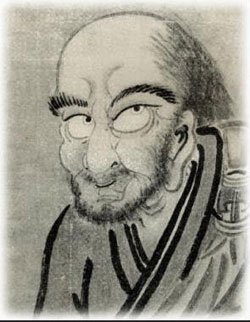
Chief Justice Roberts is kind of like Hakuin, the sort of Zen master who asks you if Obamacare is constitutional, and then whacks you with a shinai if you answer anything but “Moo!”
Chief Justice Roberts, in a manner provocative of keen curiosity, and apparently at the last minute, evolved a new (and extremely Zen) jurisprudential philosophy, urging Supreme Court justices to adopt an extremist philosophy, strangely combining restraint with activism, out of an exaggerated deference to the alleged superior expertise and mandate of Heaven possessed by elected legislators.
Apparently when an elected Congress proceeds to violate the Constitution, according to Mr. Roberts, the good Supreme Court justice will peer skyward, mutter “tsk, tsk” to himself, and proceed to pore closely over the Constitution to find some loophole which can be used to finagle the violative legislative measure into Constitutional legitimacy. He will then wave from afar to the inhabitants of the American Republic, and in his heart wish them the best in capturing total control of both other branches of government, so they can repeal the atrocity.
Protecting Americans from the consequences of their electoral choices, Mr. Roberts explicitly assured us, is not his job.
It is implicitly our job to protect ourselves from having our rights trampled and the Constitution made into a mockery by either winning landslide electoral victories totally repudiating the party currently in power, or possibly by launching a successful armed revolution. And good luck to us, because we certainly are not going to be receiving any help from Mr. Roberts.
Adolph Hitler concluded in 1945 that the German people were demonstrably unworthy of his genius and deserved to lose, and the Russians were really the master race. Mr. Roberts clearly shares this kind of shape-up or ship-out view of Constitutionalism in an electoral democracy. If you lose elections, don’t go crying to Chief Justice Roberts’ Supreme Court. The correct rule is not what the Constitution says, or what the framers had in mind, but the will of the voting electorate as interpreted by the ukases of the successful professional politicians.
Win elections, control Congress and the White House, says Chief Justice Roberts. “There is no ‘try.'”
02 Jul 2012

Andrew C. McCarthy identifies one of the key things wrong with John Roberts’ interpretive maneuver.
Chief Justice Roberts & Co. … said the American people are not entitled to an honest legislative process, one in which they can safely assume that when Congress intentionally uses words that have very different meanings and consequences — like tax and penalty — and when Congress adamantly insists that the foundation of legislation is one and not the other, the Court will honor, rather than rewrite, the legislative process. Meaning: if Congress was wrong, the resulting law will be struck down, and Congress will be told that, if it wants to pass the law, it has to do it honestly.
Just as an appeals court may not legitimately rewrite an indictment and revise what happened at a trial, neither may it legitimately rewrite a statute and fabricate an imaginary congressional record. But today, the Supreme Court rewrote a law — which it has no constitutional authority to do — and treated it as if it were forthrightly, legitimately enacted. Further, it shielded the political branches from accountability for raising taxes, knowing full well that, had Obama and the Democrats leveled with the public that ObamaCare entailed a huge tax hike, it would never have had the votes to pass.
—————————
In NFIB v Sebelius, Chief Justice Roberts explictly renounces the Supreme Court’s responsibility for strict enforcement of the Constitution on the grounds of deference to the superior expertise of, and the mandate of Heaven possessed by, elected legislators.
We do not consider whether the Act embodies sound policies. That judgment is entrusted to the Nation’s elected leaders. We ask only whether Congress has the power under the Constitution to enact the challenged provisions. …
Members of this Court are vested with the authority to interpret the law; we possess neither the expertise nor the prerogative to make policy judgments. Those decisions are entrusted to our Nation’s elected leaders, who can be thrown out of office if the people disagree with them. It is not our job to protect the people from the consequences of their political choices.
In fact, Roberts asserts the existence of an actual obligation on the part of the Court to use intellectual ingenuity and interpretive creativity to somehow find a theoretical basis on which an unconstitutional piece of legislation, like the Affordable Care Act, can be read differently, in order to finagle it into effect around the Constitution.
Under the mandate, if an individual does not maintain health insurance, the only consequence is that he must make an additional payment to the IRS when he pays his taxes. See §5000A(b). That, according to the Government,means the mandate can be regarded as establishing a condition—not owning health insurance—that triggers a tax—the required payment to the IRS. Under that theory, the mandate is not a legal command to buy insurance.Rather, it makes going without insurance just another thing the Government taxes, like buying gasoline or earning income. And if the mandate is in effect just a tax hike on certain taxpayers who do not have health insurance, it may be within Congress’s constitutional power to tax.
The question is not whether that is the most natural interpretation of the mandate, but only whether it is a “fairly possible†one. Crowell v. Benson, 285 U. S. 22, 62 (1932). As we have explained, “every reasonable construction must be resorted to, in order to save a statute from unconstitutionality.†Hooper v. California, 155 U. S. 648, 657 (1895). The Government asks us to interpret the mandate as imposing a tax, if it would otherwise violate the Constitution. Granting the Act the full measure of deference owed to federal statutes, it can be so read.
After all, according to Roberts, if the American people really dislike what elected legislators have done, they need only overcome the enormous power of incumbency, the vast nation-wide political organizations and interests behind a given measure and the political leaders who passed it, their campaign chests stuffed with hundreds of millions of dollars, all the forces of entropy and inertia, and now-established practices, institutions, and persons dependent on them, and just throw all the rascals out, win the presidency, and majorities of both houses of Congress, and possibly a super-majority in the Senate capable of closing down the filibuster, and the nation can readily thereby correct “the consequences of (past) political choices.”
If one subscribes, it seems to me, to the theory of a system of divided branches of government with checks and balances, adopted by the framers on the basis of the theories of Montesquieu , protecting the American people from the consequences of the electoral choices is precisely what the Supreme Court was created to do.
I would be very interested in reading the particular number of the Federalist Papers in which Madison, Hamilton, or Jay explains that devising sophistical readings of a law in order to allow it to appear to conform to the boundaries of enumerated powers in the Constitution so that all possible fruits of unfortunate electoral decisions may be fully allowed to be experienced by the inhabitants of the American Republic and the ephemeral will of the electorate be unconstrained is really the intended responsibility of highest judicial tribunal.
19 Jun 2012

Kevin Drum, in Mother Jones, contends that we diabolical conservatives first strong-armed the Republican Party into accepting our view of the unconstitutionality of the Obamacare individual mandate, then we successfully used the right-wing media to brainwash the mainstream media into accepting our arguments as legitimate, and all this, you see, gives cover to our partisan judges to make a partisan ruling.
Two years ago, when President Obama signed the Affordable Care Act into law, the idea that its individual mandate provision was unconstitutional was laughable. There was no case law, no precedent, and frankly, no serious argument that the federal government’s Commerce Clause power didn’t give it the authority to mandate purchase of health insurance if it wanted to. That’s why Democrats didn’t bother looking for a clever alternative—many of which were available—in order to avoid including an explicit mandate in the law. They didn’t think they needed to. Of course it was constitutional. Even Randy Barnett, the law professor who popularized the activity/inactivity distinction that opponents latched onto as their best bet against the mandate, initially didn’t really think it was anything but a long shot.
So how did that conventional wisdom change so dramatically in only two years? …
let’s hear what a nonliberal has to say about it:
Orin Kerr says that, in the two years since he gave the individual mandate only a one-percent chance of being overturned, three key things have happened. First, congressional Republicans made the argument against the mandate a Republican position. Then it became a standard conservative-media position. “That legitimized the argument in a way we haven’t really seen before,” Kerr said. “We haven’t seen the media pick up a legal argument and make the argument mainstream by virtue of media coverage.” Finally, he says, “there were two conservative district judges who agreed with the argument, largely echoing the Republican position and the media coverage. And, once you had all that, it really became a ballgame.”
This is, needless to say, a powerfully depressing analysis. For all practical purposes, Kerr is agreeing that conservative judges don’t even bother pretending to be neutral anymore. They listen to Fox News, and if something becomes a consvative talking point then they’re on board. And that goes all the way up to the Supreme Court.
Kevin Drum’s perspective amounts to assuming that extreme New Deal jurisprudence, like the 1942 Wickard v. Filburn (a decision which ruled that the Constitution’s grant of power to regulate Interstate Commerce gave Congress the power to tell an Ohio farmer named Roscoe Filburn that he was not allowed to grow wheat on his farm to feed his own chickens. Farmer Filburn using his own wheat, and not buying wheat on the market, was deemed to impact Interstate Commerce and therefore to provide a legal basis for Congressional authority.) was good law and destined to endure forever unchallenged by the reasoning of later courts.
Kevin Drum studiously ignores the fact that the Constitution-in-exile of the New Deal era has been gradually coming back. The Supreme Court resumed, in a modest way, re-adopting the perspective that Constitutional authority to regulate Interstate Commerce actually required the legislative object to involve commerce crossing state lines. In U.S. v. Lopez (1995), the Court struck down a Gun-Free School Zone law because the regulated activity concerned actually had nothing to do with Interstate Commerce.
A number of other once-thought-to-be-extinct Constitutional provisions, like the Second Amendment, have come roaring back to life in recent years.
To believe, as people like Kevin Drum and Nancy Pelosi notoriously did, that it was completely unnecessary to look for an actual constitutionally enumerated power to permit Congress to tell Americans to buy health insurance policies is to reject the fundamental American idea of limited government.
What has actually occurred, over decades, is a national debate over whether a long string of unprincipled, legal realist rulings simply setting the Constitution and the entire earlier history of constitutional law aside were correct. In law review articles, public debate, and in national elections leading to judicial appointments and ultimately to rulings, the left has been losing and the conservative position has been winning.
In the end, there should be no surprise to anyone who takes the Constitution seriously when the Obamacare individual mandate is struck down. That was the intent of the framers, and those of us who contend that that is what the Constitution says inevitably have the better arguments.
24 Apr 2012

David Steinberg, at PJM, in my view, does not really pull off the Colonel Kurtz allusion which led me to his editorial, but he does identify the crucial philosophical point: it is impossible to create new (supposititious) rights without violating (real) natural rights. The Constitution was written to protect natural rights by men who believed that they were self evident.
[Y]ou cannot invent a right. The government attempted to do this, and found they could not do so without also violating a right.
Why? Because a “right†to a good or service necessitates a violation of the rights of the provider of that good or service or of whomever is chosen to be stuck with the bill, and further, as the citizen receiving the proposed new “right†is also subject to the violation in different time and circumstance, any new “right†is by definition a decrease in liberty for everyone, and might I add “duh.â€
Elsewhere in the field of reality lies a perfect analogy for the Left’s century of affronts to Natural Law:
In all cases in which work is produced by the agency of heat, a quantity of heat is consumed which is proportional to the work done; and conversely, by the expenditure of an equal quantity of work an equal quantity of heat is produced.
This sentence, the First Law of Thermodynamics, represents the end of all inquiries into the creation of a perpetual motion generator. The First Law cannot tell you what form a proposed perpetual motion generator will take; it is, however, unfailingly predictive of the experiment’s conclusion in failure. Of course, that didn’t halt centuries of “mathematical leftists†from attempting to design and construct perpetual motion machines. The builders predating the First Law pursued knowledge in the best tradition of humanity; the builders following the Law belonged to one of three categories: they either refused to accept the Law; were ignorant of its discovery; or were charlatans who knew a great number of suckers resided in the other two categories.
“A right to health care†offers equivalent parallels to the First Law of Thermodynamics and its three categories of opposition: the deniers, the ignorants, and the common schmucks.
Unfortunately for the suddenly uncomfortable, the bigger problem for the left-leaning does not halt beyond Obamacare: can you name many Leftist proposals that do not either violate Natural Law or disdainfully tread on its boundaries? Any? How much of Leftist thought is, and should have been, dead on arrival? How many landmark bills, slogans, teachings, entire executive branch departments?
For the intellectually honest Leftist, today the pupils must widen, lest you mislead yourself and waste another day or life. The Constitution forbids Leftism.
10 Apr 2012

Ben Smith quotes an unnamed conservative lawyer who offers a simultaneously cynical and whimsical explanation of exactly why Obamacare is toast.
You have built an imaginary mansion, with thousands of rooms, on the foundation of Wickard v. Filburn — the 1942 ruling that broadened the understanding of how the Commerce Clause could be used to regulate economic activity.
We aren’t being asked to radically revise the Commerce Clause and throw out seven decades of law, and we won’t. But we know the founders never intended the Commerce Clause to allow the Federal Government to regulate everything on the planet. So we are going to accept Randy Barnett’s basically spurious exception to that basically spurious idea, and throw out the Affordable Care Act on the grounds that the Commerce Clause regulates “activity†(which we don’t really believe), but not “inactivity†(because, why not draw the line somewhere?).
This is to say: You have built a fantasy mansion on the Commerce Clause. You can hardly blame us if, in one wing of this mansion, down a dusty corridor, we build a fantasy room called “inactivity,†lock the door, and don’t let you in.
04 Apr 2012

Stuart Schneiderman mercilessly rubs in what has become increasingly obvious this week: the chosen representative of our nation’s establishment elite is really an ignoramus who’d flunk basic questions from a high school Civics course.
America’s thinking class saw Barack Obama as a light shining in the wilderness.
In deep despair over the coarsening of public discourse during the Dark Ages of the Bush administration, American intellectuals saw Barack Obama as one of their own, someone who could restore their exalted social status and raise the level of deliberative democratic debate.
Obama hadn’t accomplished anything of note; he wasn’t really qualified for the presidency; but he was superbly intelligent, had presided over the Harvard Law Review, had professed Constitutional Law at the University of Chicago Law School, and had authored two brilliant books. …
A few days ago the curtain was drawn and people could see that the Wizard of Oz was not what he claimed to be.
In an effort to get personally involved in Supreme Court deliberations over his signature piece of legislation—Obamacare—our president made it appear that he did not understand the most fundamental doctrine in American jurisprudence.
The former president of the Harvard Law Review, former professor at the University of Chicago Law review managed to mangle an explanation of “judicial review.†As every high school history student knows the doctrine was adumbrated in 1803 by Chief Justice John Jay in the case of Marbury v. Madison.
Obama asserted:
Ultimately, I’m confident that the Supreme Court will not take what would be an unprecedented, extraordinary step of overturning a law that was passed by a strong majority of a democratically elected Congress.
As everyone but Obama knows, Marbury v. Madison established the right of the Supreme Court to strike down Congressional legislation that it deemed unconstitutional.
The Court has done just that on hundreds of occasions.
Read the whole thing.
Hat tip to Karen L. Myers.
28 Mar 2012

The constitutionality of Obamacare needs extreme assistance.
When professional spinners on the left like Peter J. Boyer start explaining why the Supreme Court’s killing of Obamacare would really be a good thing for Barack Obama’s reelection chances, you can kind of tell that the realization that the Supreme Court is not likely to rule their way has pretty well sunk in.
Apart from the fact that Republicans would lose their most animating issue in the presidential race, the overturning of the health-care reform law would free Obama of the burden of having to mount a broad defense of his health-care plan as a centerpiece of his campaign. The president, who can read polls, managed to absent himself from any public observance of the reform law’s second anniversary last week. A Supreme Court invalidation of the reform law’s individual mandate, the feature that Americans find most odious (PDF) would allow Obama to embrace the issue anew, focusing on those portions of the reform (such as the provision allowing families to keep their children on their policies until they reach the age of 26) that most people actually like. Obama’s Democratic allies, meanwhile, could hammer home the importance of deciding who will be making the next appointments to the Supreme Court.
————–
The Hill quoted a major liberal analyst, who was about as pessimistic on Obamacare’s chances as it’s possible to get.
Jeffrey Toobin, a lawyer and legal analyst, who writes about legal topics for The New Yorker said the law looked to be in “trouble.” He called it a “trainwreck for the Obama administration.”
“This law looks like it’s going to be struck down. I’m telling you, all of the predictions, including mine, that the justices would not have a problem with this law were wrong,” Toobin said Tuesday on CNN. “I think this law is in grave, grave trouble.
Toobin’s observation came on the second day of oral arguments at the Supreme Court over the constitutionality of the Affordable Care Act.
Earlier that day, Supreme Court Justice Anthony Kennedy, who could be the deciding vote on whether to uphold the law, told Solicitor General Donald Verrilli that there appeared to be a “very heavy burden of justification” on aspects of the law, according to The Wall Street Journal.
Toobin described Kennedy as “enormously skeptical” during the arguments Tuesday.
07 Jan 2012

John Podhoretz explains that Barack Obama’s end-run around the Constitution this week is really evidence of his political weakness and desperation.
President Obama’s executive power-grab this week — making four “recess†appointments when the Senate isn’t in recess — is a mark not of his strength, but of his relative weakness. He is asserting an authority he does not possess through the Constitution because he has precious little personal authority left to assert.
He had it and he lost it, and he can’t figure out how to get it back — so he’s just going to take it.
“When Congress refuses to act, and as a result hurts our economy and puts people at risk, I have an obligation as president to do what I can without them,†Obama said Wednesday as he trumpeted his installation of Richard Cordray as head of his new consumer-activism bureau.
This is rhetoric designed to thrill liberals and Democrats, who (like all partisans and ideologues) love what they take to be the “good fight,†and don’t particularly care how it’s waged. That’s true even if they spent eight years screaming about supposed unconstitutional actions on the part of the Bush administration, every one of which had a far firmer foundation in constitutional law than Obama’s unprecedented action this week.
They also love it because they think it represents an awakening by Obama to the nature of the obstructionist efforts against him (and a winning re-election strategy) when he says he’ll do “what I can†to combat Washington’s brokenness.
This supposedly a) acknowledges the public sentiment against the city whose most powerful resident he is, b) alleges he’s not the reason for the problems and c) places the blame on the recalcitrant Congress.
Maybe it’s the best hand Obama has to play, but it’s not a very good hand. For one thing, the voters who have turned on him don’t think he has exercised too little power, but rather too much — so bragging about doing things without congressional sanction may not play well.
Second, no matter how resolute he sounds, the fact that he has to act in a somewhat rogue manner is an expression of a profound loss of presidential authority — and one that he can’t successfully blame on Congress.
Obama lost his ability to push his agenda through Congress when he received what he himself called a “shellacking†in the November 2010 elections. That shellacking was primarily the result of massive policy overreach when he had a Democratic Congress in his pocket.
He spent 2009 and 2010 getting what he wanted: a trillion dollar stimulus. Auto-industry nationalization. And, of course, his health-care law. It was a wildly successful first 18 months — and it led directly to the bruising defeat he suffered as soon as the American people could render their judgment on those actions.
The independent voters who’d put him over the top in 2008 were horrified by the results. Exit polls showed a 24 percent swing among them, from 8 percentage points in favor of Obama and the Democrats in 2008 to 16 points against in 2010.
What may have been even more painful for Obama’s vanity was his discovery in 2011 that his rhetorical gifts had lost their oomph. He gave speech after speech on topics dear to his heart — and found, each time, that the talk was either ineffectual or actually convinced more people to oppose him.
Read the whole thing.
Podhoretz is perfectly right. Obama’s discreditable (and illegal) ploy is only a short-term strategy to gratify his base and keep the small body of support he still possesses behind him by making a strong gesture of partisanship that makes them happy. Who cares that his action will set a really terrible precedent? Who cares that the appointments will probably be struck down in court? Just as long as he can fire up the base.
29 Nov 2011
Yuval Levin, in National Review, explains why the American left seems to be contradicting itself so frequently these days, as it rhetorically swings back and forth between appeals to Populism and demands for conceding ever more power to unelected elite experts.
The difference[s] between.. two kinds of liberalism — constitutionalism grounded in humility about human nature and progressivism grounded in utopian expectations — is a crucial fault line of our politics, and has divided the friends of liberty since at least the French Revolution. It speaks to two kinds of views about just what liberal politics is.
One view, which has always been the less common one, holds that liberal institutions were the product of countless generations of political and cultural evolution in the West, which by the time of the Enlightenment, and especially in Britain, had begun to arrive at political forms that pointed toward some timeless principles in which our common life must be grounded, that accounted for the complexities of society, and that allowed for a workable balance between freedom and effective government given the constraints of human nature. Liberalism, in this view, involves the preservation and gradual improvement of those forms because they allow us both to grasp the proper principles of politics and to govern ourselves well.
The other, and more common, view argues that liberal institutions were the result of a discovery of new political principles in the Enlightenment — principles that pointed toward new ideals and institutions, and toward an ideal society. Liberalism, in this view, is the pursuit of that ideal society. Thus one view understands liberalism as an accomplishment to be preserved and enhanced, while another sees it as a discovery that points beyond the existing arrangements of society. One holds that the prudent forms of liberal institutions are what matter most, while the other holds that the utopian goals of liberal politics are paramount. One is conservative while the other is progressive.
The principles that the progressive form of liberalism thought it had discovered were much like those that more conservative liberals believed society had arrived at through long experience: principles of natural rights that define the proper ends and bounds of government. Thus for a time, progressive and conservative liberals in America — such as Thomas Jefferson and Thomas Paine on one hand and James Madison and Alexander Hamilton on the other — seemed to be advancing roughly the same general vision of government. But when those principles failed to yield the ideal society (and when industrialism seemed to put that ideal farther off than ever), the more progressive or radical liberals abandoned these principles in favor of their utopian ambitions. At that point, progressive and conservative American liberals parted ways — the former drawn to post-liberal philosophies of utopian ends (often translated from German) while the latter continued to defend the restraining mechanisms of classical-liberal institutions and the skeptical worldview that underlies them.
That division is evident in many of our most profound debates today, and especially in the debate between the Left and the Right about the Constitution. This debate, and not a choice between technocracy and populism, defines the present moment in our politics. Thus the Left’s simultaneous support for government by expert panel and for the unkempt carpers occupying Wall Street is not a contradiction — it is a coherent error. And the Right’s response should be coherent too. It should be, as for the most part it has been, an unabashed defense of our constitutional system, gridlock and all.
Read the whole thing.
Your are browsing
the Archives of Never Yet Melted in the 'US Constitution' Category.
/div>

Feeds
|