Category Archive 'Yale'
20 Jan 2014


The odious Yale Administration recently responded to the technological progress which transferred the printed-on-paper Course Critique (which my colleagues and I on the Yale Daily News first produced in the Fall of 1967) to a more flexible searchable electronic version on the Internet to tyrannically exercise the university’s power as webhost to censor and shut it down.
One has to shake one’s head over the fact that Yale continues to manage to hire and put power into the hands of people who are both so inclined to misuse power and simultaneously so lame. Dean Dodo who made the decision to take that website down obviously had only the dimmest reptilian understanding of the possibilities of technology and the enterprise and skill of the Yale undergraduate.
Sean Haufler stepped up in response.
In January 2012, two Yale students named Harry Yu and Peter Xu built a replacement to Yale’s official course selection website. They it called YBB+ (Yale Bluebook Plus), a “plus†version of the Yale-owned site, called Yale Bluebook. YBB+ offered different functionality from the official site, allowing students to sort courses by average rating and workload. The official Yale Bluebook, rather, showed a visual graph of the distribution of student ratings as well as a list of written student reviews. YBB+ offered a more lightweight user interface and facilitated easier comparison of course statistics. Students loved it. A significant portion of the student body started using it.
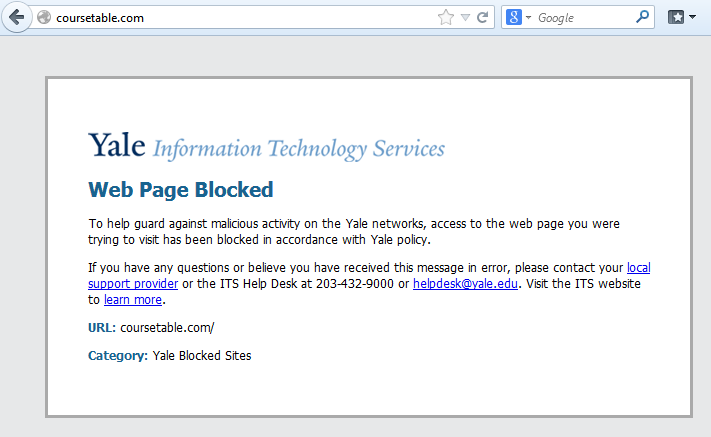
Fast-forward two years. Last Friday (1/10/14), Yale blocked YBB+’s IP address on the school network without warning. When contacted, Yale said that YBB+ infringed upon Yale’s trademark. Harry and Peter quickly removed the Yale name from the site, rebranded it as CourseTable and relaunched. Yale blocked the website again, declaring the website to be malicious activity.
Later that weekend, Yale’s administration told the student developers that the school didn’t approve of the use of its course evaluation data, saying that their website “let students see the averaged evaluations far too easilyâ€. Harry and Peter were told to remove the feature from the CourseTable website or else they would be referred to the school’s punishment committee. …
What if someone made a piece of software that displays Yale’s course evaluation data in a way that Yale disapproves of, while also (1) not infringing on Yale’s copyrights or trademarks, (2) not storing any sensitive data, (3) not scraping or collecting Yale’s data, and (4) not causing damages to Yale’s network or servers? If Yale censors this piece of software or punishes the software developer, it would clearly characterize Yale as an institution where having authority over students trumps freedom of speech.
Guess what? I made it last night.
I built a Chrome Extension called Banned Bluebook. It modifies the Chrome browser to add CourseTable’s functionality to Yale’s official course selection website, showing the course’s average rating and workload next to each search result. It also allows students to sort these courses by rating and workload. This is the original site, and this is the site with Banned Bluebook enabled (this demo uses randomly generated rating values).
Banned Bluebook never stores data on any servers. It never talks to any non-Yale servers. Moreover, since my software is smarter at caching data locally than the official Yale course website, I expect that students using this extension will consume less bandwidth over time than students without it. Don’t believe me? You can read the source code. No data ever leaves Yale’s control. Trademarks, copyright infringement, and data security are non-issues. It’s 100% kosher.
My intent behind Banned Bluebook is to demonstrate two points to Dean Miller and the Yale administration:
If Yale grants students access to data, the university does not have the right to specify exactly how students must view the data.
Censorship through IP blocking and Deep Packet Inspection is not only unethical, it’s also futile.
Read the whole thing.
Don’t the Nazi tools they hire to run Yale even go to the cinema? If Dean Wurmser has seen Josh Wheedon’s “Serenity” (2005), he or she would have heard the line from Mr. Universe: You can’t stop the signal, Mal.
20 Dec 2013
The late Assistant Professor of English Sam See
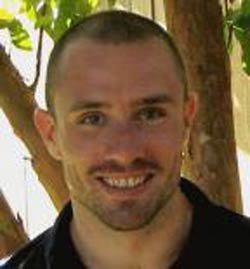
The New York Times ponders the life and personality of the on-leave assistant English prof, who recently was arrested as the result of a connubial spat and who then proceeded to die in police custody.
Faculty members and students at Yale University, where he was an admired assistant professor of English, were shaken and openly mourned the abrupt, inexplicable conclusion to his life. Investigations are now examining the circumstances of his death, to see if he had been ill or injured and determine whether the authorities bore any blame. He was 34.
In the weeks that have passed, equally puzzling questions have arisen about just who Mr. See was and how many lives he led.
Was he a hip, beloved college professor enmeshed in discord with the man he had recently married? Was he someone battling crippling health and emotional problems? Or was he a gay hustler, brazenly posting explicit pictures of himself on male escort websites in pursuit of sexual encounters?
From the incomplete pieces that have thus far emerged, it seems he was all of those things.
Mr. See’s English Department bio tells us:
My research and teaching focus primarily on British and American modernist literature and sexuality studies. I’m currently interested in the questions that aesthetic and sexual feeling present for literary historiography. My first book project explores how British and American modernist writers co-opt the evolutionary precepts of degeneration theory to depict queer feeling as natural: material but nonetheless subject to change. My next book project will examine how British and American writers throughout the twentieth century use aesthetics like the mythical method and magic realism to create queer mythologies that depict the construction of transhistorical and transnational queer communities.
Now that’s what Yale really needed: a specialist in Degeneration, teaching the subject with a positive spin.
25 Nov 2013

One of those armored vehicles (with unmanned machine-gun turret) can be seen sitting just outside the campus.
Around 9:30 A.M. this morning, an anonymous caller phoned New Haven Police warning them that his roommate was going to Yale to shoot people. There have been reports of a man being sighted carrying a long gun. Yale is on Thanksgiving break. Most people are not on campus. And police have swarmed the area between Chapel & Elm and High and College Streets.
NBC Connecticut News
——————————–
Constant Yale Daily News updates by Twitter.
18 Nov 2013

The Oldest College Daily recently advised the Yale community of a potential downside to the use of free University-provided email addresses.
Yale students’ email accounts are subject to search without consent or notification by the University, as outlined in a publicly available but little-publicized document.
Under the University’s Information Technology Acceptable Use Policy, the University maintains the right to access not only employee accounts, but students’ accounts as well. While 55 of 73 students interviewed were unsurprised that the University can monitor their correspondences, few were clear on the specifics under which Yale can search their accounts.
Only three students of 73 interviewed were aware of the specifics of Yale’s policy, with one adding that he learned about the University’s regulations through a class.
“I feel like the University should make clear under what circumstances they consider searching emails,†Sherry Du ’17 said. “The school should do more to publicize this.â€
Most students said they were not taken aback by the policy because the email account is provided by Yale.
Graduate students who came to Yale after working in the corporate world expressed especially little surprise over the policy. Ashlee Tran SOM ’14 said employees at large corporations assume their emails are monitored.
“It doesn’t shock me at all that they can do that,†Acer Xu ’17 said. “It’s Yale email, it’s an internal server.â€
According to its Acceptable Use Policy, several circumstances warrant access to students’ emails: “preserv[ing] the integrity of the IT systems,†complying with “federal, state, or local law or administrative rules,†carrying out “essential business functions of the University,†“preserv[ing] public health and safety†and producing evidence when “there are reasonable grounds to believe that a violation of law or a significant breach of University policy may have taken place.â€
Administrators did not define what actions constitute a significant breach of University policy, though ITS Director of Strategic Communications Susan West described these circumstances as “specific and unusual.â€
For the University to access a student account, two administrators must give their approval: University Provost Benjamin Polak as well as the dean of Yale College or the appropriate graduate or professional school, though deans are allowed to delegate this task.
However, in situations where “emergency access is necessary to preserve the integrity of facilities or to preserve public health and safety,†systems administrators may access an account without approval.
No explicit mention is made in the Undergraduate Regulations of the University’s right to access student accounts, though the Appropriate Use Policy is accessible through a link on page 128 of the 131-page document.
“Preserv[ing] the integrity of the IT systems,†complying with “federal, state, or local law or administrative rules,†carrying out “essential business functions of the University,†“preserv[ing] public health and safety†and producing evidence when “there are reasonable grounds to believe that a violation of law or a significant breach of University policy may have taken place.â€
Translation: Whenever we feel like it.
17 Oct 2013

43 Hillhouse Avenue, built for Henry Farnum by architect Russell Sturgis in 1871. Victorian features were removed in 1934. It has been the home of Yale’s presidents since 1937.
If the US Department of Defense ever finds itself falling short on its spending goals, if it ever can’t find enough $750 toilet seats and $450 claw hammers to buy, DOD procurement specialists can just call up the geniuses running Yale University and ask them to lend a hand with some building or renovation project.
Building the truly verdant green Kroon Hall, erected as a kind of Taj Mahal shrine to environmentalism that cleans its own water with aquatic plants, cost only $501 a square foot. In the recent renovation, including fixing plaster, installing a “state of the art” security system, changing over from steam-heat to hot water, and generally tidying up, the stately mansion on Hillhouse Avenue in New Haven, once called “the most beautiful street in America” by Charles Dickens, provided for the use of the university’s president, Yale managed to spend $810 a square foot, a total of $17,000,000!
If we assume that Yale tuition and room and board is running something like 60 grand per annum these days, that means Yale could have given 283 and 1/3 students, more than half the population of one of Yale’s 12 residential colleges, a free year of college for what all this cost. The mind boggles.
Yale Alumni Mag blog
04 Oct 2013

Charles Bartlett Johnson, Y ’54
But it’s not all bad news at Yale this week, 1954 alumnus Charles B. Johnson, chairman of Franklin Resources, aka Franklin Templeton, is celebrating his recent retirement by handing Yale a check for $250 million, the largest single donation in the university’s 312-year history.
Yale President Peter Salovey smiled appreciatively, but noted aloud that this marvelous new donation left Yale only $80 million short of the monies needed to build the two new residential colleges needed to bring Yale’s enrollment up to 6000 students.
Reuters
04 Oct 2013

Certain Yale residential colleges whose names begin with S have started the term this year experiencing a wave of laundry room terrorism.
Ivygate posted a letter from the Master of Saybrook and reported a rumor that the perpetrator (allegedly a female sophomore) had been apprehended and dealt with.
Dear Saybrugians,
Someone has been doing weird, creepy, and (frankly) disgusting things in the Laundry Room. This must stop immediately. If you have observed something of this nature, or know who the perpetrator might be, please let me know. I can’t imagine why someone would do these things, but it has got to stop, and we will take measures to be sure it does.
Thanks,
Master Hudak
————————-
Oldest College Daily story
and
Gawker
————————
All this reminds me of a series of background incidents in Stephen Coontz’s 1986 Vietnam War novel Flight of the Intruder.
The USS Shiloh carrier from which Jake Grafton and his fellow naval aviators’ A-6 attack aircraft are being launched against North Vietnamese targets experiences on board an outbreak of a form of traditional naval hijinks going back to the WWII era, a Phantom Sh*tter, who leaves personal mementos in all sorts of untoward locations, like the Executive Officer’s ashtray.
Is it possible, I wonder, that what is going on in certain colleges at Yale may have some kind of connection to the US Navy?
08 Sep 2013

Manson H. Whitlock, proprietor of the last prominent typewriter repair and sales shop in the United States, and the last of Bethany, Connecticut’s renowned Whitlock brothers passed away August 28 at the age of 96.
His elder brother, Reverdy Whitlock (Yale 1936), known to generations of Yale students as the third-generation proprietor of the used book shop on Broadway, died in April of 2011 a little more than a month shy of 98.
The other two brothers, who managed the famous Whitlock Book Barn on the grounds of the former family dairy farm in Bethany, Everett and Gilbert, left us only slightly earlier: Everett in September 2003, aet. 91, and Gilbert in March of 2004, aet. 88.
The four Whitlock brothers represented, on the essential commercial fringe of University life, a kind of charming survival of indigenous local Yankeedom, preserving in their personalities, manners, and accents an otherwise long-vanished rural Connecticut.
All the Whitlock brothers were stubborn and opinionated, but formal in manner, and taciturn and restrained in speech. All of them were also careful and precise in business and notoriously thrifty. I can still remember Reverdy reaching into his pocket and taking out an old-fashioned farmer’s change purse when the store register came up short as he was making change for a book purchase. When he opened the clips on top, a moth flew out, and I’ve always suspected that all the buffaloes on the nickels inside blinked.
All the Whitlock brothers clearly experienced a characteristic kind of quiet glee in personally approximating so perfectly all the classic New England Yankee stereotypes.
At one time, Manson Whitlock probably owned the most lucrative, if not the most prestigious, of the Whitlock businesses. Before the personal computer came along, every Yale student had to own a typewriter and every typewriter, sooner or later, needed new ribbons, and occasional cleanings and repairs.
The Whitlocks were competitive, and I suspect the other brothers quietly gloated when technology rendered Manson’s formerly vibrant typewriter shop obsolescent. But Manson didn’t care. He had put away his competence decades earlier, and he stubbornly continued to open his shop every day and contently passed away his time repairing and maintaining individual specimens of his extensive store collection. Once in a blue moon, some superannuated fossil who had declined to change over to computers would show up for a typewriter servicing or repair. Even more occasionally, a collector would descend to conduct fierce negotiations with Manson over a particularly desirable early example. One thing never changed, Manson Whitlock’s typewriters, despite the changing times, did not get any cheaper.
And Yale and New Haven will never be the same without the Whitlock Brothers. Their passing from the local scene leaves the kind of painful gap that the vanishing of Yale fence along Chapel Street and the perishing of the stately elms overlooking the Old Campus and the Green once did. Some crucial and beloved landmarks have been lost.
Manson’s New York Times obituary.
Washington Post obituary.
27 Aug 2013

Fatuous imbecile in action.
New Yale President Peter Salovey, in his address to incoming freshmen, described his own “modest upbringing”, admitted that there is inequality at Yale, but assured students they will wind up rich and happy anyway.
“You, Class of 2017, bring your different cultures, religions, ethnicities, and sexual orientations to this campus.” [link]
Yale president Peter Salovey delivered an address to incoming freshman about equality and the American dream. He spoke of his own immigrant grandparents and modest upbringing, and encouraged students to be open and open-minded about their own class (“one of the last taboos among Yale studentsâ€).
Estimated Yale tuition + room and board + books + personal expenses, according their website, is $60,900 for academic year 2013-2014.
Heartening: “Why did I choose to talk about Yale and the American Dream today? To assure you — especially those of you from families that are not affluent – that the dream is very much alive here at Yale. Ten years after they graduated, members of the Yale Class of 1998 reported impressive — and similar — average salaries and a high level of life satisfaction, regardless of whether they came from families whose standard of living was ‘far below average,’ ‘below average,’ ‘average,’ or ‘above average.’â€
23 Jul 2013

Harkness Tower at Yale
Weekend before last, the Times Magazine published one of those heavy-breathing, “We’ve got trouble right here in River City” sorts of articles about Ivy League hook-up culture, which maintained that today’s coeds at elite universities are too busy with grade-grubbing for serious relationships and are therefore settling for brief, meaningless encounters.
All this didn’t really ring true to me, so I was not surprised to find some skeptical pushback in Time from recent Yale graduate Eliana Docktermann.
I’m straight, white, female, and just graduated from an Ivy League school, so these trend pieces are supposedly about me. But they don’t ring true, and after a year of reading them, I am exhausted by the media’s obsession with the “hookup culture.†Why, besides the obvious reasons, is this topic so irresistible? Dr. Lisa Wade, an associate professor of sociology at Occidental College who has done extensive research on the subject, explains, “The media is talking about it because we love moral panic.â€
As it turns out, there’s not all that much to panic about. If you look at the data, this Ivy League “hookup culture†exists for only a tiny percentage of college kids. What’s more, the sex lives of most of today’s college students may not be all that different from those of their parents or grandparents at the same age.
So let’s look at the … biggest misconceptions about college kids and sex:
1. College students are having random hookups rather than meaningful relationships.
Well, it depends on how you define a hookup, but in general rampant casual sex is not the norm, despite what the media is saying. …
[A]ccording to the survey quoted in that same Times article, 20% of female students and 25% of male students have “hooked up†with 10 or more people. That sounds like a lot. But wait—10 or more people over the course of four years in college? That’s only two to three partners per year. Moreover, the definition of “hookup†spanned from kissing to intercourse. Of those women and men who had hooked up with 10 or more people, only 40% of those instances were sex.
Crunching the numbers, that means that only 8% of college women who responded to this survey had sex with 10 or more men who they were not dating over the course of four years. …
Most Ivy League girls too busy and ambitious for relationships.
…
[T]he demands of the modern world have left women at these elite institutions with no time for boyfriends, so they are opting out of relationships and into hookups.
Raisa Bruner …, who graduated from Yale with me in May, was dissatisfied with the conclusions of [an Atlantic] piece and decided to find out if Yalies were really dismissing relationships for hookups. She wrote in the Yale Daily News:
In a survey I conducted of over 100 Yale students, almost all of the single respondents, ambition be damned, said they were currently seeking a relationship involving dating, commitment or, at the very least, monogamous sex.
I know a number of very successful women—women who are now students at top med schools, analysts at the State Department and Rhodes scholars—who found the time while at Yale to maintain serious relationships with equally-as-busy boys (or girls). I know many other women who left Yale wishing they had had a relationship in college.
And while I can’t say that the sex lives of Yalies represents all college students or even those in the Ivy League, the data from the school about sex is a good reality check. In 2010, the Yale Daily News conducted a sex survey on campus and found that only 64.3% of students had had sexual intercourse over the course of their Yale career. The median Yale student had had only two sexual partners by the time he or she graduated. Promiscuity is not the norm. Not even for men (whom we never hear from in these articles for some reason). 30.5% of Yale men had never had intercourse. Plenty of students are forgoing sex entirely, limiting their sexual partners or engaging in exclusive relationships.
Read the whole thing.
13 Jul 2013

Yale Beinecke Library collection.
Postcard dated July 13, 1924, from Ernest Hemingway in Spain to Gertrude Stein in Paris.
Hemingway, identifying himself in the picture as Number 2, says:
“July 13
This was in the Novillada* where we really got hold of it. Algabeuo would hand us a cape and send us out. I got hold of the novillos horns and stayed on for nine minutes and finally got his head down. Don [Stewart] got so he could xxxx xxxx and throw sand in the bull’s eye and almost make him xxxx xxxx xxxx xxxx xxxx. xxxx xxxx xxxx xxxx.
Do you knpw about Bumbee’s tooth? Hooray Hemingway on Holiday”
* Novilladas are bullfights during which 3-4 year old bulls are used. The bullfighters are amateur bullfighters.
14 Apr 2013

Esther Zuckerman poses as a SWUG. My commenters are often smarter than I am. One of them, unlike me, noticed that Esther Zuckerman actually used a picture of Tina Fey to illustrate the SWUG type. The “NBC” under the photo should have been a clue. Sigh.
The Urban Dictionary provides the definition:
Senior Washed-Up Girl.
The term goes back a couple of years, but the SWUG concept only recently attracted major attention as the result of a lengthy think piece in the Yale Daily News by Raisa Bruner exploring the culture, the pros and cons, and all possible nuances of SWUGdom, its relationship to Feminism, SWUGdom as fate, as life-phase, as life-style, and as identity.
—————————————–
Yale definitely teaches young people how to play theme and variations on a concept, and Ms. Bruner’s piece caught the attention of one Justin Rocket Silverman (Now that is a millenial generation name!) who, writing in The Cut brought all this to the attention of the World Outside Yale.
Yale senior Raisa Bruner [is] kind of tired of the free-wheeling frat hookup culture that’s so compelling to younger students. The guys know this about women her age, she says, and so they don’t generally hit on senior girls. If she went to Sigma Nu, she’d watch her male classmates focus on that infinitely more fun classmate, the female freshman.
Bruner is a self-identified SWUG — a senior washed up girl. As she explained in a recent feature in the Yale Daily News, to be a SWUG is to embrace “the slow, wine-filled decline of female sexual empowerment as we live out our college glory days. Welcome to the world of the ladies who have given up on boys because they don’t so much empower as frustrate, satisfy as agitate.â€
She and her fellow SWUGs are women who don’t bother dressing up for class, or even for fancy parties (though they might still attend them), don’t seek out meaningful (or even just sexual) relationships, spend weekends at their shared homes drinking in the company of other self-identified SWUGs, and feel utter apathy about their personal lives — all at the age of 21.
—————————————–
Gawker decided that all this SWUG stuff really amounted to just a pose and a demand for some attention.
Declaring “‘I don’t give a fuck’ at the right moment,” does not a “more complex person” make. Rather than embracing personal growth internally, there is a clamorous, exaggerated declaration that growing out of a social scene is the equivalent of being “washed-up” in the face of other’s halcyon days. Overall, SWUG-life appears to be a melodramatic desire to make an identity out of boredom and dissatisfaction with the collegiate social scene.
—————————————–
Esther Zuckerman (Y’ 12), at the Atlantic, tells us that she was already a SWUG as a junior two years ago.
I first heard about the term SWUG during my junior year when I was working at the Daily News. From what I can recall, it was described to me as having been coined by a group of girls in the senior class, and I hated it. Yale had been debating treatment of women on campus all year—the school was about to face a Title IX investigation—and the idea of calling any girls on campus “washed-up” was to me offensive and demeaning (the specific words I used in a heated Gchat conversation), even if some fellow women had used the label on themselves.
But I changed my mind on SWUGs as I sort of realized I was one. Looking back through my Gmail inbox today, I crossed into my senior year, when, for me and my friends, SWUG came to be a way we described an attitude that we already possessed. SWUG meant getting meatball subs on a snowy night. SWUGs watched an episode of New Girl twice in a row with a lot red wine. SWUGs baked brownies. In our version of SWUG, an idol might be Liz Lemon, to whom Jack Donaghy once said: “Big night, Lemon? Let me guess meatball sub extra, bottle of NyQuil, TiVo Top Chef, a little miss Bonnie Raitt, lights out.” My fellow would-be SWUGs and I listened to a lot of “I Can’t Make You Love Me.” We cared about our academics and our future careers, but when it came to our social lives in the confines of Yale, well, we, as seniors, couldn’t care less.
—————————————–
The whole SWUG business may have really been put on the map at Yale by a Daily News article by Chloe Drimal, published last September, titled: Profile of a SWUG.
You’ve all met one. They’re usually at penny shots promptly at 11 p.m. come Wednesday night, and are then found in Durfee’s around 1 p.m. the next day, buying every liquid they can get their hands on.
I was jealous of them when I was a freshman. They were on a nickname basis with the hottest guys at Yale and danced at the bar of DKE with their shirts off. But looking back on it, I realize the boys were trying to get with the freshmen, not the SWUGs. …
She’s the girl who Kevin, the bartender at Toad’s, hugs when she stumbles in Wednesday night. She’ll dance like no one’s looking. She’s a SWUG. She doesn’t care. Tommy at Box 63 and Compadre at Amigos will both give her free shots on occasion; they are not doing this for freshman girls — only for SWUGs.
She’s the girl in the Zeta basement, before the Coach Reno era, who is biting into a can with her teeth to shotgun on a Sunday. Although she could never beat the Zeta boys in a shotgun, she can beat most ADPhi boys.
She’s the girl who knows the code to get into DKE. She knows the code for ADPhi. (If any single senior girl has the key to Zeta, she may want to seek help.) Facebook bores her. She uses Facebook to find out different football players’ birthdays and plugs them into an astrology website to test their compatibility. She is compatible with no one.
She’s the girl who promised she would never hook up with someone younger than her but now finds herself texting sophomore boys who unavoidably turn her down. She thinks this is funny. She thinks about getting a vibrator; she may already have a vibrator. It may be better than that sophomore boy.
She doesn’t need to walk home late at night and chance getting mugged by a New Haven local because she will just sleep on a couch in one of the frats. The late night crew at G-Heav knows to start making her an egg and cheese when they see her stumble through the door, and sometimes they will allow her to dance behind the counter and crack an egg herself. Again, they don’t do this for the young, hot, freshman girls — only SWUGs.
She’s the girl who tells her friends she is going to have a “friendship night.†When they ask what this means she explains she is going to make a guy want her and then turn him down. She gets drunk and wakes up next to the guy she was going to turn down. She knows this will go nowhere, as she has already plugged his birthday into the compatibility website, and their score was a two. She makes up a short lie about a meeting and asks him to leave her room and then goes back to bed. She doesn’t return his texts. She’s a SWUG.
She is the last one at every party, because hey — who is she going home with? She’s not afraid to dance on tables and knows the top floor of any frat always has the cleanest bathroom. She is wise. She is hot, whether the boys believe it or not. She doesn’t give a hoot. She’s single because she wants to be; her daddy told her there’s more fish in the sea. She is a SWUG, and SWUG life is pretty awesome.
Drimal’s glorification of the SWUG made her in a campus celebrity, profiled by the Yale Herald.
—————————————–
If anyone is not totally SWUGed out at this point, he can turn to some more discussions which appeared in the Oldest College Daily.
—————————————–
On a personal note, we had hook ups at Yale in my day, but we did not have either the term or the identical hook up culture. I think that, as I remember it, quite a lot of female seniors in those days had long since taken anticipated Susan Patton’s advice and were in long-term relationships with Yale men.
The SWUG concept reminds me of the characteristic resentment of ordinarily-groomed-and-dressed Yale girls toward male friends’ dates from outside Yale.
The girl from Smith staying over at Yale would arrive at breakfast nicely dressed, in full make-up, hair in perfect order, and her escort’s female Yale friends and neighbors would glower and make faces, regarding his date’s superior efforts at presentation as personal affronts.
Yale girls all tended to think dating outside Yale constituted both punishable treason and firm evidence of bad taste. I once took a date to a performance of Carl Orff’s Carmina Burana, in which my current wife was singing in the chorus, and found Karen was using every opportunity that my then girlfriend’s eyes were averted to make faces at me.
/div>

Feeds
|