The advertisement in favor of the European Union, first of all, takes a surprisingly negative, and decidedly politically incorrect, view of European relationships with China, India, and Africa.
Not every European country, I would tend to think, likes to see itself as a red-headed woman in a yellow leotard. And the proliferation of meditating broads seems to this viewer at least to represent a strikingly ineffective response to a series of martial arts challenges. Of course, donning yellow leotards and assuming the lotus position, it could be argued, is not an entirely inaccurate way of depicting the European approach to defense generally, but there really should be some reference to relying on the Americans to come in and kick those wogs’ butts for them if they attack the pretty red-headed girls.
An amazing photo slideshow from photographer Ken Graham of Maryland’s Potomac Hunt.
Getting a photo of the hunted fox is every hunt photographer’s supreme goal. Shots in which hounds are so close to the hunted fox that both appear in the same photo are rare and unusual and represent the ultimate trophy photo. This fox (who ultimately got away) happened to pick a line that took him almost on a collision course with part of the pack, producing sensational once-in-a-lifetime pictures.
Robert Lee Hotz, in the Wall Street Journal, describes recent academic studies contending that gaming quickens the eye, speeds the reflexes, and keep’s the predatory human brain alert. Lots of us knew all that already.
One particular statistic stood out.
[T]oday’s average gamer is 34 years old and has been playing electronic games for 12 years, often up to 18 hours a week. By one analyst’s calculation, the 11 million or so registered users of the online role-playing fantasy World of Warcraft collectively have spent as much time playing the game since its introduction in 2004 as humanity spent evolving as a species—about 50 billion hours of game time, which adds up to about 5.9 million years.
The Washington Post recently reported that the federal government in the Age of Obama is planning to extend into the realm of Nature the same kind of policies it pursues in the American economy.
If an avian species succeeds; if it extends its range; if it successfully competes, outbreeds, and even manages to hybridize itself with a rival species, the federal government will intervene on behalf of the loser.
To save the imperiled spotted owl, the Obama administration is moving forward with a controversial plan to shoot barred owls, a rival bird that has shoved its smaller cousin aside.
The plan is the latest federal attempt to protect the northern spotted owl, the passive, one-pound bird that sparked an epic battle over logging in the Pacific Northwest two decades ago.
The government set aside millions of acres of forest to protect the owl, but the bird’s population continues to decline — a 40 percent slide in 25 years.
A plan announced Tuesday would designate habitat considered critical for the bird’s survival, while allowing logging to reduce the risk of catastrophic wildfire and to create jobs. Habitat loss and competition from barred owls are the biggest threats to the spotted owl.
Interior Secretary Ken Salazar called the draft plan “a science-based approach to forestry that restores the health of our lands and wildlife and supports jobs and revenue for local communities.
Barred owls are a well-known and generally admired species of owl, renowned for their distinctive “Who Cooks For You? Who Cooks For You All?” call.
The Northern Spotted Owl (Strix occidentalis caurina) is clearly a typical pampered and decadent left coast inhabitant, too stoned on pot to prosper and too sexually ambiguous to reproduce effectively. The mystery is how they managed to become major democrat party donors.
Americans For Limited Government has launched a Save the Barred Owl! petition site in response to the proposed federal strigicide.
The Telegraph obituary of Lord St. John (pronounced “SinJin”) of Fawsley represents another classic of the genre, affectionately remembering the career of a delightfully flamboyant, yet reactionary, politician, wit, and scholar.
The Royal Fine Art Commission, of which he served three terms as chairman from 1985 to 1999, described itself as “the ultimate authority for consultation on matters of taste and aesthetics†— a remit which fitted Lord St John to perfection. Like Oscar Wilde, he put his genius into his life, affecting the flamboyant mannerisms of an Edwardian aesthete (proffering his hand in papal fashion, lapsing into Latin, deliberately mispronouncing modern words). At his Northamptonshire rectory he amassed an impressive collection of Victorian bric à brac and royal memorabilia, including photographs and mementos of the Royal family and a pair of Queen Victoria’s undergarments.
Irrepressible, witty and disarmingly immodest, Lord St John was an expert on much else besides aesthetics. In the 1990s, during the break-up of the marriage of the Prince and Princess of Wales, he became known for his frequent television appearances in which he would give the nation the benefit of his expertise on the attendant constitutional implications, a role in which he claimed extensive knowledge of the inner workings and private thoughts of the Royal family.
It was never entirely clear how much direct access he had, though he was certainly a great friend of Princess Margaret, whose framed likeness, prominently displayed behind him, graced many an official photograph. But that did not stop him assuring the nation that, for example, the young princes bore no grudge against Camilla Parker Bowles, or that the Prince of Wales was a loyal member of the Church of England with no intention of converting to Islam. When criticised for his willingness to pontificate on any royal issue, however trivial, he explained that his motivation was a “desire to do what one can to help the monarchy and help the Queenâ€.
In his role as Arts Minister in Mrs Thatcher’s first administration, Norman St John-Stevas was said to be one of the only cabinet members allowed to tease the Prime Minister, whom he referred to as “the Blessed Oneâ€, “the Leaderene†or (unaccountably) “Heatherâ€. He liked to tell the story of how he asked to be excused from a meeting because he had a reception to go to. “But I’m going to the same function,†protested Mrs Thatcher. “Yes, but it takes me so much longer to change,†replied St John-Stevas. …
His time at the Royal Fine Art Commission was not entirely uncontroversial. The Commission had been a dozy quango which, for many years, could hardly even be bothered to produce an annual report, and it was hoped that his appointment would inject a bit of panache and excitement. It did, and he changed the public image of the Commission considerably. But critics accused him of turning it into a personal publicity vehicle (one annual report featured no fewer than six full-colour photographs showing the chairman striking one pose after another in the company of the great and good), and of allowing his own wayward preferences to take precedence over the views of the experts.
There was, for example, the affair of the Millennium wheel on the South Bank (now known as the London Eye), which was the subject of a blistering public attack by the Commission, even though at least three commissioners strongly supported the design. After a bad-tempered meeting at which Lord St John was reportedly rude to the architects concerned, the Commission’s secretary, Sherban Cantacuzino, wrote to the architects saying: “I am sure that he enjoys putting people down, all of us have suffered from his bullying.â€
Problems magnified after Lord St John was elected Master of Emmanuel College, Cambridge, in 1991. Academic politics proved highly diverting, and his frequent absences from the Commission’s offices in London raised eyebrows. In 1994 the government called in the retired civil servant Sir Geoffrey Chipperfield to examine the Commission. His conclusions were devastating: the Commission acted arbitrarily and was not respected, and the chairman’s office and car were over-lavish for a publicly funded body. Any other chairman would probably have had to resign, but Lord St John defied all predictions and was reappointed for a third term in 1995.
His time at Emmanuel College, from 1991 to 1996, was equally tumultuous. It was said that the dons of the historically Puritan institution first had doubts about whether they had chosen the right man when several of his friends were caught naked one night in the Fellows Garden swimming pool. While he certainly raised the college’s profile (albeit particularly in such outlets as House and Garden and Hello!), there was controversy on the high table over the lavish refurbishment of the Master’s Lodge and an expensive new extension to the college which some saw as a monument to the Master rather than a useful addition. …
Lord St John was also accused of spending an excessive amount of time with a small clique of mainly public school-educated young men who, it was alleged, were favoured with introductions to royalty and captains of industry, to dinners at White’s, private theatrical performances at the Master’s Lodge and long, affectionate letters. Such special privileges were extended to very few. Other undergraduates would recall the Master cutting them off in mid-sentence with some disparaging remark in Latin. To bitchy colleagues in other colleges, Emmanuel became known as “Mein Campâ€.
Second only to royalty in Lord St John’s affections was the papacy. One of the rooms in his house was virtually a shrine to Pius IX, and in 1982 he published Pope John Paul II: his travels and mission. He himself was known to appear at official functions wearing the insignia of a Knight Grand Cross of the Order of St Lazarus of Jerusalem (he was Grand Bailiff and head of the order in England and Wales).
In Who’s Who Lord St John described himself, somewhat superfluously, as “unmarried.â€
Cathy Ruse, Georgetown Law ’89, identifies what Sandra Fluke’s congressional testimony and the Georgetown contraception national brouhaha are really all about.
Last week Sandra Fluke, a student at Georgetown University Law Center, went to Congress looking for a handout. She wants free birth-control pills, and she wants the federal government to make her Catholic school give them to her.
I’m a graduate of Georgetown Law and former chief counsel of the House Subcommittee on the Constitution. Based on her testimony, I wonder how much Ms. Fluke really knows about the university or the Constitution.
As a law student 20 years ago, I wasn’t confronted by crucifixes in the classroom or, in truth, by any religious imagery anywhere. In that respect the law school has a different “feel” than the university. The law school chapel was an unadorned, multipurpose room in the basement used for Mass when it wasn’t used for Gilbert and Sullivan Society rehearsals and club meetings. Among the clubs while I was there, the Gay and Lesbian Alliance was particularly vigorous.
I was not Catholic when I attended Georgetown Law, but I certainly knew the university was. So did Ms. Fluke. She told the Washington Post that she chose Georgetown knowing specifically that the school did not cover drugs that run contrary to Catholic teaching in its student health plans. During her law school years she was a president of “Students for Reproductive Justice” and made it her mission to get the school to give up one of the last remnants of its Catholicism. Ms. Fluke is not the “everywoman” portrayed in the media. …
When congressional committee counsels plan hearings, they look for two kinds of witnesses: “experts” and “victims.” The experts are typically lawyers or law professors who can explain the constitutional authority for the new law and its legal impact, and the victims illustrate why the law is needed.
At the hearing of the House Democratic Steering and Policy Committee chaired by Nancy Pelosi, Sandra Fluke testified as a victim. Having to buy your own contraception is a burden, she said. She testified that all around her at Georgetown she could see the faces of students who were suffering because of Georgetown’s refusal to abandon its Catholic principles.
Exactly what does the face of a law student who must buy her own birth-control pills look like? Did I see them all around me and just not know it? Do male law students who must buy their own condoms have the same look? Perhaps Ms. Fluke should have brought photos to Congress to illustrate her point.
In her testimony, Ms. Fluke claimed that, “Without insurance coverage, contraception, as you know, can cost a woman over $3,000 during law school.” That’s $1,000 per year. But an employee at a Target pharmacy near the university told the Weekly Standard last week that one month’s worth of generic oral contraceptives is $9 per month. “That’s the price without insurance,” the employee said. (It’s also $9 per month at Wal-Mart.)
Ms. Fluke’s crusade for reproductive justice is simply a demand that a Catholic institution pay for drugs that make it possible for her to have sex without getting pregnant. It’s nothing grander or nobler than that. Georgetown’s refusal to do so does not mean she has to have less sex, only that she has to take financial responsibility for it herself.
Should Ms. Fluke give up a cup or two of coffee at Starbucks each month to pay for her birth control, or should Georgetown give up its religion? Even a first-year law student should know where the Constitution comes down on that.
Andy Laperriere explains that the federal government’s cheap money/low interest policies have very real costs, including the long term reduction of economic growth.
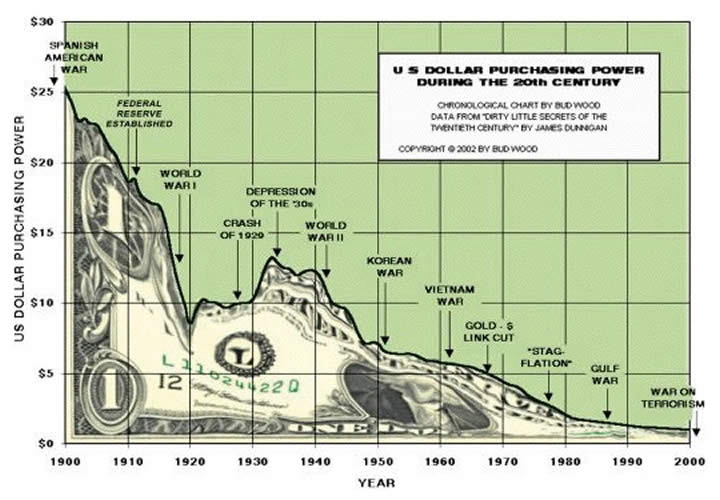
During the past three years, the Federal Reserve has tripled the size of its balance sheet—in effect printing $2 trillion—something it had never done in its nearly 100-year history. The Fed has lowered short-term interest rates to zero and signaled that it will keep them at that level for years. Inflation-adjusted short-term rates, or real rates, have been in the minus 2% range during the past couple of years for the first time since the 1970s.
The unfortunate fact is, as Milton Friedman famously observed, there is no free lunch. After the Fed’s loose monetary policy helped spur the boom-bust in housing, it’s remarkable how little attention has been devoted to exploring the costs of Fed policy.
A few critics of quantitative easing (QE) and the zero interest rate (ZIRP) have correctly pointed out that these policies weaken the dollar and thereby reduce the purchasing power of American paychecks. They increase the risk of future inflation, obscure the true cost of the unsustainable fiscal policy the federal government is running, and transfer wealth from savers to debtors.
But QE and ZIRP also reduce long-term economic growth by punishing savers, reducing saving and investment over the long run. They encourage the misallocation of resources that at a minimum is preventing the natural rebalancing of our economy and could sow the seeds of another painful boom-bust.
One intended effect of a loose monetary policy is a weaker dollar, which can help gross domestic product by boosting exports. But a weaker dollar also raises import prices (such as oil prices) for American consumers. For the average American family, this adverse impact has likely outweighed any positive impact from QE and ZIRP.
Dan Greenfield explains how the left turns a political vulnerability into an electoral asset: they frame the narrative.
A debate on the availability of contraception, no matter how well handled, only served the narrative of one side. No matter how well the debate was conducted, it meant that the right was now fighting on the battlefield that had been chosen by the left. All it took was a few sexual insults lobbed Fluke’s way for the diversion to be complete. The right was now either retreating from sexism charges or engaging in it. The social issue was framed in exactly the terms that fit the left’s narrative.
Limbaugh’s apology was nearly as bad of an idea as his original statement. The only time you advance into an enemy’s choice of terrain is when you are confident of being able to fight there and win. You do not give up the high ground just to take a few potshots at the enemy. After a temporary satisfaction, you end up losing the battlefield and being drawn into a battle that you never meant to fight. When that happens, you circle around and take back the high ground, you do not surrender because then there is nothing left to fight for.
The left’s coalitions depend on portraying the other side as engaging in a war on their protected groups. Without that war, their whole feudal lordships suddenly become unnecessary. That means it is in their vital interest to define each policy conflict as a Republican war on a protected class. While it’s advantageous at times to confront them on this when their position is weakest and ridicule it, it wasn’t worth surrendering the coalition of religious freedom to take a few potshots at the absurdity of Fluke’s testimony. Fluke, like every organizer from a protected class, is there to represent an entire group. Attacking her quickly becomes a diversion into the left’s narrative of a war on women.
Religious institutions imposed the terms of the battle by rebelling against the mandate. That forced Obama and his cronies to try and dismiss the battle, refusing to fight on that terrain. But Republicans and even some Democrats insisted on rallying on the field anyway, calling for a battle. So Team Obama diverted the battle to the terrain of their choice. They set new terms of battle, an effort which initially failed, until Limbaugh gave them the talking point they needed.
It is now an uphill battle to return to the original battlefield. It’s possible, but the initial skirmish has gone to the left which was successfully able to dictate the terms of the engagement. Their narrative has no life though, until the right breathes life into it. The larger lesson though is about the terms of battle. It is about the strategy of political warfare.
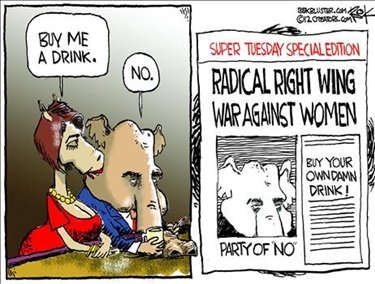
To win in 2012, the left needs to mobilize its coalition. To do that it doesn’t necessarily need to win battles, it needs to successfully position them on its choice of terrain. It needs to be seen as the feudal lords protecting the rainbow peasantry from the hordes of the right. The purpose of the whole thing is to convince the peasants to support King Hussein, despite the disastrous economy and the general malaise, the abuses of power and all the other problems with his rule.
Both sides exploit a sense of vulnerability in the population during troubled times. The left excels at cross-sectioning the population into specific groups, dividing them up, and making them feel vulnerable as a class, as a group, as a gender, as a race. Organizers emphasize that victimization and offer them a sense of empowerment through the coalition. Or as Obama puts it, “Better Together.”
The path to victory lies in either gathering the largest coalition or in fragmenting the coalition of the other side. The left is not very good at the former, its own habits and tactics limit its scope, but it is quite good at the second. It gains power through disruption, through terror and intimidation, it plays on fears, pits groups against each other and then steps in as the mediator.
It would not be nearly as effective at this if it did not also control the culture’s narrative through the media, popular culture and academia, giving it control of highbrow and lowbrow narratives at the same time. This makes it more difficult to counter its narrative or to choose the field of battle and makes it that much more dangerous to abandon a strategic position for a target of opportunity.
The website WikiLeaks has continued releasing for a fourth day what it says will eventually be 5 million e-mails sent between July 2004 and late December 2011 by the private intelligence company Stratfor. …
Wikileaks claims that Osama bin Laden’s body was transferred to Dover, Delaware on a CIA plane. An email dated May 2, 2011 states the body will then be moved “…to the Armed Forces Institute of Pathology in Bethesda.†Two US Air Force Airlift Wings are based at Dover Air Force Base in Dover, Delaware. In another email dated May 2, 2011 a Stratfor staff member expresses doubt that Bin Laden’s corpse was buried at sea and mentions, “We would want to photograph, DNA, fingerprint, etc. His body is a crime scene and I don’t see the FBI nor DOJ letting that happen.â€
According to leaked secret files of Statfor, a US security agency, Osama was not buried at sea in an Islamic ceremony but his body was shifted to the military mortuary in Dover, DE, on a CIA plane.
Then it was shifted to the medical institute of US armed forces in Maryland for examination.
At 5:26 a.m. on May 2, the morning after Barack Obama announced the successful raid on Osama bin Laden’s Abbottabad compound, Stratfor CEO George Friedman sent an email that said: “Reportedly, we took the body with us. Thank goodness.â€
Fred Burton, Stratfor’s vice president for intelligence, followed that up at 5:51 a.m. with an email titled “[alpha] Body bound for Dover, DE on CIA plane†that said: “Than [sic] onward to the Armed Forces Institute of Pathology in Bethesda.â€
At 1:36 p.m. Burton replied to a thread named “Re: OBL’s corpse†with the message: “Body is Dover bound, should be here by now.â€
That contradicts the official story that bin Laden’s body was handled in accordance with Islamic tradition and released into the sea from a U.S. Navy vessel.
If this is true, we need to elect another president from Yale who can see to it that Osama’s skull winds up (along with those of other enemies of the United States like Geronimo) preserved for long-term private appreciation and ridicule inside a certain windowless building on High Street in New Haven, Connecticut.