Retired General Jack Keane tells Mike Huckabee that the US knew the location of Osama bin Ladin’s hideout by the summer of 2010, and the Obama Administration dithered for nearly a year before authorizing the mission to eliminate him.
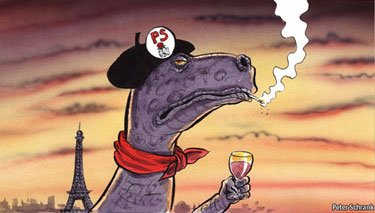
France is a treasure to mankind. French ideas, French beliefs, and French actions form a sort of loadstone for humanity. Because a moral compass needle needs a butt end. Whatever direction France is pointing in—toward Nazi collaboration, Communism, existentialism, Jerry Lewis movies, or President Sarkozy’s personal life—you can go the other way with a clear conscience.
French voters elected François Hollande as president on Sunday, giving the country a Socialist leader who has pledged to shift the burden of hardship to the rich and resolve the protracted euro-zone sovereign-debt crisis by softening the current prescription of austerity.
Time to haul right and stomp welfare. History is our guide.
UPDATE. Iowahawk: “If white people are so smart, then how do you explain Europe?â€
Shane McGowan (of The Pogues) refuses to allow his being very far along in celebrating the evening (and unable to remember the lyrics of the well-known song) to keep him from delivering a very moving performance.
Czocha Castle began as a stronghold, on the Czech-Lusatian border. Its construction was ordered by Wenceslaus I of Bohemia, in the middle of 13th century (1241–1247). In 1253 castle was handed over to Konrad von Wallhausen, Bishop of Meissen. In 1319 the complex became part of the dukedom of Henry I of Jawor, and after his death, it was taken over by another Silesian prince, Bolko II the Small, and his wife Agnieszka (see Duchy of Silesia). Origin of the stone castle dates back to 1329.
In the mid-14th century, Czocha Castle was annexed by Charles IV, Holy Roman Emperor and King of Bohemia. Then, between 1389 and 1453, it belonged to the noble families of von Dohn and von Kluks. Reinforced, the complex was besieged by the Hussites in the early 15th century, who captured it in 1427, and remained in the castle for unknown time (see Hussite Wars). In 1453, the castle was purchased by the family of von Nostitz, who owned it for 250 years, making several changes through remodelling projects in 1525 and 1611. Czocha’s walls were strengthened and reinforced, which thwarted a Swedish siege of the complex during the Thirty Years War. In 1703, the castle was purchased by Jan Hartwig von Uechtritz, influential courtier of Augustus II the Strong. On August 17, 1793, the whole complex burned in a fire.
In 1909, Czocha was bought by a cigar manufacturer from Dresden, Ernst Gutschow, who ordered major remodeling, carried out by Berlin architect Bodo Ebhardt, based on a 1703 painting of the castle. Gutschow, who was close to the Russian Imperial Court and hosted several White emigres in Czocha, lived in the castle until March 1945. Upon leaving, he packed up the most valuable possessions and moved them out.
After World War II, the castle was ransacked several times, both by soldiers of the Red Army, and Polish thieves, who came to the so-called Recovered Territories from central and eastern part of the country. Pieces of furniture and other goods were stolen, and in the late 1940s and early 1950s, the castle was home to refugees from Greece (see Greek Civil War). In 1952, Czocha was taken over by the Polish Army. Used as a military vacation resort, it was erased from official maps. The castle has been open to the public since September 1996 as a hotel[1] and conference center. The complex was featured in several movies, including a popular 1963 comedy, Gdzie jest general? (Where is the General?) and The Legend, Beyond Sherwood Forest, Secret Cipher Fortress, Spellbinder.
Looks like a good site for filming Prisoner of Zenda to me.
Just in case you’re having difficulty keeping up with all these Composite Americans, George Zimmerman, the son of a Peruvian mestiza, is the embodiment of endemic white racism and the reincarnation of Bull Connor, but Elizabeth Warren, the great-great-great-granddaughter of someone who might possibly have been listed as Cherokee on an application for a marriage license, is a heartwarming testimony to how minorities are shattering the glass ceiling in Harvard Yard. George Zimmerman, redneck; Elizabeth Warren, redskin. Under the Third Reich’s Nuremberg Laws, Ms. Warren would have been classified as Aryan and Mr. Zimmerman as non-Aryan. Now it’s the other way round. Progress!
James Taranto explains that Julia really represents the Obama Administration’s new model for society’s fundamental relationship: the union between the dependent individual and the administrative state.
In 1999 Lionel Tiger coined the word “bureaugamy” to refer to the relationship between officially impoverished mothers of illegitimate children and the government. “The Life of Julia” is an insidious attack on the institution of the family, an endorsement of bureaugamy even for middle-class women.
——————————-
Nicole Gelinas describes just how Julia’s choices subsequently impact her son Zachary and what ultimately happens to Julia.
——————————-
Iowahawk swings at the Obama Campaign’s low, hanging curveball, offering his own version of Julia’s life, which ends with a a characteristically left-wing bang.
Holy Trinity Evangelical Lutheran Church in the town of Swidnica in Silesia is one of three Lutheran churches permitted to be constructed in Roman Catholic Silesia by the 1648 Peace of Westphalia which ended the Thirty Years War.
The so-called Peace Churches had to be constructed within one year, and could be built only from wood, loam and straw outside the city walls, without steeples and church bells.
Churches were built in Swidnica, Jawor, and Glogau. The first two survive today and were restored in 2001, the third burned down in 1758.
Henry David Thoreau went to jail rather than pay taxes to local government (when he objected to federal policies, including the Mexican War and the Constitutional tolerance of Slavery), so naturally enough the same federal government, through its National Endowment for the Arts, is using tax money to fund creation by a group of academics at the University of Southern California of a Thoreau’s Walden “game.”
Lead game designer, USC Associate Professor Tracy Fullerton explains that they are designing “a rich simulation of the woods, filled with the kind of detail that Thoreau so carefully noted in his writings.â€
The simulation will “mimic the meditative outdoor life described in Thoreau’s best-known work, written about his two years spent living in a cabin on the shores of Walden Pond in Concord, Mass. The digital Walden Pond will showcase a first-person point-of-view where you can wander through the lush New England foliage, stop to examine a bush and pick some fruit, cast a fishing rod, return to a spartan cabin modeled after Thoreau’s and just roam around the woods, grappling with life’s unknowable questions.”
It is intended to serve as “an introduction for young people, who might not have read the book yet.â€
There you are, $40 Grand of your tax dollars for a visual Cliff Notes experience of walking in the woods, picking berries, catching a perch, &c.
It doesn’t sound to me as if the designers have given any thought to score keeping.
Some suggestions:
Work in family pencil factory for cash — minus 10 points
Pick a quart of huckleberries — plus 10 points
Eat a groundhog — plus 30 points, but you become sick to your stomach and lose half your movement allowance for three turns
Make a campfire — plus 5 points, but you must roll dice. If you roll a pair, you have accidentally started a fire and will burn 300 acres of woods and lose 100 points
A short film celebrating the passage of the first liberal constitution in Europe by the Polish senate, May 3, 1791, the passage of which provoked treason by magnatial aristocrats (The Confederacy of Targowica) followed by intervention and partition of the country by Russia, Prussia, and Austria. Tadeusz Kosciuszko led the national resistance to the partition. The final defeat of Kosciuszko’s forces was followed in 1795 by the Third and final Partition of Poland-Lithuania. The actual document wound up locked in an iron box under guard in Moscow’s Kremlin, so much terror did it strike in the hearts of despots. Poles and Lithuanians still sing the praises of the Constitution of the 3rd of May which extended the rights enjoyed by the nobility to the entire country. The Third of May is today a national holiday in both countries.
There was general wonder and astonishment over the revelation that Obama’s New York girlfriend in Dreams from My Father was actually a composite character based on multiple girlfriends in New York and Chicago.
Jim Geraghty contended that the use of composite characters in Obama’s autobiography was a key aspect of the book’s evasive, downright mendacious, character.
Why was young Obama’s mentor in Hawaii, Frank Davis only identified as “Frank� (Probably because Davis was alleged to be a Communist.)
Why does Obama’s description of his duties at a consulting house not match the memories of his co-workers at all?
Why does the book’s kind, easygoing portrait of Jeremiah Wright… not match the man seen in videos of his sermons and at National Press Club years later?
Every autobiography probably includes some inaccurate or self-serving memories, some interpretation of past events that portrays the author in the best possible light. But when Obama describes conversations and interactions with people who didn’t exist, or at least existed in a quite different form from the way they’re described on the page, readers have a right to wonder if they’re reading fiction or nonfiction.
Among the conservative grassroots, it is an article of faith that one of the reasons Barack Obama won in 2008 was because he misrepresented himself to the American people, and he was “not vetted. 
When you think about telling the world your story, and telling the world about the people who shaped you… would you use a composite?
———————————
Some excerpts from a 1982 letter from Barack Obama to girlfriend Alex McNear provoked discussion.
I haven’t read “The Waste Land†for a year, and I never did bother to check all the footnotes. But I will hazard these statements—Eliot contains the same ecstatic vision which runs from Münzer to Yeats. However, he retains a grounding in the social reality/order of his time. Facing what he perceives as a choice between ecstatic chaos and lifeless mechanistic order, he accedes to maintaining a separation of asexual purity and brutal sexual reality. And he wears a stoical face before this. Read his essay on Tradition and the Individual Talent, as well as Four Quartets, when he’s less concerned with depicting moribund Europe, to catch a sense of what I speak. Remember how I said there’s a certain kind of conservatism which I respect more than bourgeois liberalism—Eliot is of this type. Of course, the dichotomy he maintains is reactionary, but it’s due to a deep fatalism, not ignorance. (Counter him with Yeats or Pound, who, arising from the same milieu, opted to support Hitler and Mussolini.) And this fatalism is born out of the relation between fertility and death, which I touched on in my last letter—life feeds on itself. A fatalism I share with the western tradition at times. You seem surprised at Eliot’s irreconcilable ambivalence; don’t you share this ambivalence yourself, Alex?
On a Yale conservative discussion list, one of our alumni who teaches English Literature at a major Eastern university, remarked that from the perspective of a professional student of Eliot, Yeats, and Pound Obama’s verbiage struck him as “half gibberish, half misunderstanding,” and commented with frustration that he’d never heard of “Münzer” and could not even find him in Wikipedia.
I, too, was puzzled, but only a little investigation made it clear that Obama had misspelled the name of Thomas Müntzer, an early Reformation era heretic extremist and leader of a servile insurrection in Thuringia, who was defeated and well-deservedly executed in 1525.
Müntzer is, like Gracchus Babeuf, the kind of obscure historical figure that is remembered by specialists in the particular period and by members of the hard-core revolutionary left. Obama’s knowledge of the very existence of Thomas Müntzer is one more proof of his upbringing in a communist family, the kind of family in which the works of Engels are a standard reading staple.
———————————
The above and this additional excerpt of the same letter seem to, at least, clear up, once and for all, more than one major historical controversy.
Moments trip gently along over here. Snow caps the bushes in unexpected ways, birds shoot and spin like balls of sound. My feet hum over the dry walks. A storm smoothes the sky, impounding the city lights, returning to us a dull yellow glow. I run every other day at the small indoor track [at Columbia] which slants slightly upward like a plate; I stretch long and slow, twist and shake, the fatigue, the inertia finding home in different parts of the body. I check the time and growl—aargh!—and tumble onto the wheel. And bodies crowd and give off heat, some people are in front and you can hear the patter or plod of the steps behind. You look down to watch your feet, neat unified steps, and you throw back your arms and run after people, and run from them and with them, and sometimes someone will shadow your pace, step for step, and you can hear the person puffing, a different puff than yours, and on a good day they’ll come up alongside and thank you for a good run, for keeping a good pace, and you nod and keep going on your way, but you’re pretty pleased, and your stride gets lighter, the slumber slipping off behind you, into the wake of the past.
John Hinderaker: That, folks, is not a parody. It may provide a hint as to why Obama’s college and law school grades remain a well-kept secret.
Ann Althouse concluded: “I am now willing to believe Obama wrote his own memoir.”







 , hitting the shelves on June 19th.
 was actually a composite character based on multiple girlfriends in New York and Chicago.


