Mark Steyn scathingly reviews the recent performances of two chief executives.
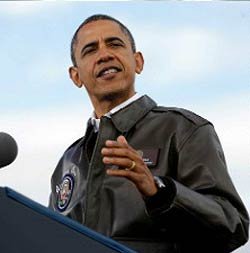
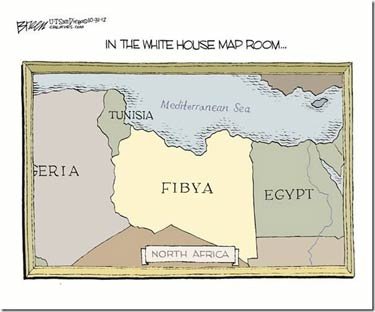
In political terms, Hurricane Sandy and the Benghazi consulate debacle exemplify at home and abroad the fundamental unseriousness of the United States in the Obama era. In the days after Sandy hit, Barack Obama was generally agreed to have performed well. He had himself photographed in the White House Situation Room, nodding thoughtfully to bureaucrats (“John Brennan, Assistant to the President for Homeland Security and Counterterrorism; Tony Blinken, National Security Advisor to the Vice President; David Agnew, Director for Intergovernmental Affairs”) and Tweeted it to his 3.2 million followers. He appeared in New Jersey wearing a bomber jacket rather than a suit to demonstrate that when the going gets tough the tough get out a monogrammed Air Force One bomber jacket. He announced that he’d instructed his officials to answer all calls within 15 minutes because in America “we leave nobody behind.” By doing all this, the president “shows” he “cares” – which is true in the sense that in Benghazi he was willing to leave the entire consulate staff behind, and nobody had their calls answered within seven hours, because presumably he didn’t care. …
Last week, Nanny Bloomberg, Mayor of New York, rivaled his own personal best for worst mayoral performance since that snowstorm a couple of years back. This is a man who spends his days micromanaging the amount of soda New Yorkers are allowed to have in their beverage containers rather than, say, the amount of ocean New Yorkers are allowed to have in their subway system – just as, in the previous crisis, the municipal titan who can regulate the salt out of your cheeseburger proved utterly incapable of regulating any salt on to Sixth Avenue. Imagine if this preening buffoon had expended as much executive energy on flood protection for the electrical grid and transit system as he does on approved quantities of carbonated beverages. But that’s leadership 21st-century style: When the going gets tough, the tough ban trans fats.
Back in Benghazi, the president who looks so cool in a bomber jacket declined to answer his beleaguered diplomats’ calls for help – even though he had aircraft and Special Forces in the region. Too bad. He’s all jacket and no bombers. This, too, is an example of America’s uniquely profligate impotence. When something goes screwy at a ramshackle consulate halfway round the globe, very few governments have the technological capacity to watch it unfold in real time. Even fewer have deployable military assets only a couple of hours away. What is the point of unmanned drones, of military bases around the planet, of elite Special Forces trained to the peak of perfection if the president and the vast bloated federal bureaucracy cannot rouse themselves to action? What is the point of outspending Russia, Britain, France, China, Germany and every middle-rank military power combined if, when it matters, America cannot urge into the air one plane with a couple of dozen commandoes? In Iraq, al-Qaida is running training camps in the western desert. In Afghanistan, the Taliban are all but certain to return most of the country to its pre-9/11 glories. But in Washington the head of the world’s biggest “counterterrorism” bureaucracy briefs the president on flood damage and downed trees.
I don’t know whether Mitt Romney and Paul Ryan can fix things, but I do know that Barack Obama and Joe Biden won’t even try – and that therefore a vote for Obama is a vote for the certainty of national collapse.
Past official accounts have been discredited. Will today’s stand up to scrutiny?
Today pushback leaks from “senior US intelligence officials” arrived offering a new version of events which directly contradicts previously-reported accounts on key damaging details.
Just days before the presidential election, U.S. officials are striking back at allegations they failed to respond quickly or efficiently against the deadly attack on the U.S. Consulate in Benghazi, Libya, detailing for the first time a broad CIA rescue effort.
Senior U.S. intelligence officials said Thursday that CIA security officers went to the aid of State Department staff less than 25 minutes after they got the first call for help from the consulate, which was less than a mile from a CIA annex. The detailed timeline provides the first in-depth look at how deeply the CIA was involved in the rescue attempt, and it comes amid persistent questions about whether the Obama administration responded as quickly and effectively as it could to the siege. …
The intelligence officials told reporters Thursday that when the CIA annex received a call about the assault, about a half dozen members of a CIA security team tried to get heavy weapons and other assistance from the Libyans. But when the Libyans failed to respond, the security team, which routinely carries small arms, went ahead with the rescue attempt. At no point was the team told to wait, the officials said.
Instead, they said the often outmanned and outgunned team members made all the key decisions on the ground, with no second-guessing from senior officials monitoring the situation from afar.
The officials spoke on condition of anonymity because they were not authorized to provide intelligence information publicly. …
The officials’ description Thursday of the attack provided details about a second CIA security team in Tripoli that quickly chartered a plane and flew to Benghazi but got stuck at the airport. By then, however, the first team had gotten the State Department staff out of the consulate and back to the CIA annex.
As the events were unfolding, the Pentagon began to move special operations forces from Europe to Sigonella Naval Air Station in Sicily. U.S. aircraft routinely fly in and out of Sigonella and there are also fighter jets based in Aviano, Italy. But while the U.S. military was at a heightened state of alert because of 9/11, there were no American forces poised and ready to move immediately into Benghazi when the attack began.
The Pentagon would not send forces or aircraft into Libya — a sovereign nation — without a request from the State Department and the knowledge or consent of the host country. And Defense Secretary Leon Panetta has said the information coming in was too jumbled to risk U.S. troops.
According to the detailed timeline senior officials laid out Thursday, the first call to the CIA base came in at about 9:40 p.m., and less than 25 minutes later about the team headed to the consulate. En route they tried to get additional assistance, including some heavier weapons, but were unable to get much aid from the Libyan militias.
The team finally got to the consulate, which was engulfed in heavy diesel smoke and flames, and they went in to get the consulate staff out. By 11:30 p.m., all of the U.S. personnel, except Stevens, left and drove back to the annex, with some taking fire from militants along the way.
By that time, one of the Defense Department’s unarmed Predator drones had arrived to provide overhead surveillance.
At the CIA base, militants continued the attack, firing guns and rocket-propelled grenades. The Americans returned fire, and after about 90 minutes, or around 1 a.m., it subsided.
Around that time, the second CIA team, which numbered about six and included two military members, arrived at the airport, where they tried to figure out where Stevens was and get transportation and added security to find him.
Intelligence officials said that after several hours, the team was finally able to get Libyan vehicles and armed escorts, but by then had learned that the ambassador was probably dead and the security situation at the hospital was troublesome. The State Department has said a department computer expert, Sean Smith, also was killed.
The second CIA team headed to the annex, and arrived after 5 a.m., just before the base came under attack again.
According to officials, militants fired mortar rounds at the building, killing two of the security officers who were returning fire. The mortar attack lasted just 11 minutes.
And less than an hour later, a heavily armed Libyan military unit arrived and was able to take the U.S. personnel to the airport.
—————–
The LA Times version makes it clear that today’s unofficial release was intended specifically to contradict Fox News’ reporting of events.
At every level in the chain of command, from the senior officers in Libya to the most senior officials in Washington, everyone was fully engaged in trying to provide whatever help they could,” a senior intelligence official said in a statement. “There were no orders to anybody to stand down in providing support.” …
Fox News asserted in a story last week that CIA managers had ordered agency security officers to “stand down” and remain in their own facility, known as the Annex, when the attack on the diplomatic compound began about 9:40 p.m. and that there was an hour delay before officers disobeyed orders and went to help repel the attack that killed Ambassador J. Christopher Stevens and State Department officer Sean Smith.
Among those who rushed to help was Tyrone Woods, a former Navy SEAL who was part of the CIA security team and who later died in the attacks.
The Fox story also asserted that the CIA “chain of command” refused to pass along requests from its officers for military aid and that special operations forces in nearby Sicily could have been sent to help but were not. Intelligence and Pentagon officials strenuously denied that Thursday.
They insisted there was no viable military option to disrupt what amounted to a series of sporadic attacks in a crowded city full of people sympathetic to the U.S. There were no armed drones in the region and airstrikes were not called for, officials said.
“Let’s say we were able to get an aircraft there. Do you go in and start strafing a populated area without knowing where friend or foe is?” a senior Defense official asked. “If you did that, you could kill the very people you are trying to help.”
A special operations team was sent to Naval Air Station Sigonella in Sicily, but the team arrived after the attack ended, said the senior Defense official, who would not be quoted by name discussing potentially classified information.
Defense Secretary Leon E. Panetta learned of the attack shortly after it began, about 4:30 p.m Eastern time, Defense officials said, and discussed it in a previously scheduled meeting with the president. Obama ordered him to pursue whatever options were feasible, a Defense official said.
Panetta “ordered all appropriate forces to respond to the unfolding events in Benghazi, but the attack was over before those forces could be employed,” Pentagon spokesman George Little said.
Shortly after 11 p.m. a surveillance drone had arrived from elsewhere in Libya — about an hour after it was requested, officials said. But the video feed was not seen by the president, contrary to some news reports. And the feed did not offer analysts a clear understanding of what was happening on the ground, officials said.
After the CIA team arrived at the compound, “over the next 25 minutes, team members approach the compound, attempt to secure heavy weapons [from Libyans], and make their way onto the compound itself in the face of enemy fire,” the senior U.S. intelligence official said.
The senior intelligence official disclosed that the CIA also sent a second six-member team from Tripoli on a chartered plane to help repel the attack. The team included Glen Doherty, another former SEAL, who was later killed when attackers fired mortar rounds at the CIA Annex.
The team arrived around midnight but got bogged down at the airport. Ultimately, it learned that “the ambassador was almost certainly dead” and headed to the agency facility “to assist with the evacuation,” the official said.
It arrived with Libyan support at the Annex at 5:15 a.m., just before mortar rounds began to strike. Woods and Doherty were killed as they fired on militants from the roof. The mortar attack lasted 11 minutes, the official said.
The drone overhead was not armed. Even if it had been, there were no viable targets, officials said.
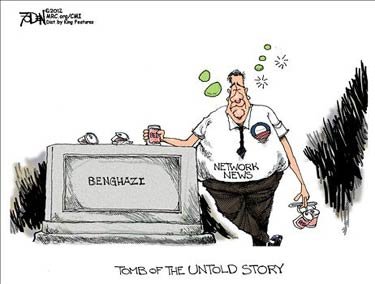
Yesterday, CBS News was the first of the Lamestream Media to break the deliberate establishment press boycott on pre-election coverage on the Benghazi debacle, actually publishing a leak from inside-government sources disadvantageous to the Obama Administration.
CBS News has learned that during the Sept. 11 attack on the U.S. Mission in Benghazi, the Obama Administration did not convene its top interagency counterterrorism resource: the Counterterrorism Security Group, (CSG).
“The CSG is the one group that’s supposed to know what resources every agency has. They know of multiple options and have the ability to coordinate counterterrorism assets across all the agencies,” a high-ranking government official told CBS News. “They were not allowed to do their job. They were not called upon.”
—————————-
Today, Jake Tapper of ABC News commented venomously on the Administration’s stonewalling and endeavored to depict ABC as a vigorously investigating news organization.
In the place of a detailed description from the Obama administration about what happened more than six weeks ago comes the drip-drip-drip of stories about the failures of the Obama administration to provide those Americans on the ground in Libya with all the security assets they needed.
—————————-
Hurricane Sandy’s arrival on the East Coast was a godsend for the establishment media and Barack Obama, filling up the front page columns and dominating TV news coverage for several crucial days just a week before the election. But the hurricane is now over, there are still four days to go, and the Benghazi story continues, bit by bit, to leak out.
George Will is typically a cool and reflective editorialist, given to serious analysis rather than partisan rhetoric, but as this year’s presidential campaign ends, Will really unloads on Obama, linking the worthless emptiness of his reelection campaign to the worthless emptiness of his presidency.
Energetic in body but indolent in mind, Barack Obama in his frenetic campaigning for a second term is promising to replicate his first term, although simply apologizing would be appropriate. His long campaign’s bilious tone — scurrilities about Mitt Romney as a monster of, at best, callous indifference; adolescent japes about “Romnesia†— is discordant coming from someone who has favorably compared his achievements to those of “any president†since Lincoln, with the “possible†exceptions of Lincoln, LBJ and FDR. Obama’s oceanic self-esteem — no deficit there — may explain why he seems to smolder with resentment that he must actually ask for a second term.
Roger L. Simon observes that the Benghazi scandal will continue long past election day and will hang, like an albatross, around the neck of a second Obama presidency.
One way or the other, Obama will pay. And as he pays, through the relentless accusations of an impeachment, inevitable or otherwise, his party will be constantly on the defensive, the reputations of their leadership incalculably besmirched. Though they do not realize or choose to ignore it now, the Democrats will be lucky if Obama loses on November 6.
If he wins, not even the mainstream media will save him. Although a few will try, the walls are already crumbling.
He’s quite right. If Obama loses, the Republicans will most likely accept his electoral rejection as sufficient punishment for Benghazi and the subsequent cover-up. If he wins, they will pursue him like the Furies, and the truth will inevitably come out to destroy him.
Dvice.com has a story of an educational experiment confirming the optimistic point of view with respect to human curiosity and ingenuity.
What happens if you give a thousand Motorola Zoom tablet PCs to Ethiopian kids who have never even seen a printed word? Within five months, they’ll start teaching themselves English while circumventing the security on your OS to customize settings and activate disabled hardware. Whoa. …
Rather than give out laptops (they’re actually Motorola Zoom tablets plus solar chargers running custom software) to kids in schools with teachers, the OLPC Project decided to try something completely different: it delivered some boxes of tablets to two villages in Ethiopia, taped shut, with no instructions whatsoever. Just like, “hey kids, here’s this box, you can open it if you want, see ya!”
Just to give you a sense of what these villages in Ethiopia are like, the kids (and most of the adults) there have never seen a word. No books, no newspapers, no street signs, no labels on packaged foods or goods. Nothing. And these villages aren’t unique in that respect; there are many of them in Africa where the literacy rate is close to zero. So you might think that if you’re going to give out fancy tablet computers, it would be helpful to have someone along to show these people how to use them, right?
But that’s not what OLPC did. They just left the boxes there, sealed up, containing one tablet for every kid in each of the villages (nearly a thousand tablets in total), pre-loaded with a custom English-language operating system and SD cards with tracking software on them to record how the tablets were used. Here’s how it went down, as related by OLPC founder Nicholas Negroponte at MIT Technology Review’s EmTech conference last week:
“We left the boxes in the village. Closed. Taped shut. No instruction, no human being. I thought, the kids will play with the boxes! Within four minutes, one kid not only opened the box, but found the on/off switch. He’d never seen an on/off switch. He powered it up. Within five days, they were using 47 apps per child per day. Within two weeks, they were singing ABC songs [in English] in the village. And within five months, they had hacked Android. Some idiot in our organization or in the Media Lab had disabled the camera! And they figured out it had a camera, and they hacked Android.”
Hurricane Sandy gave New Haven a little Halloween present.
The 16-acre New Haven Green was laid out in 1638 as the central square of a 9-square town layout. Reputedly, the size of the town green was intended to be sufficiently large as to accommodate all human beings saved at the time of the Day of Judgment, whose number was calculated by the Puritan divines on the basis of various theological considerations to amount to 144,000.
The New Haven Green served as a marketplace and militia parade ground and in the course of its history contained a watch house, a prison, a school, several churches, and a succession of statehouses during the period extending up to 1875 when New Haven shared the seat of government of the colony and later state with Hartford.
The Green also served as the colonial burying ground until 1821. Among those buried in the New Haven Green is the regicide John Dixwell. After the use of the Green as a cemetery was abandoned, the headstones were removed to Grove Street Cemetery, but the burials were undisturbed.
Winds from Hurricane Sandy knocked over an oak tree on Monday, October 29th, on the Upper Green. The following afternoon, a homeless woman recognized that a human skeleton was intertwined with the tree’s exposed roots. She called for the police, and detectives and the state medical examiner went to work, concluding that the remains were those of someone buried in the colonial era.