There have been a rash of stories recently about kids getting suspended from school for bringing in toy guns, and even merely for making a drawing of a gun, but this story from WMAL sets some kind of a new record.
The father of a middle schooler in Calvert County, Md. says his 11-year-old son was suspended for 10 days for merely talking about guns on the bus ride home.
Bruce Henkelman of Huntingtown says his son, a sixth grader at Northern Middle School in Owings, was talking with friends about the Sandy Hook Elementary School massacre when the bus driver hauled him back to school to be questioned by the principal, Darrel Prioleau.
“The principal told me that with what happened at Sandy Hook if you say the word ‘gun’ in my school you are going to get suspended for 10 days,” Henkelman said in an interview with WMAL.com.
So what did the boy say? According to his father, he neither threatened nor bullied anyone.
“He said, I wish I had a gun to protect everyone. He wanted to defeat the bad guys. That’s the context of what he said,” Henkelman said. “He wanted to be the hero.”
The boy was questioned by the principal and a sheriff’s deputy, who also wanted to search the family home without a warrant, Henkelman said. “He started asking me questions about if I have firearms, and [the deputy said] he’s going to have to search my house. Search my house? I just wanted to know what happened.”
No search was performed, and the deputy left Henkelman’s home after the father answered questions in a four-page questionnaire issued by the Sheriff’s Office.
NC Statistics grad student Joshua Katz used an algoritm to map responses to a 120-question survey of regional English by Bert Vaux of Cambridge University.
My native Schuylkill County, Pennsylvania, apparently, falls into a small zone which pronounces syrup as “SEARup,” and whose residents think Mary and merry sound the same, but marry sounds different. I have trouble imagining alternative viewpoints.
In 1927 Claude Friese-Greene shot some of the first-ever color film footage ever taken around London. He captured everyday life in the city with a technique innovated by his father, called Biocolour. The British Film Institute used computer enhancement to reduce the flickering effect of the original Biocolour and bring us this striking rare film which transports us back through time.
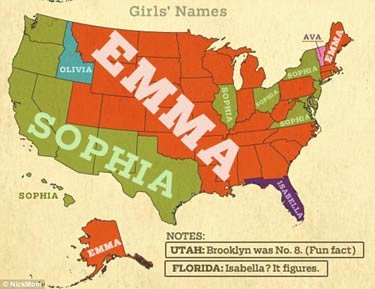
On the female front: I expect the popularity of Jane Austen explains the rise of Emma. Sophia is a lot more problematic, though similar in period quality. Exactly why Ava is doing so well in Vermont is seriously intriguing.
On the male front: At least Jared and Justin have faded, but Jacob is still hanging in there in popularity in a few states. Jaydon?!? What is Florida’s major malfunction? The other big question is where the heck did Mason come from?
Could be worse, though, Mohammed is not on top in any state.
Maybe you’ve never heard of Emmaland or Sophialand, but if you’re reading this in the United States, there’s a better than 90% chance that you live in either one of these two curious nations.
The former is made up of the 31 states where ‘Emma’ was the most popular baby name for girls in 2012. In spite of that institutional majority, another girl’s name proved more popular nationwide. ‘Sophia’ also came out ahead in 16 states, including America’s three most populous ones.
Last year, a total of 20,791 Emmas were born in the United States. The size of that cohort was only surpassed by the 22,158 Sophias added to the US population in 2012. Together, both names came out on top in 47 of the 50 states. The exceptions were Florida, where baby girls were most likely to be named Isabella (#3 nationwide); Idaho, where new parents preferred Olivia for their girls (#4 overall); and Vermont, where new parents favoured Ava for their newborn daughters (#5 in the national ranking).
Few aspects of anthrophonomastics are as eagerly discussed as the names people give their children. Perhaps because few acts are as simultaneously intimate and public: the name you give your child reveals something of the hopes and ambitions you have for your progeny, not to mention the tastes and traditions you inherited from your forebears.
In the last half century, baby-naming has become a lot more agonising. Until the mid-20th century, the popularity of baby names was less prone to variation and fluctuation. Fitting in was a greater priority than standing out: if you weren’t named after a family member of a previous generation (often your godfather and/or godmother), you were still most likely stuck with a name from a canonical list of biblical and classical names.
Donald Kagan, Sterling Professor of Classics and History, retired last month after 44 years at Yale. He delivered a memorable Farewell Address, previously only available as a very, very long video, which now may be read at one’s own convenience thanks to the New Criterion.
My subject is liberal education, and today more than ever the term requires definition, especially as to the questions: What is a liberal education and what it is for? From Cicero’s artes liberales, to the attempts at common curricula in more recent times, to the chaotic cafeteria that passes for a curriculum in most American universities today, the concept has suffered from vagueness, confusion, and contradiction. From the beginning, the champions of a liberal education have thought of it as seeking at least four kinds of goals. One was as an end in itself, or at least as a way of achieving that contemplative life that Aristotle thought was the greatest happiness. Knowledge and the acts of acquiring and considering it were the ends of this education and good in themselves. A second was as a means of shaping the character, the style, the taste of a person—to make him good and better able to fit in well with and take his place in the society of others like him. A third was to prepare him for a useful career in the world, one appropriate to his status as a free man. For Cicero and Quintilian, this meant a career as an orator that would allow a man to protect the private interests of himself and his friends in the law courts and to advance the public interest in the assemblies, senate, and magistracies. The fourth was to contribute to the individual citizen’s freedom in ancient society. Servants were ignorant and parochial, so free men must be learned and cosmopolitan; servants were ruled by others, so free men must take part in their own government; servants specialized to become competent at some specific and limited task, so free men must know something of everything and understand general principles without yielding to the narrowness of expertise. The Romans’ recommended course of study was literature, history, philosophy, and rhetoric.
It was once common to think of the medieval university as very different, as a place that focused on learning for its own sake. But the medieval universities, whatever their commitment to learning for its own sake, were institutions that trained their students for professional careers. Graduates in the liberal arts were awarded a certificate that was a license to teach others what they had learned and to make a living that way. For some, the study of liberal arts was preliminary to professional study in medicine, theology, or law and was part of the road to important positions in church and state.
Emmy Chang reports: “As of 11:19 AM local time on June 4, according to the _South China Morning Post_: “‘Rubber duck’ has since been blocked as a search term on Sina Weibo.”