Archive for January, 2015
23 Jan 2015


Nebra sky disc
The National Post describes, with grossly naive exaggeration and the worst kind of statist prejudice, an interesting, rather pretty Bronze Age artifact with an outrageously offensive history.
The Nebra disc was found in 1999 along with two bronze swords, two hatchets, a chisel, and fragments of spiral bracelets, by Henry Westphal and Mario Renner using a metal detector.
The government of the German state of Saxony-Anhalt claims to own everything in the ground and, as knowledge of the find gradually became known to the public, confiscated all the artifacts found and charged the discoverers with “looting.” Westphal and Renner were convicted and sentenced to prison, as a reward for their discovery, for four months and ten months in 2003. When they appealed, the appeal court raised their sentences to six and twelve months.
Thus, as the National Post reports, the precious artifacts were “saved from the black market” and transferred to the custody of bureaucratic officialdom and the all-knowing administrative state.
The disc has been dated on the basis of the style of the bronze swords buried with it to the mid 2nd millennium BC. Radiocarbon dating of a bit of birchbark found on one of the swords was dated to between 1600 and 1560 BC confirming the former estimate.
The author of the article was scarcely able to breathe while describing the totally astonishing alleged scientific significance of the disc. Why, the Nebra disc represents the earliest human depiction of the cosmos!
Saxony-Anhalt’s house prehistorian & archaeologist Harald Meller (who personally confiscated the horde on behalf of the Leviathan state) has interpreted the disc as a tool used for determining when a thirteenth month – the so-called intercalary month – should be added to a lunar year to keep the lunar calendar in sync with the seasons. When certain prominent constellations, particularly the Pleiades, lined up with the sun and moon as displayed on the disc, every 2-3 years, it would be time to add an extra month in order to bring the lunar and solar calendars into agreement.
Or maybe it was simply made as a piece of decorative art, depicting the most prominent constellations in the night sky.
There is, of course, no real reason, beyond arrogance and brute force, why any state should be entitled to lay claim to ownership of all undiscovered archaeological finds, and there is also no particular reason to believe that immediate state ownership is essential to their preservation. Art objects have been collected and preserved historically most commonly privately since Antiquity. In the modern world, art objects privately owned have a strong tendency to make their way via philanthropy into institutional collections.
These days, we read frequently of absolutely fascinating finds made by hobbyist metal collectors in Britain. In Saxony-Anhalt, I expect we will be reading about fewer of those, since the reward for discovery there is imprisonment for looting.
Wikipedia article
Meller’s theory explained
22 Jan 2015

Andrew the Illegal Immigrant, like many other people, blogged about the recently-gone-viral letter from Ayn Rand to her niece who wanted a loan, but (being a Rand villain) Andrew described Rand’s missive as “amazingly horrible.”
Andrew Sullivan does get these occasional fits of actual integrity in his blogging, though, and yesterday he passed along this highly effective demurral from one of his readers:
I don’t see what is so “horrible†in what Ayn Rand wrote to her niece. First, the niece didn’t ask for $25 as a gift; she asked to borrow it. If you read the letter, Rand gives TWO examples of where a similar request was made, and the money was NOT used to accomplish the stated goal, nor was it paid back. Second, Rand didn’t insist on charging interest, merely getting the principle back. Third, she simply insisted the niece be honest and A) spend it on what she said, and B) pay the loan back when she had the chance instead of spending on something else.
Or if you don’t want to be horrible like her, I too could use some new clothes to improve my employment opportunities, and a $250 (inflation adjusted from 1949) Amazon gift credit in reply would help. And you shouldn’t be horrible about insisting that I really use it for clothes, or that I pay it back, much less according to some terms. If you did insist, you would be “horrible†just like her.
This is the one thing often missed in Ayn Rand’s works: the heroes keep their promises, and pay what they owe “to the last dimeâ€, often at great cost.
And another of Andrew’s readers added:
I’m a bit miffed at how ill treated this letter is in your post. What an invaluable lesson this is about debt! …
Most people in the US think nothing about taking on a new credit card – or a fancy new degree – and the mountain of “irresponsibly†laid down debt literally destroys their lives. It destroys their entrepreneurial spirit; it destroys their educational, relational, and employment opportunities; it destroys their quality of life and entrenches mild- to severe poverty; and it degrades them psychologically and virtually eliminates any taste for risk taking and enterprise, locking them into “getting by†employment to constantly service the debt.
Would that they had someone as wise as Rand cautioning them to think reeeeealy hard before taking on $40,000 for that BS Degree or $10,000 for a late-model car when they could be driving around a reliable beater. Think of the suffering that could have been alleviated if such lessons were taught to the entire generation of then-17 year old millennials who are currently groaning under their debt.
And let’s look at the massive handicap our national debt has on this same generation and their children. Would that anyone in Congress had had an aunt as shrewd as Ms. Rand! Look at the Greek debt or historic Latin American debt. How “horrible†would it have been to have a tut-tutting aunt make people painfully aware of the potential repercussions of their decisions before undertaking them? How much global suffering could have been avoided with a little more tough love from a wiry, stick-in-the-mud Aunty like Ayn Rand?
Read the whole thing.
22 Jan 2015

Geoffrey Chaucer from the Ellesmere Manuscript.
Stevie Davies reviews Paul Strohn’s microbiography: Chaucer’s Tale: 1386 and the Road to Canterbury in The Independent.
Strohm centres on a single year, 1386, at the end of which Chaucer “suddenly found himself without a patron, without a faction, without a dwelling, without a job … without a city.”
Exiled from London and his literary circle, Strohm’s Chaucer lost an audience, in an age before the printing press, when poetry in manuscript was read aloud in performance. The book’s compelling thesis is that Chaucer’s loss generated the invention of a “portable audience” within The Canterbury Tales: the pilgrims themselves. …
One of Chaucer’s overarching themes is the volatility of fortune, whose reversals – if we are wise – teach us “to maken virtu of necessitee”. Strohm’s Chaucer is essentially a small player in a world of venal power politics, “a politician of limited gifts, and not much of a factionalist either”. A loyalist of Richard II, he’d risen by espousing the long-term losing party. Esquire to the king, Chaucer had made an advantageous marriage. But he and his higher-ranking wife, Philippa de Roet, sister to John of Gaunt’s mistress, Katherine Swynford, lived apart and his association with the loathed Gaunt jeopardised him.
Deployed by his political masters to the post of controller of wool custom, Chaucer had the unenviable job of monitoring the activities of “some of the richest and best connected and least scrupulous crooks on the face of his planet”. Strohm’s portrait of the collector of the lucrative wool custom, corrupt magnate Nicholas Brembre, is formidable. When the royalist faction secured Chaucer’s election to the 1386 Parliament, and Brembre’s wheel came thundering down, so did Chaucer’s. His grace and favour apartment was forfeit. Strohm assesses Chaucer’s withdrawal from public life as “a matter of constrained choice”. Chaucer became “a wanderer in Kent, with no fixed job and insufficient income”. …
Losing “that thick and involving texture of London life” meant forfeit not only of discomfort but of stimulation and conviviality. The listening audience Chaucer now lacked he invented as a fellowship of pilgrims: “Chaucer’s varied cast of rogues, pitchmen, scammers … divines, social snobs, humble toilers [is] a miracle of imaginative inclusion.” …
From the misfortune of 1386, Chaucer moved towards a sense of authorial identity, preparing his literary legacy for generations to come. The pilgrims mediated “between Chaucer and the extended public he has begun to imagine”. The poet’s humiliated exile, Strohm compellingly suggests, is part of the deep story of how The Canterbury Tales came into being.
21 Jan 2015

Jim Corbett’s the best quality boxlock W.J. Jeffery & Co. .450-400 double rifle, with which he killed so many man-eating tigers for the Indian government (Elmer Keith Estate Coll.).
Jim Corbett described using that .450/400 Jeffrey to slay the Thak Man-Eater at about 6:00pm on November 30, 1938, in “Man-Eaters of Kumaon”:
The tigress was now so close that I could hear the intake of her breath each time before she called, and as she again filled her lungs, I did the same with mine, and we called simultaneously. The effect was startingly instantaneous. Without a second’s hesitation she came tramping and then she stepped right out into the open, and, looking into my face, stopped dead. Owing to the nearness of the tigress, and the fading light, all that I could see of her was her head. My first bullet caught her under the right eye and the second, fired more by accident than with intent, took her in the throat and she came to rest with her nose against the rock. The recoil from the right barrel loosened my hold on the rock and knocked me off the ledge, and the recoil from the left barrel, fired while I was in the air, brought the rifle up in violent contact with my jaw and sent me heels over head right on top of the men and goats. Once again I take my hat off to those four men for, not knowing but what the tigress was going to land on them next, they caught me as I fell and saved me from injury and my rifle from being broken.â€
This was the last man-eater killed by Corbett.
—————————-
Elmer Keith died in 1984 and now, thirty years later, the famous writer’s personal firearms collection is finally appearing for sale in James D. Julia’s March 15th, 16th & 17th Firearms Auction.
Not many of us will be able to afford to own any of the highlights of the Keith Collection, but it’s certainly worth looking at the on-line catalog and imagining what you’d do if you won the Irish Sweepstakes in time to bid.
Here are two examples, either of which would be very difficult to top for historical significance and associations.
Hamilton Bowen will build you an unengraved replica (on a Ruger action) of Elmer Keith’s No. 5 .44 Special SA for a mere $4495.00. How high can the original possibly go? Six figures would not surprise me.
————————————–

“The most influential custom handgun ever made!” Elmer Keith’s own No. 5 Colt SA in .44 Special built in 1927 as “the last word in sixguns.”
21 Jan 2015

The only library surviving from Classical Antiquity is that found in the Villa of the Papyri in Herculaneum, thought to have belonged to Julius Caesar’s father-in-law, Lucius Calpurnius Piso Caesoninus.
1,785 papyrus scrolls were found, packed carefully in cases and ready to be moved to safety, which were nonetheless overtaken by a 1,000 °C (1,830 °F) cloud of hot gas and rocks emanating from the eruption of Mount Vesuvius in 79 A.D. The scrolls were charred black, but preserved under 20-25 meters (22-27 yards) of hardened volcanic ash.
New techniques apparently are beginning to permit scholars to read the scrolls.
io9 quotes a recently published paper in Nature Communications:
In recent years, new imaging techniques have been developed to read the texts without unwrapping the rolls. Until now, specialists have been unable to view the carbon-based ink of these papyri, even when they could penetrate the different layers of their spiral structure. Here for the first time, we show that X-ray phase-contrast tomography can reveal various letters hidden inside the precious papyri without unrolling them. This attempt opens up new opportunities to read many Herculaneum papyri, which are still rolled up, thus enhancing our knowledge of ancient Greek literature and philosophy.
Smithsonian reports what has been discovered so far, no lost plays of Sophocles or Aeschylus, no poems of Sappho, no treatises of Plato or Dialogues of Aristotles, instead they’ve found lots of Philodemus.
Most of the scrolls that have been unwrapped so far are Epicurean philosophical texts written by Philodemus—prose and poetry that had been lost to modern scholars until the library was found. Epicurus was a Greek philosopher who developed a school of thought in the third century B.C. that promoted pleasure as the main goal of life, but in the form of living modestly, foregoing fear of the afterlife and learning about the natural world. Born in the first century B.C. in what is now Jordan, Philodemus studied at the Epicurean school in Athens and became a prominent teacher and interpreter of the philosopher’s ideas.
Modern scholars debate whether the scrolls were part of Philodemus’ personal collection dating to his time period, or whether they were mostly copies made in the first century A.D. Figuring out their exact origins will be no small feat—in addition to the volcano, mechanical or chemical techniques for opening the scrolls did their share of damage, sometimes breaking the delicate objects into fragments or destroying them outright.
21 Jan 2015

BolesÅ‚aw Wieniawa-DÅ‚ugoszowski: “Pure vodka stains neither honor nor uniform.”
20 Jan 2015
Those Nibelungs make both wonderful toys and terrific weapons of war.
Hat tip to Vanderleun.
20 Jan 2015
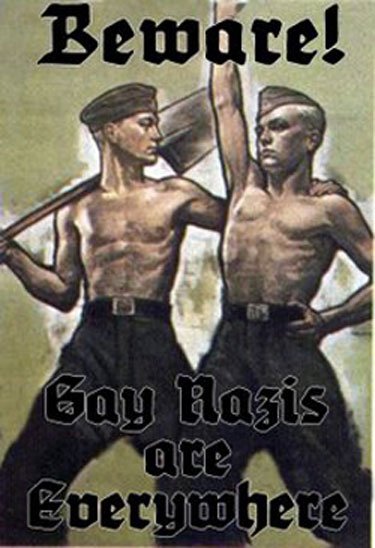
Brendan O’Neill, in the Spectator, laughs at “freedom to marry” as the phrase used to describe nothing less than forcible conversion.
Twenty-five years ago, American thinker Christopher Lasch argued that ‘progressive rhetoric has the effect of concealing social crisis and moral breakdown by presenting them as the birth pangs of a new order’. Bingo! There’s no better description of gay marriage. Here, too, progressive-sounding rhetoric is really the dolling-up of our atomised, risk-averse societies’ growing disdain for those deep relationships in which families and communities traditionally socialised the next generation, mostly away from the prying eyes of the state. This is why the gay-marriage campaign is so contradictorily illiberal, so hostile to dissent, and so attractive to petty-authoritarian politicians: because it isn’t about expanding liberty at all; it’s about unilaterally overhauling the moral outlook of the traditionalist sections of society and elevating the commitment-phobic, passion-lite, short-termist values of the chattering classes instead.
Aussie campaigners for the ‘Freedom to marry’ are actually lucky that the PM isn’t cheering their moral crusade. Because this means that when they finally win this illiberal liberty — which they unquestionably will — they’ll be able to present it as a great victory for civil libertarians who bravely took on The Man. When in truth, their victory will be built on the spilt blood of French protesters and the trampled-upon right to dissent of Americans and Britons and the transformation of gay marriage by Western political elites into a new orthodoxy that you question at your peril.
Read the whole thing.
/div>

Feeds
|