Kevin Williamson argues that the real issue in the battle between left and right in America is about intellectual and political coercion.
The Left’s last big idea was Communism. When Lenin turned out to be the god who failed, the Left undertook wide exploration for another grand unifying idea: environmentalism, multiculturalism, economic inequality, atheism, feminism, etc. What it ended up with was an enemies’ list.
That and a taste for brute force.
The enthusiasm for coercion and the substitution of enemies for ideas — Christians, white men, Israel, “the 1 percent,†the Koch brothers, take your pick — together form the basis for understanding the Left’s current convulsions. The call to imprison people with unapproved ideas about global warming, the Senate Democrats’ vote to repeal the First Amendment, the Ferguson-inspired riots, the picayune political correctness and thought-policing that annoys Jonathan Chait, the IRS’s persecution of conservative political groups, Barack Obama’s White House enemies’ list, the casual violence against conservatives on college campuses and the Left’s instinctive defense of that violence — these are not separate phenomena but part of a single phenomenon.
The difference between Elizabeth Warren’s partisans and the Tontons Macoutes is very little more than testosterone and time.
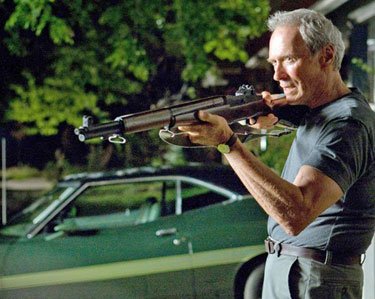
Walt Kowalski had an M1 Garand in “Gran Torino” (2008), but he must have somehow managed to bring his home from Korea personally.
The Garand rifle was the primary US long-arm used in WWII, making it a favorite of collectors. Garands are also favored for high power rifle match shooting. High demand makes Garands fairly expensive.
You have to jump through the hoop of belonging to certain gun clubs and participating in certain kinds of target match competitions before you can buy a Garand from the Civilian Marksmanship Program, and a decent one will still cost you over a thousand dollars.
Mr. Mosin Crate offers some Garands for sale from time to time. He just posted a new batch of mostly post-Korean-War 1950s examples which looked generally well-used, and they were all going for $800+.
Meanwhile South Korea is sitting on nearly a million Garands and M1 carbines supplied by the American taxpayer as military aid during the 1950s and 1960s, and Century Arms in Vermont is eager to import them to sell to American target shooters and collectors, but Barack Obama in August of 2013 issued one of his famous executive orders banning the importation of surplus military weapons by private companies.
Today, the Administration is announcing a new policy of denying requests to bring military-grade firearms back into the United States to private entities, with only a few exceptions such as for museums. This new policy will help keep military-grade firearms off our streets.â€
I seriously doubt that a Garand has ever actually been used in the commission of crime anytime in several decades.
Sent to Ludovico Sforza in 1482. He was hired. i09.com:
1. I have a sort of extremely light and strong bridges, adapted to be most easily carried, and with them you may pursue, and at any time flee from the enemy; and others, secure and indestructible by fire and battle, easy and convenient to lift and place. Also methods of burning and destroying those of the enemy.
2. I know how, when a place is besieged, to take the water out of the trenches, and make endless variety of bridges, and covered ways and ladders, and other machines pertaining to such expeditions.
3. If, by reason of the height of the banks, or the strength of the place and its position, it is impossible, when besieging a place, to avail oneself of the plan of bombardment, I have methods for destroying every rock or other fortress, even if it were founded on a rock, etc.
4. Again, I have kinds of mortars; most convenient and easy to carry; and with these I can fling small stones almost resembling a storm; and with the smoke of these cause great terror to the enemy, to his great detriment and confusion.
5. And if the fight should be at sea I have kinds of many machines most efficient for offense and defense; and vessels which will resist the attack of the largest guns and powder and fumes.
6. I have means by secret and tortuous mines and ways, made without noise, to reach a designated spot, even if it were needed to pass under a trench or a river.
7. I will make covered chariots, safe and unattackable, which, entering among the enemy with their artillery, there is no body of men so great but they would break them. And behind these, infantry could follow quite unhurt and without any hindrance.
8. In case of need I will make big guns, mortars, and light ordnance of fine and useful forms, out of the common type.
9. Where the operation of bombardment might fail, I would contrive catapults, mangonels, trabocchi, and other machines of marvellous efficacy and not in common use. And in short, according to the variety of cases, I can contrive various and endless means of offense and defense.
10. In times of peace I believe I can give perfect satisfaction and to the equal of any other in architecture and the composition of buildings public and private; and in guiding water from one place to another.
11. I can carry out sculpture in marble, bronze, or clay, and also I can do in painting whatever may be done, as well as any other, be he who he may.
Again, the bronze horse may be taken in hand, which is to be to the immortal glory and eternal honor of the prince your father of happy memory, and of the illustrious house of Sforza.
And if any of the above-named things seem to anyone to be impossible or not feasible, I am most ready to make the experiment in your park, or in whatever place may please your Excellency – to whom I comment myself with the utmost humility, etc.
Heather MacDonald reports on the latest academic breaktrough in gender equity. Naturally, it occurred in California.
Another day in academia, another twist in the bizarre world of identity studies. The Center for the Study of Sexual Culture at the University of California, Berkeley, is presenting a talk next week on “Queering Agriculture,†dedicated to the proposition that “it is absolutely crucial queer and transgender studies begin to deal more seriously with the subject of agriculture.â€
Queer theory has taken over student life on many campuses. Now that gay identity has been thoroughly institutionalized, declaring oneself “trans*,†“genderqueer,†“pangender,†or any of the other rapidly multiplying alternative sexes has become the last frontier of self-engrossed agitation available to students. But apart from the odoriferous leavings of female ginko trees, the “problem†of gender and plants did not seem to be a pressing one, making the application of queer theory to agriculture an innovation that even the most dogged observers of identity studies might not have seen coming. The talk’s presenter, a Ph.D. candidate in American studies at the University of Maryland, will allegedly show that “the growing popularity of sustainable food is laden with anthroheterocentric assumptions of the ‘good life’ coupled with idealized images and ideas of the American farm, and gender, radicalized and normative standards of health, family, and nation.â€
Cornell scientists spent 18 months collecting and identifying DNA samples collected on the trains and at 466 open stations in the New York City Transit System.
They found lots of bacteria, including those responsible for Anthrax and Tetanus.
Among the pathogenic and infectious bacteria, the Cornell researchers identified DNA related to strep infections at 66 stations and urinary tract infections at 192 stations. They found E. coli at 56 stations and other bacteria related to food poisoning at 215 stations.
A multidrug resistant bacterium called Stenotrophomonas maltophilia, associated with respiratory ailments and hospital infections, turned up at 409 stations. Another antibiotic resistant infectious microbe, called Acinetobacter baumannii, turned up at 220 stations.
..fragments of DNA associated with the bubonic plague were found at three stations in disparate parts of the city: on a garbage can at the 103rd Street station on the No. 6 line in Manhattan; a stairway railing at the 111th Street station of the A line in Queens; and another railing at the Winthrop Street station of the No. 2 and No. 5 lines in Brooklyn.
We think the rats are the likely carrier [of the plague bacteria], since we see plenty of rat and mouse DNA,†said Dr. Mason.
They also found a trace of anthrax DNA on a railing at one station and on a handhold in a subway car. “The results do not suggest that the plague or anthrax is prevalent, nor do they suggest that NYC residents are at risk,†the researchers reported.
The New York City Department of Health and Mental Hygiene “strongly†disputed that the bacteria were correctly identified. “The interpretation of the results are flawed, and the researchers failed to offer alternative, much more plausible explanations for their findings,†a department spokeswoman said in a written statement. “The NYC subway system is not a source of plague or anthrax disease, and the bacteria that cause these diseases do not occur naturally in this part of North America.â€
Owning slaves and employing staff are in a simple sense a million miles apart. A comparison of the two is going to provoke, but similarities do exist. It is an uncomfortable truth that both slave owners and corporations want to extract the maximum possible value from their human assets, without exhausting them or provoking rebellion or escape. At a deep level, managing others always involves finding solutions to the age-old problems of assessing people from limited information, then incentivising, disciplining and rewarding them, to finally being rid of them. However much we might prefer to disguise the harsher side of wage-slavery behind a rhetoric of friendly teamwork, we could benefit from some straightforward Roman honesty. Everyone knew where they [sic] stood then – even if, sometimes, that was in the line for crucifixion.
Did you know that Grand Central Terminal’s spectacular ceiling is backwards? Or That there is a secret bar, a secret tennis court, and a secret platform? Untapped Cities:
Track 61 still serves as a means of clandestine transportation. There is one track at Grand Central that sits abandoned in the midst of the busiest train terminal in the world. That is Track 61, or the Waldorf Astoria track, originally built for freight and as a loading platform for a powerhouse that sat above it. After being decommissioned, it served as a private railroad station, a clandestine way for distinguished guests of the Waldorf Astoria to enter and exit the city. This track is famously thought to have transported Franklin Delano Roosevelt, to hide the fact that he was wheelchair-bound due to polio. Today, the track continues to provide a clandestine means of transportation; it is kept up and running when the President visits town, in case he needs a means of emergency egress from the hotel. Read even more about this abandoned platform here.