The 30+% of the Republican base’s enthusiasm for Donald Trump is, by any standard, an extraordinary national political development. A lot of people have tried to explain what’s going on here. Rush Limbaugh, who is always an intelligent commentator, I think, yesterday did a better job than most.
I’ll just tell you, the ones I know who are for Trump, some of them are reluctantly for Trump. Some of them are adamantly for Trump. … The first reason — and not in any priority here — but they just have had it with the Republican Party, call it the establishment or whatever. They just lost total confidence. The last seven years there has been no opposition to the things the Democrat Party has done that have wrought, tremendous, real, measurable, demonstrable damage and change, for the worse, to this country.
The cultural depravity that’s going on and being normalized is one thing. The economic destruction. There’s no economic growth. There can’t be. The government is taking all of the growth and absorbing it. It’s getting bigger. The private sector cannot create enough growth to keep up because it’s getting smaller and smaller, and 94 million Americans in it are not even working. So there is no GDP gain of any substance, and that is maddening. It is frustratrating. These people all have kids and grandkids. And government is not where fortunes are made. Well, see, if you’re Solyndra, if you’re GE, if you’re a corporation engaging in corporate cronyism with government, you can make a fortune, and even some individuals can do it.
But for the most part the way it’s always been done is the tried-and-true way defined as the American dream. That’s getting more and more limited as time goes on because the economy is shrinking because the government’s taking. This worries people tremendously. And it’s not, by the way, folks, it’s not that they think Trump — I want to be very clear about this — it’s not that they think Trump is eminently qualified.
They just have had it with these so-called experts trying to run everything and screwing everything up, from the economic system to the health care system to targeting private sector industries as the enemies of America, they’ve had it, they’re fed up with it. Not to mention immigration and what’s happening to the demographic makeup of the country. It’d be one thing if this were happening with controlled assimilation and the definitive American culture that there’s always been was being maintained and sponsored and grown. But it’s not. It’s being eroded, on purpose and by design. And the Republican Party’s not lifting a finger to stop it and, in fact, in many ways wants to join in it when it comes to immigration.
So they’re fed up. They’ve been told one too many times to hold their nose and vote for the lesser of two evils.
I’d say myself that no one expected George W. Bush to fritter away his own, the Republican Party’s, and the Conservative Movement’s national prestige and good name by taking far too long to win a decisive victory in the Middle East while sitting there passively and letting all his (and America’s) domestic adversaries make mincemeat of both his credibility and the American Cause. No one expected the democrats to successfully manufacture and run an international Pop Star for the presidency, and no one expected the bottom to drop out of the real estate and securities markets just over a month before the election. No one expected either that Barack Obama would intransigently insist on taking a couple of large steps toward European-style Socialism even at the cost of prolonging recession.
Everyone blames the GOP “Establishment” for failing to stop all of this, but everyone obviously fails to recognize that Republican senators and congressmen tend to be either idealistic theorists of political philosophy or down-home Rotarians and Elks. Democrats, OTOH, tend to be demoniacal revolutionary fanatics or mutant alien carnivorous life-forms bent on clawing their way to wealth and power at any cost. Republicans tend to behave honorably and respect customs, rules, and precedents. Democrats treat every significant contest as a no-holds-barred, total war, damn-everything-but-winning! struggle between the forces of Light and Eternal Darkness. They fight harder and much more professionally, uninhibited by honor, rules, consistency, or decency. It’s difficult for normal and decent people to behave the way they do, and we consequently tend to lose more often.
Everyone blaming the “Establishment” also fails to recognize that the democrats are backed up every inch of the way by the Iron Triangle of Academia, Media and Entertainment, and (generally) the Courts. If Republicans try fighting on the budget, the press will scream that those Republican bastards are shutting down the government, denying the veteran his healthcare, granny her Social Security check, and our children their vacation trip to Yosemite Park. If Republicans take some kind of stand against public recognition and celebration of perversion, they will be vilified as monsters of intolerance the length and breadth of the land by the liberal press, their teachers will turn their children against them, and –before very long– the courts will overturn anything they did.
The truth of the matter is that we have skilled and effective enemies with tremendous resources who are fully and totally in control of Academia; the high ground of fashion, culture, and communication; and commonly the Judicial System as well. When our Establishment has one house of Congress, and they have all that they have plus the Executive Branch in the hands of a determined and ethically-uninhibited adversary, we are not going to have a lot of power. Even adding the Senate but lacking a veto-proof majority in the upper house still leaves us in no position to do all the things those angry voters wish Republicans had done.
The anger is understandable, but it rests ultimately on the foundation of a lack of understanding, on low-information.
Dan Greenfield contrasts the barbarous, vigorous, and decadent stages of civilization in another of his superb must-read essays.
The decadent civilization has a million laws which it applies selectively. Its universal laws, inherited from a vigorous civilization, are buried between equivocation. Decadents don’t believe in objective truths and so they cannot have universal laws. Instead they mire them in so many legalisms as to be meaningless. The laws must be interpreted by a specialized caste. Everyone is always in violation of some obscure law. Life depends on a lawless dispensation from the law. Justice is impossible. Corruption is mandatory. The only way for the decadent civilization to function is to bypass its own safeguards through corruption, black markets and lobbying. This is true in all things.
The crucial task of the law is interpretation that keeps everyone from constantly being punished. This task is accomplished by lawyers, lobbyists and the politicians who are constantly adding more laws to fix the interpretations in the old laws creating a complex mass of contradictory information.
This holds true in every other area of decadent life.
Right now, a lot of people are eager to embrace the barbarian (Donald Trump) precisely because at an instinctive level they perceive him, with all his faults, representing an alternative to the decadence of our current elite culture, and they are ready to jump over the cliff to escape the latter.
Jacques Hyzagi, in the Observer, does a Hunter-Thompson-esque profile of 1960s relic Robert Crumb.
Vermin have a chemical way to sense their own kind. (Mind you, I don’t think I have ever liked anyone I’ve met yet. A functioning psychopath, an ex-girlfriend former writer at the New York Observer once called me.)
“I will not be forced to vote for somebody I don’t want to.”
I guess Clem here got up off the couch and joined the GOP earlier this year when Donald J. Trump the Savior suddenly appeared on the political event horizon.
Trumpkins like Clem are naturally angry and upset. Donald Trump came in on top in a number of primaries and currently possesses a plurality in the delegate count. That obviously means that he is entitled to keep winning and the Republican Party ought to make him the nominee. But now the tide has begun to turn against him, and that is completely unfair.
Who wouldn’t be upset?
I guess old Clem (in the Cabela’s t-shirt) has never in his long life been previously disappointed in the candidate nominated by the GOP. Unlike myself, Clem must have rejoiced when they put up Nixon in ’68 and ’72. I couldn’t vote in ’68, but in ’72, faced with the nauseating choice of Nixon or (commie) George McGovern, I voted sarcastically for Bircher John Schmitz, who believed in the Illuminati Conspiracy.
Presumably it was OK with Clem when the evil and unconservative Republican Establishment denied the nomination in 1976 to the demigod Ronald Reagan and gave it to the inevitable loser Gerald Ford. I was disappointed, and being of Lithuanian extraction, I was actively angry that Ford clumsily misspoke during a debate with the peanut farmer seemingly denying that the countries of Eastern Europe were “captive nations” under Soviet domination, but I nonetheless grudgingly pulled the lever for Ford.
There was no problem for me, or presumably for Clem (if he actually voted) in 1980, or 1984, or 1988. The Republican choices of Ronald Reagan and then his Vice President George H.W. Bush were not controversial for most of us.
But (obviously led to self-destruction by some Greek god) George H.W. Bush flagrantly broke his campaign promise (“Read my lips: No new taxes!”), and conservatives were incensed. I voted for Pat Buchanan in the GOP Primary, and wrote in “Donald Duck” in the general election. Clearly, though, things were still hunky dory with Clem.
In 1996, I strongly preferred a conservative candidate like Steve Forbes or Phil Gramm. The Party nominated tired old, moderate old Bob Dole, a business-as-usual, Establishment Republican if there ever was one. I voted for him, but we still got hosed.
2000 was shaping up to be a Republican victory. I was still for Forbes, but George W. Bush, if not a shining light, seemed tolerably conservative, and I supported him. I was more enthusiastically behind GWB in 2004, as he was running against the Vietnam War traitor and consummate shit John Kerry.
In the course of my own long lifetime, I’ve only ever twice seen the GOP nominate guys I was in wholehearted support of: Barry Goldwater in 1964, when I was much too young to vote, and Ronald Reagan. I’ve been sufficiently hostile to GOP nominees twice (Nixon in ’72 and George H.W. Bush the oath-breaker in ’92) that I refused to vote for them. But I never gave up on the two-party system or burned my Republican registration card, because I didn’t get my way one particular year.
Personally, I always figured that people intelligent enough to be conservative were more or less bound to find themselves generally in the minority, and I recognized long ago that victories in national elections are not something we can hope to gain with any kind of real assurance. Conservatives have to look at politics the way Addison’s Cato the Elder did:
“’Tis not in mortals to command success, But we’ll do more, Sempronius; we’ll deserve it.â€
You simply do not have a gifted and principled national figure like Ronald Reagan available to run every four years. And even when you do, the timeservers, functionaries, and trimmers are liable to beat you, the way they beat us in ’76.
So, no, I do not have a lot of respect for Clem’s position or perspective. Screw him.
I will say though that all this Trump business is depressing, because a lot of more significant and talented people than Clem have lost their grip and joined the Trump Movement. There are a lot of conservative bloggers I follow and like dancing along in the wake of Donald the Blue-Suited-and-tied-excessively-long-necktied Piper. I’m making something of an heroic effort these days to restrain myself from saying the cruelest things I can possibly say, because I think they are inevitably going to lose, and I don’t really want to alienate many of them. I don’t think the Conservative Movement or the Conservative Blogosphere can do without them. Unlike Clem there, in the Cabela’s t-shirt. To hell with Clem.
It appears that Trump supporters who have rallied behind Larry Wayne Lindsey have been schlonged.
Lindsey became an overnight sensation after the Trump Report Drudge Report highlighted a video of the wannabe Trump delegate burning his Republican party registration after pro-Cruz political insiders cast him aside. The trouble with Larry’s story is that it is a big fat lie.
Larry did not attend the county caucus, which is where he needed to go in order to get elected as a delegate to the state convention. …
NBC News actually reported that Larry was shut out likely due to his own “lack of familiarity with the process.â€
“But a sign-in sheet from his county’s March 19 assembly, the second step of the process where delegates were elected to the statewide assembly, reveals that Lindsey never showed up to that meeting, and an alternate signed in for him instead.â€
And when confronted with the fact that he did not attend the correct meeting, Larry Wayne Lindsey, who regularly posts Prntly articles headlining Ted Cruz’s alleged sexual exploits and supposed ineligibility, “admits he may have missed a meeting,†but following in the footsteps of his dear leader, shockingly blames one of the “many Cruz supporters who deliberately tried to mislead him on several occasions, including on dates and times of meetings.â€
In the old days, people would die for their convictions. Protestants and Catholics alike suffered themselves to be racked, torn with irons, and burned alive to uphold the truth as they perceived it. You can still see scorch marks on the door of Balliol College from the burning of Latimer, Cranmer, and Ridley.
Brendan O’Neill, in National Review, describes how the confrontation between Heresy and Orthodoxy plays out in our own time. No scorch marks for Ian McEwan!
For a worldview that claims to be all about freedom and choice and “being oneself,†transgenderism sure is tetchy and intolerant. Consider what has just happened to the celebrated British novelist Ian McEwan. Last week, during a speech at the Royal Institution in London, McEwan took a genteel swipe at the politics of identity. He said identity politics is becoming increasingly consumerist, where we now pluck a ready-made “self†from “the shelves of a personal-identity supermarket.†The making up of one’s identity has gone so far that “some men in full possession of a penis are identifying as women and demanding entry to women-only colleges,†he said. Then came his killer line: “Call me old-fashioned, but I tend to think of people with penises as men.â€
Can you guess what happened next? Yes, McEwan was subjected to a Twitch hunt, to that 21st-century bloodsport in which anyone who expresses an unpopular view or makes a less than PC utterance or simply misspeaks a little will be “called out†(shamed) by the bedroom-bound, Twitter-living, self-styled guardians of correct thinking. Twits went berserk over his apparently perverse linking of penises with maleness. They branded him a bigot, weird, a transphobe. Trans-rights activists put the boot in, too. Stonewall, the LGBT activist group, slammed McEwan for being “uninformed†and said his weird worldview doesn’t only “denigrate the trans experience, it denies its very existence.†Paris Lees, a trans woman and journalist, scolded McEwan, telling him his “ideas about penises are outdated.†He should apologize, the mob said.
And he did. All the virtual tomato-throwing at this heretic who dared to say that people with penises are men had the desired effect. It elicited a public backtrack. In an open letter in the Guardian, McEwan accused some of his critics of being “righteous and cross,†yet he then bowed and scraped before the trans religion. Transgenderism “should be respected,†he said. Then, most strikingly, he obediently expressed the key tenet of the trans ideology: “Biology is not always destiny.†Remarkable. In the space of a few days, he went from raising interesting, awkward questions about trans identity to repeating in a national newspaper the trans mantra that “biology is not destiny.†For those of us who believe in freedom of thought, it was an ugly sight, reminiscent of those poor souls dragged before the Inquisition and set free only when they dutifully bought into their inquisitors’ belief system and publicly declared: “I believe in Jesus Christ.â€
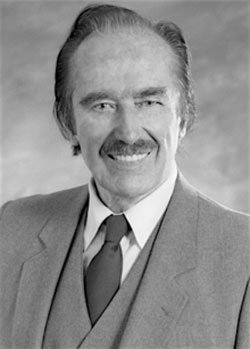
Fred Trump (1905-1999). Put another 50 lbs. on him, dye his hair blonde, dye his skin orange, give him a comb-over, remove the vest and put him in a dark blue suit with a necktie tied too long, and you have Donald.
Trump biographer Michael D’Antonio identifies the male influences, including his father, who trained Donald Trump in his “Law of the Jungle” philosophy and convinced him that bullying works and only success matters.
[F]or those of us who have followed Trump’s career from the start, the worldview he has trotted out to the public is no surprise. Some people seem shocked that he embraces torture without compunction; openly admires the suppression of freedom by Chinese and Russian dictators; and shows little grasp of ethics, governance or constitutionalism, as evidenced by his insistence that the U.S. openly engage in war crimes (by killing the families of terrorists). Or that he often seems ignorant of history and the economic benefits of free trade, dismissing the U.S. alliance and trading system that won the Cold War as “obsolete,†calling regularly for punitive tariffs and insisting over and over again, “We never win anymore,†as if trade were a zero-sum game (which it is not). Or that he relishes the idea that people at his rallies punch each other, suggesting that his supporters “knock the crap out of†any disrupters.
But, as Trump’s biographer, I can tell you these views fundamentally define the man. And if you’re looking—or perhaps hoping—for something more, you shouldn’t expect to find it. If you are seeking reassurance that the man who could be the next president of the United States possesses a coherent political philosophy or ethical foundation other than this rather pre-Enlightenment code of behavior—that he subscribes to the ideals of the Founders, or has studied and understood American democracy, human rights and our Constitutional system—you won’t get it.
Rare if not unique in American politics, Trump’s views and provocations are consistent with his biography.
Quite a story here. When you read this, you realize that Donald Trump is really a character right out of an old-time Harold Robbins novel.
Theodore Roosevelt (Progressive Party), William H. Taft (Republican), Woodrow Wilson (Democrat). Miss Columbia hands out the presidency.
Joseph Cummins reminded us, at Politico last month, that the country has a long history of scurrilous and unseemly presidential election contests. Take the 1912 Election, for instance…
[O]ne of the great American presidential manliness taunters in American history was Teddy Roosevelt. Henry James called him “a monstrous embodiment of unprecedented and resounding noise,†and he is the presidential candidate whose bombast most resembles that of Donald Trump. During the election of 1904, he called the president of Venezuela “a villainous little monkey†and tagged his Democratic opponent, Judge Alton Parker, “that neutral-tinted individualâ€â€”the “low-energy†charge of its time. In 1912, during the historic election that split the Republican Party and handed the presidency to Woodrow Wilson and the Democrats (sound familiar?), Roosevelt (who would run as a Progressive “Bull Moose†Republican) showed up at the contested convention wearing a sombrero, smoking a cigar and calling President William Howard Taft a “rat in a corner.†(Unmanned, Taft could only respond weakly that Roosevelt was “neurotic.â€) During that same fractious election, after letters came to light that seemed to indicate that the married Woodrow Wilson might be having an affair, Teddy sneered: “It wouldn’t work. You can’t cast a man as Romeo who looks and acts so much like an apothecary clerk.â€
Mark Steyn makes mincemeat of bien pensant liberals former UN Human Rights Commissioner Louise Arbour and historian Simon Schama in this debate excerpt.