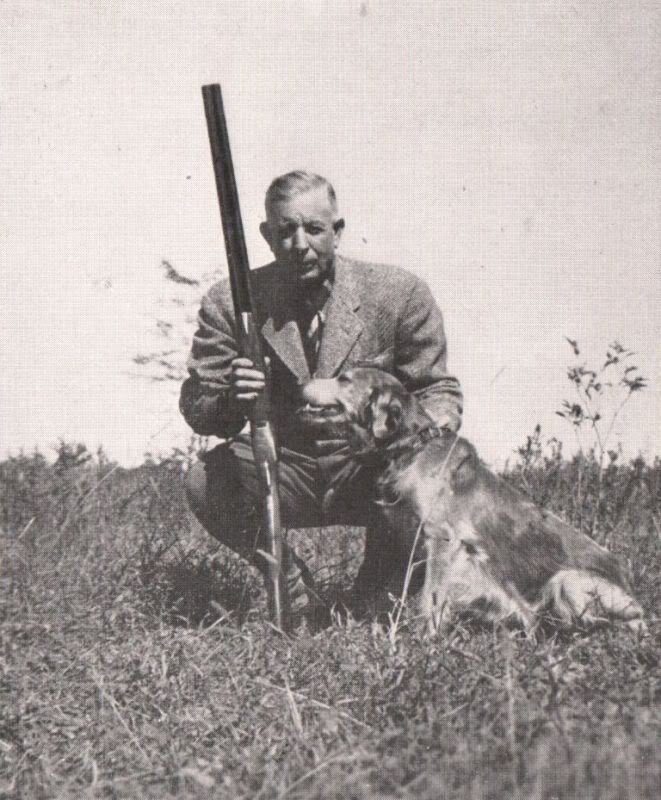
On December 1, 1948, two hunters emerged from the cool wetlands of Clarendon, Arkansas, and ambled along a country road. The men—Nash Buckingham and Clifford Green—had spent a long morning in a duck blind and were headed back to Green’s car, on their way home. Buckingham, then sixty-eight years old, was at the time one of the most famous writers in America, a sort of Mark Twain for the hunting set. At Green’s car, they met a warden, who asked to see their hunting licenses. The warden quickly realized that he was in the presence of the celebrated writer. He asked Buckingham if he could see the most famous shotgun in America, Buckingham’s talisman, an inanimate object that the writer had referred to—in loving, animistic terms—in a great number of his stories. The nine-pound, nine-ounce gun was a side-by-side 12-gauge Super Fox custom-made by the A. H. Fox Gun Company in Philadelphia.
The carbon steel plates on the frame were ornately engraved with a leafy scroll. The gun company’s signature fox, nose in the air, was engraved on the floorplate. The barrels had been bored by the renowned barrel maker Burt Becker and delivered 90 percent patterns of shot at 40 feet, an uncharacteristically tight load for a waterfowling shotgun. It was named Bo Whoop. A hunting buddy had designated it so, after the distinct deep, bellowing sound it made upon discharge.
The warden chatted up Buckingham, handling and admiring the writer’s gun, like a kid talking to Babe Ruth while holding the slugger’s bat. At some point during the conversation, the warden laid the gun down on the car’s back fender. Buckingham and Green soon bid the warden farewell and drove off, forgetting about Bo Whoop until many miles into their trip home. In a panic, they turned around and retraced their route, painstakingly eyeing every inch of the road, to no avail.
Buckingham spent the next few years in a desperate hunt for Bo Whoop. He lamented the loss of Bo Whoop in print, likening it to the death of a treasured hunting dog. He took out ads in local newspapers, offering rewards. He befriended local wardens and police, appealing to them to be on the lookout.
He would never find it. …
Sometime in the 1950s a foreman at a sawmill in Savannah, Georgia, was offered an elegant but well-used Fox shotgun with a broken stock. The seller wanted $100. The Savannah foreman took one look at the fractured stock and countered with an offer of $50. The sale was made at that price. The foreman then put the gun in his closet, where it remained for the next three decades.
The foreman’s son, who also lived in Savannah, eventually inherited the gun upon his father’s death. He, too, left the gun in his closet, this time for nearly twenty years. But in 2005, for reasons unknown (the consignor’s family wishes to remain anonymous), he brought the gun to Darlington Gun Works, a South Carolina shop owned by Jim Kelly, a noted gunsmith. The foreman’s son wanted to repair the broken stock. Kelly, a student of hunting history, saw that on the top of the right barrel there was a hand stamp that read: “Made for Nash Buckingham.†On the top of the left barrel: “By Burt Becker Phila. PA.†Kelly was floored. “I couldn’t believe that this gun had walked right in here,â€
Bo Whoop was sold by James D. Julia in 2010 for $201,250. Its purchaser donated the historic shotgun to Ducks Unlimited.
During the eleven years I ran RedState, I worked to actively squash a lot of conspiracy theories. …
My friend Donald Rumsfeld once said that there really are no conspiracies out there because no one can keep a secret. I tend to think he is right.
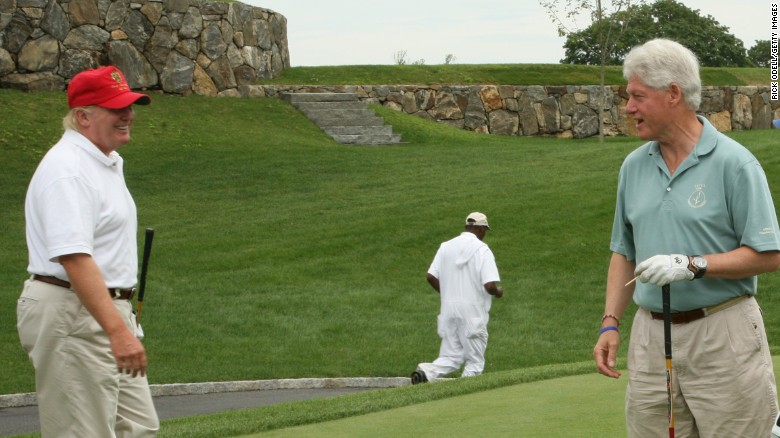
But there is one conspiracy theory I’m starting to embrace. I’m really coming to believe that Donald Trump is a Bill and Hillary Clinton operation to get Hillary Clinton elected.
A Republican candidate running for office would spend this entire week attacking Hillary Clinton for mishandling classified information.
Instead, Trump has attacked Republicans and praised Saddam Hussein.
A Republican candidate running for office would spend lots of time in swing states. Instead, Trump is focused on New York and Scotland.
A Republican candidate, when asked by the New York Times about serving if elected, would mock the reporter and make it clear how he will serve instead of play golf like Barack Obama. Instead, Trump would not commit to actually serving.
Donald Trump managed to get the Republican nomination in a very crowded field by galvanizing only 33% of the Republican vote, a good bit of which was not even Republican, but disaffected, pissed off voters coming into the GOP to support Trump.
Even after all the other candidates dropped out, Trump could not even clear 44% support in the primary.
Trump ran a primary campaign playing to the worst fears and prejudices of a certain set of Americans and was able to consolidate them against 17 other candidates.
Having spent an entire primary on offense, Trump has not spent a single day doing anything other than defense.
I am beginning to believe Trump is a Clinton operation designed to get Hillary elected. Trump is, after all, the only Republican who ran who was a Clinton donor. He is also the only Republican running who called Bill Clinton to discuss running before he even got into the race.
It would take a miracle effectuated by a political genius of the first water to make Hillary electable, especially in this unfavorable year. The Republican presidential nominee in 2016 has the key to the Oval Office in his pocket as long as he is normally presentable and can walk and talk.
Maybe Hillary can win after all, though, because it just so happens that she is married to a political genius of the first water. …
if I were Bill, how on earth could I possibly cause the unamiable, unattractive, scandal-infested, mean old Hillary to win in this most unfavorable year?
Well, what if… what if that slick old Bill actually did think up a way? How could he do it? Well, there is one way, after all. Just suppose it was possible for Bill Clinton to hijack the GOP nomination.
Suppose Bill Clinton figured out the sole, solitary possible way that he could shove a big, fat monkey wrench into the Republican Party’s Presidential Election Campaign’s works.
Let’s say, for instance, that Old Bill knew another feller, that he had a buddy, a good friend, not in politics actually, but a fellow in some respects kind of like himself, brash, shameless, fond of the ladies, appetitive, hugely out-going, and larger-than-life. Bill’s friend, like himself, would be a wealthy and successful person, a celebrity, a performer, and a chap vigorously able to go after what he wants free of ethical inhibitions.
One can picture Bill sitting down with his pal Donald, and saying, “Donald, old boy, I need you to do Hillary and me a solid. The good news is that the whole thing is going to be one of the greatest larks of all time, and together we are going to make history. This is really going to be a hoot! If it works, you get all the billions of dollars of federal contracts, leases, and subsidies you can use, and Hillary will appoint you ambassador to the Court of St. James. If it fails, sheeeit! you get to be president. This is a no-lose operation.â€
And then Bill (behind the scenes) masterminds The Donald’s campaign, knocking out one legitimate GOP candidate after another with shameless insults, abuse, and outright baldfaced lies.
Donald gets the nomination, but it could be that Bill has a plan in mind to sink the Trump campaign right about the end of next September. Photographs of Donald (like Berlusconi) in the sack with some underage girls just happen to fall into the hands of intrepid NY Times reporters in the nick of time. The GOP campaign sinks suddenly in scandal, while Donald smiles over the stories of his sexual prowess, and Hillary coasts in after all.
Donald Trump, last year, is unhappy with the Obama Administration’s mishandling of the economy, foreign policy embarrassments, and the general atmosphere of American decline. He also doesn’t like the Republican emphasis on conservative ideas and he has no sympathy with the rarified idealism of Bush-era Wilsonian Foreign Policy activism. The idea of running in the Republican primaries as a protest candidate has occurred to him.
He would get to ventilate his personal opinions, throw his weight around, and have an impact. Hell, he might win a state or two somewhere. He’d have himself a place in the History books, and as a former presidential candidate he would have a bit more influence and enjoy more respect when he did his business deals. Come to think of it, he would probably even get a little more tail. The aroma of political power does things to chicks.
Trump is reluctant, though, to alienate his pals the Clintons, so he decides to talk it over with Bill. Trump assures Bill that he means Hillary no actual harm, but as Bill thinks about all this, his grin gets wider and wider. Trump running may not really injure Hillary one bit, but it sure could make an unholy mess of the Republican race.
Bill Clinton advises Trump to be himself, and to come out loudly with all the nationalist, protectionist, working-class-hero kind of BS that Jim Webb was peddling in that book of his. What Bill is proposing is, in essence, that Trump should run as a democrat in Republican clothing. The campaign will be all democrat class warfare and promises of special government interventions for Trump’s voters, all served up under a nice Republican sauce made up of flag-waving patriotism.
Obviously, all of this turned out to match the temper of the times, the mood of the low-information voter, perfectly. No one could have predicted that it would sell quite so well, not Bill Clinton, not The Donald himself.
Aren’t all you Trump supporters going to feel dumb, when this is finally confirmed?
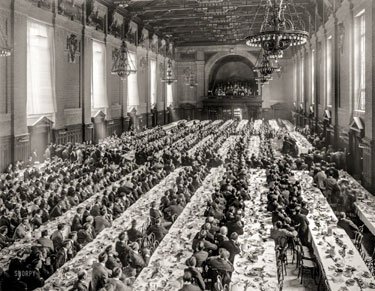
I would guess that this was a Reunion Banquet. In my day, freshman ate their meals here in University Commons. Normally, this dining hall was far less crowded. There were many fewer individual tables, spaced a lot farther apart. Yale doesn’t use the space for student meals anymore, and I believe the whole building is being renovated and changed into some kind of multi-purpose student center. But, then, where will Yale hold these kind of banquets? one wonders.
The inaugural heads of Yale’s two new residential colleges have been announced by President Peter Salovey and Yale College Dean Jonathan Holloway. Charles Bailyn, professor of astronomy and physics, will be the head of Benjamin Franklin College, and Tina Lu, professor of East Asian languages and literatures, will be the head of Pauli Murray College.
The new colleges will be finished by the time the incoming Class of 2021 arrives on campus. …
Bailyn has been a member of the Yale community since his undergraduate years, earning his B.S. in astronomy and physics from Yale College in 1981 [ Calhoun – JDZ ] and later returning to campus in 1990 to join the faculty ranks. In 2010 he was named the A. Bartlett Giamatti Professor of Astronomy and Physics. From 2011 to 2016 he served as the inaugural dean of the faculty of Yale-NUS College in Singapore.
In his research, Bailyn studies black holes and related sources of celestial X-rays, as well as dense star clusters and the effects of collisions between stars. His work on measuring the masses of black holes was awarded the 2009 Bruno Rossi Prize from the American Astronomical Society, and he has carried out research with a wide variety of ground- and space-based telescopes, including NASA’s Hubble Space Telescope. …
As a Yale undergraduate, Bailyn was awarded the George Beckwith Prize in astronomy and was an avid participant in the a cappella singing scene. Salovey and Halloway noted in their letter that Bailyn considers becoming a pitchpipe of the Duke’s Men at the age of 19 one of the highlights of his undergraduate experience. After completing his Yale College degree, he pursued graduate work at the University of Cambridge and at Harvard University, receiving his Ph.D. from Harvard in 1987 and spending three years as a member of Harvard’s Society of Fellows before returning to Yale as an assistant professor of astronomy. He has served both as chair and as director of undergraduate studies in the Department of Astronomy and was a member of the 2001-03 Committee on Yale College Education, which reviewed Yale’s undergraduate curriculum. He twice chaired the Teaching, Learning, and Advising Committee in Yale College. In his five years at Yale-NUS, he led the recruitment of more than 100 faculty members and supervised the development of the college’s common curriculum.
———————
Tina Lu joined Yale’s Department of East Asian Languages and Literatures (EALL) in 2008, with a secondary appointment in the Department of Comparative Literature. She has served as EALL’s director of graduate studies (from 2009-2010), director of undergraduate studies (2012-2013), and chair (2013-present). In 2009 she was a visiting professor with the Yale-PKU program in Beijing; since 2013 she has been a consulting faculty member to Yale-NUS College, where she taught as a visiting professor in spring 2015.
Specializing in Chinese literature from 1550 to 1750, Professor Lu has written three books — one on personal identity, one on the nature of the human community, and the most recent (still being completed) about materiality. Noted Salovey and Holloway: “In the course of them, she has discussed a portrait that comes to life, optical illusions, and stories about severed heads!†Her current work examines time travel and its pre-modern antecedents. With colleagues at other universities in art history and social history, she is also at work on a collaborative book about Xu Wei, the 16th-century polymath, playwright, and painter.
One of her major ongoing projects is The Ten Thousand Rooms, a web-based platform she is developing with grant support from the Mellon Foundation (and in collaboration with her colleague Mick Hunter) that will allow scholars around the world to work together on the transcription, translation, and commentary of pre-modern Chinese sources. She has been an invited speaker and panelist at dozens of universities and other forums in the United States and internationally. In 2009, she was awarded the Gustav Ranis Prize for Best Book on an International Subject by a Yale Faculty Member, and from 2005 to 2011 she was a Mellon Foundation New Directions Fellow. She has served on numerous Yale advisory groups, from the Humanities Program Executive Committee to the Digital Humanities Executive Committee to the Yale-NUS Advisory Committee and Curriculum Review Committee. Her undergraduate courses include EALL 200, “The Chinese Tradition,†an overview of Chinese culture and history from antiquity to the 20th century.
Lu earned her A.B. (in East Asian languages and civilizations) and Ph.D. (in comparative literature) from Harvard University. Prior to coming to Yale, she was a member of the faculty at the University of Pennsylvania from 1998 to 2008, earning tenure in 2004.
Yale’s residential college “heads” seem to be younger these days, not as distinguished as they used to be, and more commonly chosen on the basis of “diversity” (what some of us would call: favoritism), but Professor Bailyn looks to me like a decent choice. At least he’s a Yalie.
Professor Lu, appropriately for her new college, is diverse. But, at least, she has eccentric areas of academic study, so I suppose they could do worse.
What is up, however, with these new college coats of arms?
College and universities customarily assume the arms of their namesake. Benjamin Franklin had a real coat of arms, complete with dolphins no less. Why on earth aren’t they using it?
Whatever-her-name-was, doubtless, had no coat of arms, so Yale is free, I suppose, to invent one and confer it on her, but Yale ought to be aware that these are referred to coats of arms or armorial achievements, not “shields.” And unmarried ladies’ arms are displayed on a lozenge (a diamond) or an oval, and not upon a shield.
Yale can’t even do heraldry right today. Sigh.
Benjamin Franklin’s real coat of arms, blazoned: Argent on a bend between two lions’ heads erased gules, a dolphin embowed of the first between two martlets or.
J.D. Vance, the recent ex-Marine graduate of Yale Law School whose new book, Hillbilly Elegy, was discussed here not long ago, understands the social and economic pain that is causing his hometown friends and neighbors to look for quick relief, but he also recognizes that Trumpism is really the political equivalent of meth or heroin.
During this election season, it appears that many Americans have reached for a new pain reliever. It too, promises a quick escape from life’s cares, an easy solution to the mounting social problems of U.S. communities and culture. It demands nothing and requires little more than a modest presence and maybe a few enablers. It enters minds, not through lungs or veins, but through eyes and ears, and its name is Donald Trump.
Last Sunday, the day before Memorial Day, I met a Marine veteran of the Vietnam War at a local coffee shop. “I was lucky,†he told me. “At least I came home. A lot of my buddies didn’t. The thing is, the media still talks about us like we lost that war! I like to think my dead friends accomplished something.†Imagine, for that man, the vengeful joy of a Trump rally. That brief feeling of power, of defiance, of sending a message to the very political and media establishment that, for 45 years, has refused to listen. Trump brings power to those who hate their lack of it, and his message is tonic to communities that have felt nothing but decline for decades.
In some ways, Trump’s large, national coalition defies easy characterization. He draws from a broad base of good people: kind folks who open their homes and hearts to people of all colors and creeds, married couples with happy homes and families who live nearby, public servants who put their lives on the line to fight fires in their communities. Not all Trump voters spend their days searching for an analgesic.
Yet a common thread among Trump’s faithful, even among those whose individual circumstances remain unspoiled, is that they hail from broken communities. These are places where good jobs are impossible to come by. Where people have lost their faith and abandoned the churches of their parents and grandparents. Where the death rates of poor white people go up even as the death rates of all other groups go down. Where too many young people spend their days stoned instead of working and learning.
Many years ago, our neighbor (and my grandma’s old friend) in Middletown moved out and rented his house on a Section 8 voucher—a federal program that offers housing subsidies to low-income people. One of the first folks to move in called her landlord to report a leaky roof. By the time the landlord arrived, he discovered the woman naked on her couch. After calling him, she had started the water for a bath, gotten high, and passed out. Forget about the original leak, now much of the upstairs—including her and her children’s possessions—was completely destroyed. Not every Trump voter lives like this woman, but nearly every Trump voter knows someone who does.
Though the details differ, men and women like my neighbor represent, in the aggregate, a social crisis of historic proportions. There is no group of people hurtling more quickly to social decay. No group of people fears the future more, dies with such frequency from heroin, and exposes its children to such significant domestic chaos. Not long ago, a teacher who works with at-risk youth in my hometown told me, “We’re expected to be shepherds to these children, but they’re all raised by wolves.†And those wolves are here—not coming in from Mexico, not prowling the halls of power in Washington or Wall Street—but here in ordinary American communities and families and homes.
What Trump offers is an easy escape from the pain. To every complex problem, he promises a simple solution. He can bring jobs back simply by punishing offshoring companies into submission. As he told a New Hampshire crowd—folks all too familiar with the opioid scourge—he can cure the addiction epidemic by building a Mexican wall and keeping the cartels out. He will spare the United States from humiliation and military defeat with indiscriminate bombing. It doesn’t matter that no credible military leader has endorsed his plan. He never offers details for how these plans will work, because he can’t. Trump’s promises are the needle in America’s collective vein.
The great tragedy is that many of the problems Trump identifies are real, and so many of the hurts he exploits demand serious thought and measured action—from governments, yes, but also from community leaders and individuals. Yet so long as people rely on that quick high, so long as wolves point their fingers at everyone but themselves, the nation delays a necessary reckoning. There is no self-reflection in the midst of a false euphoria. Trump is cultural heroin. He makes some feel better for a bit. But he cannot fix what ails them, and one day they’ll realize it.
Red State explains how the Justice Department two-step worked:
James Comey was facing a revolt among his professional staff. If the case were sent to Lynch for adjudication, which is the usual process, the story would be that the FBI had “cleared” Clinton and therefore Justice was closing the case. In this case, Comey knew that one or more of his senior people, in order to defend the FBI, would either walk (unlikely because no one has principles that are going to cost them a six-figure income) or leak like a sieve (highly likely). This would make Comey the bad guy. It would make him corrupt to the core instead of merely the feckless p***y he’s has been revealed to be.
Unable to go for prosecution, because that would have required integrity, and fully aware that taking a pass on the case would make her unemployable as anything other than a punchline in political jokes for the next generation, she needed to unload this particular ticking time bomb. Unfortunately, she had no real reason to recuse herself from the process as her department was overseeing the case.
Enter the “chance meeting.” Last week this looked like one of the most boneheaded moves ever made by an attorney general. It turned out to be an inspired bit of political theater. This enabled Bill Clinton to throw his old friend a lifeline. By meeting informally and in near secrecy with Clinton, Lynch suddenly had a reason to essentially recuse herself from the case by “accepting the FBI’s recommendation.” …
By deferring to the FBI recommendation, Lynch has pinned the bull’s-eye firmly on Comey and his senior leadership.
Thus we have the FBI Director rendering a scathing public indictment of Hillary Clinton is every particular of the case. In fact, he goes out of his way to demolish everything she has said. And then he, Pontius Pilate-like, walks away leaving the American founding concept of the rule of law in utter shambles.
Archaeologists working in Trondheim in Norway are amazed by the discovery of a human skeleton in the bottom of an abandoned castle well. The skeleton provides evidence that confirms dramatic historical events mentioned in the Sagas.
The location and contents of the well are mentioned in Sverre’s Saga. …
In 1197 King Sverre Sigurdsson and his Birkebeiner-mercenaries were attacked and defeated in his castle stronghold, Sverresborg, by his rivals, the Baglers. According to the Saga, the Baglers burned down buildings and destroyed the castle’s fresh water supply by throwing one of King Sverre’s dead men into the well, and then filling it with stones.
Now, following a trial excavation in the well, archaeologists can confirm this dramatic story. Archaeologists managed to retrieve part of the skeleton they found in the well in 2014. A fragment of bone produced a radiocarbon date that confirmed that the individual lived and died at the end of the 12th century, the same time as the incident described in the Saga.