Archive for 2016
05 Jul 2016


Rudyard Kipling, 1865-1936.
Noel Annan, Our Age: English Intellectuals Between the World Wars: A Group Portrait:
[Britain’s Edwardian] serenity was misplaced. Astute observers at home warned that Britain was losing its industrial supremacy and was indifferent to its ill educated population. Acute observers abroad declared that the solidarity of British life was an illusion. The American historian Brooks Adams (brother of Henry) forecast the departure of Britain from the historical stage. The steel production of the United States and Germany was overtaking that of Britain; and the Boer war had revealed Britain’s inefficiency as a world power. Conrad heard the tumult beneath the surface of that thin crust men called civilization – the anarchist world of the secret agent or of Henry James’s Hyacinth Robinson. But there was one writer in particular who was aware how thin the crust was and who redefined the gentlemanly ethos, and it was often through his eyes that Our Age was told to admire it. That was Kipling.
Kipling wanted his generation to recall how much the gentleman owed to society. He valued the independence of the individual – as an artist how could he not? But the individual left on his own, isolated and lonely, disintegrated. Particularly in India where men and their wives died young, where to take one’s work seriously could result in madness because government, unlike in England, never achieved results. What prevented such a society from going over the precipice? Kipling answered: religion, law, custom convention, morality – the forces of social control – which imposed upon individuals certain rules which they broke at their peril. Conventions enabled men to retain their self-respect and even to live together under appalling circumstances. Those who break the conventions must be punished. Numbers of Kipling stories contain scenes in which the individualistic, the eccentric, the man who offends against the trivial rules of the club, are tarred and feathered with gleeful brutality. If the offender is not brought to heel, society will suffer. It is not worth spending much effort, Kipling thought, debating whether the customs, morality and religion of the place you live in are right or wrong. His contemporary, the anthropologist James Frazer, was informing the learned public that religion and magic were a kind of primitive science which would vanish as scientific knowledge spread; but for Kipling, as for Max Weber, religion was a social fact.
These forces of social control, as Kipling admitted, were harsh. The harshness could be alleviated by belonging to in-groups. These in-groups protect the individual, give him privacy, identity and self-confidence. They are the family, the school and the craft or profession you follow. These in-groups, too, teach us our place. We all need a course of indoctrination to find our place and, if you have come up in the world, to be taught it. But when the individual has proven himself in his in-group, and so long as he is not in the strict sense of the word of an eccentric, then the more daring his behaviour and the more abundant his action, the greater is the addition of joy in the world. Stalky was the prototype of this socialized individualism. He acted beyond the formal law of school or army regulations and possessed the gift of seeing himself from the outside in relation to society. In Kipling’s world action revitalized man. That was the obverse of suffering it caused. And suffering was inevitable. Political action is often not a choice between good and evil but between lesser and greater evil.
Social realities interested Kipling. The liberal pictures man as choosing goals to pursue and asks whether or not he is free to pursue them. Kipling thought that men and women were forced to accept those goals which their group or clan in society chose for them and only when they had accepted these constraints were they free to exercise their individuality and take it for a trot. He is not unlike Durkheim who saw the individual as a bolt which might snap if the nut of society held it too tightly, or by being too loose allowed it to vibrate. Excessive integration as in the officer caste in the Army could be as dangerous as imperfect integration.
Brought up in a society untouched for generations by civil wars, revolution or economic disaster, Kipling’s English contemporaries were never compelled to consider why society still continues to hang together. But in India Kipling was forced to consider it. He believed that man achieves happiness when he comprehends where he himself fits into the scheme of things. He has to realize that spring cannot forever be spring and that winter succeeds autumn. Since men continue to nurse illusions they must be taught the terms on which they are allowed to rise. Subject the upstart, therefore, to a course of indoctrination to bring his ambition within bounds and turn his children into gentlemen. Whereas for most of the greatest writers society, with its rules, conventions, customs, morality and taboos surrounding the sacred, is the enemy and their characters in fiction are depicted as locked in heroic combat with them, for Kipling they are a donnée with which mankind has to come to terms or perish.
Kipling therefore defined the gentleman differently from Trollope. His gentleman has come down in the world, is harsher, more meagre, with fewer graces and more limitations. The gentleman has now become the manager, the colonial administrator, the engineer and the skilled worker. You feel his gentleman is more beleaguered. He is threatened from above by the politicians, threatened from below by the lower orders who now have the vote, and threatened by the new barbarians in Europe. In the fable of England he wrote for his children Kipling scanned the future with anxious eyes. Would the wall of British civilization fall again before the democratic hordes of little men and the barbarians, the Prussian Winged Hats? Were not the younger rulers like Churchill tainted by the same ambition that made Roman generals overpower the emperor? Were not the financiers manipulating trade and industry to their own ends, were not luxury and wealth corrupting the ruling class and turning their children to flannelled fools at the wicket? What would be England’s fate?
05 Jul 2016
Holman W. Jenkins Jr. recognizes that Donald Trump is a shrewdly calculating utilitarian who is in it for himself. What, he wonders, will happen if Trump decides at some point that he cannot win?
Before they gather in Cleveland for their convention, it’s not too soon for Republicans to begin thinking about what exactly a Donald Trump defeat might be like.
As with his now-documented habit of charitable promises that seldom materialize, Mr. Trump never intended to endanger a sizable part of his personal wealth to fund a presidential campaign. That means he’ll continue to campaign on the cheap, by saying incendiary things and having them transmitted by the free media. Expect more speeches like the protectionist-cum-conspiracy theory speeches in suburban Pittsburgh on Tuesday and New Hampshire on Thursday, even if such diatribes frighten major donors and mainstream Republicans and make life harder for down-ticket Republican candidates in the fall. …
Here resides the problem all along for those hoping for a Trump-to-the-middle move. Such moves are expensive. Base-broadening campaigns require lots of paid TV to reach non-engaged voters and Trump skeptics, pummeling them with reassuring images suggesting that a Trump presidency would be OK.
Mr. Trump not only is unwilling or unable to finance such a campaign. He evidently is unwilling to do what’s necessary to entice GOP donors to finance it on his behalf. This means GOP officeholders seeking re-election can expect a constant headwind of inflammatory Trump statements designed to stimulate the free media coverage that his asset-lite campaign requires. Republican candidates up and down the ballot therefore become unwilling sharers of a high-risk Trump electoral wager, a gamble more likely to end in a Hillary landslide than a Trump White House.
The more intriguing question concerns what happens if Mr. Trump decides he can’t win and no longer is willing to throw good money after bad. Unless they were born on a turnip truck yesterday, campaign vendors will be the first to figure it out. Look for them quickly to cut off services rather than get stiffed in the inevitable Trump campaign bankruptcy filing.
Mr. Trump’s harsher Republican critics are kidding themselves to think Mr. Trump is crazy or unstable and will suffer a breakdown. More likely, he will simply and coldbloodedly toss the ball to the GOP, saying, in effect, “If you want to pay for some events or TV, I’m available. Otherwise I’m done.†The GOP would then have to shoulder the dual burden of propping up a minimally respectable Trump campaign while also distancing its down-ballot candidates from Mr. Trump so they might survive.
And that’s the optimistic scenario. Mr. Trump has learned the value of audacity. He might well decide to cover his retreat and preserve his amour propre with a flurry of lawsuits and conspiracy theories about a “rigged†election.
He’s already begun putting narrative flesh on these bones. He speaks of “crooked Hillary†and increasingly of the Clinton Global Initiative, Bill Clinton’s philanthropy, and what he calls the Clintons’ “politics of personal profit and theft.†In his trade speeches, he portrays the Clintons as members of a nefarious global elite that has enriched itself while foisting impoverishing trade deals on the U.S. middle class.
He perhaps will throw in a few suggestions that foreign governments hold hidden leverage over Hillary because of her hacked, illegal email server. He’ll mention Bill Clinton’s pardon of Marc Rich.
Republicans can also expect to be a target of his accusations. He doesn’t need to be plausible, just tell a story that justifies his own stance that he didn’t lose, the other side cheated, “Washington elites†conspired against him, etc.
If the Trump endgame is destined to go this way, Republicans should hope it does so early, ideally before the convention is even over. To date, Mr. Trump continues to tease top GOPers and conservatives with the idea that he may yet come their way, turn his formidable talents to advancing conservative causes. This merciless exploiting of Republican romantics has begun to seem like something out of “The Blue Angel†or Lucy with the football.
05 Jul 2016
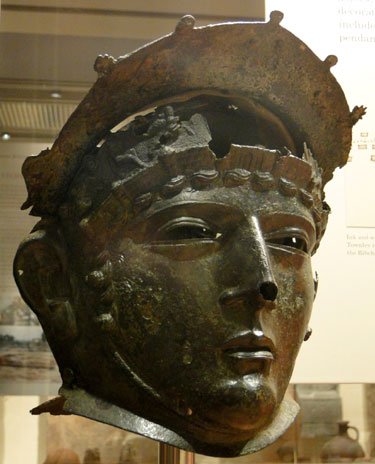
The Ribchester Helmet is a Roman bronze ceremonial helmet dating to between the late 1st and early 2nd centuries AD, … now on display at the British Museum. It was found in Ribchester, Lancashire, England in 1796, as part of the Ribchester Hoard. The model of a sphinx that was believed to attach to the helmet was lost.
Wikipedia:
The helmet was discovered, part of the Ribchester Hoard, in the summer of 1796 by the son of Joseph Walton, a clogmaker. The boy found the items buried in a hollow, about three metres below the surface, on some waste land by the side of a road leading to Ribchester church, and near a river bed. The hoard was thought to have been stored in a wooden box and consisted of the corroded remains of a number of items but the largest was this helmet. In addition to the helmet, the hoard included a number of paterae, pieces of a vase, a bust of Minerva, fragments of two basins, several plates, and some other items that the antiquarian collector Charles Townley thought had religious uses. The finds were thought to have survived so well because they were covered in sand.
The helmet and other items were bought from Walton by Townley, who lived nearby at Towneley Hall. Townley was a well-known collector of Roman sculpture and antiquities, who had himself and his collection recorded in an oil painting by Johann Zoffany. Townley reported the details of the find in a detailed letter to the secretary of the Society of Antiquaries, intended for publication in the Society’s Proceedings: it was his only publication. The helmet, together with the rest of Townley’s collection, was sold to the British Museum in 1814 by his cousin, Peregrine Edward Towneley, who had inherited the collection on Townley’s death in 1805.
In addition to the items purchased by Townley, there was also originally a bronze figurine of a sphinx, but it was lost after Walton gave it to the children of one of his brothers to play with. It was suggested by Thomas Dunham Whitaker, who examined the hoard soon after it had been discovered, that the sphinx would have been attached to the top of the helmet, as it has a curved base fitting the curvature of the helmet, and has traces of solder on it. This theory has become more plausible with the discovery of the Crosby Garrett Helmet in 2010, to which is attached a winged griffin.
04 Jul 2016

Daily Star:
AN SAS soldier killed three Islamic State fighters with a Gurkha knife with the elite trooper decapitating one with a single swipe of the kukri after he was caught in an ambush in Iraq.
The sergeant, with 15 years’ combat experience, killed a further two gunmen and injured at least three others.
The attack occurred when Iraqi troops launched a massive assault on the besieged city of Fallujah, a key IS stronghold.
The SAS were acting as military advisors and leading small groups of Iraqi special forces.
During one attack, an SAS and Iraqi team entered a bombed-out factory hunting a sniper. But the troops were ambushed by IS gunmen and several Iraqi soldiers were killed and four seriously wounded.
The SAS soldier returned fi re as he dragged injured troops to safety before he was pinned down by enemy gun-fire.
When he ran out of ammo the IS gunmen attempted to capture him alive but instead the 27-year-old sergeant began lashing out with kukri, given to him by a British Gurkha soldier.
A senior defence source said: “As soon as his ammunition was expended, the IS gunmen tried to storm him.
“As they went to grab him he unsheathed his kukri and began slashing away.
“He decapitated the first gunman, slit the throat of second and killed another with a third blow. He then sliced away at three others.
“The IS gunmen fled in panic allowing the SAS soldier to carry the injured men to safety.
“He expected to be killed but thought he’d take as many of the enemy with him.
“When he was reunited with Iraqi troops they thought the he was seriously wounded because he was covered in blood but he explained that the blood wasn’t his.
“He cleaned his knife, grabbed some more ammo and then led another Iraqi special forces team into battle.â€
The sergeant is now expected to receive a gallantry award from the Iraqi Army.
The Daily Star Sunday understands that the SAS man had taken his kukri on combat missions in Iraq, Afghanistan and Libya but this was the first time that it had been used in battle.
He was given the knife by a Gurkha before he joined the SAS and was told that once unsheathed the knife must draw blood.
Full story.
04 Jul 2016
Jonah Goldberg explains why he is not moved by arguments urging him to fall into line and start supporting Donald Trump.
I can’t stand Kasich. But he meets my own minimal requirements for support. Trump, simply, doesn’t. He falls short of the mark like John Candy in the long jump. I’m not going to rehash all of my reasons for this conviction, but suffice it to say I think he’s unpatriotically unprepared and unqualified for the job. Politically, conservatism at its core is about the importance of ideas and the importance of character. With the exception of his longstanding support for protectionism and the unalloyed importance of “strength,†Trump cares not a whit for policy or philosophy. His attachment to principles is, for the most part, a nearest-weapon-to-hand approach. As a matter of character he’s crude, boorish, dishonest, proudly promiscuous, and has launched countless businesses based on the idea that it’s morally acceptable to take advantage of people. He dodged the actual Vietnam War but claimed that avoiding the clap in the 1970s was his own personal Vietnam.
Kozak and many others either disagree with me on these points or they simply don’t care. If it’s the former, we have some substantial disagreements about what I think are obvious facts. If it’s the latter, then I take our disagreement as a badge of honor. If Roger Simon wants to describe that as “moral narcissism,†so be it. But, there’s a practical point here too. I plan on being in this line of work for a while longer. In the future, I want to be able to continue to say character and ideas matter without someone shouting, “Oh yeah, then why did you support Donald Trump?†…
By waiving the standards we use to judge liberal politicians in order to defend an allegedly conservative one, we are waiving those standards for all time. I’m not talking about some allowances at the margins, politics should be flexible — strange bedfellows and all that. But there’s a difference between being flexible and willingly snapping your own spine to bend over for a politician who, almost certainly, has contempt for the standards you once held near and dear.
Read the whole thing.
03 Jul 2016

Newser:
It wasn’t quite death-by-selfie, but it wasn’t far off. Peru This Week reports that a German tourist died Wednesday while posing for a photo at Peru’s famed Machu Picchu site.
Oliver Park, 51, went into a restricted area of the mountainous tourist locale in the Andes, despite warning signs and instructions from wardens, reports the BBC. The channel says that while posing for a photo at the edge of a ravine, Park apparently decided to jump in the air to make it look like he was flying. Instead, he ended up falling off the cliff.
03 Jul 2016

Fox4kz:
A 62-year-old Australian man who ventured to within 3 to 5 feet of one bison was seriously injured Tuesday when the animal charged and tossed him into the air several times, park officials said in a statement.
This is the second such incident within weeks.
A 16-year-old Taiwanese exchange student was gored by a bison on May 15 while posing for a photo.
/div>
Feeds
|