Archive for 2016
03 Jul 2016
Golden Arrow Land Speed Racer, 925 hp, 11 March 1929 set a record of 231.45 mph.


02 Jul 2016

Believed to be from San Antonio, Texas, circa 1967.
Via Robert Ruark’s Andover nephew.
02 Jul 2016


Richard Verney, 19th Baron Willoughby de Broke, 1869-1923.
Noel Annan, Our Age: English Intellectuals Between the World Wars: A Group Portrait:
The ideal that Our Age was taught to admire when they were children was the ideal of English gentleman. The ideal of those pre-1914 days has been caricatured for so long, and sometimes amusingly, that one forgets this was the ethos that Churchill invoked in 1940. It went back to the eighteenth century. Wellington embodied it, Waterloo exhibited it. According to this code an Englishman should be guided by an overpowering sense of civic duty and diligence. Every man’s first loyalty should be to the country of his birth and the institution in which he served. Loyalty to institutions came before loyalty to people. Individuals should sacrifice their careers, their family, and certainly their personal happiness or whims, to the regiment, the college, the school, the services, the ministry, the profession or the firm. Service was an acknowledgment that there were other communities or territories which it was now the duty of the British to rule. Ruling other men and other races did not mean discovering and complying with their wishes. Their wishes would almost certainly be self-interested pleas for ephemeral ends often a mask for the duplicity of would-be politicians, demagogues and agitators. While the rest of the world feared the will to power that was behind the missionary force of the Empire, the British, whose administrators exported the life of the motherland in their clothes, their food, their sport and pipe-smoking, could never be brought to admit they were in danger. They were indignant when told that they exploited idealistic movement such as anti-slavery and Zionism as ways of getting others to do their work for them, or that they betrayed idealists such as E. D. Morel in the Belgian Congo or T.E. Lawrence in Arabia. Plutarch gave them examples of the type to admire: Lycurgus rather than Pericles, Julius Caesar rather than Pompey or Brutus; never Cleon or Catiline.
The gentleman was someone who developed his latent qualities by engaging in gentlemanly pursuits. An officer acquired an eye for country by riding to hounds, and thus learnt the art of moving his infantry platoon into dead ground to hide them from the enemy. Provided he excelled as a sportsman and played games fearlessly, his men would follow him anywhere. At Waterloo, officers courted danger to encourage their men much the same way as naval officers at Trafalgar strolled up and down the quarterdeck regardless of sharpshooters or grapeshot. In the early days both of the Boer war and the Great War to take cover was thought to be a bit iffy. A gentleman disguised his abilities as much as he disguised his emotions: not to do so was to show side and drop one’s guard. When Tony Chevenix Trench, later a public school headmaster, emerged from a Japanese prisoner of war camp, he was greeted by his brother with the words, ‘Oh, I didn’t expect to find you alive.’ The key to recognition was good manners – unceremonious, relaxed behavior designed to put friends at ease. The temptation to intellectualize about one’s calling was unwise and people who had theories needed to be watched. To reduce tradition and custom to dry principles, to become too reliant on technology, was to forget that character was more important than hare-brained schemes. Men should be judged by their conduct rather than their ideas. Mark Anthony was an example of self-indulgence and that weakness of character which tempts a man to desert duty for pleasure. Women were a potential snare and they should be treated warily. But good women were romantic objects and, because they were good, could be treated as such. The young were full of good stuff but callow. They would be all the better for being snubbed and put in their place.
People wanted to show that they too knew what leisure pursuits to follow, what matters to copy. This is how others would recognize that you are incorporated within society. Perhaps it is not going too far to say that a man and his family came to be regarded as citizens by the degree to which they were able to conform to the code of the governing class and to the part of the country they belonged. Before 1914 you had to assimilate as far as your means allowed to the governing class’s way of life to be received within the social pale. Servants indicated status, and it is astonishing how many of those with modest incomes and jobs had servants until one remembers the kitchen ranges, coal fires instead of Central heating, the copper instead of a washing machine, created so much work that there was a real inducement to economize on consumer goods and employ servants. A housemaid needed to be paid only thirty pounds a year. Clothes no less than servants were the clue to your social standing. A hat was a symbol of being socialized. That was one reason why even the poorest wore one: they were staking claim to being a citizen even if they had no vote. Only the self-confident could neglect the requirements of fashion, like the Cecils who dressed in shapeless garments or the intellectuals who climbed mountains and communed with nature on thirty-mile walks. Invited in 1929 to Bicton for a country house party, Alan Pryce-Jones, twenty-one years old and impecunious, descended for dinner wearing a black tie to find the other men wearing tail coats. ‘Which footman have you got?’ asked his uncle and host when he apologized. ‘It is not the fault of the footman,’ he replied, ‘I haven’t brought a white tie.’ Putting a hand on his shoulder, his host proposed the only remedy. ‘My dear fellow, sack your man.’ He was not invited again. …
Like Dickens, Trollope thought that making money and decent ambition in life were desirable: his gentry and clergy talk money all the time. His crooked financiers were guilty not because they pursued wealth but because they overrode the law and morality. But if a gentleman goes in for politics he should not act the prig when he finds he has to bribe his electors. Compromise and dissimulation are part of the game. You stand by your leader even if you don’t like him because personal likes or dislikes should be beneath the gentleman in politics. It is ignoble to claim you are a fly caught in the wheel of history or whine that you had a hard upbringing. Nor is it corrupt to show deference to rank and position. No doubt there are plenty of silly, vain and pompous aristocrats in Trollope’s pages but formal differences in society will always exist. The deference a scientist might show to a Nobel Prize winner or journalist to his editor is no more than tribute to sagacity and know-how. Social distinctions are not barriers, they are signposts which can be disregarded for good cause; but in a country which had no signposts it will be hard to find one’s way.
There were other virtues that the true gentleman required. He should not be too spontaneous in his conduct. That virtue which Castiglione had so admired had become suspect. Like a game fox a man should run straight. Predictability was a virtue. To strain to be original was a sign of side, conceit, vanity and showing off. To be determined to distinguish oneself from one’s fellows was considered disagreeable. A dandy could get by, an aesthete was fishy. Of course, the notion of the gentleman is bound up with social status: indeed it held within it the assumption that a gentleman was responsible for others, for his tenants, the soldiers under his command, his flock in the parish, his servants: but only rarely the hands in his mill. He would command, but off duty he would be courteous.
In his entertaining book on the subject Philip Mason maintains that Protestant Christianity said so impossibly high standard of conduct that the cult of the gentleman had to be substituted to provide a realizable ideal.
02 Jul 2016

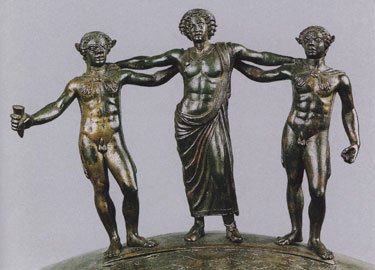
The Ficoroni Cista, Bronze, Late 4th century BC, National Etruscan Museum of Villa Julia, Rome.
Maddalena Paggi, Department of Greek and Roman Art, The Metropolitan Museum of Art, October 2004:
Praenestine cistae are sumptuous metal boxes mostly of cylindrical shape. They have a lid, figurative handles, and feet separately manufactured and attached. Cistae are covered with incised decoration on both body and lid. Little studs are placed at equal distance at a third of the cista’s height all around, regardless of the incised decoration. Small metal chains were attached to these studs and probably used to lift the cistae.
As funerary objects, cistae were placed in the tombs of the fourth-century necropolis at Praeneste. This town, located 37 kilometers southeast of Rome in the region of Latius Vetus, was an Etruscan outpost in the seventh century B.C., as the wealth of its princely burials indicates. Excavations conducted at Praeneste in the nineteenth and beginning of the twentieth century were primarily aimed at the recovery of these precious-metal objects. The subsequent demand for cistae and mirrors caused the systematic plundering of the Praenestine necropolis. Cistae acquired value and importance in the antiquities market, which also encouraged the production of forgeries. Four Praenestine cistae, out of a total of 118 specimens so far recovered, are in New York City (three in the Metropolitan Museum and one in the collection of the Pierpont Morgan Library).
Cistae are a very heterogeneous group of objects, but vary in terms of quality, narrative, and size. Artistically, cistae are complex objects in which different techniques and styles coexist: engraved decoration and cast attachments seem to be the result of different technical expertise and traditions. Collaboration of craftsmanship was required for their two-stage manufacturing process: the decoration (casting and engraving) and the assembly.
The most famous cista and the first to be discovered is the Ficoroni presently in the Museum of Villa Giulia in Rome, named after the well-known collector Francesco de’ Ficoroni (1664–1747), who first owned it. Although the cista was found at Praeneste, its dedicatory inscription indicates Rome as the place of production: NOVIOS PLVTIUS MED ROMAI FECID/ DINDIA MACOLNIA FILEAI DEDIT (Novios Plutios made me in Rome/ Dindia Macolnia gave me to her daughter). These objects have often been taken as examples of middle Republican Roman art. However, the Ficoroni inscription remains the only evidence for this theory, while there is ample evidence for a local production at Praeneste.
The high-quality Praenestine cistae often adhere to the classical ideal. The proportions, composition, and style of the figures indeed present close connections and knowledge of Greek motifs and conventions. The engraving of the Ficoroni cista portrays the myth of the Argonauts, the conflict between Pollux and Amicus, in which Pollux is victorious. The engravings on the Ficoroni cista have been viewed as a reproduction of a lost fifth-century painting by Mikon. Difficulties remain, however, in finding precise correspondences between Pausanias’ description of such a painting and the cista.
The function and use of Praenestine cistae are still unresolved questions. We can safely say that they were used as funerary objects to accompany the deceased into the next world. It has also been suggested that they were used as containers for toiletries, like a beauty case. Indeed, some recovered examples contained small objects such as tweezers, make-up boxes, and sponges. The large size of the Ficoroni cista, however, excludes such a function and points toward a more ritualistic use.
01 Jul 2016

35th Berlin Marathon
John McWhorter, in the Atlantic, compares the complexity of several languages.
When a language seems especially telegraphic, usually another factor has come into play: Enough adults learned it at a certain stage in its history that, given the difficulty of learning a new language after childhood, it became a kind of stripped-down “schoolroom†version of itself. Because all languages, are, to some extent, busier than they need to be, this streamlining leaves the language thoroughly complex and nuanced, just lighter on the bric-a-brac that so many languages pant under. Even today, Indonesian is a first language to only one in four of its speakers; the language has been used for many centuries as a lingua franca in a vast region, imposed on speakers of several hundred languages. This means that while other languages can be like overgrown lawns, Indonesian’s grammar has been regularly mowed, such that especially the colloquial forms are tidier. Lots of adult learning over long periods of time is also why, for example, the colloquial forms of Arabic like Egyptian and Moroccan are somewhat less elaborated than Modern Standard Arabic—they were imposed on new people as Islam spread after the seventh century.
In contrast, one cannot help suspecting that not too many adults have been tackling the likes of sÇq’ayÇÆ›aaÉ£wÇaÉ£hasÌ. Kabardian has been left to its own devices, and my, has it hoarded a lot of them. This is, as languages go, normal, even if Kabardian is rather extreme. By contrast, only a few languages have been taken up as vehicles of empire and imposed on millions of unsuspecting and underqualified adults. Long-dominant Mandarin, then, is less “busy†than Cantonese and Taiwanese, which have been imposed on fewer people. English came out the way it did because Vikings, who in the first millennium forged something of an empire of their own in northern and western Europe, imposed themselves on the Old English of the people they invaded and, as it were, mowed it. German, meanwhile, stayed “normal.â€
30 Jun 2016

Alison Green provides for general amusement the story of a millennial who was fired from her internship for writing a proposal for a more flexible dress code.
I spoke with my manager about being allowed some leeway under the dress code and was told this was not possible, despite the other person being allowed to do it. I soon found out that many of the other interns felt the same way, and the ones who asked their managers about it were told the same thing as me. We decided to write a proposal stating why we should be allowed someone leeway under the dress code. We accompanied the proposal with a petition, signed by all of the interns (except for one who declined to sign it) and gave it to our managers to consider. Our proposal requested that we also be allowed to wear running shoes and non leather flats, as well as sandals (not flip-flops though) and other non-dress shoes that would fit under a more business casual dress code. It was mostly about the footwear, but we also incorporated a request that we not have to wear suits and/or blazers in favor of a more casual, but still professional dress code.
The next day, all of us who signed the petition were called into a meeting where we thought our proposal would be discussed. Instead, we were informed that due to our “unprofessional†behavior, we were being let go from our internships. We were told to hand in our ID badges and to gather our things and leave the property ASAP.
We were shocked. The proposal was written professionally like examples I have learned about in school, and our arguments were thought out and well-reasoned. We weren’t even given a chance to discuss it.
Read the Whole Thing.
———————————
Ace is among the older people chuckling over this.
Now as foolish as the girl was this is really a failure of her educators and parents. She was only repeating what she had been trained to do and rewarded for all during her snowflake education. She truly did not see that she had no standing to complain and that her narcissistic activism would be disapproved of so strongly. And from her letter in the article it doesn’t appear that she has learned very much from the experience either.
But of course young people have always been a bit self-focused and prone to do all the stupid, foolish things that young people are wont to do though the exact menu of which stupid, idiotic things are chosen from varies from generation to generation. So I’m not surprised that there was a person like the letter-writer making a fuss over the dress code the way she did. Usually people like this just get severely embarrassed or let go and all the other newbies have a smirk at their foolishness and also learn a lesson from the example.
But what stands out here to me is that all but one of the interns signed the petition. Which means that all the signers ran the petition-signing scenario through their future-world consequence prediction machine and decided that yes – this will work out great! This common high level of unfounded self-esteem mixed with a complete unfamiliarity with how the real world actually works may be a unique trait of young millennials that is over and beyond all the traditional youthful stupidities.
30 Jun 2016

I grew up in a different portion of Appalachia and am of a different (Roman Catholic – Lithuanian) ethnic background, but I shared J.D. Vance’s experience, a generation earlier, of attending an elite Ivy League school as a blue-collar background outsider. Our town’s last coal mine closed in 1954, and my father had to bribe his way into the Steamfitters’ union, so that he could work all week four hours from home, and then return on weekends. The summer after my high school graduation, before entering Yale, I was working on the same kind of construction projects, installing new bathrooms in Scarsdale’s Taj Mahal High School. I can recall sitting on a box, during lunch, reading the Scarsdale High School Yearbook, and counting twelve graduates of that year who would be my classmates. Nobody in the entire history of Shenandoah, Pennsylvania, before me, had ever gone to Yale.
I am currently reading J.D. Vance’s Hillbilly Elegy, with which I have strong, natural sympathies.
Yale planted a seed of doubt in my mind about whether I belonged. This place was so beyond the pale for what I expected of myself. I knew zero Ivy League graduates back home; I was the first person in my nuclear family to go to college and the first person in my extended family to attend a professional school. When I arrived in August 2010, Yale had educated two of the three most recent Supreme Court justices and two of the most six recent presidents, not to mention the sitting secretary of state (Hillary Clinton). There was some- thing bizarre about Yale’s social rituals: the cocktail receptions and banquets that served as both professional networking and personal matchmaking events. I lived among newly christened members of what folks back home pejoratively call the “elites,†and by every outward appearance, I was one of them: I am a tall, white, straight male. I have never felt out of place in my entire life. But I did at Yale.
Part of it has to do with social class. A student survey found that over 95 percent of Yale Law’s students qualified as upper-middle-class or higher, and most of them qualified as outright wealthy. Obviously, I was neither upper-middle-class nor wealthy. Very few people at Yale Law School are like me. They may look like me, but for all of the Ivy League’s obsession with diversity, virtually everyone—black, white, Jewish, Muslim, whatever— comes from intact families who never worry about money. Early during my first year, after a late night of drinking with my classmates, we all decided to stop at a New Haven chicken joint. Our large group left an awful mess: dirty plates, chicken bones, ranch dressing and soda splattered on the tables, and so on. I couldn’t imagine leaving it all for some poor guy to clean up, so I stayed behind. Of a dozen classmates, only one person helped me: my buddy Jamil, who also came from a poorer background. Afterward, I told Jamil that we were probably the only people in the school who’d ever had to clean up someone else’s mess. He just nodded his head in silent agreement.
/div>

Feeds
|






