Archive for March, 2017
08 Mar 2017


The Telegraph has a humor item from one of the more advanced educational Gulags across the pond.
A student union has banned a university Conservative society from using its social media accounts – because they challenged its position on free speech.
Lincoln University’s Conservative Society has been censored by its student union after it posted an image online showing that the university had been ranked “very intolerant†on free speech in a recent survey.
In response, the Students’ Union swiftly suspended the society’s social media accounts, on the grounds that highlighting the university’s ranking had brought it into disrepute.
However, the decision has been met with widespread derision from social media users and Lincoln MP Karl McCartney, who said that union officials should be “ashamedâ€.
“This intolerant, illiberal and totalitarian response is akin to something out of the Soviet Union or North Korea rather than a place for learning and debate,†he said.
Read the whole thing.
07 Mar 2017

Civilian spectators watched the bombardment of Fort Sumter from the Battery. (click on image to see larger version)
Richard Stirner and the American Scholar would be among the first to condemn as treason and deplore the 1860 attempt of Southern States to gain their Independence, but if California seceded because of Trump, well, that’s a horse of a different color.
If secessionist Californians get a referendum on California nationhood, and if the referendum gives the secessionists the results they are looking for, what happens then? Given the antipathy of a segment of Trump voters to all things Hollywood and by extension all things California, the political calculations in the White House are hard to predict. Other elected leaders and candidates for office, in California and throughout the nation, would certainly ponder the matter. If anyone were to cite Texas v. White, secessionists could counter with a simple question: If the current union, which created the Supreme Court, is now scrapped the way its predecessor union was, how can this court decision be binding? The state attorney general might well be asked to examine legal aspects of that and other questions, including the time-honored right of revolution that Jefferson proclaimed in the Declaration of Independence.
Others might formulate a plan for continued association between California and the United States. Bilateral agreements might well be proposed that would let the U.S. departments of Defense and Homeland Security go on using their existing California bases and facilities via lease. Other agreements might permit the continued collaboration of other federal entities and their California equivalents. An agreement to transfer the assets and liabilities of the existing Federal Reserve Bank of San Francisco to a new Bank of California might be feasible since that bank, like all the other banks within the Federal Reserve System, is owned by the member banks in its district—owned via stock shares.
Who can say what would happen after that? It’s unthinkable that the attempt at separation could be supported by threats of force, but then we are now thinking about so many other things that would have seemed unthinkable only months ago. Would the shock value of the possibility of secession revolutionize our two-party system and lead, perhaps, to a consensus on a package of proposed constitutional amendments that might ease the crisis and pull the nation back from the brink? If a California secession referendum should succeed in 2019, the immediate effects on the presidential and congressional elections of 2020 are stunning to envision, if only as a lurid conjecture. But such a conjecture might just become reality.
07 Mar 2017

William Deresiewicz is a big squishy liberal, who thinks racism (after 50+ years of constant indoctrination, social engineering, and federal scrutiny of American hearts and minds) is still a terrible major problem, but even he is appalled at the Speech & Thought Control PC regime that has taken power at every elite college and university.
Selective private colleges have become religious schools. The religion in question is not Methodism or Catholicism but an extreme version of the belief system of the liberal elite: the liberal professional, managerial, and creative classes, which provide a large majority of students enrolled at such places and an even larger majority of faculty and administrators who work at them. To attend those institutions is to be socialized, and not infrequently, indoctrinated into that religion. ..
Elite private colleges are ideologically homogeneous because they are socially homogeneous, or close to it. Their student populations largely come from the liberal upper and upper-middle classes, multiracial but predominantly white, with an admixture of students from poor communities of color—two demographics with broadly similar political beliefs, as evidenced by the fact that they together constitute a large proportion of the Democratic Party base. As for faculty and managerial staff, they are even more homogenous than their students, both in their social origins and in their present milieu, which tends to be composed exclusively of other liberal professionals—if not, indeed, of other liberal academics. Unlike the campus protesters of the 1960s, today’s student activists are not expressing countercultural views. They are expressing the exact views of the culture in which they find themselves (a reason that administrators prove so ready to accede to their demands). If you want to find the counterculture on today’s elite college campuses, you need to look for the conservative students.
Which brings us to another thing that comes with dogma: heresy. Heresy means those beliefs that undermine the orthodox consensus, so it must be eradicated: by education, by reeducation—if necessary, by censorship. It makes a perfect, dreary sense that there are speech codes, or the desire for speech codes, at selective private colleges. …
[P]olitical correctness is not about justice or creating a safe environment; it is about power. And so much of what is taking place at colleges today reflects the way that relations of power have been reconfigured in contemporary higher education. Campus activists are taking advantage of the fact (and I suspect that a lot of them understand this intuitively, if not explicitly) that students have a lot more power than they used to. The change is the result not only of the rise of the customer-service mentality in academia, but also of the proletarianization of the faculty. Students have risen; instructors have fallen. Where once administrations worked in alliance with the faculty, were indeed largely composed of faculty, now they work against the faculty in alliance with students, a separate managerial stratum more interested in the satisfaction of its customers than the well-being of its employees. …
The power of political correctness is wielded not only against the faculty, however, but also against other groups within the student body, ones who don’t belong to the ideologically privileged demographics or espouse the approved points of view: conservative students; religious students, particularly Christians; students who identify as Zionists, a category that includes a lot of Jewish students; “athletes,†meaning white male athletes; white students from red states; heterosexual cisgendered white men from anywhere at all, who represent, depending on the school, between a fifth and a third of all students. (I say this, by the way, as an atheist, a democratic socialist, a native northeasterner, a person who believes that colleges should not have sports teams in the first place—and in case it isn’t obvious by now, a card-carrying member of the liberal elite.) I haven’t heard too many people talk about creating safe spaces for Christians, or preventing micro-aggressions against conservatives, or banning hate speech against athletes, or disinviting socialists.
What I have heard, frequently, for as long as I have been involved in academia, are open expressions of contempt or prejudice or hostility against those suspect groups or members of those groups. If you are a white man, you are routinely regarded as guilty until proven innocent, the worst possible construction is put upon your words, and anything you say on a sensitive issue is received with suspicion at best. I attended a workshop on micro-aggressions at the University of Missouri last year. The problem with micro-aggressions, the leader said, is that they “create a space of hostility,†that they say, “you don’t belong; you are different in a way that’s not okay.†Those formulations precisely describe the environment that the groups I just enumerated often encounter at elite private colleges, except that unlike the typical micro-aggression, the offense is not inadvertent. It is quite deliberate.
Read the whole thing.
06 Mar 2017

Described as a “Letter to a Solder Written by an 8-Year-Old.” I don’t know that I believe that it’s authentic, but I figured I had to put it up because Gerard van der Leun would like it.
From Henry Bernatonis.
06 Mar 2017

Except they do, and lots of other things, too! Go, Eagles.
3:38 video
06 Mar 2017

Cory Bennett explains that the Deep State could easily have have initiated surveillance on its own with no explicit permission from the White House. This would, of course, in no way preclude the use of the fruits of such surveillance by persons affiliated with Barack Obama against the Trump Administration and Trump appointees.
[T]here are still many ways in which information from Trump Tower phone calls could end up in the hands of intelligence agents or law enforcement officials — even without any knowledge on Obama’s part.
First, they may have come upon Trump Tower phone calls if a targeted foreign agent was on the other end of the line — this method comes from the Foreign Intelligence Surveillance Court, or FISA court. Or Trump Tower digital chatter might have shown up while authorities dug through the vast quantities of data hoovered up via more sweeping foreign surveillance programs.
Second, the FBI could also have asked for a so-called “pen register†or “trap and trace device,†which record only the parties involved in a phone call. These requests have a lower bar for approval.
While it’s unknown whether any of these scenarios occurred, it’s “very likely that the people in the Obama administration had access to the communication of senior Trump officials in the run-up to the election, because they have very, very broad authority,†said Cindy Cohn, executive director of the Electronic Frontier Foundation, which has advocated for revising surveillance laws.
And given the ongoing FBI-led investigation into potential ties between Trump’s associates and Russian officials, it’s plausible that law enforcement officials and intelligence agencies had an interest in — or simply came across — the communications in Trump Tower, specialists said. The government is also investigating an alleged Russian plot to use cyberattacks and disinformation to help Trump win.
According to news reports, the FBI last summer went to the FISA court — which approves clandestine spying efforts — asking for warrants to monitor four members of Trump’s team suspected of having improper exchanges with Russian officials. After being rebuffed, officials reportedly narrowed their request and got approval in October to monitor a computer server in Trump Tower to establish whether there were ties to Russian banks.
But such surveillance would be vastly different than the type of direct wiretapping Trump raised in his tweetstorm Saturday morning.
Nojeim explained that government investigators have two routes to obtaining a wiretap in the U.S. — one for criminal probes, one for intelligence gathering.
On the criminal side, the government must present a judge with probable cause that a wiretap-eligible offense has occurred — or is occurring — and that a wiretap will uncover the necessary evidence. Wiretap-eligible offenses are numerous, and they run the gamut from bribing witnesses to more opaque ones like “fraud by wire.â€
The other route is through the FISA court, where the hurdles are trickier, specialists said, because the spying programs it oversees focus on foreign targets.
Officials must present the FISA court judge with probable cause that the person being wiretapped is an agent of a foreign power, like a spy, or an agent of a foreign terrorist organization. The government must also show that the phone line, email account or computer server in question is going to be used by that foreign target. If that target is an American citizen, the attorney general also has to OK the spying.
“There is a significant hurdle to wiretapping a person in the United States under either of these authorities,†Nojeim said.
Indeed, senior U.S. officials with knowledge of the government’s investigation into Russia’s alleged digital meddling with the U.S. election told The Washington Post there had been no wiretap of Trump.
But surveillance experts — and especially surveillance critics — were quick to note the myriad other routes officials have to get at the banter inside Trump Tower.
Through routine data collection programs authorized under Section 702 of the Foreign Intelligence Surveillance Act, the government gathers information from the internet backbone, which carries web browsing histories and a rapidly increasing amount of telephone traffic.
The government discards information that is plainly domestic and searches through the rest using only specific selectors — a phone number or email address, for instance. But Americans’ information that is incidentally collected and determined to contain some foreign intelligence value is fair game for review.
Cohn said such data on Americans could include communications that are to, from or about foreign targets the FISA court has already approved for surveillance. For example, if two Trump campaign officials were talking via email about a Moscow official under surveillance, that conversation might get flagged as relevant.
Trump’s anger over the potential surveillance of him and his campaign is only likely to increase people’s awareness of these programs, some of which are up for reauthorization at the end of 2017.
The White House reportedly supports a “clean†reauthorization with no revisions. But the heightened attention to the topic has already been used in Capitol Hill hearings to argue for an overhaul of the laws.
“I think that even if [Trump is] not exactly right about what happened here, the fact that he could tweet this … and we can’t tell exactly what happened, means that we need to have an honest conversation in this country about these authorities,†Cohn said.
06 Mar 2017

Andrew McCarthy explains why Obama’s spokeman’s lawyerly denials are far from conclusive proof of innocence.
[R]eporting indicates that, prior to June 2016, the Obama Justice Department and FBI considered a criminal investigation of Trump associates, and perhaps Trump himself, based on concerns about connections to Russian financial institutions. Preliminary poking around indicated that there was nothing criminal involved. Rather than shut the case down, though, the Obama Justice Department converted it into a national-security investigation under the Foreign Intelligence Surveillance Act (FISA). FISA allows the government, if it gets court permission, to conduct electronic surveillance (which could include wiretapping, monitoring of e-mail, and the like) against those it alleges are “agents of a foreign power.†FISA applications and the evidence garnered from them are classified – i.e., we would not know about any of this unless someone had leaked classified information to the media, a felony.
In June, the Obama Justice Department submitted an application that apparently “named†Trump in addition to some of his associates. As I have stressed, it is unclear whether “named†in this context indicates that Trump himself was cited as a person the Justice Department was alleging was a Russian agent whom it wanted to surveil. It could instead mean that Trump’s name was merely mentioned in an application that sought to conduct surveillance on other alleged Russian agents. President Trump’s tweets on Saturday claimed that “President Obama . . . tapp[ed] my phones[,]†which makes it more likely that Trump was targeted for surveillance, rather than merely mentioned in the application.
In any event, the FISA court reportedly turned down the Obama Justice Department’s request, which is notable: The FISA court is notoriously solicitous of government requests to conduct national-security surveillance (although, as I’ve noted over the years, the claim by many that it is a rubber-stamp is overblown).
Not taking no for an answer, the Obama Justice Department evidently returned to the FISA court in October 2016, the critical final weeks of the presidential campaign. This time, the Justice Department submitted a narrowly tailored application that did not mention Trump. The court apparently granted it, authorizing surveillance of some Trump associates. It is unknown whether that surveillance is still underway, but the New York Times has identified – again, based on illegal leaks of classified information – at least three of its targets: Paul Manafort (the former Trump campaign chairman who was ousted in August), and two others whose connection to the Trump campaign was loose at best, Manafort’s former political-consulting business partner Roger Stone, and investor Carter Page. The Times report (from mid-January) includes a lot of heavy breathing about potential ties between the Trump campaign and Russia; but it ultimately concedes that the government’s FISA investigation may have nothing to do with Trump, the campaign, or alleged Russian efforts to interfere in the U.S. election by hacking e-mail accounts.
Trump’s tweets on Saturday prompted some interesting “denials†from the Obama camp. These can be summarized in the statement put out by Obama spokesman Kevin Lewis:
A cardinal rule of the Obama Administration was that no White House official ever interfered with any independent investigation led by the Department of Justice. As part of that practice, neither President Obama nor any White House official ever ordered surveillance on any U.S. citizen. Any suggestion otherwise is simply false.
This seems disingenuous on several levels.
First, as Obama officials well know, under the FISA process, it is technically the FISA court that “orders†surveillance. And by statute, it is the Justice Department, not the White House, that represents the government in proceedings before the FISA court. So, the issue is not whether Obama or some member of his White House staff “ordered†surveillance of Trump and his associates. The issues are (a) whether the Obama Justice Department sought such surveillance authorization from the FISA court, and (b) whether, if the Justice Department did that, the White House was aware of or complicit in the decision to do so.
Read the whole thing.
06 Mar 2017
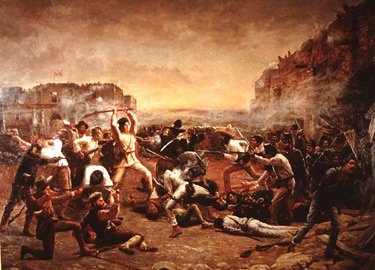
Robert Jenkins Onderdonk, Fall of the Alamo, 1903, Texas State Archives.
March 6, 1836: Following a thirteen-day siege, more than 2000 Mexican troops launched a pre-dawn attack from all four sides on the fortress defended by 180 men. The Mexicans were repulsed twice, but a third assault gained the north wall and broke through the west wall. After fierce fighting, the defenders were killed to a man. The casualties included Colonel William Barret Travis, James Bowie, and former Congressman from Tennessee David Crockett.
05 Mar 2017

Louis Comfort Tiffany, Favrile Vase
At DuMouchelles’ March 11 Sale, Lot 031010
L.C. TIFFANY FAVRILE VASE, H 9″, W 5 1/4″:Paperweight. Iridescent finish. Marked underneath ‘1616 L; L.C. Tiffany –
Favrile’.
Wikipedia:
Favrile glass is a type of iridescent art glass designed by Louis Comfort Tiffany. It was patented in 1894 and first produced in 1896. It differs from most iridescent glasses because the color is ingrained in the glass itself, as well as having distinctive coloring. Favrile glass was used in Tiffany’s stained-glass windows.
Already at $3500.00
05 Mar 2017

You’re really ready for trouble when you have holstered an attack dog!
/div>

Feeds
|





