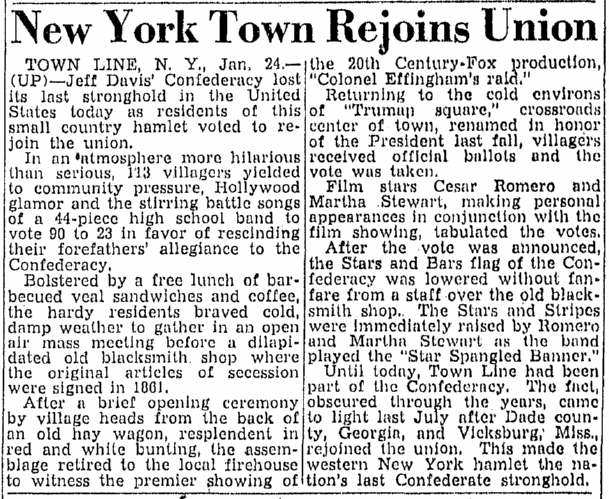
Knowledge Nuts informs us that Lee and Johnson may have surrendered in 1865, but the last Confederate stronghold, Town Line, New York, which seceded and joined the Confederacy in 1861, held out without rejoining the Union until 1946.
Unusually for a town so near the Canadian border, Town Line, New York voted to secede from the Union in 1861 and join the Confederacy. While the circumstances surrounding the treasonous act is shrouded in urban legend, the secession—ignored by the Union government—remains a curious aberration. Town Line was the only Northern town to turn rebel during the Civil War, and didn’t rejoin the US until 1946, making it the last stronghold of the Confederacy.
Town Line in Erie County, New York is only a few miles from the Canadian border. Go to the local fire station and until recently, you might have seen the personnel wearing shoulder patches reading “Last of the Rebels 1861–1946.†During Civil War celebrations, townsfolk display the Confederate flag and wear the Confederate gray. Any visitor would be baffled. It is well-known that the loyalty of towns farther south, near the Mason-Dixon Line, wavered along the divide between North and South during the war. But in upstate New York a few minutes from Canada? In a town populated in the 1860s by first- and second-generation German immigrants with no kinship ties to the South?
Nobody really knows the reason why, in late 1861, the men of Town Line gathered in a schoolhouse and voted 85–40 (or by some accounts 80–45) to leave the Union and join the Confederacy. They clearly supported Abraham Lincoln in the previous election. Among other provocations, perhaps the most likely was President Lincoln’s call for 75,000 men, to which the German farming community refused to comply.
The secession was largely symbolic, as the government did not recognize it. It never sent troops in to compel the town to return to the US, the Post Office continued its business and taxes were still duly paid. That didn’t mean, though, that the entire thing was a sham. There were real rebels in the town, and a few even left to actually enlist in the Confederate army. On the other hand, some of the men also fought for the Union. By 1864, as the tide of war turned against the South, the town’s secessionists were being harassed, forcing some to flee to Canada.
Things settled back to normal at the end of the war. The secession was conveniently forgotten until 1945. In a wave of patriotism accompanying American victory in World War II, residents realized that they were technically not part of the US. Returning veterans were chagrined and infuriated that they were not American. A special committee wrote to President Harry Truman about the situation. Truman responded good-naturedly, “Why don’t you run down the fattest calf in Erie County, barbecue it and serve it with fixins, and sort out your problems.â€
The matter was once again put to the vote. Incredibly, the first vote held on December 1945 still failed to secure unity. The town had by now become national news, and the next attempt at reunion was attended by celebrities like movie actor Cesar “the Joker†Romero. Finally, on January 26, 1946, Town Line officially voted to be readmitted into the Union. (Still, 23 rebels decided against the measure—truly the town’s last Confederates.) The rebel flag that had flown for 85 years was hauled down, and the residents took the oath of allegiance.
Avon [Connecticut] residents called police after a bear tried to get into a home this weekend and one neighbor got the whole incident on camera.
Neighbors talking to 911 dispatch stated that the bear was trying to gain access into a home on Stagecoach Road.
“My neighbor across the street just came over in a panic. She’s a little old lady, screaming that a bear got on the back porch and is slamming on her glass door,” one call to 911 stated.
Members of Department of Energy and Environmental Protection were not called to the scene. They said a bear “spent considerable time on a deck and was reluctant to leave.” This incident was especially terrifying for the female homeowner who was baked brownies as the bear pressed up against her glass door.
“We have a bear attempting to get into a house and he’s not afraid of noise, screaming or yelling or pounding,” Avon resident Bob Belfiore said when he called 911.
DEEP said a neighbor, who was later identified as Belfiore, rushed to help his neighbor get the bear to go away. The animal made its way onto the deck’s railing before standing up and peering in.
“Though it looks cute on the railing, this bear was angry about not being able to get at the food,” Belfiore said.
At one point, the bear was able to open up the screen door, but thankfully couldn’t manage to open the glass slider. Belfiore told Eyewitness News this bear was persistent.
“He actually left the kitchen area and went to a second set of doors off the deck,” Belfiore said. “And I tried those and then went to a third set of doors into the living room and attempted to get into those.”
Avon police did head up to the house after getting the 911 calls, but the bear had already left the area. There were no reported injuries.
“It was a rather harrowing experience although it looks cute in the photos,” Belfiore said.
In 1949, Sir Samuel Fildes’ painting “The Doctor†(1891) was used by the American Medical Association in a campaign against a proposal for nationalized medical care put forth by President Harry S. Truman. The image was used in posters and brochures along with the slogan, “Keep Politics Out of this Picture.†65,000 posters of The Doctor were distributed, which helped to raise public skepticism of the nationalized health care campaign. By 2008,
unfortunately, the AMA was controlled by the Left and fighting for doctors’ and patients’ rights to private health care was no longer part of its agenda.
Kevin Williamson debunks the “Health Care is a right!” rhetoric.
With the American Health Care Act dominating the week’s news, one conversation has been unavoidable: Someone — someone who pays attention to public policy — will suggest that we pursue policy x, y, or z, and someone else — someone who pays a little less careful attention, who probably watches a lot of cable-television entertainment masquerading as news — responds: “The first thing we have to do is acknowledge that health care is a human right!†What follows is a moment during which the second speaker visibly luxuriates in his display of empathy and virtue, which is, of course, the point of the exercise. …
Here is a thought experiment: You have four children and three apples. You would like for everyone to have his own apple. You go to Congress, and you successfully persuade the House and the Senate to endorse a joint resolution declaring that everyone has a right to an apple of his own. A ticker-tape parade is held in your honor, and you share your story with Oprah, after which you are invited to address the United Nations, which passes the International Convention on the Rights of These Four Kids in Particular to an Individual Apple Each. You are visited by the souls of Mohandas Gandhi and Mother Teresa, who beam down approvingly from a joint Hindu-Catholic cloud in Heaven. Question: How many apples do you have? You have three apples, dummy. Three. You have four children. Each of those children has a congressionally endorsed, U.N.-approved, saint-ratified right to an apple of his own. But here’s the thing: You have three apples and four children. Nothing has changed. Declaring a right in a scarce good is meaningless. It is a rhetorical gesture without any application to the events and conundrums of the real world. If the Dalai Lama were to lead 10,000 bodhisattvas in meditation, and the subject of that meditation was the human right to health care, it would do less good for the cause of actually providing people with health care than the lowliest temp at Merck does before his second cup of coffee on any given Tuesday morning. Health care is physical, not metaphysical. It consists of goods, such as penicillin and heart stents, and services, such as oncological attention and radiological expertise. Even if we entirely eliminated money from the equation, conscripting doctors into service and nationalizing the pharmaceutical factories, the basic economic question would remain. We tend to retreat into cheap moralizing when the economic realities become uncomfortable for us. No matter the health-care model you choose — British-style public monopoly, Swiss-style subsidized insurance, pure market capitalism — you end up with rationing: Markets ration through prices, bureaucracies ration through politics.
Claiming that you have a “Right to Health Care” usually amounts to the assertion that you have a right to force somebody else to pay for goods and services for your benefit, in essence a claim that you have a right to enslave other people.
———————————
Avik Roy puts it a different way. Avik argues that our right to health care consists of our right to obtain health services through voluntary interactions with health care providers, and Government is taking away that right.
For those enrolled in government-run health insurance, it is illegal to try to gain better access to doctors and dentists by offering to make up the difference between what health care costs, and what the government pays.
That basic right—the right of a woman and her doctor to freely exchange money for a needed medical service—is one that 90 million Americans have been denied by their government. …
You see, health care is a right, in the same way that liberty is a right. And that liberty—to freely seek the care we need, to pay for it in a way that is mutually convenient for us and our doctors, is one that our government is gradually taking out of our hands.
Andrew Kay explains that applying for an academic position and on-line dating in the 21st century dehumanize the pursuer in very similar ways.
I minimized OkCupid and returned to my cover letter. I felt afresh the silliness of the undertaking: to make an earnest bid for any job in which you’re one of perhaps three hundred highly qualified applicants, in a field where twenty such jobs might come along in a given year, requires a degree of moxie bordering on self-delusion. Both the academic job market and online dating, I was coming to realize, involve their participants in economies of excess, superabundance. You enter each world laden with the knowledge that you are one agent in a vast and hyper-competitive ecosystem surging with rivals; that, having captured the curiosity of a person or institution of your desiring, you’re but one of a dozen prospects they are likely entertaining alongside you. Make a false move—or simply come off as average—and risk being swept aside.
Like the OkCupid profile, the academic job letter reduces the multi-chromatic splendor of a self to a single beige that it shares with everyone else. Here are inner worlds—rococo architectures fashioned over years of contemplation—broken down into a short opening paragraph wherein you introduce yourself, indicating your home institution and the title of your dissertation, as well as the job you seek (MY SELF SUMMARY and WHAT I’M LOOKING FOR); two paragraphs in which you sum up your dissertation, articles and research interests (WHAT I’M DOING WITH MY LIFE and I SPEND A LOT OF TIME THINKING ABOUT); a couple of paragraphs in which you dramatize your strengths as a teacher and convey the myriad things you offer in the way of department service (I’M REALLY GOOD AT); a closing paragraph in which you say, in effect, “I’d love an interview; if you’re interested, here’s how to contact me†(YOU SHOULD MESSAGE ME IF).
Somehow, within the confines of this form, I had to capture hiring committees’ attention. This meant gussying up the raw material of my scholarship in language that was sexy, piquant, certain to leave them wanting more. English academics, I should explain, occupy a peculiar relation to their ideas and the language in which these are housed. Many display an erotic responsiveness to the terms trending in their field: the aptly chosen theoretical catchword, or charismatic articulation of a (preferably anarchic) thought. (I once asked a colleague whether she and her partner spent much time talking about their research together. “That’s called foreplay, Andrew,†she responded.)
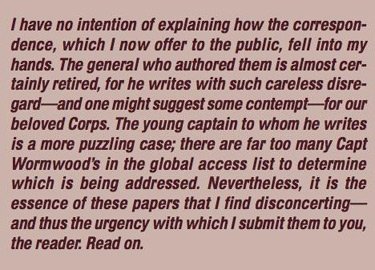
Fabius Maximus, with permission from the Marine Corps Gazette, published seven Attrionist Letters to a particular Captain Wormwood from General Screwtape discussing recently successful modifications of military doctrine.
It was an unremarkable Roman cemetery, containing the bodies of ordinary people. They lived and died on the banks of the Thames, making a living in the poorer and dirtier districts of Roman Londinium.
When an analysis of the skeletons came through, no one expected a result that could change our view of the history of Europe and Asia. But that is what they seem to have found, because two of the skeletons, dated to between the 2nd and 4th century AD, were Chinese.
Here at the most westerly point of the known world, in the cultural backwater of ancient Britain, lived people who came from its easternmost extremity. How did they get there?
To the Romans, the Chinese were a mysterious civilisation: technologically advanced, disquietingly powerful, and purveyors of, according to Seneca, obscene garments that corrupted the empire’s womanhood. To the Chinese, the Romans were a moderately intriguing civilisation with, according to one account, weak and pliant rulers.
It would be 1,000 years before the travels of Marco Polo would help properly to bring the culture of the east to the people of the west. Now, though, that history has to be revised.
After the excavation of a cemetery in Southwark, new skull analysis techniques identified a multicultural community containing four people who were ethnically African and two Asian, probably Chinese.
The find is spectacular but it is also mysterious, according to Rebecca Redfern from the Museum of London. She has no idea how they had ended up lying in this cemetery, so far from home.
Several British news outlets today ran a story with headlines about Chinese people in Roman Britain. While there is no doubt that the Roman Empire was cosmopolitan, and it is entirely likely that people of East Asian ancestry will be found in all parts of the Empire, we need to take a step back from the hype and look at the data.
The new study in question is by Rebecca Redfern and colleagues, out in the October issue of the Journal of Archaeological Science. The researchers looked at 22 skeletons from the Lant Street cemetery in the London borough of Southwark, dating to the 2nd-4th century AD. In order to figure out where people might be from, they examined oxygen isotopes from the teeth, carbon and nitrogen isotopes from the bones, and the shape of the skull, correlating those data where possible with burial evidence.
The data that Redfern and colleagues produced are really quite interesting. The oxygen isotope values, which were isolated from 19 of these people, range widely — too much to be explained by local variation in water sources. This means that many of them came to London from elsewhere, some time after childhood. Far fewer of the individuals produced good data for carbon and nitrogen analysis of diet — just half of the sample was testable, and those data reveal a diet similar to what was eaten in selected other parts of the Empire. (They did not compare the data to Rome itself, for example, only to Portus Romae, south-coastal Velia, and Herculaneum in Italy and to Leptiminus in Tunisia.)
But the new method that Redfern and colleagues use to figure out ancestry is not ancient DNA analysis, but a statistical modeling of variations in the skulls and teeth that could be linked to ancestral differences. In short, they employ a method similar to what forensic anthropologists use to figure out if an unknown skeleton is of Asian, African or European ancestry.
The shortcomings of this method, however, are considerable and are outlined by Redfern and colleagues in their article. For example:
The fact that many of the samples were fragmented means that 41% of the sample had only two traits to score. As the researchers write, “This degree of missing data can affect classification accuracies, particularly among the sample having two or less (sic) traits.”
“We recognise that this is a subjective approach… and that many of the individuals used to generate these methods derive from modern populations outside of the territories that formed the Roman Empire. […] The population affiliation divisions used here may disguise or fail to find many affiliations because they are subjective, and morphology varies between individuals and over time,” they further note. This is problematic because bioarchaeologists cannot be sure how much the skull and tooth shapes have changed over 2,000 years. Comparing an ancient population with a modern one may not yield accurate results. (For example, when I put metric data from skeletons from Rome into FORDISC, a software program that compares metric data from skulls, the program happily classifies them into Asian samples.)
“The method development was particularly lacking in north African and southern Mediterranean populations, whose DNA shows a greater degree of genetic diversity compared to sub-Saharan and more northern ones. Therefore, the results must be understood in their temporal and spatial context, and the biases introduced by the methods acknowledged.” With few comparative samples from contemporary Africa and the southern Mediterranean, which are much more likely to be the origin of Roman Britons than is Asia, this means there may be bias introduced into the interpretation of the skull and tooth shapes.
This article is a remarkable attempt to correlate three different isotopes and skeletal morphology to answer questions about the diversity of Roman Britain in the later Empire, and it succeeds in showcasing that diversity even in this small sample. But it does not show, as the tabloids have been crowing, that there were Chinese in Roman London. The statistical results are intriguing, but the oxygen data from the two so-called Asians seem to be within the range of others in the sample, and only one produced dietary isotope data. For a slam-dunk, they need DNA. If and when they produce this, though, establishing a solid correlation between DNA from the Roman era and the results of the statistical method on the Roman skulls and teeth has the potential to help other bioarchaeologists assess ancestry without doing expensive destructive analysis.
Rock Island Auction, May 6, 2017, Lot 2124, Exceptionally Rare and Magnificent, Documented Silver-Banded, Factory Cased Colt No. 5 Squareback Model Texas Paterson Percussion Revolver.
Estimated price: $350,000 – $475,000 — Sold for $500,000.
Description: This exceptional revolver is one of approximately 1,000 Texas Paterson revolvers manufactured by Samuel Colt’s Patent Arms Manufacturing Company from 1838-40. The No. 5 Holster Model revolvers were the largest of all the Paterson handguns and achieved fame as a result of their use by Captain Jack Hays and other Rangers on the Texas frontier. In fact, a major purchaser of the No. 5 was the Republic of Texas. Samuel Walker was familiar with the No. 5 during his days as a Texas Ranger and used the revolver to great effect. His experience with the Paterson persuaded him to advocate for a larger, quicker loading revolver powerful enough to kill either a man or horse with a single shot. His discussions with Samuel Colt led to the Colt Walker Model revolver in 1847. What followed next was a rapid evolution in revolver design spearhead by Colt who introduced the Dragoon series of revolvers that were based on the Walker design. Samuel Walker is often credited for establishing early Colt revolvers as an effective handgun. The Walker and Dragoon revolvers definitely provided Colt with financial relief and fame. This particular No. 5 revolver was once owned by Francis Bannerman. It is illustrated and described in detail on pages 80-83 of “The Art of the Gun: Magnificent Colts Volume I” by Robert M. Lee and R.L. Wilson. The revolver has a high polish blue finish on the barrel, frame, cylinder, and grip strap. The hammer is color casehardened. The five-shot, square back cylinder is roll-engraved with the stagecoach holdup scene. German silver bands are inlaid on the barrel at the muzzle, on the top of the barrel at the breech, on the underside of the barrel lug curves and on the recoil shields. An oval German silver escutcheon is inlaid on the back strap. The barrel has a German silver front sight blade. The two-piece grip is fancy grain walnut with a high polish piano finish. The straight sided barrel has a distinctive double curved lug with no provision for a loading lever. The top of the barrel is roll-stamped “- Patent Arms M’g. Co. Paterson, N.J. – Colt’s Pt. -” reading from the breech to the muzzle with “star & snake†terminals at either end of the legend. The top of the cylinder is marked “COLT” in addition to the roll-engraved stagecoach scene. The serial number “141” is visible on: (1) the rear face of the barrel lug, (2) bottom of the cylinder wedge, (3) bottom of the frame in the trigger well, (4) inside of the trigger, (5) rear face of the cylinder, (6) inside of the hammer and (7) bottom of the left grip heel. All of the visible serial numbers match. The revolver is complete with a mahogany Paterson style case with beveled lid and scalloped German silver escutcheon plate. The case is lined with dark blue velvet with wire clips to retain the accessories. The case contains: (1) spare five-shot, square back cylinder marked “J./201″ on the rear face, (2) brass cleaning rod with turned wooden head, (3) .36 caliber, single cavity, round ball iron bullet mold with three wooden handles, (4) Paterson combination tool with fire blue finish, (5) side-latch brass Colt capper marked “No. 333” on the inside of the body and lid, (6) distinctive Paterson copper and brass combination powder and ball flask numbered “16” on both the upper and lower sections and roll-stamped with the same Patent Arms Co. legend with “star & snake†terminals as the top barrel flat and (7) several .36 caliber lead balls that were originally in the flask.
Condition: Very fine. This revolver remains in exceptionally fine condition, appears to be un-fired and retains 70% of the original high polish blue finish. The blue on the barrel is thin with some cleaning overall, but the metal surfaces are smooth and the edges are crisp. The barrel legend is extremely sharp. The cylinder retains nearly all of the stagecoach scene and has about 90% of the blue finish. The front and rear face of the cylinder and the percussion nipples show no trace of flash pitting or firing wear. The frame and back strap retain more than 90% of the high polish blue finish; the face of the recoil shield, top of the frame and the cylinder pin are in the same excellent condition as the exterior surfaces and show no wear. The hammer has nearly 95% of the original case colors with no flash pitting. The nicely figured walnut grip is in very fine with some scattered finish flaking. The visible serial numbers on all components are sharp. The factory case is fine. The case exterior has a few scattered and minor handling and storage marks, and the interior has some oil stains and compression marks but no serious wear. The spare cylinder has some flash pitting on the percussion nipples and the front and rear face but retains 100% of the stagecoach scene and nearly 80% of the blue finish. The cleaning rod remains very fine. The bullet mold has traces of blue finish on the blocks and sprue cutter while the wooden handles show minimal wear. The excellent combination tool retains 90% of the nitre blue finish. The capper is fine, complete, and original with an attractive, un-polished patina and sharp markings. The rare Paterson combination powder and ball flask is excellent and retains nearly 90% plus original of the bright original gold plated finish with crisp markings and serial numbers. This is a truly exceptional example of the most desirable of all Colt Paterson firearms – the Texas Paterson revolver. The combination of un-fired condition, rare German silver inlays, and factory case with rare accessories make this one of the finest of all Paterson revolvers extant. Provenance: Robert M. Lee Collection.
Is this a member of Indonesia’s lost pygmy tribe? Mysterious small figure is caught on camera scurrying out of the undergrowth in remote area of northern Sumatra.
The person was spotted in Banda Aceh, on the northern tip of Sumatra. He appeared to be half-naked and ran down a dirt track carrying a large stick. After a group of bikers chased him, the man dived into bushes and disappeared.
A mysterious half-naked ‘tribesman’ was seen running down a dirt track in Indonesia by a group of bikers.
The small man was spotted near Banda Aceh, on the northern tip of the island of Sumatra.
Some viewers guessed the man could be a member of the mythical Mante tribe, who are said to be forest dwellers.
A group of bikers were mystified when they came across a half-naked tribesman running down a dirt track in Banda Aceh, Indonesia
The motorcyclists were travelling down the track when they saw the bald man leap out of the trees.
The footage shows one of the bikers falling on the ground as the mystery figure runs away from the group.
One of the bikers continues down the track in pursuit of the skittish man, who jumps into the bushes by the side of the road.
The group stop at the spot where the man disappeared and look for him in the bushes.
A biker, who has a camera fitted to its helmet, chases the mystery figure down the path. The figure appears to be naked and is carrying a large stick
The grass is so high that they can no longer see the figure as he slipped into the trees behind.
A couple of the motorcyclists venture into the bushes to try and see where the ‘tribesman’ went and find the large stick he was carrying.
Some viewers think that the mysterious man is a member of a lost pygmy tribe in Indonesia.
The mythical Mante tribe are said to be smaller than the average man and flee when they see people from the outside world.
The only record of the supposed tribe was in the 17th century, when it was claimed two Mante tribesmen were captured and presented to the Sultan.
But most people think the Mante people are simply legend.
New healthcare proposals would result in bridge and command crew keeping access to Medbay, but security personnel being forced to make their own provision.
Members of Starship crew who are ‘statistically most likely’ to be shot, stabbed or sprayed by hypnotic plants will have to supply their own cover for treatment of alien parasites in their skulls after Starfleet brought in new healthcare directives yesterday.
Crewmembers who spend their time being beamed to hostile planets have been told that being sent on an away mission into the unknown terrors of a hostile and uncaring universe is being reclassified as a ‘pre-existing condition’, meaning they will not be entitled to Medbay treatment should the entirely predictable happen.
A stopped clock is right two times a day, and once in a blue moon Andrew Sullivan is still capable of writing a very intelligent essay. Here is Andrew explaining why the Populist Nationalist Right has arisen as a political force capable of asserting its own will, and why its issues and perspectives deserve serious consideration.
The pendulum is always swinging. Sometimes it swings back with unusual speed and power.
You can almost feel the g-force today. What are this generation’s reactionaries reacting to? They’re reacting, as they have always done, to modernity. But their current reaction is proportional to the bewildering pace of change in the world today. They are responding, at some deep, visceral level, to the sense that they are no longer in control of their own lives. They see the relentless tides of globalization, free trade, multiculturalism, and mass immigration eroding their sense of national identity. They believe that the profound shifts in the global economy reward highly educated, multicultural enclaves and punish more racially and culturally homogeneous working-class populations. And they rebel against the entrenched power of elites who, in their view, reflexively sustain all of the above.
I know why many want to dismiss all of this as mere hate, as some of it certainly is. I also recognize that engaging with the ideas of this movement is a tricky exercise in our current political climate. Among many liberals, there is an understandable impulse to raise the drawbridge, to deny certain ideas access to respectable conversation, to prevent certain concepts from being “normalized.†But the normalization has already occurred — thanks, largely, to voters across the West — and willfully blinding ourselves to the most potent political movement of the moment will not make it go away. Indeed, the more I read today’s more serious reactionary writers, the more I’m convinced they are much more in tune with the current global mood than today’s conservatives, liberals, and progressives. I find myself repelled by many of their themes — and yet, at the same time, drawn in by their unmistakable relevance. I’m even tempted, at times, to share George Orwell’s view of the neo-reactionaries of his age: that, although they can sometimes spew dangerous nonsense, they’re smarter and more influential than we tend to think, and that “up to a point, they are right.â€
From Saturday Night Live: Three scientists (Scarlett Johansson, Kyle Mooney, Mikey Day) receive a shock when they debut their invention, a machine that translates for pets.