1938 Phantom Corsair — The Phantom Corsair is a prototype automobile built in 1938. It is a six-passenger 2-door sedan that was designed by Rust Heinz of the H. J. Heinz family and Maurice Schwartz of the Bohman & Schwartz coachbuilding company in Pasadena, California.
Rust Heinz planned to put the Phantom Corsair, which cost approximately $24,000 to produce in 1938 (equivalent to about $370,000 in 2010), into limited production at an estimated selling price of $12,500. However, Heinz’s death in a car accident in July 1939 ended those plans, leaving the prototype Corsair as the only one ever built.
The Phantom Corsair now resides in the National Automobile Museum (also known as The Harrah Collection) in Reno, Nevada.
The automobile was featured as the “Flying Wombat” in the David O. Selznick film The Young in Heart (1938), starring Janet Gaynor, Douglas Fairbanks, Jr., Paulette Goddard, and Billie Burke.
The Corsair was also featured in a segment of the Popular Science film series in 1938.
The car is one of the rare vehicles that is unlockable during free roam in the 2002 video game Mafia: The City of Lost Heaven.
The Corsair is one of the 15 rare drivable vehicles featured in the 2011 video game L.A. Noire.
John Pettie, Bonnie Prince Charlie Entering the Ballroom at Holyroodhouse, 1892, National Museum of Scotland.
“Mo Ghile Mear” (My Gallant Darling) is an Irish song, composed by Seán Clárach Mac Domhnaill (1691–1754) as a lament by the Gaelic goddess Éire for Bonnie Prince Charlie.
BÃmse buan ar buairt gach ló,
Ag caoi go cruaidh ‘s ag tuar na ndeor
Mar scaoileadh uaim an buachaill beo
‘S ná rÃomhtar tuairisc uaidh, mo bhrón
Nà labhrann cuach go suairc ar nóin
Is nÃl guth gadhair i gcoillte cnó,
Ná maidin shamhraidh i gcleanntaibh ceoigh
Ó d’imthigh uaim an buachaill beó.
Marcach uasal uaibhreach óg,
Gas gan gruaim is suairce snódh,
Glac is luaimneach, luath i ngleo
Ag teascadh an tslua ‘s ag tuargain treon.
Seinntear stair ar chlairsigh cheoil
‘s lÃontair táinte cárt ar bord
Le hinntinn ard gan chaim, gan cheó
Chun saoghal is sláinte d’ fhagháil dom leómhan.
For a while I was a gentle maiden
And now a spent worn-out widow
My spouse ploughing the waves strongly
Over the hills and far away.
He is my hero, my dashing darling
He is my Caesar, dashing darling.
I’ve had no rest from forebodings
Since he went far away my darling.
I’m incessantly sorrowing each day,
Lamenting sorely and showing signs of tears
As the lively lad has been separated from me
And no news from him is told, my sadness.
The cuckoo sings not pleasantly at noon
And the sound of hounds is not heard in nut woods,
Nor summer morning in misty glen
Since he went away from me, my lively boy.
Noble, proud young horseman
Warrior unsaddened, of most pleasant countenance
A swift-moving hand, quick in a fight,
Slaying the enemy and smiting the strong.
[M]illenials have been turning to a painful new procedure in jewelry.
Diamond engagement rings are now not just for wearing around a finger, but the diamonds are being embedded IN the ring finger as a new piercing trend is underway, WCBS reported.
A New York City tattoo and body piercing shop owner said he has noticed an increase in customers asking for the procedure.
“We notice lately a lot of people coming looking for that,†Sam Abbas, owner of Ink Studio in the West Village, told WCBS.
He explained that all tools must be sterilized in doing the type of piercing but maintaining the area and keeping it clean are critical for the customer.
“You’re dealing with the blood, so you got to be very, very safe,†he said, explaining that an experienced piercing artist is a must.
The process, as shown in a mock piercing on CBS2’s reporter, Cindy Hsu, involved marking the spot on the finger with a pen and then using rubbing alcohol and iodine to sterilize the area. A small tool is then used to remove a patch of skin where an anchor, made of titanium or gold is inserted. This anchor holds the gem in place.
“I think it looks nice, but if you really think what it’s doing to the body – and you can have scarring – it’s so many complications that can happen from it,†millennial Cynthia Rivas told the news outlet.
The whole procedure runs about $100 but the cost of the diamond is separate.
Abbas admitted the pain associated with the procedure is certainly a factor to consider, but some are surprised it isn’t as bad as expected.
“You’re going to feel it. You’re getting pierced. It is a little bit painful,†he said. But people did it, and I have a lot of people who say, ‘Oh nice, it’s nothing, I expect more.â€
For medical professionals, like Dermatologist Dr. Monica Halem, more serious factors should be considered before making the decision to follow the latest trend.
“First of all, these procedures are not being done by a doctor, and it is a surgical procedure,†she told WCBS. “There are a lot of important structures that sit right under the skin there that can easily be damaged, like tendons.â€
She also pointed to the danger of having the diamond, exposed on the finger, getting snagged.
“That’s sitting right above the skin, that’s easily caught on something and can do a lot of damage,†she said. It was not clear how the wearer can eventually add a wedding band as it is traditionally worn on the same finger.
Another caveat: It can take up to 5 weeks for the site to heal after the procedure. And if that engagement doesn’t quite pan out – or the fad wears off – removing the diamond is apparently more painful than getting it in the first place.
Brett Stevens notes that the birthrate of Europeans (and that of the more elite sectors of the American population) has fallen below replacement and he blames Modernity itself.
Modernity is killing us. As Plato intuited, the problem with bad systems is not solely that they are inept, but that this ineptitude shapes people. It causes people to despair. They then die out, much as Western Europeans are in Europe and North America. Why strive if life is fundamentally empty, miserable, and filled with neurotic worry?
Just as with animals, when we are in a good environment, we thrive; when we are confined, hopeless, cornered, despairing, miserable, or in pain, we will ourselves to death. Western European people worldwide have been living in a state of constant hopelessness since the end of WW1, but our doubt about life itself goes much deeper.
Modernity arose with the French Revolution. Away went the little villages ruled by gentle lords, the customs and culture, and the sense of purpose and faith in life itself that quelled our existential suffering. Before the Revolution, we knew we were doing the right thing if we lived according to our tradition.
After the Revolution, in came bureaucracy. Cities replaced the towns. Mass culture and mass mobilization replaced intelligent leadership. There was constant infighting, from the politics of elections to the churn among companies trying to decide who would control large swathes of the economy.
Our once-intelligent society had become shocking dumb. Not only did the stupid but obedient thrive in the age of managerial control, because every manager loves a low-risk worker even if that worker is not particularly good at anything, but all public opinions had to pander to a crowd with the collective intelligence of the audience for an amusement park.
Spread by social coercion, this stupidity quickly absorbed every institution in the West so that they got dumb together. Government got dumb at the same rate that the church, art scene, schools, professionals, corporations, and non-profits did. We kept pace as we rushed into the abyss.
By the time 1968 came around, ready for the coup de grâce, the West had given up on itself for three generations. They had nothing to believe in because modern life was really not all that much fun. Sure, it was prosperous, but everyone spent their time in mindless unnecessary jobs, maintaining glitchy gadgets, babysitting third world or low caste labor, dealing with government and our crazy fellow citizens, filing paperwork, and otherwise being forced into confronting the tedious, ugly, and faith-crushing every day.
This delighted the Left, who are fundamentally neurotics that are motivated by a desire to destroy everything beautiful, good, and true because they do not detect those things in themselves. Solipsism, it turns out, is a form of neurosis where we mistake ourselves for the source of reality itself, when we are really only mirrors.
Our modern world makes us hate life. We spend way too much time working in jobs that are jails, then must live in ugly cities where most people are neurotic or otherwise low-grade mentally disturbed, and participate in a process of life that is designed to humble, humiliate, bore, and subjugate all of us. No wonder people are not reproducing.
Gory, gory what a helluva way to die,
Gory, gory what a helluva way to diel
Gory, gory what a helluva way to die,
He ain’t gonna jump no more
There was blood upon the risers,
there was brains upon his chute
Intestines were a-dangling
from his paratrooper suit
They poured him from his helmet,
and they poured him form his boots
And he ain’t gonna jump no more.
Gory, gory what a helluva way to die,
Gory, gory what a helluva way to die,
Gory, gory what a helluva way to die,
He ain’t gonna jump no more.
Now the letter they sent home,
to his wife and baby son.
Madam we regret to say,
your troopers life is done.
But hold your head up high,
his name is written in the sky!
He ain’t gonna jump no more!
Gory, gory what a helluva way to die,
Gory, gory what a helluva way to die,
Gory, gory what a helluva way to die,
He ain’t gonna jump no more.
Now the baby son grew up and said,
“A troopers life for me!”
A jumper like my daddy was,
is all I want to be.
I only hope that I can jump
just half as good as he!
He ain’t gonna jump no more!
Gory, gory what a helluva way to die,
Gory, gory what a helluva way to die,
Gory, gory what a helluva way to die,
He ain’t gonna jump no more.
Now they sent him to Afghanistan
and then into Iraq!
The bullet then came speeding up,
and deep into his back.
He hit the ground but his grenade
found enemy on track!
He ain’t gonna jump no more!
Gory, gory what a helluva way to die,
Gory, gory what a helluva way to die,
Gory, gory what a helluva way to die,
He ain’t gonna jump no more.
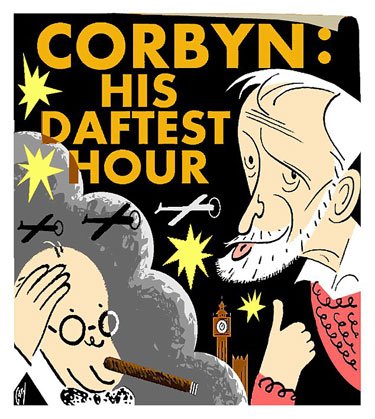
Following Jeremy Corbyn’s recent defense of Mr. Putin in Parliament, Richard Littlejohn cannot help imagining the Labour leader as Prime Minister during the early part of WWII.
In the House of Commons today, the Prime Minister, Mr Corbyn, refused to join the chorus of condemnation which has followed repeated German bombing attacks on British towns and cities.
He said there was no conclusive evidence that Herr Hitler was responsible for the Blitz, which he speculated may well have been carried out by rogue elements in the Luftwaffe with the specific intention of damaging the international reputation of the Nazi regime.
Mr Corbyn insisted it was essential to maintain robust dialogue with Berlin and told MPs he was ordering the War Department to return any unexploded bombs to Berlin for further investigation.
Just because they were dropped from German planes, which took off in Germany, and had ‘Made In Germany’ stamped on them, that was no reason to leap to the conclusion that the German government was involved in any way.
The Americans could well be behind it, he suggested, as an excuse to get involved in another European war.
There would be no official response from Downing Street until the full facts could be established, he insisted. He said those bellicose Conservatives who wanted to fight the Germans on the beaches, on the landing grounds, in the fields, the streets and the hills, were guilty of reckless provocation against one of our leading European partners.
Britain’s earlier decision to send 300,000 heavily armed soldiers to occupy the pleasure beaches at Dunkirk, without a League of Nations resolution, had only served to heighten tensions and may well be a war crime.
Challenged about German military expansionism, the Prime Minister said Herr Hitler had every right to annex Poland, Czechoslovakia, France, the Low Countries and the Sudetenland, as a vital bulwark against Western aggression.
Earlier, in an interview with the broadcaster Lord Haw-Haw on the wireless station Nazism Today, Mr Corbyn defended his official spokesman, Mr Milne, who had claimed that intelligence reports from MI5, MI6 and the Special Operations Executive were unreliable and ‘problematic’.
Mr Milne also suggested that Herr Hitler might be the victim of a smear campaign by Israel, even though Israel doesn’t actually exist yet.
Mr Corbyn has rejected out of hand widespread reports that millions of Jewish men, women and children across Europe are being rounded up by the Nazis. He said that was as absurd as trying to suggest that there was any anti-Semitism in the Labour Party.
The Prime Minister further refused widespread demands to expel German diplomats from the Court of St James’s and intern any German citizens living in Britain. Mr Corbyn said the bombing had ‘nothing to do with Nazism’ and said he had asked Scotland Yard to be on full alert for any backlash against ‘the vast majority of peace-loving Nazis’.
Even as large swathes of Coventry, Plymouth and the East End of London are devastated by the nightly bombardment from the skies, with civilian casualties currently estimated at 50,000, Mr Corbyn vowed there would be no retaliation.
He has rejected a proposal from the Royal Air Force to launch 1,000 bomber raids on German cities, and has ordered Spitfire and Hurricane squadrons in the South-East to remain on the ground.
Mr Corbyn is adamant that the young German pilots crossing the Channel from France every day are not enemy combatants and must be considered refugees fleeing conflict and possible torture at the hands of the French Resistance.
Any who crash, or are captured, should be treated as asylum seekers and directed immediately to the National Assistance headquarters in Croydon. There will be no shoot-to-kill policy on his watch, Mr Corbyn stated.
The Prime Minister believes that the best way to secure a lasting peace in Europe is by inviting his ‘friend’ Herr Hitler to the Houses of Parliament for a nice cup of tea.
Mr Corbyn blamed the failure of diplomatic efforts thus far to end the bombing on savage spending cuts in the Foreign Office brought in after World War I.
Almost as many countries arrogate the honour of having been the natal soil of St. Patrick, as made a similar claim with respect to Homer. Scotland, England, France, and Wales, each furnish their respective pretensions: but, whatever doubts may obscure his birthplace, all agree in stating that, as his name implies, he was of a patrician family. He was born about the year 372, and when only sixteen years of age, was carried off by pirates, who sold him into slavery in Ireland; where his master employed him as a swineherd on the well-known mountain of Sleamish, in the county of Antrim. Here he passed seven years, during which time he acquired a knowledge of the Irish language, and made himself acquainted with the manners, habits, and customs of the people. Escaping from captivity, and, after many adventures, reaching the Continent, he was successively ordained deacon, priest, and bishop: and then once more, with the authority of Pope Celestine, he returned to Ireland to preach the Gospel to its then heathen inhabitants.
The principal enemies that St. Patrick found to the introduction of Christianity into Ireland, were the Druidical priests of the more ancient faith, who, as might naturally be supposed, were exceedingly adverse to any innovation. These Druids, being great magicians, would have been formidable antagonists to any one of less miraculous and saintly powers than Patrick. Their obstinate antagonism was so great, that, in spite of his benevolent disposition, he was compelled to curse their fertile lands, so that they became dreary bogs: to curse their rivers, so that they produced no fish: to curse their very kettles, so that with no amount of fire and patience could they ever be made to boil; and, as a last resort, to curse the Druids themselves, so that the earth opened and swallowed them up. …
The greatest of St. Patrick’s miracles was that of driving the venomous reptiles out of Ireland, and rendering the Irish soil, for ever after, so obnoxious to the serpent race, that they instantaneously die on touching it. Colgan seriously relates that St. Patrick accomplished this feat by beating a drum, which he struck with such fervour that he knocked a hole in it, thereby endangering the success of the miracle. But an angel appearing mended the drum: and the patched instrument was long exhibited as a holy relic. …
When baptizing an Irish chieftain, the venerable saint leaned heavily on his crozier, the steel-spiked point of which he had unwittingly placed on the great toe of the converted heathen. The pious chief, in his ignorance of Christian rites, believing this to be an essential part of the ceremony, bore the pain without flinching or murmur; though the blood flowed so freely from the wound, that the Irish named the place St. fhuil (stream of blood), now pronounced Struill, the name of a well-known place near Downpatrick. And here we are reminded of a very remarkable fact in connection with geographical appellations, that the footsteps of St. Patrick can be traced, almost from his cradle to his grave, by the names of places called after him.
Thus, assuming his Scottish origin, he was born at Kilpatrick (the cell or church of Patrick), in Dumbartonshire. He resided for some time at Dalpatrick (the district or division of Patrick), in Lanarkshire; and visited Crag-phadrig (the rock of Patrick), near Inverness. He founded two churches, Kirkpatrick at Irongray, in Kireudbright; and Kirkpatrick at Fleming, in Dumfries: and ultimately sailed from Portpatrick, leaving behind him such an odour of sanctity, that among the most distinguished families of the Scottish aristocracy, Patrick has been a favourite name down to the present day.
Arriving in England, he preached in Patterdale (Patrick’s dale), in Westmoreland: and founded the church of Kirkpatrick, in Durham. Visiting Wales, he walked over Sarn-badrig (Patrick’s causeway), which, now covered by the sea, forms a dangerous shoal in Carnarvon Bay: and departing for the Continent, sailed from Llan-badrig (the church of Patrick), in the island of Anglesea. Undertaking his mission to convert the Irish, he first landed at Innis-patrick (the island of Patrick), and next at Holmpatrick, on the opposite shore of the mainland, in the county of Dublin. Sailing northwards, he touched at the Isle of Man, sometimes since, also, called. Innis-patrick, where he founded another church of Kirkpatrick, near the town of Peel. Again landing on the coast of Ireland, in the county of Down, he converted and baptized the chieftain Dichu, on his own threshing-floor. The name of the parish of Saul, derived from Sabbal-patrick (the barn of Patrick), perpetuates the event. He then proceeded to Temple-patrick, in Antrim, and from thence to a lofty mountain in Mayo, ever since called Croagh-patrick.
He founded an abbey in East Meath, called Domnach-Padraig (the house of Patrick), and built a church in Dublin on the spot where St. Patrick’s Cathedral now stands. In an island of Lough Deng, in the county of Donegal, there is St. Patrick’s Purgatory: in Leinster, St. Patrick’s Wood; at Cashel, St. Patrick’s Rock; the St. Patrick’s Wells, at which the holy man is said to have quenched his thirst, may be counted by dozens. He is commonly stated to have died at Saul on the 17th of March 493, in the one hundred and twenty-first year of his age. …
The shamrock, or small white clover (trifolium repens of botanists), is almost universally worn in the hat over all Ireland, on St. Patrick’s day. The popular notion is, that when St. Patrick was preaching the doctrine of the Trinity to the pagan Irish, he used this plant, bearing three leaves upon one stem, as a symbol or illustration of the great mystery. To suppose, as some absurdly hold, that he used it as an argument, would be derogatory to the saint’s high reputation for orthodoxy and good sense: but it is certainly a curious coincidence, if nothing more, that the trefoil in Arabic is called skamrakh, and was held sacred in Iran as emblematical of the Persian Triads. Pliny, too, in his Natural History, says that serpents are never seen upon trefoil, and it prevails against the stings of snakes and scorpions. This, considering St. Patrick’s connexion with snakes, is really remarkable, and we may reasonably imagine that, previous to his arrival, the Irish had ascribed mystical virtues to the trefoil or shamrock, and on hearing of the Trinity for the first time, they fancied some peculiar fitness in their already sacred plant to shadow forth the newly revealed and mysterious doctrine. …
In the Galtee or Gaultie Mountains, situated between the counties of Cork and Tipperary, there are seven lakes, in one of which, called Lough Dilveen, it is said Saint Patrick, when banishing the snakes and toads from Ireland, chained a monster serpent, telling him to remain there till Monday.
The serpent every Monday morning calls out in Irish, ‘It is a long Monday, Patrick.’
That St Patrick chained the serpent in Lough Dilveen, and that the serpent calls out to him every Monday morning, is firmly believed by the lower orders who live in the neighbourhood of the Lough.