Larry Kummer, at Fabius Maximus, identifies the lessons the leadership of both sides learned from the early Vietnam War Battle of Ia Drang (famously depicted in the Mel Gibson movie “We Were Soldiers” [2002]). Only one side’s leadership got the lesson right.
On 14 November 1965 the 1st Cavalry Division (Airmobile) flew to the Ia Drang Valley of Vietnam, initiating the first major battle between the North Vietnamese and American armies. This marked our transition from advisers to direct combatants. There were two battles. One at Landing Zone X-Ray, where Americans under the command of Lt. Colonel Harold G. Moore (Lt. General, US Army, deceased) withstood fantastic odds – inflicted absurdly disproportionate casualties (with the aid of airpower and artillery), and withdrew. One at Landing Zone Albany, where Lt. Colonel Robert McDade made a series of basic mistakes that led to his unit being mauled. …
Ia Drang tested the new concept of air assault, in which helicopters inserted troops to a distant battlefield, then supplied and extracted them. During that four day “test†234 American men died, “more Americans than were killed in any regiment, North or South, at the Battle of Gettysburg, and far more than were killed in combat in the entire Persian Gulf War.†Both sides drew optimistic conclusions from the result.
We believed that our combination of innovative technology and tactics could achieve the victory that eluded France. We saw Ia Drang as a tactical success that validated our new methods, and so we expanded the war. We absurdly believed the victory resulted from our technology, not the valor and skill of our troops.
“In Saigon, the American commander in Vietnam, Gen William C. Westmoreland, and his principal deputy, Gen William DePuy, looked at the statistics of the 34-day Ia Drang campaign … and saw a kill ratio of 12 North Vietnamese to one American. What that said …was that they could bleed the enemy to death over the long haul, with a strategy of attrition.â€
North Vietnam’s leaders drew the opposite conclusions.
“In Hanoi, President Ho Chi Ming and his lieutenants considered the outcome in the Ia Drang and were serenely confident. Their peasant soldiers had withstood the terrible high-tech firestorm delivered against them by a superpower and had at least fought the Americas to a draw. By their yardstick, a draw against such a powerful opponent was the equivalent of a victory. In time, they were certain, the patience and perseverance that had worn down the French colonialists would also wear down the Americans.â€
Also, North Vietnam’s leaders believed that US commanders would more often be like McDade than Moore. The next decade proved that they were correct. General Võ Nguyên Giáp understand the significance of this battle, and that the war would evolved as he had explained in 1950 to the political commissars of the 316th Division (then discussing France, but eventually true of America as well — in Vietnam as well as our post-9/11 wars)…
“The enemy will pass slowly from the offensive to the defensive. The blitzkrieg will transform itself into a war of long duration. Thus, the enemy will be caught in a dilemma: he has to drag out the war in order to win it and does not possess, on the other hand, the psychological and political means to fight a long drawn-out war.â€
— From Bernard Fall’s Street without joy: Indochina at war, 1946-54 (1961).
Ross Douthat explained last year why the Harry Potter books struck such a chord in our contemporary meritocratic world.
[I]f you take the Potterverse seriously as an allegory for ours, the most noteworthy divide isn’t between the good multicultural wizards and the bad racist ones. It’s between all the wizards, good and bad, and everybody else — the Muggles.
For the six readers who have never read the Potter books but who have stuck with the column thus far nonetheless: Muggles are non-magical folks, the billions of regular everyday human beings who live and work in blissful ignorance that the wizarding world exists. The only exception comes when one of them marries a wizard or has the genetic luck to give birth to a magic-capable child, in which case they get to watch their offspring ascend to one of the wizarding academies while they experience its raptures and revelations secondhand.
The proper treatment of Muggles, meanwhile, is the great controversy within the wizarding world, where the good guys want them protected, left alone and sometimes studied, while the bad guys want to see them subjugated or enslaved (and all the Muggle-born “mudbloods†purged from the wizarding ranks).
All of this plays as an allegory for racism, up to a point … but only up to a point, because what’s notable is that nobody actually wants to see the mass of Muggles (as opposed to their occasional wizardish offspring) integrated into the wizarding society. Indeed, according to the rules of Rowling’s universe, that seems to be impossible. You’re either born with magic or you aren’t, and if you aren’t there’s really not any obvious place for you in Hogwarts or any other wizarding establishment.
So even from the perspective of the enlightened, progressive wizarding faction, then, Muggles are basically just a vast surplus population that occasionally produces the new blood that wizarding needs to avoid becoming just a society of snobbish old-money inbred Draco Malfoys. And if that were to change, if any old Muggle could suddenly be trained in magic, the whole thrill of Harry Potter’s acceptance at Hogwarts would lose its narrative frisson, its admission-to-the-inner-circle thrill.
Which makes the thrill of becoming a magical initiate in the Potterverse remarkably similar to the thrill of being chosen by the modern meritocracy, plucked from the ordinary ranks of life and ushered into gothic halls and exclusive classrooms, where you will be sorted — though not by a magic hat, admittedly — according to your talents and your just deserts.
I am stealing this magic-and-meritocracy parallel from the pseudonymous blogger Spotted Toad, who wrote a fine post discussing how much the Potter novels and movies trade upon the powerful loyalty that their readers feel, or feel that they should feel, toward their teachers and their schools. But not just any school — not some suburban John Hughes-style high school or generic Podunk U. No, it’s loyalty to a selective school, with an antique pedigree but a modern claim to excellence, an exclusive admissions process but a pleasingly multicultural student body. A school where everybody knows that they belong, because they can do the necessary magic and ordinary Muggles can’t.
Thus the Potterverse, as Toad writes, is about “the legitimacy of authority that comes from schools†— Ivy League schools, elite schools, U.S. News & World Report top 100 schools. And because “contemporary liberalism is the ideology of imperial academia, funneled through media and nonprofits and governmental agencies but responsible ultimately only to itself,†a story about a wizarding academy is the perfect fantasy story for the liberal meritocracy to tell about itself. …
In the Potter novels the selective school is conterminous with wizarding society as a whole (allowing for some elves and goblins to do maintenance and keep the books), and thus the threats to that world’s liberal integrity all come from within the academy’s walls, from Slytherin House and its arrogant aristocrats, who must be constantly confronted in the halls and classrooms of the beloved school itself. Voldemort, the dark lord, has Muggle blood, but he isn’t trying to rally an army of non-magic-wielders to seize Hogwarts’ towers; he’s trying to remake meritocratic — er, magical — institutions in his own dark image. And so the battle for Harvard — er, Hogwarts — is the battle for the world.
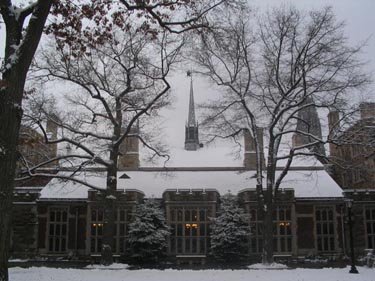
Which is basically the premise of a great deal of youthful liberal activism these days — that once the last remnants of Slytherin are eradicated from the leafy quads of Yale or Middlebury, once Draco Malfoy’s frat or final club is closed and the last Death-Eater sympathizers purged from the faculty, then the battle of ideas will have been finally and fully won.
Several weeks ago, a FB friend steered me to an essay on the decline of the university. It was pedestrian, as these things go; you likely know the reasoning as well as I do by now. But there was a reader’s comment attached that has haunted me since.
The reader argued that the essayist was upset because he (the essayist) assumed that the mission of the university was fixed. He (the reader) has a point. Most of the earliest universities in Europe and America were founded to glorify God and train clergy; that was the dominant university mission for over 600 years and only began to shift during the Enlightenment. The Enlightenment refocused (again, most) universities on the pursuit and dissemination of truth. (Note, that “t” is in the lowercase; truth, in the lowercase, is merely a correspondence between what is thought and said and a reality that exists independently of what is thought and said.)
Perhaps what’s going on now is yet another shift in the mission of universities–a shift away from the pursuit and dissemination of truth and toward a kind of bourgeois, psycho-therapeutic performance of collective identities and grievances.
If that’s what’s going on, then we are surely going to witness a schism within the university, a schism in which mathematics and hard sciences go in one direction (i.e., continue the pursuit and dissemination of truth) and the social sciences and humanities go in another direction (described above).
Picking, cooking, and eating flowers and wild herbs was once a common practice across rural Italy. From Naples’ sciurilli (deep fried courgette flowers) to Veneto’s frittelle di fiori de gazia (acacia flowers doughnuts), most regions have a dish whose key ingredient is flowers. But after World War II, industrialization and urbanization led to the abandonment of this ancient tradition. Now, one woman is trying to bring it back.
Elena Rosa, whose last name literally means “Rose,†is growing flowers, wild herbs, and rare vegetables in a two-hectare farm nestled between the wheat fields of rural Piedmont, about 30 miles from the snowcapped peaks of the Cottian Alps. Rosa grew up in Turin, Piedmont’s main city, but spent summers with her grandparents in Ceresole Reale, a mountain village inside Gran Paradiso National Park. That’s where she first learned about foraging.
“As a kid, I loved helping my grandma picking vegetables,†she says. “I used to go out into the woods to look for wild caraway to make grappa.†Now, some 30 years later, she’s delivering flowers to the kitchen of a Michelin-starred restaurant. …
Common recipes included soups and frittatas made with luppolo (hop flower), jams and infusions made with rosa canina (dog rose), and dumplings filled with tarassaco (dandelion). Flowers were also a key ingredient in popular herb digestifs such as Serpui, a grappa seasoned with wild thyme, and Genepy, a spirit made with eponymous genepy herbs.
“Wild flowers and herbs are rich in vitamins and minerals, and they were especially important during time of famine, disease, or war to provide sufficient nutrition to the population,†says Alessandro Di Tizio, a graduate of the University of Gastronomic Science in Pollenzo who works as a professional ethnobotanist. …
“After World War II, many young people left rural areas to look for work in cities, and were no longer interested in foraging,†De Tizio explains. “And those who stayed could often do without foraging thanks to newly available industrial products.†…
Two years ago, Rosa purchased abandoned farmland in Gemerello, a rural area at the foot of the Cottian Alps. After years of job-hopping, from sous-chef in a top restaurant to manager in a construction business, she was looking to start her own organic farm. The initial plan was to grow to grow regular crops, but her foraging sessions with “grandma Iride†inspired her to start what she calls an “ancient seed farm.â€
She now grows roughly 200 different seeds, ranging from rare vegetables to wild plants and flowers including nasturtium, cornflower, and dahlias. “I have learned that flowers are very nutritious and can be used for a vast range of recipes,†Rosa says.
Flowers of Blitum virgatum, commonly known as leafy goosefoot (left), and a rare breed of calliope eggplant grown by Elena Rosa (right). Elena Rosa (left) and Vittoria Traverso (right)
But starting an ancient seed farm was not easy. Italy’s byzantine bureaucracy was in the way. “Local health authorities don’t know how to rate flowers,†Rosa explains. “I got a mix of surprised and skeptical reactions when I explained you can actually eat them.â€
…
[D]espite bureaucratic obstacles, her products are slowly taking off. Last spring, Rosa brought a sample of her produce to Michelin star chef Christian Milone, who runs the family-owned restaurant Trattoria Zappatori in the nearby town of Pinerolo.
When Milone was a kid, wild flowers and herbs were a staple ingredient in his parents’ kitchen. “Frittatas with luppolo (hop flowers) were one of my favorite dishes,†he says. Tasting Rosa’s sample was like re-discovering long-lost flavors.
A month later, Milone was serving dishes prepared with Rosa’s herbs and flowers. One such floral creation is crostino con erba ostrica, a bread crouton topped with Mertensia maritima, a wild herb known as oyster leaf due to its oyster-like taste, and garnished with violets, daisies, and cornflower petals. “It’s like an oyster for vegans,†Rosa says.
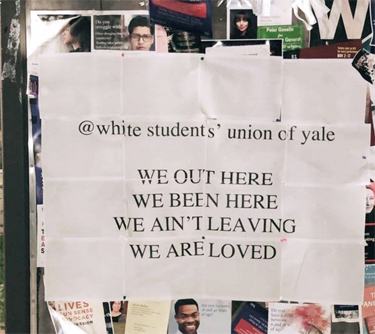
The Yale Police Department is investigating reports from Yale students who witnessed two masked people post racially provocative flyers on bulletin boards around Cross Campus on Tuesday night. …
Yale students took photos of the posters, removed them from the bulletin board, replaced them with messages of support for people of color and reported the incident to Yale student life staff and the YPD on Tuesday night. The flyers depicted the symbol of a “White Students’ Union of Yale†and quoted slavery advocate and class of 1804 graduate John Calhoun — the former namesake of what is now Grace Hopper College. The quote reads, “In looking back, I see nothing to regret, and little to correct.â€
YPD officers are currently reviewing camera footage to identify the perpetrators, Goff-Crews told the News. … The department has also stepped up its patrols in “sensitive areas on campus,†including the center of Yale’s campus, where the incident occured [sic].
“I find the sentiments signified by these flyers deeply troubling, and I want to be clear: hate is not welcome on our campus,†Salovey wrote in a campuswide email. “As I have said in the past, the answer to speech one finds repugnant is more speech. [Flyers aren’t speech? Quotations from Calhoun aren’t speech? – JDZ] I have no doubt that the members of the Yale community will respond to expressions of hate, racism, and exclusion on this campus with even stronger affirmations of our values—and a renewed commitment to creating a diverse, inclusive community where all people are welcomed.â€
In the email, Salovey confirmed that the perpetrators violated a University policy which only permits registered student organizations to post flyers on campus [Oh, my! that is an expulsion-worthy offense for sure. –JDZ].
Yale has notified the Southern Poverty Law Center — which monitors hate groups in the U.S. — and the Anti-Defamation League — a Jewish group that fights anti-Semitism and bigotry — about the incident, according to Salovey’s email. …
On Tuesday night, a student posted a photograph of the flyer on the popular Facebook group “Overheard at Yale,†prompting heavy backlash against the perpetrators among commenters.
Students and alumni interviewed by the News condemned the flyers. Prior to Salovey’s email, at least two individuals told the News that they contacted Salovey’s office calling for the University to respond to the incident.
On Wednesday morning, Gene Lyman ’92 also emailed Salovey’s office calling on the University to investigate the situation thoroughly, discipline any current students involved and “reassert Yale’s values as an inclusive and intellectually honest community.â€
“Even if this should prove a hoax, or someone’s sick idea of a joke, I cannot emphasize enough how unacceptable the sentiment expressed in these flyers is,†Lyman wrote in the email to Salovey.
Lyman said he received a response from Joy McGrath, Salovey’s chief of staff, as well as Salovey’s email to the Yale community.
Sohum Pal ’20 sent an email about the incident to Salovey, Goff-Crews and Dean of Yale College Marvin Chun on Tuesday night. In his email, Pal called for the establishment of a Title VI office, which would enforce the federal law that prohibits discrimination based on race, ethnicity, color and national origin at educational institutions, and for a systematic change in University responses to grievances around racial discrimination. Pal said that the University should create a “mechanism for change†instead of releasing emails to “reaffirm its commitments.â€
“Tonight, people put up these fliers around campus,†Pal wrote in his email. “I felt vulnerable — is it any surprise? My time at Yale has been many things — sometimes empowering, but more often I’ve been struck at how expendable students, faculty, and staff of color must be to the university.†Unlike Lyman, Pal said he received no direct response to his email.
Ashtan Towles ’19, a former peer liaison for the Afro-American Cultural Center, told the News that while the perpetrators remain unknown, the act was “done in cowardice,†comparing the masked individuals to Klu Klux Klan members who don masks to protect their identities.
“This incident is merely one of thousands through which white nationalists have attempted to stoke fear in Black communities, but I am always in awe of the resilience and pride that exists in the Black community at Yale,†Towles said in an email to the News.
According to Simon Ghebreyesus ’21, the sentiments of white pride in the flyers are a “sinister presence†for students of color to grapple with at Yale and across the country.
Epongue Ekille ’21 told the News that she had generally viewed Yale as a racially inclusive place but the flyer incident “negates it all.â€
“It was both surprising and not at the same time. Although Yale is proud of its diversity, the matter of the fact is that the student population is majority white and wealthy,†Ekille said. “I’m not surprised that people who have these opinions exist at Yale, I’m just surprised that they would publicly advertise it.â€
Evidently, the answer to speech satirizing the rhetoric and poses of African-American Identity Group activists is not actually “more speech.” The answer is to publish hysterical news stories, to refer to the “repugnant speech” as “discrimination,” and “exclusion,” and “hate,” to suggest that it constitutes a possible violation of federal anti-discrimination law, and to treat it as a proper basis for investigation, notification of national left-wing speech and thought supervisory groups, and disciplinary sanctions.
How terribly cowardly it was of those right-wing students to conceal their identities!
The Times yesterday applauded the arrival of a new anti-Trump Legal Group founded by conservatives.
[M]ore than a dozen prominent conservative lawyers have joined together to sound a note of caution. They are urging their fellow conservatives to speak up about what they say are the Trump administration’s betrayals of bedrock legal norms.
“Conservative lawyers are not doing enough to protect constitutional principles that are being undermined by the statements and actions of this president,†said John B. Bellinger III, a top State Department and White House lawyer under President George W. Bush.
The group, called Checks and Balances, was organized by George T. Conway III, a conservative lawyer and the husband of President Trump’s counselor, Kellyanne Conway. In recent opinion articles, Mr. Conway has criticized Mr. Trump’s statements on birthright citizenship and argued that his appointment of Matthew G. Whitaker to serve as acting attorney general violated the Constitution.
The new group also includes Tom Ridge, a former governor of Pennsylvania and secretary of homeland security in the Bush administration; Peter D. Keisler, a former acting attorney general in the Bush administration; two prominent conservative law professors, Jonathan H. Adler and Orin S. Kerr; and Lori S. Meyer, a lawyer who is married to Eugene B. Meyer, the president of the Federalist Society.
“We believe in the rule of law, the power of truth, the independence of the criminal justice system, the imperative of individual rights and the necessity of civil discourse,†the group said in a statement. “We believe these principles apply regardless of the party or persons in power.â€
Mr. Conway, who has long been a member of and contributor to the Federalist Society, said he had nothing but admiration for its work. But he added that some conservative lawyers, pleased with Mr. Trump’s record on judicial nominations and deregulation, have been wary of criticizing him in other areas, as when he attacks the Justice Department and the news media.
In a recent opinion article, George T. Conway III criticized Mr. Trump’s statements on birthright citizenship.CreditChip Somodevilla/Getty Images
“There’s a perception out there that conservative lawyers have essentially sold their souls for judges and regulatory reform,†Mr. Conway said. “We just want to be a voice speaking out, and to encourage others to speak out.â€
The new group’s members say their goal is not to criticize the Federalist Society but to encourage debate about some of the Trump administration’s policies and actions. …
In interviews, the group’s members said they did not speak with a single voice and had varying concerns about the administration’s policies.
——————————-
A lot of Ivy League graduates derive from their education, and the architecture, and the centuries of tradition and prestige, the firm belief that the American Establishment enjoys the mandate of heaven, and cannot possibly be fundamentally wrong. They are not comfortable in the role of rebels and outsiders.
It is obviously a social class thing. Donald Trump is an uncouth vulgarian with a loose mouth and a bad haircut. It simply will not do to be associated with a ragamuffin like Trump. It is not respectable. Besides, the democrats now have the House, and soon the knives will really come out. Maybe Trump will go down. Maybe they’ll mau mau him out of office the way they did Nixon. Time to start taking out some insurance. I’m dazzled by all the high principle.
When Justice Kennedy decided that the US Constitution mandated Same Sex Marriage, that, I’d say, undermined the Rule of Law. When Obama’s head of the Civil Rights Division of the Justice Department, Russlynn Ali, sent a “Dear Colleague” letter threatening universities with the loss of federal funding unless they immediately created Star Chambers with lowered evidence standards and reduced rights for the accused to investigate sexual harassment accusations, that undermined the Rule of Law. When left-wing, democrat-appointed federal district judges arbitrarily set out to overturn one Executive Branch policy after another single-handed, that undermined the Rule of Law. Right now, when democrats, having lost elections, get extensions provided by partisan district judges and magically produce more ballots, that undermines Democracy and the Rule of Law.
But those brave, high-principled conservative solons were never bothered enough by any left-wing distortions of the Constitution or end-runs around the Rule of Law to go out and organize a brand-new opposition organization with which to express their indignation over any of that.
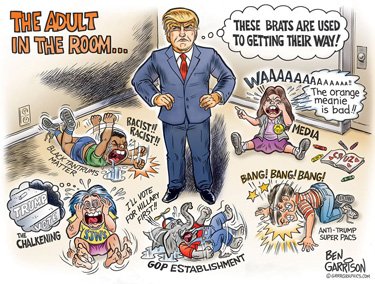
But, Trump! orange-faced, bad-hair, outer-borough-talking Trump! when the likes of Trump has the temerity to impugn the integrity and bona fides of sacred institutions like CNN and the New York Times, when Trump complains of partisan opposition to himself and his policies from within the government, that is carrying things too far! That kind of thing constitutes an outrage too dreadful to be borne. (And an opportunity to receive a lot of “strange, new respect” and approving front page notice from the Times!)
There is no hill a lot of people are willing to die on, but there are certainly hills that some people are eager to pose on.
Some poster on Reddit came up with this makeover for Donald Trump.
————–
In early 1861, after Lincoln’s election, a little girl famously wrote to him, telling him he’d look better with a beard. Old Abe responded by growing one, proving the little girl right.
Taking grooming advice from a member of the public was good for the first Republican president, and it’s bound to be even better for the most recent.
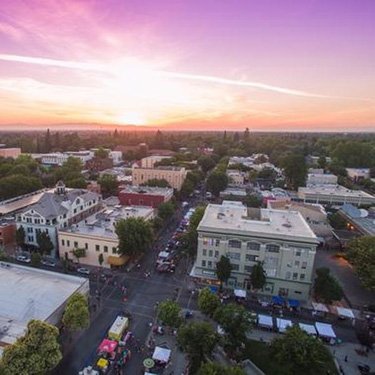
Gerard van der Leun, now a refugee burned out of his home, with the loss of everything, by the fire that swept over Paradise, California, is in Chico and reports that the good people of that town are acting like real Americans.
Near closing time in the men’s Clothing Clearance Corner on the first floor of Penny’s at the Chico Mall, a young girl is replacing the piles of tossed clothing left by the numbed shoppers from Paradise frantic for cheap basic clothing. Some of them are camped in tents somewhere close by the mall; for how long nobody knows. But this young, quietly lovely girl is putting the Clothing Clearance Corner back in apple pie order as the store’s dismal day closes. I take my few finds from the Clothing Clearance Corner and, leaving, say, “That seems like a thankless task.â€
“Not at all,†she replies. “Not at all.â€
“Really? Why the hell not?â€
“Hey, I do this job every day in this store. It’s my assigned task and usually its okay but I only do it for the money because it gets really monotonous, meaningless.â€
She’s a student, I perceive.
“But today those people really needed these clothes in this corner because of the price. And tomorrow more people like that will really need them too. And so I want to make this the best I can for them. So I’m going to put it all back on hangers and arrange them by size. It will be right by the morning. You better go. We’re closing. Thank you for coming in.â€
Just a young girl working late in the Clothing Clearance Corner. Doing one of those little jobs; one of those jobs that actually make the world turn. She was leaving it all on the field.
At the ends of the neighborhood streets, I see people setting up tables and I see the people of the neighborhoods coming out onto the main streets and putting out whatever they have to give there for the taking if needed. They are literally leaving it all on the field.
At the Elks Lodge after I picked up some bedding and a few new pillows and looked out over acres of goods being laid out for the taking, from flats of pet food to cribs and playpens (someplace safe to rest your baby that is not on your hip). As I was leaving to see the East Avenue Church scene an Elk (My late father was a member of this lodge up until his death in 1972); a brother, I say, of my father waves me over and opens the back seat of my car and puts in two cases of one liter bottles of San Pellegrino . The Elks are leaving it all on the field.
In the 24-Hour Walgreens Pharmacy on East Avenue, the pharmacists have been working overlapping shifts since the fire swept over Paradise last Thursday. These people and their back up staff work seemingly rock solid for hours on end. They fill and file and dispense medications which people from Paradise do not have with them. This is a demanding and thankless and exhausting task. And yet — I am the witness — they have been doing this without letup. Many have come in from surrounding towns, from Redding, to help and to keep the medications needed by a town of 30,000 displaced into a city of 80,000. Yes, the Walgreens pharmacists are leaving it all on the field.
Stan Lee (born Stanley Martin Lieber; December 28, 1922 – November 12, 2018) was an American comic book writer, editor, and publisher. He was the editor-in-chief of Marvel Comics, and later its publisher and chairman, leading its expansion from a small division of a publishing house to a large multimedia corporation.
In collaboration with several artists—particularly Jack Kirby and Steve Ditko—he co-created fictional characters including Spider-Man, the Hulk, Doctor Strange, the Fantastic Four, Daredevil, Black Panther, the X-Men, and—with his brother, co-writer Larry Lieber—the characters Ant-Man, Iron Man, and Thor. In doing so, he pioneered a more complex approach to writing superheroes in the 1960s, and in the 1970s challenged the standards of the Comics Code Authority, indirectly leading to it updating its policies.