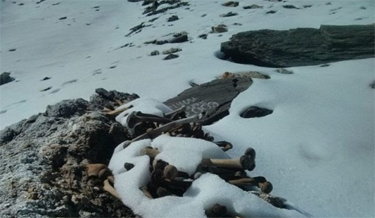
In 1942, H K. Madhawl, a British forest guard in Roopkund, India made an alarming discovery (despite the fact that there had been reports of bones on the lake shore since the mid 19th century). At an elevation of 15,750 feet, near the bottom of a small valley, was a frozen lake absolutely full of skeletons. Roopkund Lake, in the state of Uttarakhand, India, was a six-foot-deep glacial lake that typically remained frozen year round.
What he saw up there confused everyone. At first, it was one bone. But as the temperatures rose, the number of exposed remains grew exponentially. That summer, the ice melting revealed even more skeletal remains, floating in the water and lying haphazardly around the lake’s edges. People wondered what happened, and what were these people doing up here?
The immediate assumption (it being war time) was that these were the remains of Japanese soldiers who had died of exposure while sneaking through India. The British government, terrified of a Japanese land invasion, sent a team of investigators to determine if this was true. However upon examination they realized these bones were not from Japanese soldiers—they weren’t new enough.
With the immediate concerns of war eased, the urgency of identifying the remains became less of a priority and efforts to further analyze the remains were sidelined. It was evident that the bones were quite old indeed. Flesh, hair, and the bones themselves had been preserved by the dry, cold air, but no one could properly determine exactly when they were from. More than that, they had no idea what had killed over 300 people in this small valley. Many theories were put forth including an epidemic, landslide, and ritual suicide. For decades, no one was able to shed light on the mystery of Skeleton Lake.
But what caused their death? Was there a massive landslide? Did some disease strike suddenly? Were the individuals conducting a ritualistic suicide? Did they die of starvation? Were they killed in an enemy attack? One theory even suggests that the individuals did not die at the scene of the lake, but their bodies were deposited there as a result of glacial movement.
A 2004 expedition to the site seems to have finally revealed the mystery of what caused those people’s deaths. The answer was stranger than anyone had guessed.
The 2004 expedition took samples of the bones as well as bits of preserved human tissues. As it turns out, all the bodies date to around 850 AD.
DNA evidence indicates that there were two distinct groups of people, one a family or tribe of closely related individuals, and a second smaller, shorter group of locals, likely hired as porters and guides. A number of these victims of the mountain were so well preserved that they still had remnants of flesh, hair, fingernails, and clothes. Rings, spears, leather shoes, and bamboo staves were found, leading experts to believe that the group was comprised of pilgrims heading through the valley with the help of the locals.
The plausible scenario of what exactly happened? The two groups perhaps met at the foot of the mountain. The first of the two, taller and who which outnumbered the others, probably wanted to make a pilgrimage pass through the mountain and are thought to have been of Iranian origin. The second group, with thinner and smaller bones, showed up as their local Indian guides. The travelers were related to each other (a large family or tribe), and could have come from Iran. The locals that guided the way were unrelated.
Another suggestion is that they braved the elements to collect “Keeda Jadi,†which are larvae of the ghost moth that have become the home to a fungus (that actually wraps around the larvae and slowly devours it).
These “Magical Mushrooms†are believed to have incredible medicinal properties and locals head out in search of them in the springtime.
The journey should have progressed well until the point everyone was trapped, with no place to run and hide as a disaster struck. A violent torrent of baseball-sized hailstones falling from the skies battered the whole group. All the bodies had died in a similar way, from blows to the head. However, the short deep cracks in the skulls appeared to be the result not of weapons, but rather of something rounded. The bodies also only had wounds on their heads, and shoulders as if the blows had all come from directly above. What had killed them all, porter and pilgrim alike?
Among Himalayan women there is an ancient and traditional folk song. The lyrics state that “these are the holy lands of the Goddess Nanda, her sanctuary in the mountains. King Jasdal of Kanauj and his wife were undertaking the “Nanda Jat†pilgrimage; along the way, the queen gave birth. Instead of pleasing their goddess with their tributes, the deity was angered for this defielment of her pure mountain. To punish the group, she sent a great snowstorm, flinging iron-like hailstones that took the life of each and every personâ€.
After much research and consideration, the 2004 expedition came to the same conclusion. All 300 people died from a sudden and severe hailstorm. Trapped in the valley with nowhere to hide or seek shelter, the “hard as iron†cricket ball-sized [about 23 centimeter/9 inches circumference] hailstones came by the thousands, resulting in the travelers’ bizarre sudden death. The remains lay in the lake for 1,200 years until their discovery.
Michael Brendan Dougherty explains why he wants a hideously expensive huge wristwatch, historically associated with the Italian Navy.
If my children someday ask me about a certain personal extravagance, I will blame the Axis Powers.
On December 18, 1941, Luigi Durand de la Penne and five of his comrades were ahead of schedule. They stopped to eat figs and drink cognac, when, to their great fortune, they saw two British battleships and a British destroyer entering the harbor of AlexÂandria, Egypt. These men were part of Italy’s elite frogman unit, the Decima Flottiglia MAS. They had launched from the Italian submarine Scirè, driving their two-man sea chariots toward the British fleet. These chariots were manned torpedoes, with a maximum speed of 3 knots, and so unwieldy and unreliable that their riders referred to them as maiali, or pigs. The frogmen used rebreathing units invented for spear fishers during interwar years to operate undetected under the surface of the water. From there, they could navigate their explosives around nets and set up other forms of protection for their ships. That night, these six men would dramatically alter the balance of power in the Mediterranean.
Leaving behind figs and cognac, de la Penne and his crewmate approached the HMS Valiant. Their equipment began to fail — this was the Italian navy, after all — with de la Penne’s wetsuit and mask letting in water. He swallowed it to clear his vision. After a mighty struggle with his pig, he managed to place the limpet mine on the keel of the Valiant. But almost immediately afterward, he and his partner had to surface for air. They were spotted and captured.
Refusing to talk, de la Penne was placed below deck, right above his charge. Ten minutes before it was set to explode, he alerted the captain that in a few minutes the Valiant would sink and all he could do was evacuate his men. De la Penne reached the deck unscathed after the bomb went off, and he witnessed similar mines exploding beneath the HMS Queen Elizabeth, the HMS Jervis, and the oil tanker Sagona.
Six men had disabled the bulk of the British fleet in the Mediterranean. The world wouldn’t discover it for months, since the ships sank in shallow water on flat bottoms. Winston Churchill would praise the ingenuity and courage of the Italian frogmen when he relayed the news in a secret session of Parliament. After the war, the captain of the Valiant, Admiral Charles Morgan, even lobbied for a British decoration for de la Penne.
How did the frogmen know that they were ahead of schedule? Or determine that there were ten minutes left before the explosion? They had another piece of equipment, issued to them by the Italian navy: a hulking, 47-millimeter, plexiglass-domed, submersible wristwatch. Its guts were made by Rolex, but the Italian watch firm Panerai modified the cases, soldered on wire lugs, and added a sandwich-style dial. The bottom half was a disk painted with glowing radioactive material; the top half was a black disk with cutouts to make the indices. This was the Panerai Radiomir.
And I really want to spend an exorbitant amount of money to get a watch that looks like the ones that de la Penne and his comrades wore.
Well, not exactly like it. The modern versions are no longer made with radium, so they don’t give their makers and wearers cancer. Also they have better components and much shinier and more polished cases than the originals. You get them not from military contractors but from luxury boutiques, where the staff wear white gloves to handle them and speak to you in hushed tones.
It makes no sense, really. Cheapo battery-powered watches keep better time than expensive modern Panerai. An even more accurate time is available on my smartphone. But you can’t get better advertising than de la Penne’s physical courage and sportsmanlike conduct in one of the most daring feats of World War II. He wore it. It’s cool. And I want one so bad.
December 14, 1972: “We’re on our way, Houston!â€
Apollo 17 astronauts Jack Schmitt and Gene Cernan lift off from the Moon to rendezvous with the orbiting command module and begin the journey home.
Just think, most living Americans were not even born the last time we set foot on the moon! Our national priorities for the past 46 years have been a disgrace.
The contemporary American Welfare State is about as useless and afflicted with Confucian stodginess as Ming China, whose admiral Zheng He made several voyages of exploration to Africa and the “Western Ocean” early in the 1400s, after which all such voyages were curtailed.
“Titania McGrath” strikes again, with a posting on Quillette this time, poking fun at the SJW crowd.
My name is Titania McGrath. I am a radical intersectionalist poet committed to feminism, social justice, and armed peaceful protest. In April of this year, I decided to become more industrious on social media. I was inspired by other activists who had made use of their online platforms in order to spread their message and explain to people why they are wrong about everything.
This week the powers-that-be at Twitter hit my account with a “permanent suspension†(a semantic contradiction, but then I suppose bigots aren’t known for their grammatical prowess). This was the latest in a series of suspensions, all of which were imposed because I had been too woke. The final straw appeared to be a tweet in which I informed my followers that I would be attending a pro-Brexit march so that I could punch a few UKIP supporters in the name of tolerance.
Don’t get me wrong. I have always supported censorship. Major social media platforms have a responsibility to ensure that we are expressing the correct sort of free speech. Twitter’s decision to suspend Alex Jones, host of American website InfoWars, set the right kind of precedent. I fully supported this action because Jones is known for disseminating fake news and wild conspiracy theories. But the fact that I was also banned makes me think that Twitter were being secretly controlled by InfoWars from the very start. …
[T]hose who fight for the progressive cause are continually bombarded by alt-right trolls who like to engage in a form of harassment known as “debate.†Only a few days before my suspension, a misogynist referred to me as “shrill and humourless.†As I was quick to point out, humour is a patriarchal construct. This is why it has been so gratifying to see the success of our current wave of feminist comedians, those brave women who are subverting the genre by ensuring that it doesn’t make anyone laugh.
Do not pity me. As a woman in a heteronormative patriarchal world I am accustomed to males like Jack Dorsey attempting to keep me silent. In my absence from Twitter, I took the opportunity to spend some time at a resort in Val d’Isère, where I could relax and contemplate my oppression. I even managed to write a book which I have entitled Woke: A Guide to Social Justice. I did want to call it My Struggle, but that title was already taken apparently.
I am a healer, a weaver of dreams. I have been put on this earth to defend minorities and fight for social justice. My work is not about ego. It is so much bigger than me. So please make sure you spread the word about my new book so that as many copies as possible can be sold.
Last month, a challenge from Durham University spurred bakers to whip up a soul cake, a bygone bun once integral to a medieval tradition of feeding the poor and honoring the dead. But, in the spirit of competitive baking reality shows, there was a catch: Nobody really knows how, traditionally, it was supposed to be baked.
We know generally what soul cakes looked like, and what was inside of them. We know that bakers crafted them into small, round, square, or oval buns—garnishing the top with currants in the shape of a cross. And we know its purpose: Giving a soul cake to someone in poverty allegedly freed a departed soul from Purgatory. But we’re still in the dark about its intended taste and texture, and exactly how to go about concocting a soul cake in true medieval fashion.
“We have a recipe from a household book from 1604 compiled by a certain Lady Elinor Fettiplace that includes a recipe for a soul cake,†says Dr. Barbara Ravelhofer, a professor of English literature at Durham University and facilitator of the soul cake challenge. “However, it doesn’t give us the quantities—nor does it tell us how long to bake it. So you have to work out for yourself what to do with the ingredients.†Spearheaded by Dr. Ravelhofer and the Records of Early English Drama North East team, the Great Northern Soul Cake Bake doubles as a competition and crowdsourcing project. By challenging the public to decode the bare-bones recipe, the research team hopes to understand and resurrect the original soul cake—as well as the tradition that surrounds it.
Soul cakes are connected to Britain’s early Christian celebrations known as All Saints’ Day and All Souls’ Day, Halloween-like festivities commemorating the recently departed. On November 2nd, beggars would weave their way through the chilly darkness, rapping on wealthy homeowners’ doors in exchange for a soul cake. But obtaining it was no cake walk. To successfully soul, one had to sing for sweets.
Whether it be musical or theatrical, souling required performance in exchange for a cake—a tradition that looks a lot like modern-day trick-or-treating. And, though it’s impossible to definitively claim souling as the progenitor of tricking and treating, Dr. Ravelhofer says they’re certainly connected. However, she points out, there are key differences. “A soul-caker was somebody who did something to obtain something,†she says. “Whereas trick-or-treating strikes me as, ‘Give me something or else I’ll do something.’â€
Demanding candy door-to-door, she posits, is a “slightly degenerated, commercialized form†of the All Souls’ Day transactions of medieval Europe. Souling, Dr. Ravelhofer adds, also had a strong connection to charity and memoriam. The act of doling out freshly baked goods, while thinking of a “poor, departed soul,†filled two needs with one deed, giving to the hungry and freeing a soul in question from Purgatory in one fell swoop.
While vestigial remnants of this practice can still be found in some parts of England, the tradition of souling, and the cakes that came with it, have since disappeared—until now.
To more fully understand the history and tradition of All Souls Day, Dr. Ravelhofer and her team devised the bake off. The technical challenge (the first of a series of three) called for readers to recreate a successful iteration of the festive bun using only Elinor Fettiplace’s 17th-century recipe, which reads:
“Take flower & sugar & nutmeg & cloves & mace & sweet butter & sack & a little ale barm, beat your spice & put in your butter & your sack, cold, then work it well all together & make it in little cakes & so bake them, if you will you may put in some saffron into them or fruit.â€
Folks from across the globe responded, submitting recipes, photographs, and anecdotes via email, Facebook, and Twitter, with results ranging from wild successes to valiant flops.
“We had proper food archaeologists who really got into the spirit of things, and then we had candidates who tried to microwave it,†says Dr. Ravelhofer.
David Petts, Senior Lecturer in Archaeology at Durham University, posted about his soul cakes on his personal blog, likening them to “slightly dense hot-cross buns.†Another participant found that using a ruby or dark ale gave the cakes a soft, chewy texture. Yet another made a successful stoneground cake by adding rye, theorizing that medieval bakers may have used additional grains.
But cataloguing the failed cakes, Dr. Ravelhofer says, has been just as informative as admiring the more edible ones.
Understanding what doesn’t work, and why, allows historians to do detective work when it comes to understanding what the recipe may or may not have looked like.
Boy, would these stories trigger the snowflakes of color on any major college campus these days! Listverse:
Although nearly all of the conquistadors were men, there were a few women who participated in the conquests. Maria de Estrada, who was nicknamed the “Great Lady,†was probably the first white woman to set foot in the Americas. Estrada and her husband, Pedro Sanchez Farfan, spent time in Hispaniola and Cuba before investing and enlisting in Hernan Cortes’s expedition to Mexico in 1519.
Estrada was a full-fledged soldier, unwilling to receive special treatment because she was a woman. She participated in every battle and is believed to have been quite skilled with the sword. Her greatest moment was considered to be her fighting in La Noche Triste (“The Night of Sadnessâ€), the conquistadors’ disastrous retreat from the Aztec capital on June 30, 1520. After the conquest of the Aztecs in 1521, Cortes rewarded Estrada for her brave service with two towns in Morelos.
They’re staples on every American dining table and the requisite ingredients in virtually every European cuisine, so inseparable that polite society dictates they always be passed together. Salt and pepper are the undisputed champions of condiments—but how did they get so popular?