Archive for October, 2021
12 Oct 2021

Babylon Bee, 5/20/21: BILLUND, DENMARK—As part of its new push toward inclusion and diversity, LEGO has unveiled a new set of genderless bricks without male or female connectors.
USAToday, 10/11/21:
Lego announced Monday the company will work to remove gender stereotypes from its toys following a global study that looked into how creative play is gendered.
The research, commissioned by the Lego Group and carried out by the Geena Davis Institute on Gender in Media, found attitudes toward children’s activities and future goals continue to be unequal and confined to gender biases. Read the rest of this entry »
12 Oct 2021

Richard Hanania explains why both the social and legal system keep ratcheting up stricter and more totalitarian standards of Wokeness and punishment for Wrong Speech.
[F]ew regulators and lawmakers responsible for the state of civil rights law intended to create a world where schools are teaching that punctuality and hard work are racist. But by getting government into the field of social engineering and making hurt feelings a matter of law, they set us on the path to modern wokeness. … Read the rest of this entry »
11 Oct 2021


Christopher Columbus (detail), from Alejo Fernández, La Virgen de los Navegantes, circa 1505 to 1536, Alcázares Reales de Sevilla.
In his magisterial biography, Admiral of the Ocean Sea, 1942, Samuel Elliot Morrison observes:
[Christopher Columbus did] more to direct the course of history than any individual since Augustus Caesar. …
The voyage that took him to “The Indies” and home was no blind chance, but the creation of his own brain and soul, long studied, carefully planned, repeatedly urged on indifferent princes, and carried through by virtue of his courage, sea-knowledge and indomitable will. No later voyage could ever have such spectacular results, and Columbus’s fame would have been secure had he retired from the sea in 1493. Yet a lofty ambition to explore further, to organize the territories won for Castile, and to complete the circuit of the globe, sent him thrice more to America. These voyages, even more than the first, proved him to be the greatest navigator of his age, and enabled him to train the captains and pilots who were to display the banners of Spain off every American cape and island between Fifty North and Fifty South. The ease with which he dissipated the unknown terrors of the Ocean, the skill with which he found his way out and home, again and again, led thousands of men from every Western European nation into maritime adventure and exploration.
The whole history of the Americas stem from the Four Voyages of Columbus; and as the Greek city-states looked back to the deathless gods as their founders, so today a score of independent nations and dominions unite in homage to Christopher the stout-hearted son of Genoa, who carried Christian civilization across the Ocean Sea.
An annual post.
10 Oct 2021

A Corinthian helmet.
For any of my Hollywood movie star, hedge fund owning, kleptocrat dictator readers, Christie’s offers a collecting guide to a very interesting (and hideously expensive) hobby.
Ancient Greek helmets are a source of fascination for the modern audience as they provide a glimpse into this ancient culture and how their warriors functioned. Primarily, helmets were physical protection, worn in battles beginning in the Archaic period, together with greaves, chest plates and shields in many cases.
Helmets were also often symbols of status, with more ornate examples worn by an elite group. ‘Many buyers are looking to understand the ancient world through physical objects,’ says Hannah Fox Solomon, Antiquities Head of Sale and Specialist at Christie’s New York. Ancient helmets are just one example from which to do so.
The Illyrian helmet, one of two helmets to appear in the early 7th century BC, is the most common type. It is recognisable by its square face guard and pointed non-hinged cheek pieces, as well as the smooth dome featuring raised parallel ridges to which a crest made from horsehair, wood or leather would be pinned in place by a rivet at the crown.
The Corinthian helmet is the other 7th century helmet, with its characteristic almond-shaped eyes and rounded nose guard. ‘I think that the eyes are especially beautiful,’ says Solomon. ‘It’s an immediately recognisable shape: the domed head, the slightly flaring neck guard, the elongated eye openings . Aesthetically, it’s a beautiful form that has a lyrical nature.’
The Samno-Attic helmet, a later variation on the earlier types, features cheek pieces attached by hinges, and generally has a lighter feel with wider openings for the face and ears. They are often more ornate, some with moulded decoration and tall tubular plume-holders. Feathers were believed to be connected to Ares, the god of war, and scholars believe warriors wore feather atop their helmets as a means of intimidating the enemy. …
As with many objects on the market, condition has a major impact on the value of a helmet. ‘Some helmets are perfect, but some helmets have evidence of what we call the “death blow”,’ says Solomon, referring to damage on the side of the dome. ‘While I can only hypothesise whether or not that is true, occasionally you’ll find helmets with damage that makes you wonder if it was the result of battle.’
Importantly, however, not all damage is immediately visible. Often helmets need to be x-rayed in order to establish their condition. An x-ray can reveal cracks, areas lost or that have been filled with modern material, all of which affects the value.
RTWT
10 Oct 2021
Atlas Obscura:
If you sail to the island of Sanday in the Orkney archipelago in northern Scotland, you’ll see the silhouettes of neighboring islands on the horizon. Upon arrival you’ll see white, sandy beaches that trail into rough, once-agricultural terrain, and experience its erratic weather—sun then fog then rain then clear skies all in the same day. Nestled there, on a shallow cliff, is a mound of earth and rocks: a prehistoric tomb dating to around 3500 B.C.
The tomb sits on a low-lying peninsula, where growing storms and agitated seas are eroding it away. So, in August and September 2021, a group of archaeologists made their way there, to Tresness, the site of that lone Neolithic tomb, with their sights set on excavation. The research team was anxious to study the tomb before it was lost; it contains a single chamber, presumably for someone important.
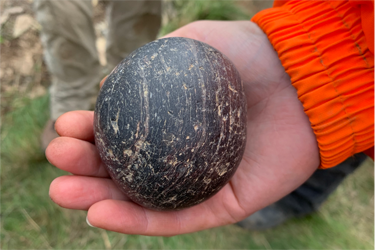
“What we discovered was an exceptionally well-preserved monument,” says Hugo Anderson-Whymark, a curator of prehistory at National Museums Scotland who co-led the research. There were no remains, but inside the monument were a couple rare finds: two polished stone balls, each about the size of a tennis ball.
The other leading archaeologist of the excavations, Vicki Cummings of the University of Central Lancashire, unearthed both of the orbs herself. With the first, she remembers pulling her trowel back and immediately noticing that something was different. “It was really exciting,” she says. “I said after the first one, ‘I’ll never find anything like that ever again in my career,’ and then I found another one. It’s very rare that you would find two such amazing objects, it was incredible.”
But these two balls aren’t exactly a unique find—they’re part of a widely distributed mystery left by the Neolithic inhabitants of the British Isles. More than 500 stone balls like them have been discovered to date. For centuries, no one paid them much attention. Farmers or builders would randomly discover them in fields, and then either keep them or donate them without another thought. It wasn’t until archaeologist Sir Daniel Wilson published illustrations of the orbs in 1851 that people began to take notice. “Suddenly you saw, from 1850 onwards, lots of them coming out the woodwork,” says Anderson-Whymark. “There were about 100 known by the early 20th century.” But because of the way that many of them were found—without archaeological context—scholars didn’t know where most came from. That’s why Cummings was so floored by what she found. Discovering not one but two, in their original location in a tomb, is incredible—only a few have ever been found in their original context. Also, most of the 20 balls that have been found in the Orkney Islands are carved and etched with patterns and designs. These, on the other hand, were polished smooth.
RTWT
Clearly, those Neolithic fellows played some game of the Boules family resembling Lawn Bowls, Raffe, Boules, Bocce, or Péntaque.
10 Oct 2021

Sarah Davidson explains in LithHub:
Didion famously said that when she was young, she learned to write by typing Hemingway’s stories. “I learned a lot about how a short sentence worked in a paragraph, how a long sentence worked. Where the commas worked.”
In an article, “Last Words,” arguing against the publication of Hemingway’s unfinished work, she quoted the first paragraph of A Farewell to Arms. Then wrote, “That paragraph, which was published in 1929, bears examination: four deceptively simple sentences, 126 words, the arrangement of which remains as mysterious and thrilling to me now as it did when I first read them… Only one of the words has three syllables. Twenty-two have two. The other 103 have one. Twenty-four of the words are ‘the,’ fifteen are ‘and.’ There are four commas.”
Now people are counting her words. I did that with the last paragraph of The Year of Magical Thinking. The paragraph has ten deceptively simple sentences, 137 words. Only two of the words have three syllables. 16 have two. The other 119 have one. 16 of the words are “the,” one is “and.” There are five commas.
Both writers used a preponderance of single-syllable words, which underscored for me the power of those drum-like single beats. Both writers were sparing with commas, but Didion did not adopt Hemingway’s repetitions of “and… and… and…” to string clauses together.
RTWT
09 Oct 2021

Michael Novak explains how Lepanto (1571) and Vienna (1683) finally reversed the aggressive Muslim tide of conquest that had begun in 622.
In a.d. 622, Mohammed set out from Medina to conquer the whole Christian world for Allah by force of arms. Within a hundred years, his successors had occupied and pillaged every Christian capital of the Middle East, from Antioch through North Africa (home of Saint Augustine) and Spain. All that remained outside Allah’s reign was the northern arc from Southern France to Constantinople.
What we are seeing in 2014 has a history of more than 1,300 years — a very bloody, terror-ridden history. Except that today the struggle is far, far more secular than religious — a war over political institutions and systems of law, with almost no public argument over religious doctrine.
Edward Gibbon, in TheDecline and Fall of the Roman Empire (1776-78), describes how tall Islamic minarets could have been seen in Oxford before his birth, and the accents in its markets would have been Arabic: “The interpretation of the Koran would now be taught in the schools of Oxford, and her pulpits might demonstrate to a circumcised people the sanctity and truth of the revelation of Mahomet.”
Gibbon was writing about the decisive battle of Poitiers in a.d. 732, when at last a Christian leader, Charles Martel (“Charles the Hammer”), drove back the Muslims from their high-water mark in Western Europe with such force that they went reeling backwards into Spain. From there, it took Spain another 750 years — until 1492 — to drive Islamic armies back into North Africa, whence they had invaded. Even so, the Islamic terror bombers who just a few years ago killed more than a hundred commuters in Madrid did so (they announced) to avenge the Spanish “Reconquista” of 1492. For Islam, to lose a territory once Muslim is to incur a religious obligation to wrest it back. Read the rest of this entry »
09 Oct 2021

Brandon Brown
Distractify:
[T]he “Let’s Go Brandon” meme that has been making its way around the internet thanks to Twitter. But what does it actually mean? A small incident in an interview with a NASCAR driver has intersected with politics and brought new life to a chant about the president.
According to Know Your Meme, “Let’s Go Brandon” is from an interview with NASCAR racer Brandon Brown and NBC that took place in Oct. 2021. He had just won the NASCAR Xfinity Series. In the background, the crowd can be heard chanting “F–k Joe Biden!”
But in what might be an effort to remain professional, the interviewer, Kelli Stavast, said that the crowd was saying “Let’s go, Brandon!”
“Brandon, you also told me — as you can hear the chants from the crowd,” Kelli says before the camera pans to the audience. In the video, you can clearly hear the audience say, “F–k Joe Biden!” Although Brandon doesn’t seem to be paying attention to them.
As of now, neither Brandon nor Kelli has responded to the meme. And it’s not clear whether she actually misheard the crowd or if she was trying to cover up what they were chanting.
RTWT
Brandon for VP!

08 Oct 2021

A tokay gecko bites back despite being held in the coils of the golden tree snake.
Photograph: Wei Fu/Royal Society of Biology.
HT: This Isn’t Happiness.
08 Oct 2021

Tony Stafki, The Battle of Lepanto
(In the contemporary painting above: “The Catholic ships form a cross and the Muslim ships form a cresent. – The standard of the Holy Cross which was blessed by Pope Pius V can be seen on Don Juan of Austria’s ship which is leading the charge. – Papal ships (St. Peter’s keys) – The miracle of the wind: just before the armies met the wind completely switched in favor of the Catholic ships. – Devils can be seen amongst the Muslim ships (they were summoned from hell by the Muslim leader). The devils have peacock feathers as swords, a manifestation of their pride. – Our Lady of Victory with a sword in one hand ready to crush the devils and the other hand outstretched to the Muslim souls. – St. Michael leading the Angels – There are small white lights by the oars on the Muslim ships representing the souls of the Catholic prisoners.”)
————————
October 7, 1571, the fleet of the Holy League, an alliance of the kingdoms of Spain, of Sicily and of Naples, of the Republics of Venice and of Genoa, of the Grand Duchy of Tuscany, of the Duchy of Savoy, of the Papal States, and of the Sovereign and Military Order of St. John, decisively defeated the Ottoman Empire’s main battle fleet in five hours of fighting at Lepanto at the northern edge of the Gulf of Corinth.
Miguel de Cervantes Saavedra, author of Don Quixote, was shot twice in the chest and once in the left arm in the course of the battle.
—————————-
Rev. Fr. Luis Coloma, The Story of Don John of Austria, trans. Lady Moreton, (New York: John Lane Company, 1912), pp. 265-271:
The Turkish fleet came on imposing and terrible, all sails set, impelled by a fair wind, and it was only half a mile from the line of galliasses and another mile from the line of the Christian ships.
D. John waited no longer; he humbly crossed himself, and ordered that the cannon of challenge should be fired on the “Real,” and the blue flag of the League should be hoisted at the stern, which unfurled itself like a piece of the sky on which stood out an image of the Crucified. A moment later the galley of Ali replied, accepting the challenge by firing another cannon, and hoisting at the stern the standard of the Prophet, guarded in Mecca, white and of large size, with a wide green “cenefa,” and in the center verses from the Koran embroidered in gold.
At the same moment a strange thing happened, a very simple one at any other time, but for good reason then considered a miracle: the wind fell suddenly to a calm, and then began to blow favorably for the Christians and against the Turks. It seemed as if the Voice had said to the sea, “calm,” and to the wind, “Be still.” The silence was profound, and nothing was heard but the waves breaking on the prows of the galleys, and the noise of the chains of the Christian galley slaves as they rowed.
Fr. Miguel Servia blessed from the quarter-deck all those of the fleet, and gave them absolution in the hour of death. It was then a quarter to twelve.
—————————-
Lepanto by G.K. Chesterton
Mahound is in his paradise above the evening star,
(Don John of Austria is going to the war.)
He moves a mighty turban on the timeless houri’s knees,
His turban that is woven of the sunset and the seas.
He shakes the peacock gardens as he rises from his ease,
And he strides among the tree-tops and is taller than the trees,
And his voice through all the garden is a thunder sent to bring
Black Azrael and Ariel and Ammon on the wing.
Giants and the Genii,
Multiplex of wing and eye,
Whose strong obedience broke the sky
When Solomon was king.
They rush in red and purple from the red clouds of the morn,
From temples where the yellow gods shut up their eyes in scorn;
They rise in green robes roaring from the green hells of the sea
Where fallen skies and evil hues and eyeless creatures be;
On them the sea-valves cluster and the grey sea-forests curl,
Splashed with a splendid sickness, the sickness of the pearl;
They swell in sapphire smoke out of the blue cracks of the ground,
They gather and they wonder and give worship to Mahound.
And he saith, “Break up the mountains where the hermit-folk can hide,
And sift the red and silver sands lest bone of saint abide,
And chase the Giaours flying night and day, not giving rest,
For that which was our trouble comes again out of the west.
We have set the seal of Solomon on all things under sun,
Of knowledge and of sorrow and endurance of things done,
But a noise is in the mountains, in the mountains, and I know
The voice that shook our palaces four hundred years ago:
It is he that saith not ‘Kismet’; it is he that knows not Fate ;
It is Richard, it is Raymond, it is Godfrey in the gate!
It is he whose loss is laughter when he counts the wager worth,
Put down your feet upon him, that our peace be on the earth.”
For he heard drums groaning and he heard guns jar,
(Don John of Austria is going to the war.)
/div>
Feeds
|