Via John Steele Gordon.
“When a Republican is in the White House, the media want to be Woodward and Bernstein. When a Democrat is in the White House, they want to be Monica Lewinsky.”
|
22 Mar 2021
Only Too TrueMedia Bias, Monica Lewinsky
Via John Steele Gordon. “When a Republican is in the White House, the media want to be Woodward and Bernstein. When a Democrat is in the White House, they want to be Monica Lewinsky.” 21 Mar 2021
Atlanta Shootings Coverage and Establishment Response Set Record Level of MendacityAndrew Sullivan, Atlanta Massage Parlor Shootings, Mainstream Media, Media Bias, Racial Politics
Ed Driscoll calls it precisely: WE’VE DESCENDED INTO SOME SORT OF BIZARRE HELL-WORLD IN WHICH ANDREW SULLIVAN IS A VOICE OF SANITY.
21 Mar 2021
For You Parker FansAmoskeag Auctions, Auction Sales, Guns, Parker A1 Special, Parker Shotguns
Amoskeag Auction No. 129, Lot 128:
serial #137720, 12 ga., 32” Whitworth steel barrels choked modified and full with bright excellent bores, each of the tubes showing a small ding along their top edge about 4” from the muzzles. There is no wall-thickness noted below .030” most .035” or more. This rare Parker A-1 Special remains in very honest, fine as-found condition, being consigned directly from the family of the man who ordered and used the gun on his extensive plantation in Mississippi’s Gulf Coast. Built on a No. 2 frame, the barrel shows perhaps 80% of a dark gray-blue fading original blue, mixing with a mottled pewter patina, showing some light oxidation staining about the surface. The nice engraved rings at the muzzles remain intact and the engraved wedges at the breeches remain crisp, the rib with dual ivory beads and “No. 1 Special Parker Brothers Makers Meriden Conn Whitworth Steel” hand engraved rather than roll-marked as-mentioned in The Parker Story. The frame is now a very pleasing pewter-tone patina with the open intertwining scroll and floral embellishment remaining crisp, the nice fine background punch-dot shading, three beaded ribs at the rear of each fence. The water table still shows the nice fine engine turning which matches the bottom of the barrel flats, fading a bit from the years. The triggers gold plating is fading somewhat but is strong at the roots and the bow of the guard is neatly pierced. The checkered capped pistol grip English walnut buttstock rates very fine with much original varnish, stunning grain figure, the special A-1 checkering remaining crisp, the fleur-de-lis’ at the rear of the cheeks a bit soft. The splinter forend is fully checkered and shows a bit more wear showing some smoothed points, all of the forend metal a deep pewter gray. The pistol grip cap sits on a nice beaded flat brass spacer and has gold inlay at its center lightly engraved around the border with Mr. Crump’s name in an oval “James L Crump/New Orleans”. Close inspection reveals that the stock shows a repair to a break through its left side at wrist, the repair neatly camouflaged beneath the checkering (as a 12 ga. gun, it should not be considered fireable with a repaired break in this area). The length of pull to the period Hawkins 1” recoil pad is 14 1/4” with drops of 1 5/8” and 2 5/8”, showing roughly half an inch of cast-off. The gun locks up solidly with the top lever still just right of center, the barrels tight on-face. The safety is non-automatic and the arm cocks and fires properly however the ejector mechanism has been disabled. An external inspection shows that all of the parts seem to be present. James Lyman Crump was a cotton man for roughly 50 years before moving to develop a farm and spacious Holly Bluff lodge on his 3600 acre tract along the Jourdan River which they would name Holly-Bluff-on-the-Jourdan. He would put some 600 acres into cultivation, breeding a hybrid “Braford” beef cattle, upland rice, Kentucky fescue and Ladino Clover, clearing leveling and draining the land for the purpose. The gardens at Holly Bluff on Bay St. Louis became so luscious and wonderful that they were a must-see for tourists to the area for many years. Crump was a sportsman and owned and used this arm for many years, indeed the muzzleloader sold in our last auction dubbed “Pocahontas” hung over the fireplace in that rustic lodge for many years, these arms consigned directly from a descendant. The A-1 special is arguably Parker’s finest high-grade arm, this example being one of only five listed in the Parker stock books as “Whit1” being an A-1 Special with Whitworth steel barrels, this serial number gun is mentioned in the monumental work The Parker Story on page 362 in the A-1 Special chapter. The Parker Story calls the floral embellishment Texas bluebells, although this example would seem to have some daisies and other flowers thrown in, perhaps very fittingly as the gardens at Holly Bluff was so extensive and beautiful. There were thirteen 12 ga. guns made with 32” barrels, this very rare gun being one of the special “five” with the special engraved barrel marking in the Parker stock books. The authors of The Parker Story quote: “the reason for the use of Whit1 for their quality code and their unusual markings is not certain. It must be that all five of these Whit1 guns were made for something special or unusual.”. Parker Guns, I.D. and Serialization also confirms “Grade 8, A-1 Special, Ejectors, capped pistolgrip, 12 ga. with 32” barrels”. A very lovely and very special Parker double for the advanced Parker collector or the discerning collector of fine double guns. (3K9828-1) C&R (20,000/30,000) ——————————— The A1 Special Grade was Parker’s 8th highest grade shotgun, topped only by the 9th grade Invicible. The A1 Special was introduced in 1907, and cost $500 at the time. You could buy a small house in lots of places in America for $500 in 1907. Only 79 examples of this model were ever built. Parker collectors will be snapping at this one like trout after caddis flies. Personally, I’d consider a 2-frame Parker heavier than I’d like for Upland Hunting. This gun also has a wrist crack and a dent. I prefer a straight stock to a pistol grip. And the elaborate engraving is too florid and Baroque for my taste. I’d be happier with lots of less expensive and scarce English guns. 21 Mar 2021
Cannibal Indians Should Spear and Cook the Lot of ThemAuca Indians, Cancel Culture, Dead Missionaries, General Poltroonery, Political Correctness, Wheaton College
This Wheaton College Chapel plaque used to read: “GO YE AND PREACH THE GOSPEL” DEDICATED TO THE GLORY OF GOD AND IN BECAUSE OF THE GREAT COMMISSION, ED AND THEY CHOSE THE JUNGLES OF ECUADOR – ON JANUARY 8, 1956, THE FIVE MISSIONARIES WERE ERECTED BY THE CLASS OF 1949 JANUARY 8, 1957 “FOR THE LOVE OF CHRIST CONSTRAINETH US” The Chicago Tribune reports the outrage of the week.
20 Mar 2021
Ovid’s BirthdayPoets, Publius Ovidius Naso, Rome
Today in 54 B.C. was born Publius Ovidius Naso. He ranks, with his contemporaries Virgil and Horace, among the three greatest Latin poets. Ovid was, of the three, the most unruly and irreverent and consequently died in exile on the shores of the Black Sea. 19 Mar 2021
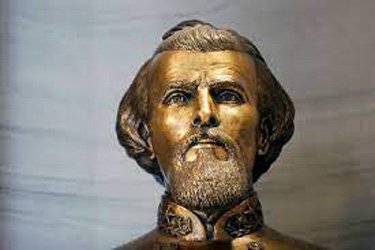
Tennessee Senate Votes to Fire Entire State Historical CommissionCancel Culture, Nathan Bedford Forrest, TennesseeHappily, “When asked to name the greatest soldier of the war, Robert E. Lee replied, ‘A man I have never seen, sir. His name is Forrest.’ ” Nathan Bedford Forrest had 30 horses shot out from under him and, pari passu, personally killed 31 enemy soldiers. At the commencement of the war, Forrest was a self-made millionaire, one of the richest men in Tennessee. He lost everything in defense of his native state. Not surprisingly, the State of Tennessee used to honor the memory of one of its greatest heroes and defenders with a bust in the state capitol. Happily there has been a serious response to Forrest’s targeting by left-wing Cancel Culture.
17 Mar 2021
Everybody Wants to be Irish on St. Patrick’s DayGalway Girl, Ireland, St. Patrick's Day, Thai TimsIncluding these cute Thai kids. 17 Mar 2021
It Wouldn’t be St. Patrick’s Day Without Some Shane MacGowan"The Parting Glass", Shane MacGowan, St. Patrick's Day
Hat tip to the News Junkie. 17 Mar 2021
St. Patrick’s DayHagiography, Ireland, St. Patrick, St. Patrick's Day, Traditions
From Robert Chambers, The Book of Days, 1869: LEGENDARY HISTORY OF ST. PATRICK Almost as many countries arrogate the honour of having been the natal soil of St. Patrick, as made a similar claim with respect to Homer. Scotland, England, France, and Wales, each furnish their respective pretensions: but, whatever doubts may obscure his birthplace, all agree in stating that, as his name implies, he was of a patrician family. He was born about the year 372, and when only sixteen years of age, was carried off by pirates, who sold him into slavery in Ireland; where his master employed him as a swineherd on the well-known mountain of Sleamish, in the county of Antrim. Here he passed seven years, during which time he acquired a knowledge of the Irish language, and made himself acquainted with the manners, habits, and customs of the people. Escaping from captivity, and, after many adventures, reaching the Continent, he was successively ordained deacon, priest, and bishop: and then once more, with the authority of Pope Celestine, he returned to Ireland to preach the Gospel to its then heathen inhabitants. The principal enemies that St. Patrick found to the introduction of Christianity into Ireland, were the Druidical priests of the more ancient faith, who, as might naturally be supposed, were exceedingly adverse to any innovation. These Druids, being great magicians, would have been formidable antagonists to any one of less miraculous and saintly powers than Patrick. Their obstinate antagonism was so great, that, in spite of his benevolent disposition, he was compelled to curse their fertile lands, so that they became dreary bogs: to curse their rivers, so that they produced no fish: to curse their very kettles, so that with no amount of fire and patience could they ever be made to boil; and, as a last resort, to curse the Druids themselves, so that the earth opened and swallowed them up. … The greatest of St. Patrick’s miracles was that of driving the venomous reptiles out of Ireland, and rendering the Irish soil, for ever after, so obnoxious to the serpent race, that they instantaneously die on touching it. Colgan seriously relates that St. Patrick accomplished this feat by beating a drum, which he struck with such fervour that he knocked a hole in it, thereby endangering the success of the miracle. But an angel appearing mended the drum: and the patched instrument was long exhibited as a holy relic. … When baptizing an Irish chieftain, the venerable saint leaned heavily on his crozier, the steel-spiked point of which he had unwittingly placed on the great toe of the converted heathen. The pious chief, in his ignorance of Christian rites, believing this to be an essential part of the ceremony, bore the pain without flinching or murmur; though the blood flowed so freely from the wound, that the Irish named the place St. fhuil (stream of blood), now pronounced Struill, the name of a well-known place near Downpatrick. And here we are reminded of a very remarkable fact in connection with geographical appellations, that the footsteps of St. Patrick can be traced, almost from his cradle to his grave, by the names of places called after him. Thus, assuming his Scottish origin, he was born at Kilpatrick (the cell or church of Patrick), in Dumbartonshire. He resided for some time at Dalpatrick (the district or division of Patrick), in Lanarkshire; and visited Crag-phadrig (the rock of Patrick), near Inverness. He founded two churches, Kirkpatrick at Irongray, in Kireudbright; and Kirkpatrick at Fleming, in Dumfries: and ultimately sailed from Portpatrick, leaving behind him such an odour of sanctity, that among the most distinguished families of the Scottish aristocracy, Patrick has been a favourite name down to the present day. Arriving in England, he preached in Patterdale (Patrick’s dale), in Westmoreland: and founded the church of Kirkpatrick, in Durham. Visiting Wales, he walked over Sarn-badrig (Patrick’s causeway), which, now covered by the sea, forms a dangerous shoal in Carnarvon Bay: and departing for the Continent, sailed from Llan-badrig (the church of Patrick), in the island of Anglesea. Undertaking his mission to convert the Irish, he first landed at Innis-patrick (the island of Patrick), and next at Holmpatrick, on the opposite shore of the mainland, in the county of Dublin. Sailing northwards, he touched at the Isle of Man, sometimes since, also, called. Innis-patrick, where he founded another church of Kirkpatrick, near the town of Peel. Again landing on the coast of Ireland, in the county of Down, he converted and baptized the chieftain Dichu, on his own threshing-floor. The name of the parish of Saul, derived from Sabbal-patrick (the barn of Patrick), perpetuates the event. He then proceeded to Temple-patrick, in Antrim, and from thence to a lofty mountain in Mayo, ever since called Croagh-patrick. He founded an abbey in East Meath, called Domnach-Padraig (the house of Patrick), and built a church in Dublin on the spot where St. Patrick’s Cathedral now stands. In an island of Lough Deng, in the county of Donegal, there is St. Patrick’s Purgatory: in Leinster, St. Patrick’s Wood; at Cashel, St. Patrick’s Rock; the St. Patrick’s Wells, at which the holy man is said to have quenched his thirst, may be counted by dozens. He is commonly stated to have died at Saul on the 17th of March 493, in the one hundred and twenty-first year of his age. … The shamrock, or small white clover (trifolium repens of botanists), is almost universally worn in the hat over all Ireland, on St. Patrick’s day. The popular notion is, that when St. Patrick was preaching the doctrine of the Trinity to the pagan Irish, he used this plant, bearing three leaves upon one stem, as a symbol or illustration of the great mystery. To suppose, as some absurdly hold, that he used it as an argument, would be derogatory to the saint’s high reputation for orthodoxy and good sense: but it is certainly a curious coincidence, if nothing more, that the trefoil in Arabic is called skamrakh, and was held sacred in Iran as emblematical of the Persian Triads. Pliny, too, in his Natural History, says that serpents are never seen upon trefoil, and it prevails against the stings of snakes and scorpions. This, considering St. Patrick’s connexion with snakes, is really remarkable, and we may reasonably imagine that, previous to his arrival, the Irish had ascribed mystical virtues to the trefoil or shamrock, and on hearing of the Trinity for the first time, they fancied some peculiar fitness in their already sacred plant to shadow forth the newly revealed and mysterious doctrine. … In the Galtee or Gaultie Mountains, situated between the counties of Cork and Tipperary, there are seven lakes, in one of which, called Lough Dilveen, it is said Saint Patrick, when banishing the snakes and toads from Ireland, chained a monster serpent, telling him to remain there till Monday. The serpent every Monday morning calls out in Irish, ‘It is a long Monday, Patrick.’ That St Patrick chained the serpent in Lough Dilveen, and that the serpent calls out to him every Monday morning, is firmly believed by the lower orders who live in the neighbourhood of the Lough.
Links
News
Culture
Most Linked
Technology
Philosophy
Economics
Cuisine
Intel
Virginia
Architecture
More or Less Sound Blogs
Sound Female-Written Blogs
MilBlogs
Legal
Sporting and Natural History
Blogs From Britain
Blogs From France
Blogs From Europe
Blogs From Iraq
Blogs From Latin American
Unsound, Irrational, and Deluded
College Circle Blogs
Blogs from, or Reporting on, Belarus
Comic Strips
Blogs from Mauritius
Weather
Blogs From the Philippines
Photography Blogs
Blogs From Israel
Defies Categorization
Yale College 1970 Blogs
Racial blogs
Blogs From Russia
Blogs From Japan
Linguistics
Statistics
Shrink Blogs
Games
Macho Blogs
Security
Blog Fodder
Business
Blogs From Germany
Photo Blogs
Welcome to
NEVER YET MELTED
Another Right-Wing Web Aggregator and Purveyor of Unpopular Opinions
 David Zincavage contact: jdz@usa.net blog advertising is good for General Bullmoose and good for the USA. 


Feeds
|