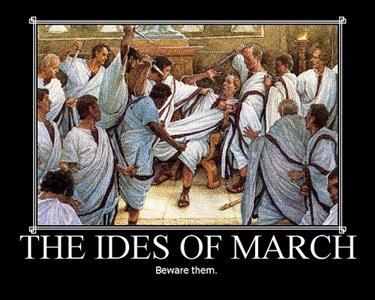
In my high school, the better students, in the two Academic class sections, received instruction in Latin in 9th and 10th grade. Our Latin teacher had a curious personal custom. He sacrificed annually in honor of Great Caesar, on the Ides of March, the male student in each class who had offended him by doing the least work and/or being the most disruptive. He sacrificed additionally one female student from each class whose selection, I fear, was based only upon his own capricious whim and covert sexual attraction.
The sacrifice consisted of the victim being bent over a desk and receiving three strokes of a paddle, delivered by a six foot+, 250 lb.+ Latin teacher laying on the strokes with a will and putting his weight behind them. (I won’t name him.) Mr. X’s paddle was a four foot long piece of 1 1/2″ thick pine, produced in our high school’s wood shop by General Curriculum students, who did not take Latin, but admired Mr. X. The paddle was roughly in the form of a Roman gladius, and its surface was scored by a series of regular lines, because it was generally believed that a blow from an uneven surface was more painful.
Mr. X had a fixed policy of assigning the duty of construing the day’s Latin assignment on the blackboard in strict and completely predictable order, going up and down the aisles of desks. Two or three of the smart kids would always actually do the Latin, (I was one of them) and it was our recognized duty to supply the translations in advance to the person who would be going to the blackboard.
Readiness to translate correctly was really vital, because Mr. X would apply his dreaded paddle to anyone who failed to write out the day’s assignment correctly on the blackboard. It was rare, but every once in a while some truly feckless idiot would neglect to seek out Kenny Hollenbach, Jack Rigrotsky, or yours truly, and would arrive at the blackboard, chalk in hand, unprepared.
Mr. X typically broke the current paddle over the defaulter’s posterior, and the mental defectives in shop class would gleefully commence the fabrication of a new, yet more elaborate, edition of the famous paddle.
Every March 15th, two 9th and 10th grade Academic Curriculum sections would look on with the same sadistic interest of Roman spectators at the gladitorial games, as Mr. X conducted his sacrifices. I can recall that he struck the pretty strawberry blonde with the well-developed embonpoint so hard that he raised dust from her skirt. We were a bit puzzled that girls actually submitted to being beaten with a paddle for no reason, but all this went on undoubtedly because the legend of Mr. X the fierce disciplinarian had enormous appeal in our local community. The whole thing was fascinating, and it all made such a good story that everyone, student and adult, in his heart of hearts, enthusiastically approved.
Mr. X would never be allowed to get away with that kind of thing today. Alas! In Hades, poor Caesar must do without his sacrifice. And it is my impression that Latin instruction has rather overwhelmingly also become a thing of the past. Kids today learn Spanish. Modern languages are easier and are thought more relevant.
My high school Latin teacher is the large chap wearing glasses. He also coached one of our sports teams.
Amazon.com Inc. said it recently removed a three-year-old book about transgender issues from its platforms because it decided not to sell books that frame transgender and other sexual identities as mental illnesses.
The company explained its decision in a letter Thursday to Republican Sens. Marco Rubio of Florida, Mike Lee of Utah, Mike Braun of Indiana and Josh Hawley of Missouri, which was reviewed by The Wall Street Journal. The senators had written last month to Chief Executive Jeff Bezos requesting an explanation of why “When Harry Became Sally: Responding to the Transgender Moment” was no longer available on Amazon nor on its Kindle and Audible platforms.
“As to your specific question about When Harry Became Sally, we have chosen not to sell books that frame LGBTQ+ identity as a mental illness,” Amazon said in the letter, which was signed by Brian Huseman, Amazon’s vice president of public policy, referring to sexual identities that include lesbian, gay, bisexual and transgender, among others.
“When Harry Became Sally,” written by the conservative scholar Ryan T. Anderson, was published in February 2018. The book focuses on a variety of issues including gender identity.
“Everyone agrees that gender dysphoria is a serious condition that causes great suffering,” said Mr. Anderson and Roger Kimball, the publisher of Encounter Books, the New York-based nonprofit that published the book, in a statement Thursday in response to Amazon’s letter.
“There is a debate, however, which Amazon is seeking to shut down, about how best to treat patients who experience gender dysphoria,” they added, calling their book “an important contribution” to that conversation. “Amazon is using its massive power to distort the marketplace of ideas and is deceiving its own customers in the process,” they said.
Amazon’s decision comes as the nation’s largest tech platforms are under increased scrutiny regarding the decisions they make over which content is acceptable.
There are many intensely-charged cultural and political issues on which rational, well-educated men will inevitably disagree.
The etiology and moral status of homosexuality and gender dysphoria is a striking example of just such a controversy.
So, how has it come to pass that large consumer corporations, like Amazon, have recently appointed themselves as dictators and Platonic Guardians in charge of deciding in favor of the preferred position of the Radical Left, and using their business platforms and strategic position in Society to shut down debate and outlaw the very existence of an alternative viewpoint in polite society?
We shop at Amazon, but nobody elected Mark Zuckerberg or Brian Huseman to any position in charge of “public policy” of any kind.
If the owner of my local grocery or hardware store got too big for his britches and started telling customers how to vote and what to think, he obviously wouldn’t stay in business very long.
The Big Tech billionaires, sitting on top of companies currently enjoying accidental and ephemeral de facto monopolies are flushed with wine and insolence. They must have read too many left-wing sophisters and economists who tell you that such marketplace predominance is totally defensible, permanent, and secure. They are dead wrong. Alta Vista, not so very long ago, was the cat’s pajamas of search engines. Yahoo and AOL used to be hot stuff. The examples of absolutely sector dominant companies that are now one with Nineveh and Tyre is limitless.
Amazon can be replaced, and I have news for Mr. Zuckerberg: he has pissed away serious quantities of customer loyalty and good will. I used to like and admire Amazon. I preferred shopping with Amazon. Not anymore. Venture Capitol, just offer me any reasonable alternative and I will be delighted to drop Amazon and all the rest of today’s Big Tech Dictatorships permanently. That happy day is coming. Count on it, Amazon!
Ron Liddle, in the UK Spectator, looks disfavorably on the Duke and Duchess of Netflix and Oprah to boot.
The USA is the least communalistic and most individualistic nation of any on Earth. It is written into their Declaration of Independence that an individual’s right to the pursuit of happiness trumps, if I can use the word, every other consideration. It is all a little alien to us over here in Britain, which is one reason why we tend to find Meghan Markle a repulsive creature. What the ghastly Oprah Winfrey and indeed Hillary Clinton do not understand is that if there was any resentment towards Meghan in the UK, it was not because she is of mixed race, but because she is American and behaves like a caricature of a particularly stupid American. The color of her skin matters not a jot: it is the noisome ordure which spews out of her mouth on a daily basis that grates. Again, the narcissism and self-obsession and the acquired victimhood, the vapid and banal attempts at self-justification.
The American insistence on the primacy of the individual also explains Meghan’s different interpretation of two words which we, over here, think we understand clearly: ‘duty’ and ‘truth’. When her idiot husband was told he would not be getting back his honorary military ranks, the two of them (i.e. Meghan) released an emetic statement to the press suggesting that there were many ways one might perform one’s duties. No. Duty is something imposed and involves self-sacrifice, discipline and obedience. It does not mean doing what the hell you like, which is what the two of them have done. But if you are a country which doubts the validity of a communal ethos of ‘duty’, then Meghan’s standpoint is one you may well arrive at, especially if you are not terribly bright.
Similarly, Markle was asked about ‘her’ truth. People don’t have their own truth. There is truth and there is falsehood, and there’s an end to it. But once more, the native ideology devolves the concept of truth down to the individual level, regardless of whether it is truth at all. It is from America that we have imported the morally and rationally bereft progressive ideology that insists that if people feel they have been victimized, then they have been. And that everybody can be whatever they want to be, regardless of the facts. Elevate the individual — beyond reason, beyond government, beyond God — and this is what you get: a D-list sleb who married well thinking she has been victimized and is in possession of a ‘truth’ which runs counter to the truth.
The cultural divide broadens still further when we consider Oprah Winfrey, one of America’s greatest mysteries. But boy, does she have hauteur and dominion. It is very difficult for us to understand why the Yanks so revere the woman. She is an appalling interviewer, seemingly utterly incurious, every question submitted for approval and the answers rehearsed over and over again. Ill-informed, incapable of asking an interesting question, always slightly more regal than whoever it is she is interviewing. There is no intellect on display, just a perpetual desire to paddle about in the shallows, or indeed barely skim the surface, of the subjects before her. But then she subscribes to the same inane ideology — that Meghan Markle has a truth that is equally valid to the truth, and who is she to question that validity? Anti-journalism. It was rumored she might one day run for office. I think she’d be perfect for the East and West Coast voters, a conduit of witless acceptance of every meaningless liberal shibboleth to which those deluded people subscribe.
I think he’s perfectly right in despising these people’s attitudes, but I think his notions of “individualism vs. communalism” are wildly inaccurate.
The older America was, as Tocqueville noted, both enormously individualistic, but also intensely dutiful and civic-minded. No one would have accused, for instance, Davy Crockett and Jim Bowie of a lack of individualism, but both were perfectly prepared to give their lives for the liberty of their countrymen.
What’s wrong with Meghan, Oprah, et. al. isn’t rugged individualism, their afflictions are infantilism, narcissism, self-entitlement, and sanctimony. Meghan and Oprah are selfish, it’s true, but they are also among the least individualistic, the most tediously conformist people in the world.
Since we are already on the subject of insane collecting obsessions and astounding prices, I figure I may as well pass along this video discussion of the latest case of time-keeping conspicuous consumption from Cartier.
I bought a Rolex decades ago, and I still find it rather loco to think $29K is a price worth paying for a watch (unless you are Jeff Bezos or Bill Gates), but other people’s enthusiasms and obsessions I do find rather interesting and I occasionally sit through these watch nerd videos.
I guess he’s right: there is something impressive about top-end innovative design and extreme connoisseurship. Alas! those of us who neglected to acquire high-end positions at Goldman Sachs will probably not be engaging in this kind.
Ward’s Auctions Item 10010 “CHRISTMAS BOX!!! UMC, ”CLUB”, 12 Gauge, 2 5/8” … “VERY DIFFICULT TO FIND AND COVETED BY COLLECTORS!!! Grade: Excellent ++ – Value: 20000 to 50000”
It takes all kind of people to make a world and different people naturally have different hobbies and collecting interests.
Still, a number of us gun nuts were frankly astounded when one discussion group member passed along a link to the above auction lot.
This item is an old-time Christmas edition box that contained 100 2 5/8″ 12 gauge Union Metallic Cartridge Company shotgun shells, the equivalent of four normal boxes. 2 5/8″ length 12 gauge is a lighter chambering more commonly found in English-made double-barrel shotguns and in very old American guns. The usual modern American chambering is 2 3/4″.
This box was empty. The buyer got no shotgun shells. It had been “professionally restored,” and sealed and was filled with “NPE” — whatever that is.* The box doesnt even tell you how many drams of powder those shells were loaded with, or what size shot they contained. I assume they must have been Number 6 shot. It sold for –hold onto your seat!– $22,000.00 plus a 15% buyer premium, a total of $25,300.00. Wow!
The sporting scenes on the top and sides of the box are nice examples of nostalgic Americana, dating, I’d estimate, from circa 1910 to 1920.
I knew that there were folks out there who collected cartridges and others who collected period sporting advertising. I’m not surprised to find that there are people who’d like to own this empty shotgun shell box, but I find the price this thing went for downright astounding. You could obviously go right out a buy a nice Purdy shotgun for that kind of money, which seems obviously a lot better than an empty box.
I guess this one must be essentially the Holy Grail of shotgun shell boxes.
———————–
* Correction: “NPE” is “new primed empty.” And it does contain shotgun shells, just empty, already primed ones, that you could load with powder and shot yourself. That explains why no dram measurements or shot sizes.
I had no idea that, back then, they sold shotgun shells in this form.

Thomas Cole, The Course of Empire: Destruction, 1833-1836, New York Historical Society.
Dr. Srdja Trifkovic warns that the Abendslandes are Unterganging awfully badly these days.
[F]or over a century—at least since Oswald Spengler’s Decline of the West was published in 1918—there have been warnings by philosophers, political scientists, theologians and others, mainly disbelievers in “progress” and the improvability of man, that our civilization is in peril. They make use of a massive body of evidence to point out that we live in abnormal times, characterized by the collapse of moral norms and civilizational standards on both sides of the Atlantic Ocean. The malaise is strikingly augmented in our own time by the metastatic growth of Weiningerian self-hatred throughout the Western world.
Over the past year the U.S. sociopolitical system’s crisis has acquired a mature form, with increasingly frequent outbursts of acute dysfunctionality. The process is manifested primarily in the legitimization of violence, debasement of the “democratic process,” imposition of crude forms of censorship, and criminalization of words and actions unacceptable to the Beltway regime and its cohorts in the media, Big Tech, the academe, and Hollywood.
A horrid new order is being set up. For a brief while it may yet resemble the Old Republic, but only as Count Dracula resembles a living person.
On the eastern side of the Atlantic, much of Europe is being transformed culturally and demographically into a gross caricature of its former self. Its southern maritime border is as porous as the U.S. border with Mexico. Europe’s “secular theocracy” (to borrow Paul Gottfried’s pertinent term) is focused on reforming and reshaping its subjects’ conscience to accept multicultural self-annihilation as an attitude, a set of beliefs, and mandatory policy.
As a result, the Old Continent is increasingly populated by aliens physically residing in Berlin, Toulon, or Leeds, but spiritually in Anatolia, Punjab, or the Maghreb. They are often desperate to get to Europe, but once established there they want to replicate the cultural environments of their unpleasant native lands in their new abode. Full of scorn for the hosts’ cultural Marxist professions of “tolerance” and “diversity,” their disdain is unappeased by groveling concessions.
Today’s “United Europe” is light years away from the civilized and, on the whole, decent community of nations which existed before 1914. The EU does not create social and civilizational commonalities, except on the basis of wholesale denial of authentically European standards and values. The result is dreary cultural sameness of anti-discriminationism and anti-Christian veneration of Otherness.
Nor have the controllers of the EU machine given up on their Superstate project after Brexit. In the loss of diversity of social evolution that goes alongside the diminishing diversity of nature, they seek the obliteration of the identity of European nations, their special color and uniqueness. They see national elections (e.g. in Hungary or Poland) as a nuisance which throws reactionary sovereigntist spanners into their works, such as imposing mandatory quotas of Muslim immigrants on each member country. Their obsessions, which but two generations ago would have been deemed eccentric or insane, now dominate the Western mainstream.
Almost a century ago Julien Benda published his diatribe against the intellectual corruption of his times, The Treason of the Intellectuals. The “Treason” happened when the intellectual elite gave up promoting lasting civilizational values and allowed short-term political preferences to distort their understanding of the intellectual vocation as such. In 1920s Europe, intellectuals started discarding their regard for traditional philosophical and scholarly ideals, venerating particularisms and moral relativism instead.
Half a century later Christopher Lasch diagnosedthe mature form of Benda’s “treason.” Alluding to José Ortega y Gasset’s Revolt of the Masses, Lasch called his collection of essays The Revolt of the Elites. The phenomenon’s key feature is the detachment of the new professional-managerial elites—lawyers, media commentators, academic experts, think-tank analysts, financial planners, etc.—from traditional, naturally emerging communities. This new elite exists in the abstract world of manipulating information inputs and figures. It generates a new, strongly ideological form of political discourse which is based on secularism, moral and cultural relativism, and its members’ rejection of any sense of attachment to the wider community.
To wit, at the White House Conference on the Industrial World Ahead in February 1972, Carl Gerstacker, Chairman of Dow Chemical, outlined his vision of the “anational” corporation of the near future. “I have long dreamed of buying an island owned by no nation,” he said, and of establishing the Dow world headquarters there, “beholden to no nation or society.”
Two years later, Richard Gardner enthusiastically asserted in Foreign Affairs that the “house of world order” will have to be built from the bottom up rather than from the top down: “an end run around national sovereignty, eroding it piece by piece, will accomplish much more than the old-fashioned frontal assault.” This was clearly a variation of the Gramscian theme of the long march through the institutions. For his vision and efforts Gardner was subsequently rewarded by Jimmy Carter with ambassadorships to Spain and Italy.
In the same spirit, Bill Clinton’s Deputy Secretary of State Strobe Talbott declared shortly after leaving office that the United States won’t exist “in its current form” in the 21st century because the concept of nationhood itself will become obsolete. Talbott stated in 1992, and reiterated in his 2008 book, The Great Experiment, that in the 21st century “nationhood as we know it will be obsolete; all states will recognize a single, global authority and that all countries are basically social arrangements, accommodations to changing circumstances. No matter how permanent and even sacred they may seem at any one time, in fact they are all artificial and temporary.”
In short, members of the Western elite class know no loyalty to country or nation. They seek a peculiar end of history in the transformation of deracinated and brainwashed hoi polloi into a postmodern sociotechnological system regulated by themselves. Their edifice rests on the dictum that countries do not belong to the people who have inhabited them for generations, but to all who happen to be within their boundaries at a given moment. Enlightened persons must not feel a bond for any group except for allegedly underprivileged minorities. Accordingly, they actively promote self-destruction and encourage self-hate of Caucasians and demonize all white male heterosexuals. They seek the final blending of races, genders, and the burgeoning array of sexual preferences into a pliable melange ruled by Dr. Talbott’s Single Global Authority.
Talk about your yard sale finds. A small porcelain bowl bought for $35 at a Connecticut yard sale turned out to be a rare, 15th century Chinese artifact worth between $300,000 and $500,000 that is about to go up for auction at Sotheby’s.
The white bowl adorned with cobalt blue paintings of flowers and other designs is about 6 inches (16 centimeters) in diameter. An antiques enthusiast came across the piece and thought it could be something special when browsing a yard sale in the New Haven area last year, according to Sotheby’s.
The piece, one of only seven such bowls known to exist in the world, will be up for auction in New York on March 17 as part of Sotheby’s Auction of Important Chinese Art.
The buyer, whom is not being named, paid the $35 asking price and later emailed information and photos to Sotheby’s asking for an evaluation. The auction house’s experts on Chinese ceramics and art, Angela McAteer and Hang Yin, get many such emails every week, but this was one of the kind they dream about.
“It was immediately apparent to both of us that we were looking at something really very, very special,” said McAteer, Sotheby’s senior vice president and head of its Chinese Works of Art Department. “The style of painting, the shape of the bowl, even just the color of the blue is quite characteristic of that early, early 15th century period of porcelain.”
They confirmed it was from the 1400s when they were able to look at it in person. There are no scientific tests, only the trained eyes and hands of specialists. The bowl was very smooth to the touch, its glaze was silky and the color and designs are distinctive of the period. …
McAteer and Yin determined the bowl dates back to the early 1400s during the reign of the Yongle emperor, the third ruler of the Ming Dynasty, and was made for the Yongle court. The Yongle court was known to have ushered in a new style to the porcelain kilns in the city of Jingdezhen, and the bowl is a quintessential Yongle product, according to Sotheby’s.
The bowl was made in the shape of a lotus bud or chicken heart. Inside, it is decorated with a medallion at the bottom and a quatrefoil motif surrounded by flowers. The outside includes four blossoms of lotus, peony, chrysanthemum and pomegranate flower. There are also intricate patterns at the top of both the outside and inside.
McAteer said only six other such bowls are known to exist, and most of them are in museums. No others are in the United States. There are two at the National Palace Museum in Taipei, Taiwan, two at museums in London and one in the National Museum of Iran in Tehran, according to Sotheby’s.
How the bowl ended up at a Connecticut yard sale remains a mystery. McAteer said it’s possible it was passed down through generations of the same family who did not know how unique it was.
The Brienne trunk contained over 5000 undelivered letters.
Inverse.com reports that a new technology is being used to read undelivered and still sealed 17th century mail.
Simon and Marie de Brienne were the 17th century’s most active postmaster and postmistress, delivering personal and political letters alike across Europe. But the Briennes also had a secret.
In addition to delivering letters, they stored away for thousands of “dead letters” — the typically discarded letters belonging to recipients who couldn’t pay postage. Rediscovered in 1926, the Brienne’s trunk is the final resting place of over 5,000 letters. Nearly half have never been opened for fear of destruction.
Now, using X-ray microtomography instead of a letter opener, a team of scientists has opened one of these letters for the very first time and demonstrated their pioneering new system on four letterpackets from Renaissance Europe.
Why it matters — This system gives scientists a powerful new tool for accessing the daily-lives of Renaissance people and for better understanding what the personal, professional, and political pressures of the day might have been like.
It also offers scientists an opportunity to explore one of history’s ancient security measures, a “letterlock.” This is an early, physical predecessor to today’s modern cryptography.
“[W]e developed virtual unfolding to prove our letterlocking theories, and elucidate a historically vital — but long underappreciated — form of physical cryptography,” write the authors.”
The research was published Tuesday in the journal Nature Communications.
Here’s the background — Long before the invention of email, or even bitter-tasting lickable envelopes, Renaissance correspondents had to think more creatively about the safety of their epistolatory works. One way that these letters were kept safe, write the authors, was through intricate, origami-like letterlocks.
“Before the proliferation of mass-produced envelopes in the 1830s, most letters were sent via letterlocking, the process of folding and securing writing [materials] to become their own envelopes,” the authors explain.
“Letterlocking was an everyday activity for centuries, across cultures, borders, and social classes, and plays an integral role in the history of secrecy systems.”
The authors write that in their study of 250,000 letterlocked messages (beyond the Brienne haul) from the “Renaissance world,” they discovered a spectrum of security systems, ranging from simply sealed to booby-trapped letters with tamper-evident locking mechanisms to deter “man-in-the-middle” attacks.
In other words, a mechanism that would secretly signal to the recipient if others had snuck a peek at their secret writing.