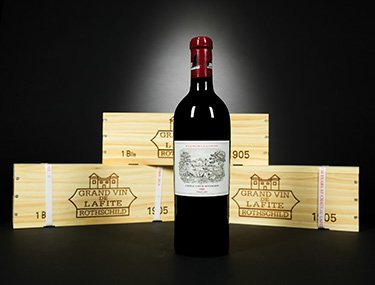
Elin McCoy, of Bloomberg, reports on her six-course dinner with lots of vintages tasted at Chateau Lafte-Rothschild.
The intimacy of the evening was reflected in the cuisine familiale menu. We took our seats and soupe VGE arrived—individual tureens filled with delicate broth, winter vegetable, and truffles covered in puff pastry—the first of six courses. To accompany it, Eric picked an intense, truffle-scented 2005 Château L’Evangile from the Rothschilds’ Pomerol estate. Also poured was a smooth, seductive, and rich 1989 Château Duhart-Milon, the neighboring fourth growth that the family purchased in 1962; it was astonishing how well it aged. If anything at the upcoming auction could be considered a bargain, this is it, with an estimate of $1,000 to $1,500 for a case of 12 bottles.
The main course was a simple boeuf a la ficelle—beef filet with a tangy, minty green sauce, surrounded by tender leeks, scallions, carrots, and turnips—and with it, Lafites from both 1989 (estimate: $4,000 to $6,000 for 6 bottles) and 1959 (estimate: $3,000 to $4,600 for one bottle). The former was gulp-able and voluptuous, with layers of spice, cassis, and cedar. And the latter? Deep-colored and concentrated, with notes of mint, cedar, truffle, and tobacco, the 1959 is the greatest Lafite I have ever drunk; the epitome of harmony and velvety elegance. This is its moment, but it seems like it could live on this plateau for decades. Wais Jalali, the CEO and Chairman of private equity firm Cerebrus LLC and whose cellar includes 48,000 bottles, declared it “the wine of the night.â€
Cheese appeared, and with it came the biggest surprise of the evening: the delicate 1905 Lafite (estimate: $3,000 to $4,800 for one bottle). At 114 years, it showed the kind of longevity Lafite is known for, demonstrating why perfect storage conditions are so important when buying old wines. With its silky texture, ethereal scents of plums and currants, and a long finish, it suggested to me a long-ago world.
The meal ended with a creamy lemon mousse, paired with an apricot-scented, opulent 1989 Château Rieussec, which unfortunately will not be available at the upcoming auction.
Afterward, we settled into the small, cozy, adjoining salon, where several guests puffed on Cuban cigars and we sipped an old Mirabelle and Lafite’s private label of Tres Vieille Reserve Cognac. I reflected on the pleasure of decades-old wines.
“Every wine has its moment, but you have to choose the right moment,†the baron had explained on the cellar tour. Each of the wines poured demonstrated that perfectly. Most of these vintages are available in the upcoming auction, but only the single bottle of 1868 (estimate: $13,000 to $20,000) includes dinner at the château. I’d happily pay that much for dinner alone.
A number of Democrats have proposed changes to the structure of government that they think would help them win, such as lowering the voting age to 16, abolishing the Electoral College, packing the Supreme Court, and changing how Senate seats are allocated. Now, though, some of the Democratic presidential hopefuls are attacking the heart of the matter: what they call an “outdated Constitution†that sometimes “allows Republicans to be elected.â€
“The election of Trump exposed a fundamental flaw in the Constitution,†Senator Elizabeth Warren said at a campaign rally. “Everyone said Hillary was supposed to win, but she didn’t. And we’re afraid that in the future, maybe Democrats won’t win again. We can’t allow that.â€
Warren and numerous other Democrats have proposed an amendment to the Constitution that will state that only Democrats are allowed to win elections, a proposal they say will increase election “fairness.â€
“When I think about someone other than a Democrat being elected,†said Senator Cory Booker, “it makes me so mad.†He then raised his fists and shook them, a gesture indicating he was mad. Candidate Beto O’Rourke also spoke out for the proposed amendment, though all he got out was, “It’s a great–†before skateboarding into a tree and quickly fleeing the scene of the incident.
Yuval Levin, in NR, explains why the old WASP elite was really more meritorious than the modern Meritocracy.
For much of American history .. [t]he apex of American political, cultural, and economic power was largely the preserve of a fairly narrow white, Anglo-Saxon, Protestant near-aristocracy, centered in the Northeast and exercising power across generations. This was never an absolute barrier to others’ rising, of course, but it was a major obstacle.
The claim to power of this WASP elite, like that of most modern aristocracies, was a mix of heritage and rearing. They possessed their privileges by virtue of their birth, but they were raised and educated in ways intended to prepare them for responsibility and authority. And they were—at least in principle though in many cases also in practice—expected to subject themselves to a code of behavior, a commitment to public service, a degree of personal reticence, a regard for the rules of fair play, and a sense of responsibility that was rooted in the implicit recognition that their power was an inherited privilege, not an earned achievement. …
This new aristocracy is in some important respects less reticent about its own legitimacy than the old. Because each of its members must work to prove his merit—to pass the key tests, and clear the key hurdles—today’s elite is more likely to believe it has earned its power, and possesses it by right more than privilege. Because our elite as a whole has inclined to this view, it tends to impose fewer restraints on its own uses of power, and generally doesn’t subscribe to the kind of code of conduct that sometimes characterized past aristocracies. Even when today’s elites devote themselves to public service, as many do, they tend not to see it as fulfilling an obligation to give back for an unearned privilege but as further demonstrating their own high-mindedness and merit.
A meritocracy naturally assumes its authority is merited. But rather than prove its worth by its service to the larger society, the idea of merit at the core of our meritocracy is radically individualistic and dismally technocratic. The sort of elite that results implicitly substitutes a cold and sterile notion of intellect for a warm and spirited understanding of character as its measure of worth, and our society (including some elites themselves) increasingly cannot escape the intuition that this is an unjustifiable substitution. But rather than impose tests of character on itself, our elite inclines to respond to these concerns with increasingly intense displays of its ideal of social justice. It doubles down on the logic of meritocracy, adopts the language of privilege in its critiques of the larger society, and pushes for even more inclusive criteria of admission to elite institutions—all in an effort to make its claims to legitimate authority more persuasive.”
In the short-haired, jacketed-and-tied all-male Yale of 1966, we hung our overcoats and left books and other personal property in the coatroom without a thought. No one would steal. There were silver water pitchers and sugar bowls engraved with the respective residential college arms in the dining halls.
In the long-haired, informal, coeducated and triumphantly meritocratic Yale of 1971, everyone left their coats and books on chairs in the Common Room within sight of the Dining Hall. If you left them unobserved, someone might walk off with them. The silver water pitchers and sugar bowls were all gone, stolen by the meritorious. I myself saw, on separate occasions, groups of undergraduates walking out of both the Skull & Bones tomb and the Berkeley College Common Room, carrying away expensive oriental rugs. The common rooms gradually emptied down to the very large leather couches, which were too big to fit in undergraduate rooms. Students had appropriated for personal use the common room lamps, chairs, and side tables.
And, personally, I don’t think the Meritocracy of that time has changed a lot over the years.
32,000 yrs ago an Arctic ground squirrel cached some fruit in its burrow, which was later sealed by sediment & frozen. In the 2000s scientists unearthed the fruit & cultivated its tissue. It grew into this: a Pleistocene ancestor of the narrow-leafed campion (Silene stenophylla)
Some of the excavated squirrel burrows contained *hundreds of thousands* of ancient fruit & seeds. All that genetic information—the ungerminated generations, the apparitions of Ice Age Earth—frozen in time & place, preserving the possibility of resurrection.
Es muy raro verlos, pero están. 2 aguará guazú en la Provincia de Corrientes, en plena cosecha de arroz. Caricias de la Creación. pic.twitter.com/c59M4W6Kwx
Sid Vicious plus William Butler Yeats equals Shane MacGowan.
Matthew Hennessey, meanwhile, in the City Journal notes that you couldn’t kill Shane MacGowan with a stick.
They say God takes care of fools and drunks. If so, he’s been working overtime the last few decades taking care of Shane MacGowan. As the frontman and principal songwriter of the Irish rock band the Pogues, MacGowan is as famous for his lyrics and whiskey-timbered voice as for his unlikely longevity, despite a Homeric appetite for intoxicating substances, especially, but not limited to, alcohol. Though he cuts a shambolic figure, MacGowan is still upright at 56, a feat many view as a minor miracle. His rheumy eyes and distinctive throat-clearing cackle suggest not genius, necessarily, but late-stage dipsomania; there is nary a tooth left in his head. God or something like God must be taking care of MacGowan. He’s not been doing the job himself.