HT: Vanderleun.

16 Apr 2018
Sod Off, Swampy!
"Sod Off Swampy", Britain, Greenpeace, Instapundit, International Petroleum Exchange, The Left, The Right Stuff


Glenn Reynolds remains as indefatigable, witty, and preeminent among conservative bloggers as usual. One of his particularly effective blogging techniques is the use of amusing, and implicitly classifying and categorizing, post titles.
I happened to notice his use the other day of a scornful response to left-wing insolence and irrationality: “Sod off, Swampy!”, and I began wondering where that came from.
So I looked it up, and found that it goes back to a Greenpeace protest at London’s International Petroleum Exchange in 2005.
The London Times reported:
Kyoto protest beaten back by inflamed petrol traders
WHEN 35 Greenpeace protesters stormed the International Petroleum Exchange (IPE) yesterday they had planned the operation in great detail.
What they were not prepared for was the post-prandial aggression of oil traders who kicked and punched them back on to the pavement.
“We bit off more than we could chew. They were just Cockney barrow boy spivs. Total thugs,†one protester said, rubbing his bruised skull. “I’ve never seen anyone less amenable to listening to our point of view.â€
Another said: “I took on a Texan Swat team at Esso last year and they were angels compared with this lot.†Behind him, on the balcony of the pub opposite the IPE, a bleary-eyed trader, pint in hand, yelled: “Sod off, Swampy.â€
Greenpeace had hoped to paralyse oil trading at the exchange in the City near Tower Bridge on the day that the Kyoto Protocol came into force. “The Kyoto Protocol has modest aims to improve the climate and we need huge aims,†a spokesman said.
Protesters conceded that mounting the operation after lunch may not have been the best plan. “The violence was instant,†Jon Beresford, 39, an electrical engineer from Nottingham, said.
“They grabbed us and started kicking and punching. Then when we were on the floor they tried to push huge filing cabinets on top of us to crush us.†When a trader left the building shortly before 2pm, using a security swipe card, a protester dropped some coins on the floor and, as he bent down to pick them up, put his boot in the door to keep it open.
Two minutes later, three Greenpeace vans pulled up and another 30 protesters leapt out and were let in by the others.
They made their way to the trading floor, blowing whistles and sounding fog horns, encountering little resistance from security guards. Rape alarms were tied to helium balloons to float to the ceiling and create noise out of reach. The IPE conducts “open outcry†trading where deals are shouted across the pit. By making so much noise, the protesters hoped to paralyse trading.
But they were set upon by traders, most of whom were under the age of 25. “They were kicking and punching men and women indiscriminately,†a photographer said. “It was really ugly, but Greenpeace did not fight back.â€
Mr Beresford said: “They followed the guys into the lobby and kept kicking and punching them there. They literally kicked them on to the pavement.â€
Last night Greenpeace said two protesters were in hospital, one with a suspected broken jaw, the other with concussion.
A spokeswoman from IPE said the trading floor reopened at 3.10pm. “The floor was invaded by a small group of protesters,†she said. “Open outcry trading was suspended but electronic trading carried on.â€
Eighteen police vans and six police cars surrounded the exchange and at least 27 protesters were arrested. A small band blocked the entrance to the building for the rest of the evening.
Richard Ward, IPE’s chief executive, said that the exchange would review security but denied that protesters had reached the trading floor. However, traders, protesters and press photographers confirmed to The Times that the trading floor had been breached.
15 Apr 2018
“Civilizations”
"Civilization" (1969), "Civilizations" (2018), David Olusoga, Kenneth Clark, Left Think, Mary Beard, Multiculturalism, Racial Politics, Relativism, Ressentment, Simon Schama

The late Kenneth Clark.
The BBC has decided to attempt to rebut Kenneth Clark’s magisterial tour d’horizon of Western Art, the 13-part 1969 television series “Civilization.” This rejoinder on behalf of our contemporary Woke Multicultural Establishment begins appearing Tuesday evening in the United States on PBS.
Kenneth Clark singlehandedly took viewers from Greek Antiquity to the 20th Century, but correcting Clark’s Eurocentric emphasis on Dead White Great Men apparently requires three presenters: Classicist Mary Beard, the talented (but respectably progressive) historian Simon Schama, and (the Nigerian and therefore full-fledged representative of the viewpoint of persons and cultures of Color) David Olusoga.
Andrew Ferguson, at the Weekly Standard, has seen the series, and warns us what to expect:
[Civilizations] is kind of Clark-like —a catalogue of glorious creations followed by a vision of an art form in an advanced state of spiritual exhaustion. The difference is that the decline of an art form saddened Clark. Each of the episodes of Civilisations that I’ve seen ends with a celebratory profile of a contemporary artist. Invariably their work suffers in comparison with what’s gone before—how could it not?—but the moments serve a summary purpose.
The episode called “How Do We Look?†closes with Kehinde Wiley, the artist who recently completed the official presidential portrait of Barack Obama. The narrator describes Wiley as a practitioner of “the modern art of the body,†which “draws its power†from “challenging the tradition of classical art.†Of course he lives in Brooklyn but “he has traveled all over the world to explore the legacy of colonialism and the different ways we see.†Suddenly we see him in the Metropolitan Museum of Art, moving from masterpiece to masterpiece. A tinny ensemble plays Vivaldi—a fusty reminder of the distant past. “I love the history of art,†he tells the camera. “I love looking at these beautiful images. But I also recognize that there’s something quite sinister about their past.â€
“Sinister†sounds judgmental, doesn’t it? So judgmental indeed that I don’t think even Clark used it at all in his Civilisation. But it nicely summarizes the attitude toward the West that viewers of the new Civilisations will find unavoidable, even if they’re confident enough to find it unpersuasive.
Next to life-enhancing, the most important word in Clark’s account of civilization was confidence. Several things came together to make a civilization, Clark said: a measure of material prosperity, a sense of history, a range of vision, and a feeling of permanence, of being situated in a particular moment between past and future, that makes it worthwhile to construct things meant to last.
“But far more,†he said, “it requires confidence—confidence in the society in which one lives, belief in its philosophy, belief in its laws, confidence in one’s own mental powers.†His program was an effort to persuade his audience that confidence in their inherited civilization was well-earned.
In the closing moments of the final episode of Civilisation, Clark intended to strike a note of optimism. “When I look at the world about me in the light of these programs, I don’t at all feel as though we are entering on a new period of barbarism,†he said. He shows us the campus of the then-new University of East Anglia. Apple-cheeked college students pop in and out of classrooms, labor over books—the baby boomers as Clark hoped they were in 1969. “These inheritors of all our catastrophes look cheerful enough. . . . In fact, I should doubt if so many people have ever been as well-fed, as well-read, as bright-minded, as curious, and as critical as the young are today.â€
Watching at home, we can assume, was the 14-year-old Mary Beard, all a-tingle and raring to go to college herself, where she could use her curiosity and reading and bright-mindedness to prove the great man and his theory wrong.
———————
A recent biography of Kenneth Clark and his “Civilization” series was recently discussed here.
15 Apr 2018
The Mueller Witch Project
Donald Trump, Michael Ramirez, Robert Mueller, Witchhunt

click on image for larger version.
14 Apr 2018
“Hamlet” — Really, A Book About Hunting
"Hamlet and the Vision of Darkness", "Hamlet", Books, Hunting, Rhodri Lewis, William Shakespeare

Legend has it that the young William Shakespeare was caught poaching deer at Charlecote Park and was brought up and charged before Sir Thomas Lucy, the owner and local magistrate.
James Shapiro, in the New York Review of Books, explains that Rhodri Lewis’ Hamlet and the Vision of Darkness, Princeton, October 2017, serves up a new interpretation of Hamlet.
No Freudian obsession with Gertrude, no too-much-cerebration-leading-to-inaction, no Harold Bloom and “The Invention of the Human”, no Humanism, at all.
Hamlet, it turns out, is really all about hunting.
Shakespeare repudiates two fundamental tenets of humanist culture. First, the core belief that history is a repository of wisdom from which human societies can and should learn…. Second, the conviction that the true value of human life could best be understood by a return ad fontes—to the origins of things, be they historical, textual, moral, poetic, philosophical, or religious (Protestant and Roman Catholic alike). For Shakespeare, this is a sham…. Like the past in general, origins are pliable—whatever the competing or complementary urges of appetite, honour, virtue, and expediency need them to be.
The fruitless search for absolutes by which to act or judge is doomed to failure: “Hamlet turns to moral philosophy, love, sexual desire, filial bonds, friendship, introversion, poetry, realpolitik, and religion in the search for meaning or fixity. In each case, it discovers nothing of significance.â€
The absence of any moral certainties means that it’s a “kill or be killed†world, and the most impressive chapter in Hamlet and the Vision of Darkness establishes how the language of predation saturates the play. Lewis’s brilliant analysis here gives fresh meaning to long-familiar if half-understood phrases, including the “enseamed†marital bed, “Bait of falsehood,†“A cry of players,†“We coted them on the way,†“Start not so wildly,†“I am tame, sir,†“We’ll e’en to it like French falconers,†and “When the wind is southerly, I know a hawk from a handsaw.†Thirty years ago this analysis might have been the basis of an important, if localized, study—but that sort of book could never find a major publisher today. Here, it becomes a clever way of establishing what for Lewis is the play’s bass line:
Whatever an individual might strive to believe, he always and only exists as a participant in a form of hunting—one in which he, like everyone else, is both predator and prey.
14 Apr 2018
Zuckerberg’s Suit-and-Tie
Ann Althouse, Mark Zuckerberg, Men's Attire
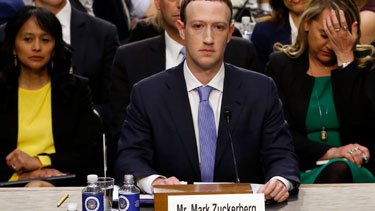
Ann Althouse snarkily quotes Robin Givan of NPR on Mark Zuckerberg’s choice of attire for testifying before Congress.
This was sort of a grudging suit and tie. The tie wasn’t really knotted very well. It kind of hung loosely from his neck.
“His shirt looked like it was a bit too big. The suit kind of looked like, OK, here’s the most basic suit I can find…. and that’s not to say that the suit wasn’t expensive. It simply wasn’t tailored…. This was a moment when this 33-year-old sort of disruptor really had to come face to face with the fact that he was no longer disrupting. He was in a position in which he had to fix things. And the suit really just underscored very visually that [Zuckerberg] was crossing from being an outsider into now being an insider…. He has, one, used fashion as a way to distinguish himself and to send a message about what it is that he believes he’s doing and where his company is situated in the broader cultural context. But I also think it matters because one of the reasons these hearings are in fact televised is because they are political theater. Part of theater is the costuming, and that helps us understand who the players are, what their goals are and what the messaging is.”
Then, in characteristic Althouse fashion, herself delivers the coup de grace:
I agree that it’s theater. But:
1. All clothing is theater (the RuPaul adage is “We’re all born naked the rest is drag”), and…
2. We need to ask what theater he provided, and I disagree that the bad suit and tie showed that he had crossed over to insiderdom. It would have been perfectly easy for the billionaire Zuckerberg to call in people to dress him in a perfectly fitting suit, a suit that would read to the theater audience as saying that he had arrived in the halls of power ready to assume what he acknowledges are the serious responsibilities that have arisen around him. By wearing a visibly bad suit, he sent the message that he is still the disruptive kid. The authorities got him into this suit, and he chose to look like the kid whose mom dressed him to go a funeral or whatever. He’s the guy who did what he had to and adopted the outward trimmings, but only and always with the look of intended to get back into his T-shirt and jeans.
—————————
Left coast billionaires wear hoodies and short pants as a badge of honor. Their ability to not wear a suit-and-tie, in their minds, proves that they’ve really made it, escaping the conventional servitude of the adult business world.
I blame my own generation.
When my graduating class arrived at Yale, you were required to wear a jacket-and-tie to dining hall meals. Yalies customarily consequently went around every day in sportcoats. Rebellious free spirits might remove their neckties, and fold them and put them in their pocket between meals.
Well. along came my own Yale class. It was very early in the semester that this troublemaker or that would show up for breakfast in pajamas sport coat & tie, which was soon inevitably followed by swimsuit jacket-and-tie, and finally nudity jacket-and-tie.
It really did not take very long before the Administration caved. After which… la Deluge.
There are geezers today, running around in t shirts and short pants, who still take pride in overturning the jacket-and-tie rule in Yale Dining Halls.
13 Apr 2018
Bill Clinton Presidential Portrait
William Clinton

The Clinton Library is open now…and they have unveiled the Official Portrait.
13 Apr 2018
What Went Into William Burroughs Coffin With His Dead Body

William S. Burroughs, born 1914 in St. Louis — died 1997 in Lawrence, KS. “The thing I like about Kansas is that it’s not nearly as violent [as New York City], and it’s a helluva lot cheaper. And I can get out in the country and fish and shoot and whatnot.”
From three poems by John Giorno:
About ten in the morning on Tuesday, August 6, 1997, James Grauerholz and Ira Silverberg came to William’s house to pick out the clothes for the funeral director to put on William’s corpse. His clothes were in a closet in my room. And we picked the things to go into William’s coffin and grave, accompaning him on his journey in the underworld.
His most favorite gun, a 38 special snub-nose, fully loaded with five shots. He called it, “The snubby.†The gun was my idea. “This is very important!†William always said you can never be too well armed in any situation. Of his more than 80 world-class guns, it was his favorite. He often wore it on his belt during the day, and slept with it, fully loaded, on his right side, under the bedsheet, every night for fifteen years.
Grey fedora. He always wore a hat when he went out. We wanted his consciousness to feel perfectly at ease, dead.
His favorite cane, a sword cane made of hickory with a light rosewood finish.
Sport jacket, black with a dark green tint. We rummaged through the closet and it was the best of his shabby clothes, and smelling sweetly of him.
Blue jeans, the least worn ones were the only ones clean.
Red bandana. He always kept one in his back pocket.
Jockey underwear and socks.
Black shoes. The ones he wore when he performed. I thought the old brown ones, that he wore all the time, because they were comfortable. James Grauerholz insisted, “There’s an old CIA slang that says getting a new assignment is getting new shoes.â€
White shirt. We had bought it in a men’s shop in Beverly Hills in 1981 on The Red Night Tour. It was his best shirt, all the others were a bit ragged, and even though it had become tight, he’d lost alot of weight, and we thought it would fit. James said, “Don’t they slit it down the back anyway.â€
Necktie, blue, hand painted by William.
Moroccan vest, green velvet with gold brocade trim, given him by Brion Gysin, twenty-five years before.
In his lapel button hole, the rosette of the French government’s Commandeur Des Arts et Lettres, and the rosette of the American Academy Of Arts and Letters, honors which William very much appreciated.
A gold coin in his pants pocket. A gold 19th Century Indian head five dollar piece, symbolizing all wealth. William would have enough money to buy his way in the underworld.
His eyeglasses in his outside breast pocket.
A ball point pen, the kind he always used. “He was a writer!â€, and wrote long hand.
A joint of really good grass.
Heroin. Before the funeral service, Grant Hart slipped a small white paper packet into William’s pocket. “Nobody’s going to bust him.†said Grant. William, bejewelled with all his adornments, was travelling in the underworld.
Not exactly my idea of a poem, but I do like many of the funerary offerings accompanying William Burroughs across the Styx.
12 Apr 2018
No Wonder There Are So Many Democrats!
Biology, DNA

The BBC reports that the human part of humanity is outnumbered.
More than half of your body is not human, say scientists.
Human cells make up only 43% of the body’s total cell count. The rest are microscopic colonists.
Understanding this hidden half of ourselves – our microbiome – is rapidly transforming understanding of diseases from allergy to Parkinson’s.
The field is even asking questions of what it means to be “human” and is leading to new innovative treatments as a result.
“They are essential to your health,” says Prof Ruth Ley, the director of the department of microbiome science at the Max Planck Institute, “your body isn’t just you”.
No matter how well you wash, nearly every nook and cranny of your body is covered in microscopic creatures.
This includes bacteria, viruses, fungi and archaea (organisms originally misclassified as bacteria). The greatest concentration of this microscopic life is in the dark murky depths of our oxygen-deprived bowels.
Prof Rob Knight, from University of California San Diego, told the BBC: “You’re more microbe than you are human.”
Originally it was thought our cells were outnumbered 10 to one.
“That’s been refined much closer to one-to-one, so the current estimate is you’re about 43% human if you’re counting up all the cells,” he says.
But genetically we’re even more outgunned.
The human genome – the full set of genetic instructions for a human being – is made up of 20,000 instructions called genes.
But add all the genes in our microbiome together and the figure comes out between two and 20 million microbial genes.

11 Apr 2018
“Free Speech” at Yale
Free Speech, Myths, Yale

Woodbridge Hall, home of the Yale Administration.
How leftist exactly is Peter Salovey’s Yale Administration? So leftist that its representatives will strong-arm Yale students to prevent them from counter-demonstrating when a leftist pseudo-labor organization (i.e., a “union” of graduate students) stages a “strike” in order to shakedown the university.
Current undergraduate Esteban Elizondo describes “free speech at Yale” today in the Washington Examiner.
In April 2017, the Yale College Republicans and I organized a counter-protest against graduate students’ symbolic “hunger strike†for unionization. Our counter-protest was a barbecue right next to the grad students, but either a mistake was made or someone regretted sanctioning our event, because a few hours after the event was approved, I received an email from Holloway asking for me to call him. That is when he delivered his admonition to me.
During the barbecue, participants were actively forbidden by Director of Administrative Affairs Pilar Montalvo from engaging with the graduate student union, lest we be shut down. Montalvo’s office had a view of the protests, and when we disobeyed, she stormed out onto the plaza wildly, reiterating her threats. I later learned that it was Montalvo, who works in the Office of the President, who contacted multiple deans at Yale to pressure me to cancel the barbecue.
Regardless of who is ultimately right, it is important that campuses encourage controversial discourse. It is through these conversations that we seek out truth, and intellectual controversy should be an essential part of any university. Yale shamefully attempted to stifle a peaceful counter-protest at multiple levels and forbade two ideologically different groups from engaging with each other.
The larger message Yale intended to send us was clear: Certain discourse is forbidden on campus. Yale simply maintains the facade of free speech to pacify students and the press while intentionally fostering a campus with little ideological debate. Yale professors usually prefer classes without rigorous debate, and I noticed that, controlling for quality, students generally received higher marks when they conformed to the professor’s opinion.



