(My apologies for inflicting on you the sanctimonious cant at the end of the video.)
“(…) Purple dye production was a gritty and often conspicuous, seaside business for those doing the intense manual labor required to harvest it. Although there are few other references to it, the Roman poet Martial alludes to the fact that Tyrian purple, named after the city of Tyre, retained a distinct, rather fishy smell even after it had been made into a garment. He mentions a certain Philaenis, who enjoyed wearing the luxurious textile for its smell rather than for its color. The poet also composed a list of bad smelling things that he would rather smell like than a woman named Bassa: sulphurous waters, a fish pond, an amorous goat, the old shoes of a veteran soldier, the breath of a Jew who had been fasting, ointment made from Sabine oil, and fleece twice dipped in Tyrian purple (‘bis murice uellus inquinatum’). Smelling worse than even a double-dipped fleece of Tyrian purple was quite the slur against the woman. (…)”
A metal detectorist has tracked down a rare gold coin from Richard III’s reign near to the site of the Battle of Bosworth.
The Half Angel is one of just a handful of such coins that have survived from the king’s two-year reign.
It was discovered by Michelle Vall while she was taking part in a charity detecting rally in September at Monks Kirby, near the Bosworth Field. News of the discovery has just come to light.
The coin will be auctioned international coins, medals and jewellery specialist Dix Noonan Webb in London on December 13. It is expected to fetch up to £15,000.
Christopher Webb, head of the coins department at Dix Noonan Webb, said: “This is a very rare discovery that has miraculously survived in a field for more than five centuries.
“Its importance as a coin is enhanced by the tantalising possibility that it may have belonged to one of Richard’s army, whose defeat at Bosworth ended the Wars of the Roses and ushered in the Tudor dynasty.”
Michelle, a 51-year-old primary school teaching assistant, from Blackpool, said: “After detecting for two-and-a-half hours in a farmer’s field, I got a signal.
“The coin was deep down, about 16 inches below the surface, and the soil there is thick clay so it took a bit of digging out.
“I spotted this glint of gold in the hole, although I obviously did not know exactly what it was at first. I put it in the palm of my hand and then I went back to the organisers’ tent.
“One of them identified it and people became very excited. That was when I realised that it was a Half Angel.â€
Michelle has decided to sell the coin as, she said, it is “too valuable to keep”.
She added: “I did not want to keep it in a locked cupboard.
“I feel very privileged that I have found something so precious and historic.
“The memory of that day, the excitement not just of myself but also of other detectorists, when I found that beautiful, tiny, piece of historic gold will live with me forever.â€
The Half Angel gold coin was first introduced in 1472 and was half the value of the Angel coin.
The rare gold coin was discovered near the site of the Battle of Bosworth
Richard III issues of the coin are rare because his reign was so brief and there has always been a big interest in items from the controversial king’s rein particularly since his remains were discovered in Leicester in 2012.
It is possible that the coin might have belonged to one of Richard’s soldiers fleeing from the battle that changed the course of English history.
At Thanksgiving, Victor Davis Hanson is grateful for our parents’ generation, the generation that won the War, particularly those like my own father who served in the Marine Corps.
Much has been written about the disappearance of these members of the Greatest Generation—there are now over 1,000 veterans passing away per day. Of the 16 million who at one time served in the American military during World War II, only about a half-million are still alive. …
More worrisome, however, is that the collective ethos of the World War II generation is fading. It may not have been fully absorbed by the Baby Boomer generation and has not been fully passed on to today’s young adults, the so-called Millennials. While U.S. soldiers proved heroic and lethal in Afghanistan and Iraq, their sacrifices were never commensurately appreciated by the larger culture.
The generation that came of age in the 1940s had survived the poverty of the Great Depression to win a global war that cost 60 million lives, while participating in the most profound economic and technological transformation in human history as a once rural America metamorphosed into a largely urban and suburban culture of vast wealth and leisure.
Their achievement from 1941 to 1945 remains unprecedented. The United States on the eve of World War II had an army smaller than Portugal’s. It finished the conflict with a global navy larger than all of the fleets of the world put together. By 1945, America had a GDP equal to those of Germany, Japan, the Soviet Union, and the British Empire combined. With a population 50 million people smaller than that of the USSR, the United States fielded a military of roughly the same size.
America almost uniquely fought at once in the Pacific, Asia, the Mediterranean, and Europe, on and beneath the seas, in the skies, and on land. On the eve of the war, America’s military and political leaders, still traumatized by the Great Depression, fought bitterly over modest military appropriations, unsure of whether the country could afford even a single additional aircraft carrier or another small squadron of B-17s. Yet four years later, civilians had built 120 carriers of various types and were producing a B-24 bomber at the rate of one an hour at the Willow Run factory in Michigan. Such vast changes are still difficult to appreciate.
Certainly, what was learned through poverty and mayhem by those Americans born in the 1920s became invaluable in the decades following the war. The World War II cohort was a can-do generation who believed that they did not need to be perfect to be good enough. The strategic and operational disasters of World War II—the calamitous daylight bombing campaign of Europe in 1942-43, the quagmire of the Heurtgen Forest, or being surprised at the Battle of Bulge—hardly demoralized these men and women.
Miscalculations and follies were not blame-gamed or endlessly litigated, but were instead seen as tragic setbacks on the otherwise inevitable trajectory to victory. When we review their postwar technological achievements—from the interstate highway system and California Water Project to the Apollo missions and the Lockheed SR-71 flights—it is difficult to detect comparable confidence and audacity in subsequent generations. To paraphrase Nietzsche, anything that did not kill those of the Old Breed generation made them stronger and more assured.
As an ignorant teenager, I once asked my father whether the war had been worth it. After all, I smugly pointed out, the “victory†had ensured the postwar empowerment and global ascendance of the Soviet Union. My father had been a combat veteran during the war, flying nearly 40 missions over Japan as the central fire control gunner in a B-29. He replied in an instant, “You win the battle in front of you and then just go on to the next.â€
I wondered where his assurance came. Fourteen of 16 planes—each holding eleven crewmen—in his initial squadron of bombers were lost to enemy action or mechanical problems. The planes were gargantuan, problem-plagued, and still experimental—and some of them also simply vanished on the 3,000-mile nocturnal flight over the empty Pacific from Tinian to Tokyo and back.
As a college student, I once pressed him about my cousin and his closest male relative, Victor Hanson, a corporal of the Sixth Marine Division who was killed on the last day of the assault on Sugar Loaf Hill on Okinawa. Wasn’t the unimaginative Marine tactic of plowing straight ahead through entrenched and fortified Japanese positions insane? He answered dryly, “Maybe, maybe not. But the enemy was in the way, then Marines took them out, and they were no longer in the way.â€
Found in John Alden’s house, built in 1653 using material from an earlier house erected in 1632, at 105 Alden Street in Duxbury, Massachusetts “in a secret protective cubbyhole near the front door of the home” during a 1924 renovation, this wheel-lock bears makers’ marks on the lock and barrel indicating it was made by the Beretta, family of Brescia, Italy, known to have been in business since 1526.
It is the only firearm brought over on the Mayflower known to have survived and it is preserved today in the collection of the National Firearms Museum operated by the NRA.
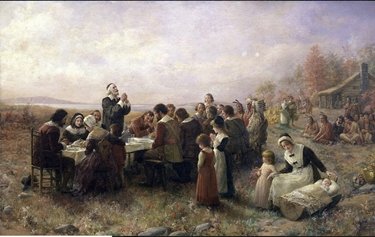
Mike Franc, at Human Events in 2005, identified the real reason for celebration at the first Thanksgiving.
Writing in his diary of the dire economic straits and self-destructive behavior that consumed his fellow Puritans shortly after their arrival, Governor William Bradford painted a picture of destitute settlers selling their clothes and bed coverings for food while others “became servants to the Indians,†cutting wood and fetching water in exchange for “a capful of corn.†The most desperate among them starved, with Bradford recounting how one settler, in gathering shellfish along the shore, “was so weak … he stuck fast in the mud and was found dead in the place.â€
The colony’s leaders identified the source of their problem as a particularly vile form of what Bradford called “communism.†Property in Plymouth Colony, he observed, was communally owned and cultivated. This system (“taking away of property and bringing [it] into a commonwealthâ€) bred “confusion and discontent†and “retarded much employment that would have been to [the settlers’] benefit and comfort.â€
Just how did the Pilgrims solve the problem of famine? In addition to receiving help from the local Indians in farming, they decided allow the private ownership of individual plots of land.
On the brink of extermination, the Colony’s leaders changed course and allotted a parcel of land to each settler, hoping the private ownership of farmland would encourage self-sufficiency and lead to the cultivation of more corn and other foodstuffs.
As Adam Smith would have predicted, this new system worked famously. “This had very good success,†Bradford reported, “for it made all hands very industrious.†In fact, “much more corn was planted than otherwise would have been†and productivity increased. “Women,†for example, “went willingly into the field, and took their little ones with them to set corn.â€
The famine that nearly wiped out the Pilgrims in 1623 gave way to a period of agricultural abundance that enabled the Massachusetts settlers to set down permanent roots in the New World, prosper, and play an indispensable role in the ultimate success of the American experiment.
A profoundly religious man, Bradford saw the hand of God in the Pilgrims’ economic recovery. Their success, he observed, “may well evince the vanity of that conceit…that the taking away of property… would make [men] happy and flourishing; as if they were wiser than God.†Bradford surmised, “God in his wisdom saw another course fitter for them.â€
The real story of Thanksgiving is the triumph of capitalism and individualism over collectivism and socialism, which is the summation of the story of America.
Sonny Bunch preps you for the inevitable Thanksgiving political arguments with your reactionary uncle.
The Jedi Are a Racist Space Aristocracy
Everyone watches the original trilogy and thinks “Hey, wow, this ‘Jedi’ thing is pretty cool. I can train to control the force and become a knight and help maintain order throughout the galaxy? Awesome!” As we learn in the prequels, though, this is not at all how it works: only those who are born with a certain genetic defect can control the force and this defect is hereditary, meaning the Jedi order is inherently dynastic and anti-meritocratic in nature. Speaking of people who lorded their genetic makeup over others…
Rebellion Celebrations Are Literally Naziesque
As I’ve noted elsewhere, George Lucas modeled the celebration at the end of A New Hope—where the non-white, non-human Chewbacca is denied a medal as a sea of pasty faces look on—on shots cribbed from Leni Riefenstahl’s work. I don’t want to go all Godwin on you, but even your drunk, backwards uncle doesn’t support Hitler, does he?
Colonialist Rebels Exploited Innocent Ewoks
So dig this my dudes: On the forest moon of Endor, the Empire was able to build a shield generator without really bothering the indigenous life forms. They coexisted in harmony, Empire and Ewok alike engaging in a live and let live philosophy. And then the Rebels show up, convince the Ewoks that C-3PO’s some sort of god, and enlist them in a holy war against the Empire! Not only that, they send their newfound teddy bear allies into battle armed with naught by sticks and stones against a garrison that is armed with lasers and AT-STs! AYFKM with this, man? Luke Skywalker is basically a latter-day Hernan Cortes. And, as we know, the conquistadors were history’s greatest monsters.
The Destruction of Alderaan Was Completely Justified
The only trump card that Republican apologists have left to play, at this point, is the notion that the destruction of Alderaan was some sort of horrible war crime. For a variety of reasons, this is ridiculous. However, all you really need to do is say this: “Grand Moff Tarkin was no worse than noted haberdasher and Democratic President Harry S. Truman.” Sometimes you gotta break a few eggs to maintain the peace, you know?
Ted Cruz Supports the Rebels
So there you are, a hip young millennial trying to explain why your bigoted, backwards uncle has it all wrong. Here’s YOUR trump: “You know who else supports the rebellion? That dope from Texas TED CRUZ.” You don’t even have to explain why this so obviously proves your point—it’s not your job to enact that labor, after all—because every non-backwards person at the table will recognize how smart you are and will call on your ignorant relative to just be quiet.
Check. And. Mate. Your Salon Dot Com internship is waiting, young sith.
The .45 ACP M1911A1 pistol has served the U.S. armed forces for more than a century in every war zone and hotspot on the planet — and thanks to this year’s federal defense budget, it will serve civilians for the foreseeable future.
The $700 billion 2018 National Defense Authorization Act that Congress sent to President Donald Trump’s desk on Nov. 16 included an amendment that required the Secretary of the Army to transfer a cache of small arms and ammo “no longer actively issued for military service†to the government-sponsored Civilian Marksmanship Program, including the M1911 and M1911A1 pistols, the M–1 Garand, and .22 rimfire rifles. …
The last transfer of 1911s to the CMP was in 2015, when President Barack Obama signed a defense bill that included a measure to transfer 10,000 pistols for sale to the program; lawmakers har stated that May that the DoD spends $2 a year to store each of its 100,000 surplus 1911s. With 10,000 already transferred and 8,300 additional pistols “sold or disposed of,†per Guns.com, that means there are at least 80,000 1911s ready and waiting for a nasty civilian to give them a good home.